VanDusen Botanical Garden: A Complete Visitor's Guide
Spread across 55 acres on the site of a former golf course, VanDusen Botanical Garden brings together more than 7,500 plant species from around the world. Open year-round with seasonal hours, it rewards visitors in every month with something different in bloom, from spring cherry blossoms to the famous winter Festival of Lights.
Quick Facts
- Location
- 5251 Oak Street, Vancouver, BC (at West 37th Avenue, Shaughnessy)
- Getting There
- TransLink buses along Oak Street and West 41st Avenue stop within short walking distance. Check current routes at translink.ca.
- Time Needed
- 2 to 3 hours for a relaxed walk; allow a full half-day if you stop often to photograph or read interpretive signage
- Cost
- Adults CAD $11.19–$15.81 (seasonal pricing, subject to change); children 0–4 free. Tax not included. Group discount (10+) available.
- Best for
- Plant lovers, families with young children, photographers, slow-travel visitors, and anyone needing a genuine break from urban noise
- Official website
- vandusengarden.org
About VanDusen Botanical Garden
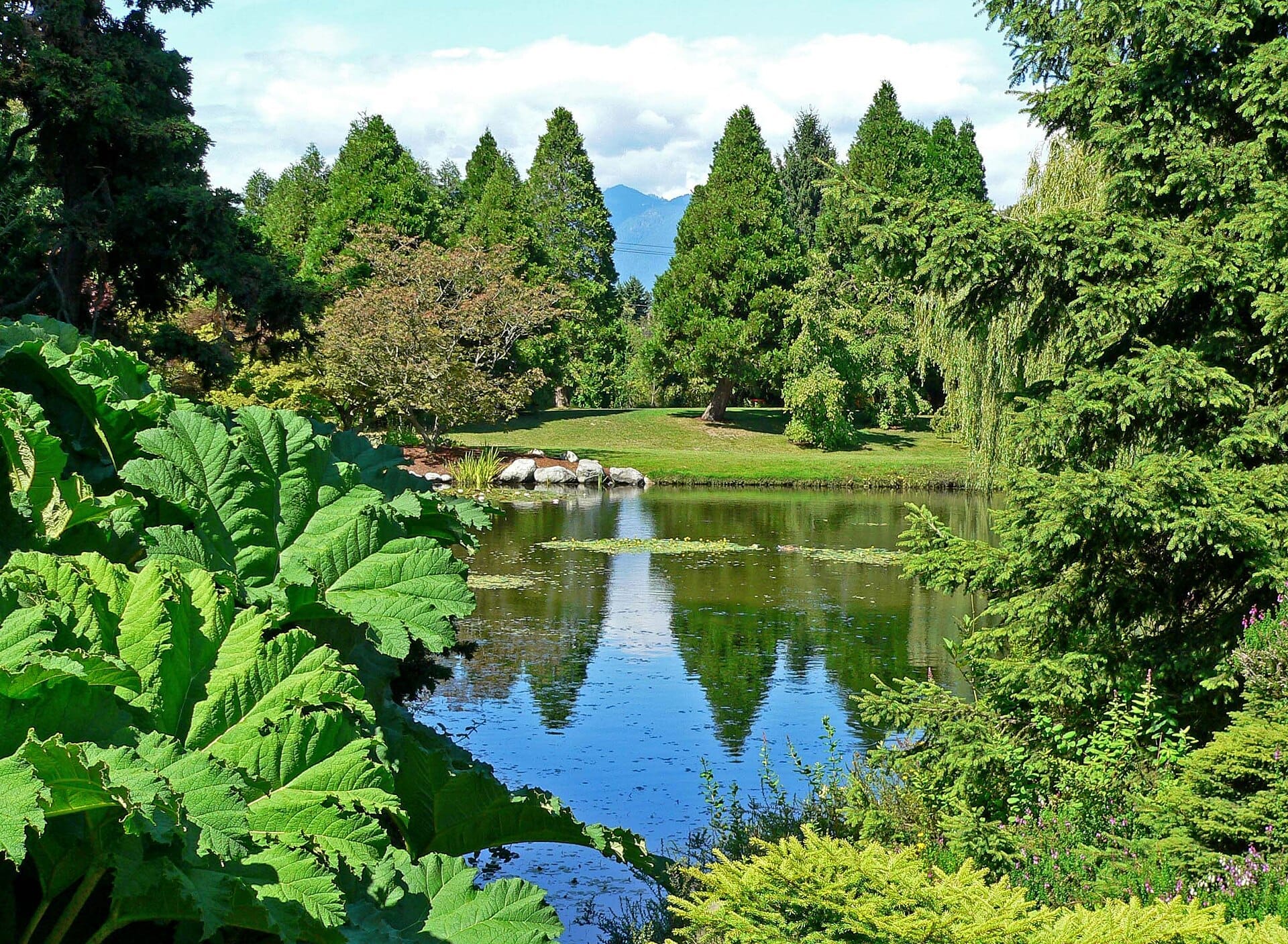
VanDusen Botanical Garden is a 55-acre living collection operated by the Vancouver Board of Parks and Recreation in partnership with the Vancouver Botanical Gardens Association. Opened in 1975 on the grounds of the former Shaughnessy Golf Club, it now holds more than 7,500 plant species and varieties sourced from every continent except Antarctica. It sits quietly between the tree-lined streets of Shaughnessy and Oakridge, about 6 kilometres south of downtown Vancouver, and functions as both a serious horticultural institution and a genuinely enjoyable public garden.
Unlike Stanley Park, which draws crowds with its waterfront and cycling loop, VanDusen attracts a more deliberate visitor. Most people arrive specifically for the garden. That means the atmosphere skews calm even on summer weekends, and the paths rarely feel congested. The layout follows the contours of the original golf course terrain, with small lakes, grassy clearings, and gently sloped beds connecting themed collections across the site.
ℹ️ Good to know
Last entry is 30 minutes before closing. In winter (November, December, January, February), regular daytime hours do not universally end at 14:00, as the garden’s schedule varies by month and is often 10:00–15:00 or 10:00–16:00 rather than a strict 10:00–14:00 close. Plan your arrival before noon in those months to avoid a rushed visit. The garden is closed December 25.
The Garden Through the Seasons
Spring is the showiest season at VanDusen. From late March through May, the rhododendron collection comes into full colour, with hundreds of cultivars ranging from delicate pale pink to deep burgundy. The magnolias and flowering cherries follow closely behind, and by mid-April the whole garden carries a faint sweetness in the air, particularly on still mornings when the dew is still on the grass. The April admission period (typically around 10:00 to 17:00, with higher seasonal pricing for adults) reflects how popular this window is.
Summer often extends the hours into the early evening from June through Labour Day, making VanDusen one of the few green spaces in Vancouver where you can walk among mature trees in the long evening light of July without rushing. The rose garden and herb collections peak in June, while the water features attract dragonflies and the occasional great blue heron through July and August. Mornings before 10:00 are visibly quieter than afternoons, when families with children arrive after lunch.
Autumn brings a colour shift that is more subtle than the spring spectacle but arguably more photogenic. The maples and liquidambars turn in October, and the reduced crowds (hours drop back to standard daytime hours (often around 10:00 to 17:00) from early September) mean you can stand in the middle of a path and listen to leaves falling without anyone waiting to pass. November through February is low season for plants but peak season for a different reason entirely: the Festival of Lights, a ticketed evening event where the garden is decorated with thousands of lights. Confirm festival dates and separate ticketing directly with VanDusen before planning around it, as it operates on its own schedule distinct from regular admission.
💡 Local tip
Winter daytime hours are reduced and typically run from 10:00 to mid‑afternoon (usually 15:00–16:00) in January, February, November, and December, but they vary by month and event schedule. If you visit during this period, the garden is quietest and the admission rate drops to its lowest: CAD $11.19 for adults. You will have the paths largely to yourself, which is a genuinely different experience from peak season.
Tickets & tours
Hand-picked options from our booking partner. Prices are indicative; availability and final rates are confirmed when you complete your booking.
Full-day tour to Victoria and Butchart Gardens from Vancouver
From 163 €Instant confirmationFree cancellationChristmas guided tour of Victoria and the Butchart Gardens
From 166 €Instant confirmationFree cancellationSightseeing tour of Victoria and Butchart Gardens from Vancouver
From 140 €Instant confirmationFree cancellationGrouse Mountain and Capilano Suspension Bridge Park tour
From 252 €Instant confirmationFree cancellation
Highlights Worth Finding
The Elizabethan Maze is one of the most photographed features at VanDusen and genuinely worth locating on the map at the entrance. Formed by 3,000 pyramid cedars, it is tall enough to disorient adults and delights children who reach the centre first. It is not a puzzle that takes long to solve, but it is the kind of detail that sticks in the memory of a visit.
The Korean Pavilion and the surrounding Asian garden area offer a different register of quiet. The plant textures here are finer, the ornamental grasses more restrained, and the space feels deliberately contemplative. If you arrive stressed from the city, this section tends to slow people down. Nearby, the Sino-Himalayan garden holds species collected from the mountains of western China and the eastern Himalayas, with an emphasis on rhododendrons, gentians, and primulas that are rarely seen in standard North American garden plantings.
The water features throughout the garden are not decorative afterthoughts. The lakes support nesting ducks and Canada geese through spring, and the planted margins include native sedges and irises alongside introduced moisture-loving species. Bring a pair of binoculars in early morning if bird activity interests you.
For visitors who want to understand VanDusen in the context of broader Vancouver horticulture, it pairs well with a visit to the Nitobe Memorial Garden at UBC, which takes a more formal Japanese approach to garden design, or the UBC Botanical Garden, which focuses more heavily on scientific plant collections. The three represent distinct traditions and make for a rich combined itinerary for anyone interested in botanical Vancouver.
Practical Walkthrough: Arriving and Getting Around
The main entrance is at the corner of Oak Street and West 37th Avenue. There is on-site parking, though the lot is small and fills up on summer weekends by mid-morning. Arriving by transit is straightforward: TransLink buses such as the R4 41st Ave and route 41 run along West 41st Avenue and connect the garden area to SkyTrain's Canada Line at Oakridge-41st Avenue Station, while routes including 17 and N15 serve Oak Street nearby. Check current schedules at translink.ca as route numbers and frequencies change periodically.
At the entrance, pick up a printed map. The garden is large enough that without one you will likely miss entire sections, particularly the Sino-Himalayan area and the Food Garden tucked toward the southwest of the property. The main paths are wide, well-maintained gravel and paved surfaces, and flat enough for strollers and wheelchairs across most of the garden. Some secondary paths through the meadow areas are narrower and uneven. For detailed accessibility information, contact the garden directly before your visit.
The Visitor Centre near the entrance has washrooms, a gift shop with plant-related books and seed packets, and the Truffles Café, which serves light food and beverages. For a full meal, you will need to plan elsewhere. The surrounding Shaughnessy and Oakridge neighbourhoods have limited restaurant options within walking distance, so arriving fed or bringing a picnic is worth considering.
💡 Local tip
Photography note: the garden allows personal, non‑commercial photography without a permit. Early morning in summer (arriving at the 09:00 opening) gives you soft directional light and near-empty paths. Overcast days, common throughout Vancouver's spring and autumn, actually produce excellent even light for close-up flower photography without harsh shadows.
Admission Pricing at a Glance
VanDusen uses a seasonal pricing structure with lower off‑season rates in the colder months and higher in‑season rates in the busier months, but the exact date ranges and prices are subject to change. Prices below exclude GST.
- Adult (19–64): CAD $11.19 (off‑season) / CAD $15.81 (in‑season) (prices subject to change)
- Senior (65+): CAD $8.95 (off‑season) / CAD $12.65 (in‑season) (prices subject to change)
- Youth (13–18): CAD $7.85 (off‑season) / CAD $11.05 (in‑season) (prices subject to change)
- Child (5–12): CAD $5.60 (off‑season) / CAD $7.90 (in‑season) (prices subject to change)
- Preschooler (0–4): Free year-round
- Garden members: Free year-round
- Groups of 10+ paid admissions: 10% discount
Verify current prices at vandusengarden.org before visiting, as these can change. Membership is available through the Vancouver Botanical Gardens Association and pays off quickly for Vancouver residents who plan multiple visits.
Who Will Get the Most From This Garden (and Who Might Not)
VanDusen works especially well for families with children who have at least some patience for walking. The maze is a genuine highlight for kids, and the ducks on the lakes hold their attention without needing to be explained. Parents looking for a gentler day out than the more physically demanding options around Vancouver will find this a reliable choice. For broader family planning ideas, the guide to Vancouver with kids covers how VanDusen fits alongside other child-friendly attractions.
Plant enthusiasts, garden designers, and anyone studying horticulture will find the interpretive signage thorough and the collections genuinely varied. This is not a display garden built for Instagram aesthetics alone. The depth of the collection across geographic and taxonomic themes reflects serious curatorial intent. Those interested in Vancouver's full range of green spaces should also look at the botanical gardens guide for Vancouver for context on how VanDusen compares to other options.
Travelers with limited time in Vancouver who are prioritizing iconic city views, waterfront experiences, or urban exploration may find VanDusen a lower priority. It is not a landmark the way Stanley Park or Gastown are, and if your Vancouver visit is two days or fewer, it requires deliberate time allocation. The winter daytime hours of 10:00 to 14:00 are also a real constraint: if you arrive after noon on a January afternoon expecting a full garden experience, you will find yourself walking quickly to the exit.
Visitors seeking free outdoor space in Vancouver have strong alternatives. Free things to do in Vancouver covers parks, beaches, and seawall stretches that cost nothing to access. VanDusen's admission fee is modest but not zero, and on a tight budget it is worth weighing against those alternatives.
Insider Tips
- Arrive at opening on a weekday in late April or early May for peak rhododendron bloom with minimal crowds. By 11:00 on a Saturday in May, the main paths see consistent foot traffic.
- The garden map at the entrance marks all themed collections, but the Sino-Himalayan section in the southwest corner is undervisited and often quieter than the central areas even on busy days.
- If you are visiting in summer, check whether any wedding or private event bookings are scheduled on that day. The garden is a popular venue, and certain areas may be temporarily restricted on event days. Call ahead or check the official website.
- The Truffles Café has outdoor seating that overlooks a small water feature. Arriving early and having a coffee before the main crowds appear is one of the more pleasant ways to start the visit.
- Annual membership pays for itself in roughly two adult visits during in-season pricing. If you live in Vancouver or plan to return within a year, it is worth considering at the admissions desk.
Who Is VanDusen Botanical Garden For?
- Plant enthusiasts and gardeners looking for a serious horticultural collection
- Families with young children who want a calm, walkable outdoor space
- Photographers seeking natural light and floral subjects across all seasons
- Visitors with a half-day to spare who want something quieter than the central waterfront
- Couples and slow travelers who prefer immersive green space over sightseeing checklists
Nearby Attractions
Other things to see while in Kitsilano:
- H.R. MacMillan Space Centre
Tucked inside Vanier Park on the Kitsilano waterfront, the H.R. MacMillan Space Centre delivers immersive planetarium shows, hands-on space science exhibits, and occasional observatory evenings. It's a serious science destination that works equally well for curious adults and school-age children.
- Jericho Beach
Jericho Beach is a wide, west-facing public beach on Vancouver's west side with unobstructed views of the North Shore mountains, English Bay, and Vancouver Island on clear days. Free to access year-round, it draws a quieter crowd than Kitsilano Beach and carries layers of Indigenous, military, and maritime history beneath its relaxed surface.
- Kitsilano Beach
Kitsilano Beach stretches along the north edge of the Kitsilano neighbourhood, facing English Bay with clear sightlines to the North Shore mountains. Free to access year-round, it draws swimmers, volleyball players, and sunset-watchers from across the city. The beach is also home to Kitsilano Pool, reputed to be the longest outdoor pool in Canada and one of the longest saltwater pools in North America.
- Museum of Vancouver
Founded in 1894 and housed in a distinctive flying-saucer-shaped building in Vanier Park, the Museum of Vancouver is Canada's largest civic museum. It traces the city's evolution from Coast Salish territory through the boom years to present-day neighbourhood culture, with rotating exhibitions that take genuine curatorial risks.