H.R. MacMillan Space Centre: Vancouver's Window to the Universe
Tucked inside Vanier Park on the Kitsilano waterfront, the H.R. MacMillan Space Centre delivers immersive planetarium shows, hands-on space science exhibits, and occasional observatory evenings. It's a serious science destination that works equally well for curious adults and school-age children.
Quick Facts
- Location
- 1100 Chestnut Street, Vanier Park, Kitsilano, Vancouver BC
- Getting There
- Bus routes serve the Burrard Bridge / Vanier Park area; the Aquabus and False Creek Ferries from False Creek stop nearby seasonally
- Time Needed
- 2 to 3 hours for exhibits plus one planetarium show
- Cost
- Adult CAD $27.50 + tax; Child (5–11) CAD $19.60 + tax; Under 5 free with paying adult
- Best for
- Families with school-age kids, astronomy enthusiasts, rainy-day seekers
- Official website
- www.spacecentre.ca
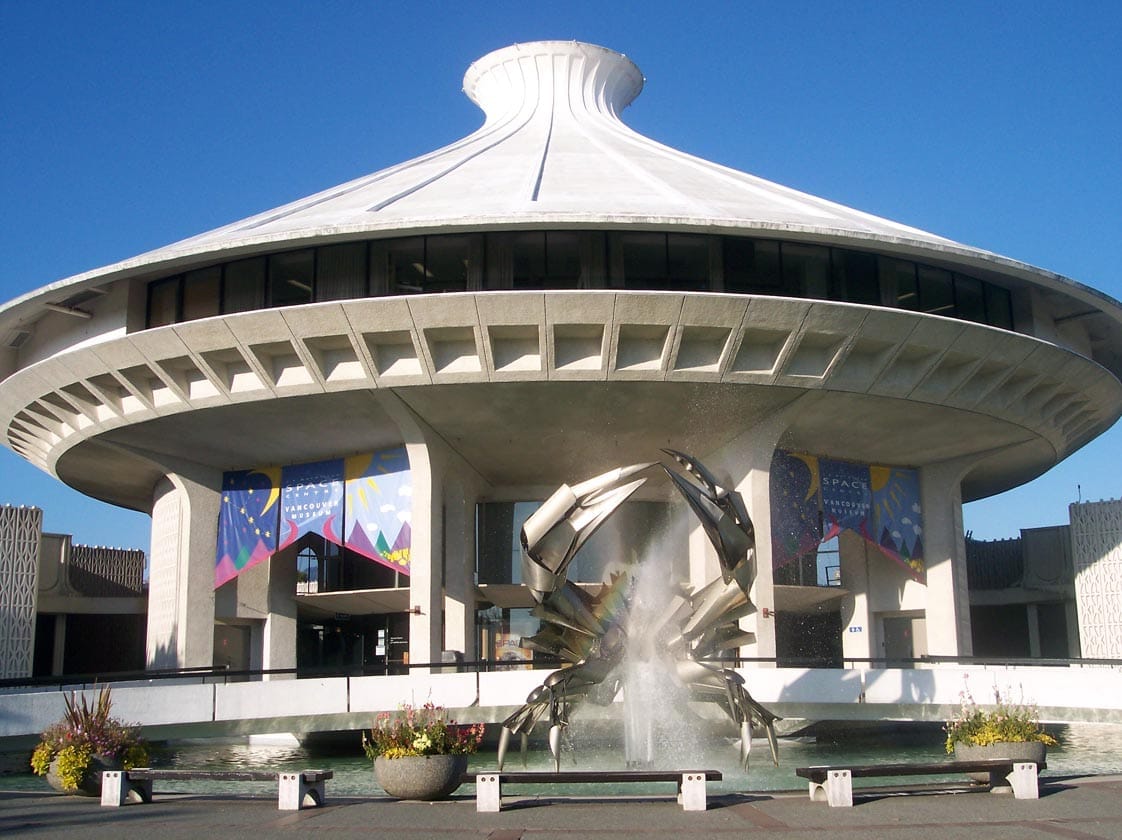
About the H.R. MacMillan Space Centre
The H.R. MacMillan Space Centre is a planetarium, science museum, and public observatory rolled into one compact building in Vanier Park, on the southern shore of English Bay in Kitsilano. It sits in a cluster with the Museum of Vancouver and the Vancouver Maritime Museum, making the park one of the city's more underrated cultural hubs.
The building itself dates from 1967 to 1968, constructed as part of Vancouver's centennial celebrations. Its distinctive copper dome — housing the planetarium theatre — is one of the most recognizable architectural shapes on the Vancouver skyline when viewed from the water. The complex was formally recognized as a heritage site in 1996, and the planetarium dome has become a kind of quiet landmark for the Kitsilano waterfront.
This is not a sprawling institution. Compared to a major science museum, the floor space is modest. But the programming is focused and well-executed, and the planetarium's digital projection system turns the domed ceiling into a genuinely striking environment. Visitors who pair it with a stop at the nearby Museum of Vancouver or a walk along Vanier Park get considerably more out of the trip.
The Planetarium: The Centrepiece Experience
The planetarium Star Theatre is the reason most people come. Shows run throughout the day and cover topics ranging from solar system exploration to deep space cosmology. The projection system fills the entire curved ceiling, so when a sequence takes you through the Milky Way or across the surface of Mars, the effect is genuinely immersive in a way that a flat screen simply cannot replicate.
Shows are typically 30 to 45 minutes and change based on the programming calendar. Some are narrated live by a presenter, while others are pre-recorded with professional voice-over. The live-narrated sessions tend to be the more engaging option, particularly for adults, since presenters can adapt content to the audience and answer questions. Check the official site before you visit to confirm which format is running on your chosen day.
💡 Local tip
Planetarium seats fill up, especially on weekends and during school holidays. Book tickets online in advance at spacecentre.ca to secure your preferred show time and avoid the walk-up queue.
The dome theatre is also used for evening laser shows, which run on a separate schedule and have a different audience in mind — these are atmospheric, music-driven experiences rather than educational programming. If you're bringing children specifically for the science content, daytime shows are the better fit.
Tickets & tours
Hand-picked options from our booking partner. Prices are indicative; availability and final rates are confirmed when you complete your booking.
Grouse Mountain and Capilano Suspension Bridge Park tour
From 252 €Instant confirmationFree cancellationVancouver Art Gallery Tickets
From 19 €Instant confirmationFree cancellationVancouver Stanley Park cycling tour
From 56 €Instant confirmationFree cancellationWhistler, Shannon Falls and Sky Gondola tour from Vancouver
From 135 €Instant confirmationFree cancellation
The exhibits: hands-on science
The exhibit floor wraps around the central dome structure and covers areas including space exploration history, the physics of rocketry, and the search for life beyond Earth. The approach is interactive: expect buttons to press, simulators to try, and displays built to withstand curious hands. This is clearly designed with children in mind, but the content doesn't talk down to adults.
One of the more memorable installations is the astronaut training simulator, which gives visitors a physical sense of the disorientation involved in spaceflight. There are also scale models of rockets and spacecraft, and display panels that contextualise Canadian contributions to space exploration — a genuinely underappreciated topic that the Space Centre handles well.
The exhibit space is not enormous, and adults visiting without children may feel they've covered the ground in under an hour. Plan your visit around a planetarium show to get full value from the admission price.
Observatory Evenings: The Hidden Variable
The Space Centre operates a public observatory, historically offering evening sessions on Wednesdays and Fridays from 19:00 to 22:30, weather permitting, but the official Space Centre website currently lists the observatory as closed until further notice. This is the kind of detail that changes without much announcement, so verify directly at spacecentre.ca before planning an evening visit around the observatory.
⚠️ What to skip
Do not assume observatory sessions are running. Check spacecentre.ca for current status before your visit, as availability is weather-dependent and scheduling changes without broad notice.
When the observatory is operational, it offers a rare opportunity for urban stargazing using the centre's telescope. Vancouver's light pollution limits what's visible, but the guided experience of finding specific objects with a trained presenter makes it worthwhile for astronomy-curious visitors. On a clear night, the views across English Bay from Vanier Park before or after the session are a meaningful bonus.
Getting There and Navigating the Visit
Vanier Park sits just southwest of the Burrard Bridge. By bus, several TransLink routes service the Kitsilano and Burrard Bridge corridor. Confirm current route details at translink.ca, as schedules adjust seasonally. The Space Centre lists accessible parking on site, along with wheelchair-accessible entry, accessible washrooms, and accessible seating in the planetarium theatre.
One of the more enjoyable ways to arrive in the warmer months is via the Aquabus or False Creek Ferries, which stop at the Vanier Park dock when operating seasonally. The short crossing from Granville Island takes only a few minutes and costs a small fare. Arriving by water puts you directly at the park's edge with views of the downtown skyline behind you. The False Creek Ferries dock is a short walk from the Space Centre's entrance.
Parking is available on site, which is practical for families with young children or those visiting with strollers and equipment. The park itself is flat and easy to navigate by wheelchair or stroller.
ℹ️ Good to know
Opening hours: Monday to Friday 10:00–15:00; Saturday and Sunday 10:00–17:00, but always confirm as hours may change. Hours may vary on public holidays. A $1 transaction fee applies to each online ticket purchase.
Who Should Come, and Who Might Not Get Full Value
Families with children aged 5 to 14 will get the most from the Space Centre. The exhibit design, show content, and pacing are well-calibrated for that age range. Visitors interested in Vancouver's broader cultural offerings may also find this fits naturally into a day that starts at Granville Island Public Market and ends with a walk along the Kitsilano Beach waterfront.
Adults visiting without children and without a specific interest in astronomy or space science may find the exhibit floor covers quickly. At roughly CAD $27.50 plus tax per adult, the admission cost is relatively high for an hour of exhibits alone. For those visitors, the planetarium show is essential, not optional, to justify the price.
Anyone seeking an outdoor experience or natural scenery should know that the Space Centre is entirely indoors. On a rare clear Vancouver summer day, the park outside is one of the better spots in the city for views toward downtown, but the museum itself does not incorporate outdoor elements. For that combination of science and outdoor exploration, Science World near False Creek is the indoor alternative, while Vancouver's best museums guide covers both options in context.
The Space Centre is also a reliable rainy-day destination, which in Vancouver is a practical consideration from October through March. The combination of a 45-minute planetarium show and the exhibit floor gives families a full morning or afternoon indoors without the need to rush.
Photography and Practical Notes
Photography inside the planetarium dome during shows is generally not permitted, as the light interference disrupts other visitors' experience. The exhibit floor is typically photographable, and the exterior of the copper dome makes for a strong architectural shot, particularly in the late afternoon when low light catches the patina of the dome from across the park's lawn.
The park outside the Space Centre offers clear sightlines toward downtown Vancouver and the North Shore mountains. In summer, arriving about 30 minutes before your show time and walking the park perimeter gives you both the view and enough time to collect your tickets without stress.
Insider Tips
- Book planetarium show tickets online even if you plan to walk in for exhibits first. The show you want can sell out while you're browsing the exhibit floor, and there's a $1 per ticket transaction fee either way.
- Wednesday and Friday evenings are listed by third-party sources as observatory nights, but always confirm at spacecentre.ca before making these the purpose of your trip. Weather cancellations happen frequently.
- The cluster of museums in Vanier Park — the Space Centre, the Museum of Vancouver, and the Vancouver Maritime Museum — occasionally offers combined or discounted admission. Ask at the front desk when you arrive.
- Arriving by Aquabus or False Creek Ferries from Granville Island is the most enjoyable approach in summer. The water crossing is short, inexpensive, and delivers you directly to the park with a view of the dome ahead.
- If you have children under five, admission is free with a paying adult. The planetarium shows are age-rated — check the official site to confirm which shows are suitable for very young children, as some content involves simulated darkness and intense visuals.
Who Is H.R. MacMillan Space Centre For?
- Families with school-age children looking for structured, educational indoor activities
- Astronomy and space science enthusiasts wanting a planetarium experience in Vancouver
- Rainy-day visitors needing a half-day indoor alternative in the Kitsilano area
- Travelers combining a visit with Granville Island or a Vanier Park walk
- Groups where ages vary — the Space Centre's content spans enough ground to hold different age groups simultaneously
Nearby Attractions
Other things to see while in Kitsilano:
- Jericho Beach
Jericho Beach is a wide, west-facing public beach on Vancouver's west side with unobstructed views of the North Shore mountains, English Bay, and Vancouver Island on clear days. Free to access year-round, it draws a quieter crowd than Kitsilano Beach and carries layers of Indigenous, military, and maritime history beneath its relaxed surface.
- Kitsilano Beach
Kitsilano Beach stretches along the north edge of the Kitsilano neighbourhood, facing English Bay with clear sightlines to the North Shore mountains. Free to access year-round, it draws swimmers, volleyball players, and sunset-watchers from across the city. The beach is also home to Kitsilano Pool, reputed to be the longest outdoor pool in Canada and one of the longest saltwater pools in North America.
- Museum of Vancouver
Founded in 1894 and housed in a distinctive flying-saucer-shaped building in Vanier Park, the Museum of Vancouver is Canada's largest civic museum. It traces the city's evolution from Coast Salish territory through the boom years to present-day neighbourhood culture, with rotating exhibitions that take genuine curatorial risks.
- South Granville
South Granville is a walkable stretch of Granville Street running south from the Granville Street Bridge to around West 16th Avenue. Known for its concentration of commercial art galleries, interior design showrooms, independent clothing boutiques, and serious restaurants, it offers a different pace and character from downtown Vancouver's busier retail strips.