Tyniec Abbey: Kraków's Ancient Clifftop Monastery
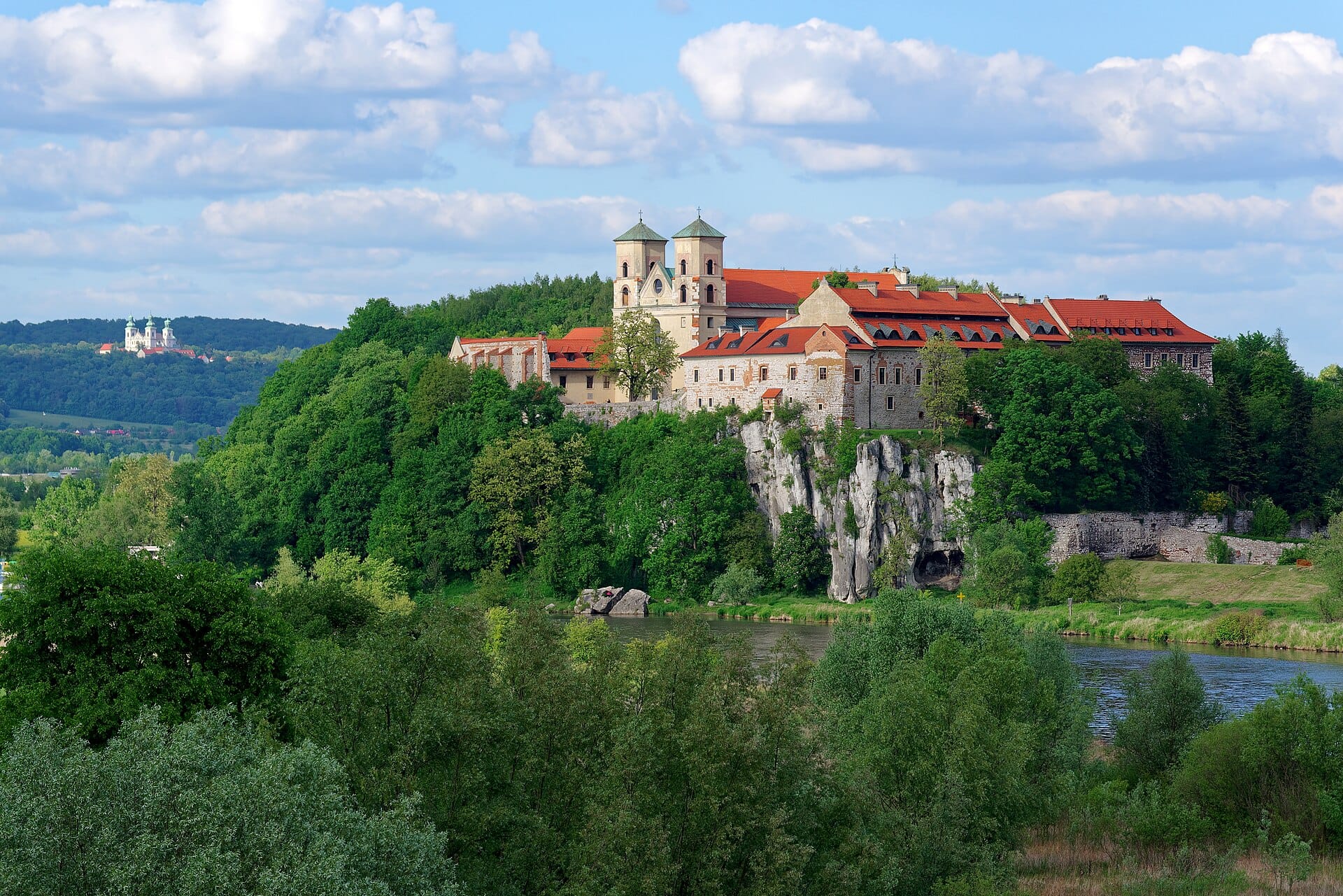
Founded around the mid-11th century, traditionally attributed to King Casimir I the Restorer, the Benedictine Abbey of Tyniec sits on a dramatic limestone promontory above the Vistula River, roughly 13 km southwest of Kraków's Old Town. Equal parts working monastery, open-air museum, and scenic escape from the city, it rewards travelers willing to make the journey.
Quick Facts
- Location
- ul. Benedyktyńska 37, Tyniec, Kraków (approx. 12–13 km southwest of the Old Town)
- Getting There
- Bus 112 from Rondo Grunwaldzkie (near Most Grunwaldzki) to Tyniec stop
- Time Needed
- 2–3 hours including travel; half-day if you walk along the Vistula
- Cost
- Courtyard free; Museum 8 PLN regular / 5 PLN reduced; Guided tour prices vary by format — check current rates on the official site
- Best for
- History buffs, architecture lovers, peaceful escapes, cycling day trips
- Official website
- opactwotynieckie.pl
What Tyniec Abbey Actually Is
The Benedictine Abbey of Tyniec is not a ruin, a reconstruction, or a tourist replica. It is a continuously operating Benedictine monastery that has stood on this limestone cliff above the Vistula River since the mid-11th century. That makes it one of the oldest monastic institutions in Poland, predating much of what visitors see in Kraków's own Old Town. Monks still live here, observe the canonical hours, run a shop selling monastery products, and occasionally host retreats. For visitors, that living quality is what separates Tyniec from a conventional heritage site.
The abbey's Polish official name is Opactwo Benedyktynów w Tyńcu, and it carries the designation Pomnik historii, Poland's highest category of protected historic monument. The complex sits at the southern edge of Kraków, now within the city's administrative boundary but feeling entirely removed from it. Below the cliff, the Vistula moves slowly, broad and grey-green depending on the season. The contrast between that flat river valley and the vertical limestone rise on which the abbey rests is the first thing that registers as you approach.
💡 Local tip
Check seasonal opening hours before you go. The museum runs shorter hours in winter (10:00–16:00) versus summer (10:00–18:00). The courtyard is open 06:00–22:00 daily. Guided tour times vary, so confirm via the official abbey website at opactwotynieckie.pl.
Nearly a Thousand Years of History on One Rock
King Casimir I the Restorer is traditionally credited with founding the abbey in the mid-11th century, bringing Benedictine monks from the Abbey of Saint-Gilles in present-day France to establish the community. At that time Kraków itself was consolidating its role as a royal seat, and Tyniec was founded as part of a broader effort to anchor Christian ecclesiastical life in the region. The monks brought with them the Rule of Saint Benedict, a tradition of liturgical chant, scriptoria, and agricultural management of surrounding lands — all of which left physical traces across the site that visitors can still read today.
The abbey has been damaged, dissolved, rebuilt, and restored multiple times across its history. Swedish invasions in the 17th century, Austrian partition-era suppression in 1816 (when the monastery was closed and monks expelled), and the eventual return of the Benedictines in 1939 are all chapters that shaped the physical layers now visible in the architecture. The Romanesque foundations give way to Gothic additions, then Baroque remodelling of the church interior. Understanding even a little of that timeline transforms what would otherwise be a pleasant scenic outing into something genuinely three-dimensional.
If Tyniec fits into a broader exploration of Kraków's religious architecture, it pairs well with a visit to Wawel Cathedral, which was developing simultaneously during the early Piast dynasty period, and gives useful context for the political-religious world in which Tyniec was founded.
Tickets & tours
Live prices and dates from our booking partner. If you book, we may earn a commission at no extra cost to you.
Entrance ticket for the Legends of Krakow robotic show
From 9 €Instant confirmationFree cancellationWieliczka Salt Mine guided tour with hotel pickup from Krakow
From 58 €Instant confirmationFree cancellationWieliczka salt mine guided tour from Krakow
From 60 €Instant confirmationFree cancellationAuschwitz-Birkenau Spanish Guided Tour with Hotel Pick-Up
From 44 €Instant confirmation
The Visit: What You Actually See
Arriving by bus, you walk uphill along a path lined with old stone walls before the complex opens out into a courtyard. The scale is quieter than expected. This is not a cathedral precinct designed to overwhelm; it is a working monastery adapted to receive visitors without theatrics. The courtyard itself is free to enter, and many visitors spend time here without going further, sitting on the low walls and looking out over the river bend below.
The Baroque church of Saints Peter and Paul is the dominant building. Inside, the proportions are narrow and tall, with side chapels, carved stonework, and choir stalls that still see daily liturgical use. The smell inside is candle wax and old stone — cool even in summer. Gregorian chant can sometimes be heard if you arrive near the canonical hours, which the monks observe at fixed points through the day. That overlap of active monastic life and tourist visiting is one of Tyniec's defining characteristics; it requires a degree of consideration on the visitor's part.
The site museum, located within the abbey buildings, displays archaeological finds from excavations on the promontory, including Romanesque stonework, medieval ceramics, and items that document the layers of occupation on this cliff before and after the monastery's founding. Admission is 8 PLN regular and 5 PLN reduced. An audioguide is available in multiple languages for an additional small fee. Guided tours covering the church, museum, and courtyard are priced separately; children under 6 often enter free, and family tickets or combined options may be available — check the current offer on the official site. Given those prices, the guided tour is worth considering — the context provided significantly deepens what you take away from the physical spaces.
How the Experience Changes by Time of Day
Morning visits, particularly on weekdays, offer the closest thing to solitude. The bus from central Kraków is not frequent, and most tour groups that visit tend to arrive later in the morning or at midday. Before 10:00, with the museum not yet open, you have the courtyard largely to yourself, the light catching the limestone walls at a low angle, and the valley below still partly in mist during autumn and spring. That quality of stillness is worth an early start.
By midday on summer weekends, the site is noticeably busier with both domestic Polish visitors and tourists who have made the trip from the city. The monastery shop, which sells Benedictine liqueurs, honey, teas, and other products made or curated by the monks, draws a queue. Late afternoon light from the west catches the cliff face and the river particularly well for photography, and weekday afternoons tend to have thinner crowds than weekend mornings.
ℹ️ Good to know
The monastery shop sells products made or associated with the Tyniec community, including herbal preparations, liqueurs, and books on Benedictine spirituality. It is one of the few places you can buy these items directly. The shop is open during museum hours — check the official site for current times.
Getting There: Transport Options
The most reliable public transport route from central Kraków involves getting to Rondo Grunwaldzkie (near Most Grunwaldzki) and then taking bus 112 toward Tyniec. The bus stop you want is Tyniec (one stop past Bolesław Śmiały). Journey time from the city centre runs roughly 45 to 60 minutes depending on connections. The total distance is approximately 12 to 13 km southwest of the Old Town. Kraków has no metro system, so bus and tram combinations are the standard approach.
Cycling is a genuine alternative. The route along the Vistula riverbank southwestward from the city is well-established and largely flat until the final climb to the abbey. It takes around 45 to 60 minutes by bike from the city centre, and the path offers views of the river and surrounding countryside that the bus route does not. Rental bikes are available in central Kraków.
For general orientation on moving around Kraków, the getting around Kraków guide covers tram and bus networks, ticketing, and practical tips for navigating the city without a car.
Taxis and ride-hailing apps (including Uber and Bolt, which operate in Kraków) are an option if you prefer a direct trip. The journey from the Old Town by car takes around 25 to 35 minutes depending on traffic. Verify current fares directly in-app before booking, as prices shift with demand and time of day.
Practical Details: What to Know Before You Arrive
The site is described as disabled-friendly by official Kraków tourism sources, though visitors should be aware that parts of the complex occupy a naturally steep limestone promontory. Some historic sections involve gradients and steps that are unavoidable given the topography. If mobility is a concern, contacting the abbey in advance to clarify specific access points is advisable.
Dress modestly for entry into the church — shoulders and knees covered is the standard expectation at active religious sites in Poland. Sturdy footwear is practical given the stone-paved courtyards and uneven surfaces. In summer, the exposed courtyard and cliff top have little shade, so sun protection matters more than you might expect for a monastery visit.
Photography is generally permitted in the courtyards and exterior spaces. Inside the church, behave in line with the active religious context: photography during liturgical services is inappropriate, and the monks' residential areas are not accessible to visitors.
⚠️ What to skip
The abbey is a functioning monastery, not purely a visitor attraction. If you arrive during the canonical hours (Lauds, Vespers, Compline, etc.), the church may be in use for liturgy. This is not an inconvenience — it is the point of the place — but it means some areas may be temporarily inaccessible to tourists. Plan with flexibility.
How Tyniec Fits Into a Kraków Trip
Tyniec works well as a half-day excursion from central Kraków, ideally combined with time along the Vistula riverbank. It is one of several destinations southwest of the city that offer a genuine counterpoint to the concentration of attractions in the Old Town and Kazimierz. For travelers spending multiple days in the city, the abbey fits naturally into a slower second or third day.
It is also worth knowing that Tyniec sits on the Via Benedictina, a Council of Europe Cultural Route linking Benedictine monasteries across Europe. For travelers with an interest in religious heritage specifically, that context connects the abbey to a much wider network. If monastic and ecclesiastical heritage is a priority, pairing Tyniec with the Collegium Maius and Wawel Cathedral on the same trip builds a coherent picture of medieval Kraków's intellectual and spiritual infrastructure.
Travelers following an itinerary that combines major Kraków landmarks with a day like this one should look at the 3-day Kraków itinerary for a framework that balances the city centre highlights with excursions of this kind.
Who Might Not Enjoy This Visit
Travelers with very limited time in Kraków and a focus on high-density sightseeing may find the 45-to-60-minute transit commitment difficult to justify. The abbey does not offer the same visual scale or dramatic grandeur as Wawel Castle or the interior of St. Mary's Basilica. For visitors primarily interested in World War II history, Jewish heritage, or modern cultural venues, Tyniec will feel tangential. It rewards those who actively want quiet, historical depth, and a reason to leave the city centre — and it is less suited to those who don't.
Insider Tips
- Arrive before 10:00 on a weekday if you want the courtyard to yourself. The site is rarely crowded early, and the light on the limestone walls before midday is substantially better for photography than the flat afternoon light.
- The monastery shop stocks Benedictine liqueur and honey produced in connection with the community. These make thoughtful gifts and are not widely available elsewhere in Kraków. Stock and availability vary, so don't assume you can return for it later.
- If you're cycling from the city, the route along the Vistula is largely flat and well-signed. The final approach to the abbey involves a short climb, but nothing technically demanding. Budget around 45–60 minutes each way from the Old Town area.
- Gregorian chant at Vespers (late afternoon) or Compline (evening) can occasionally be heard from within the church if monks are observing the liturgical hours. Checking the canonical schedule on the abbey's website before your visit increases the chance of arriving at a musically significant moment.
- The view from the cliff edge over the Vistula bend is one of the better landscape viewpoints accessible from Kraków without significant hiking. Even visitors who skip the museum entirely find the promontory itself worth the trip on a clear day.
Who Is Tyniec Abbey For?
- History and architecture travelers who want context beyond the Old Town's well-known medieval core
- Visitors looking for a contemplative, uncrowded half-day away from the city centre
- Cyclists exploring the Vistula riverbank route southwest of Kraków
- Travelers interested in religious heritage, monastic life, and Benedictine history
- Families with older children who have an interest in medieval history and don't need constant stimulation
Nearby Attractions
Combine your visit with:
- Auschwitz-Birkenau Memorial & Museum
The Auschwitz-Birkenau Memorial and Museum, located near the town of Oświęcim about 70 km from Kraków, is one of the most significant Holocaust memorial sites in the world. Entry to the grounds is free, but advance registration is required. A visit here demands time, preparation, and emotional readiness.
- Jordan Park
Founded in 1889 by physician Henryk Jordan, this 20-hectare municipal park just west of the Old Town has been Kraków's go-to outdoor space for families, joggers, and skaters for over a century. Entry is free, the facilities are practical, and the crowd is almost entirely local.
- Ojców National Park
Ojców National Park, established in 1956 and covering just 21.46 km², packs limestone ravines, bat-filled caves, medieval castle ruins, and forested walking trails into a compact valley only 16 km north of Kraków. It rewards visitors with striking geology, real quiet, and a pace completely different from the city.
- Stary Kleparz Market
Stary Kleparz has operated as a public market since the mid-14th century, making it the oldest continuously running marketplace in Kraków. Free to enter, open six days a week from early morning, and stocked with local produce, dairy, flowers, and street food, it gives visitors a clear window into how the city actually shops.
Planning a trip? Discover personalized activities with the Nomado app.