Turaida Castle: The Red-Brick Fortress Above the Gauja Valley
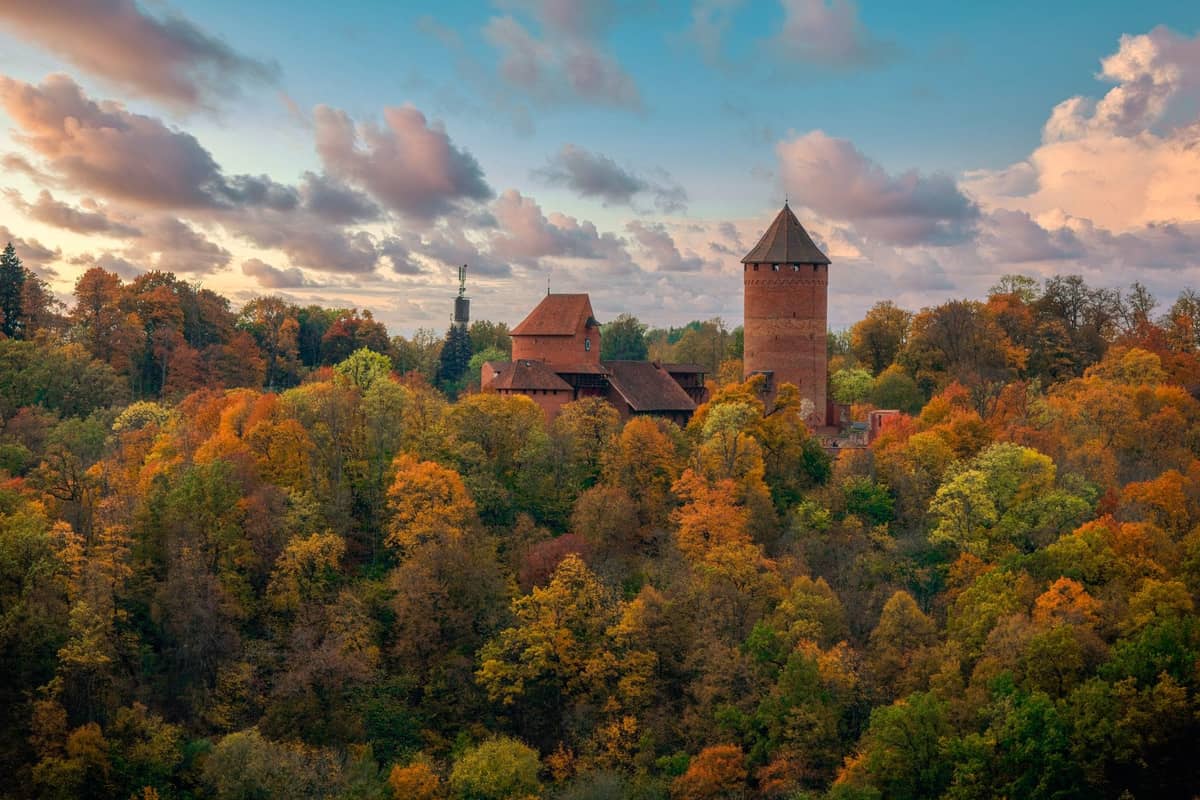
Standing on a forested ridge above the Gauja River, Turaida Castle is Latvia's most photogenic medieval fortress. Founded in 1214 by the Bishop of Riga, the reconstructed red-brick keep anchors a sprawling open-air museum reserve where eight centuries of Baltic history feel tangible.
Quick Facts
- Location
- Turaidas iela 10, Sigulda, LV-2150, Latvia (Gauja National Park)
- Getting There
- Train or bus from Riga to Sigulda (approx. 1 hr), then taxi or local bus to the reserve
- Time Needed
- 2.5 to 4 hours for the full reserve; 1.5 hrs for castle only
- Cost
- Adults approx. €8, students/seniors approx. €6, children 7–18 approx. €4.50, under 7 free (verify current prices at turaida-muzejs.lv)
- Best for
- History lovers, photographers, families, day-trippers from Riga
- Official website
- http://www.turaida-muzejs.lv
What Is Turaida Castle?
Turaida Castle (Latvian: Turaidas pils) is a reconstructed medieval stone fortress and the focal point of the Turaida Museum Reserve, an open-air heritage complex on the right bank of the Gauja River in Sigulda, Latvia. The name Turaida derives from the ancient Liv language and translates poetically as 'Thor's Garden,' an apt name for a site surrounded by ancient oaks, sculpted gardens, and one of the most dramatic river valleys in the Baltic states.
The castle sits at the upper edge of the Gauja Valley, perched on a ridge that falls steeply toward the river below. From the top of the main round tower, you look out across a canopy of mixed forest, with the pale outline of Sigulda New Castle visible on the opposite bank. On clear autumn mornings, the valley fills with low mist and the red brick of the tower catches the early light in a way that makes the view genuinely striking.
💡 Local tip
Arrive at opening time (09:00) to climb the main tower before tour groups arrive. The view is identical an hour later, but the staircase is much quieter.
Eight Hundred Years of History on One Ridge
The stone castle was founded around 1214 by order of Archbishop Albert of Riga, built on a site that had previously served as a Livonian fortified settlement. This was the era of the Livonian Crusade, when German ecclesiastical and military orders were consolidating control across what is now Latvia and Estonia. Turaida served as an administrative centre for the Archbishop of Riga for several centuries, making it one of the most politically significant fortresses in medieval Livonia.
The castle changed hands repeatedly over the following centuries, passing through Swedish, Polish-Lithuanian, and Russian control. A fire in 1776 left much of the structure in ruins, and the site fell into gradual decay. Systematic archaeological work and restoration began in the mid-20th century, and the castle you see today is largely a reconstruction informed by those excavations. The main cylindrical tower, the most recognisable element of the silhouette, was rebuilt as part of those restoration efforts. The reconstruction is presented openly by the museum, which is worth acknowledging: this is a carefully rebuilt historic site, not an unaltered medieval ruin.
For historical context about Latvia's layered occupation history, the Soviet history guide for Riga provides useful background on how centuries of foreign rule shaped Latvian national identity.
Tickets & tours
Hand-picked options from our booking partner. Prices are indicative; availability and final rates are confirmed when you complete your booking.
Canal boat sightseeing tour in Riga
From 13 €Instant confirmationArt and culture walking tour of Riga with a local
From 66 €Instant confirmationFree cancellationSelf-guided discovery walk in Riga - the essential old town and its secrets
From 30 €Instant confirmationFree cancellationExclusive private guided tour of Riga's architecture with a local
From 175 €Instant confirmationFree cancellation
Walking the Reserve: What You Actually See
The Turaida Museum Reserve covers considerably more ground than the castle itself. Ticket entry covers the main castle complex, the Dainu Hill sculpture garden (where Latvian folk song texts are carved into wooden installations among the trees), several restored historic farmsteads showing rural Latvian life from different centuries, a medieval garden, and the small Church of Turaida built in 1750, one of the oldest preserved rural churches in Latvia.
The church is worth a few minutes even for non-religious visitors. It is one of the oldest preserved rural churches in Latvia, and the small cemetery beside it contains the grave of Maija, known as the Rose of Turaida, a figure from a romantic 17th-century legend who has become one of Latvia's most retold folk stories. Flowers are often left on the grave, which gives you a sense of how alive this history remains locally.
The farmsteads are spread across the wooded reserve grounds and require some walking between them. Wear shoes with grip: the paths are well-maintained in summer but involve uneven forest terrain and some slopes. In wet weather, sections become muddy. The full loop covering all areas takes between two and a half to four hours depending on pace and how long you linger in each building.
ℹ️ Good to know
Opening hours vary by season. Summer (1 May – 30 September): 09:00–20:00. Autumn (1 October – 31 October): 09:00–19:00 (indoor exhibitions typically 10:00–18:00). Winter (1 November – 28/29 February): 10:00–17:00. Spring (1 March – 30 April): 10:00–18:00. Indoor exhibitions typically open 10:00 and may close earlier than outdoor areas.
How the Experience Changes by Season
Summer brings the fullest version of the site: all farmsteads open, outdoor events, and the Dainu Hill garden at its most lush. The downside is that July and August draw the most visitors. Weekend afternoons in peak summer see large group tours moving through the castle, and the main tower staircase, which is narrow and circular, can create bottlenecks. Weekday mornings are noticeably calmer.
Autumn is arguably the best time to visit. September and October transform the Gauja Valley into a display of copper and gold, and the red brick of the tower against orange forest makes for some of the most photographed images of Latvian heritage. Crowds thin sharply after the first week of September, and the light in the valley takes on a quality that summer's flat brightness never quite matches. Temperatures drop quickly in October, so bring an extra layer.
Winter visits have a stark, quiet appeal. The reserve feels almost private, the castle silhouette above bare trees is unobstructed, and a dusting of snow on the ramparts is genuinely picturesque. However, some smaller farmstead buildings may be closed, and the shorter opening hours (10:00–17:00) limit your time. Ice on the paths and castle stairs is a real hazard during the coldest winter months.
If you are planning your timing around weather, the best time to visit Riga guide covers seasonal patterns across the wider region in useful detail.
Getting There from Riga
Sigulda is approximately 50 kilometres northeast of Riga, and regular trains run from Riga Central Station to Sigulda. The journey takes around an hour. Buses are also available from Riga Coach Terminal. From Sigulda town, the museum reserve is about 3 kilometres away. A taxi from Sigulda station takes under ten minutes and is the most straightforward option if you are not renting a car. Local bus services also run, but schedules can be infrequent, so check current timetables before relying on them.
By car from Riga, the drive via the A2/P3 route takes roughly 50–60 minutes depending on traffic, and parking is available at the reserve. This gives you the most flexibility for combining Turaida with other Sigulda area attractions in a single day.
Turaida is most naturally visited as part of a day trip from the capital. The day trips from Riga guide outlines how to structure the full Sigulda experience, including combining Turaida with Gutmanis Cave and the Sigulda castle complex.
Photography, Practicalities, and Honest Caveats
The main tower is the obvious photographic subject. The best exterior shots come from the path below the castle approach, where the tower rises above the tree line with valley behind it. For interior views from the top, a wide-angle lens or a phone with a panoramic mode works better than a telephoto in the confined space. Morning light hits the south-facing wall of the tower directly; afternoon light works better on the interior courtyard.
The castle interior itself is not large. The tower contains several floors connected by stone stairs, each with interpretive panels and some period artefacts and models. It is informative but compact. Visitors expecting vast hall after hall of medieval armour may feel the indoor content is modest relative to the walk across the reserve. The value of Turaida is more the totality of the landscape, the views, and the layered history of the reserve as a whole than any single exhibit.
⚠️ What to skip
The main tower stairs are steep, narrow, and uneven. They are not suitable for pushchairs and are challenging for anyone with limited mobility. Much of the outdoor reserve grounds are accessible by foot on gravel and woodland paths, but upper castle sections involve stairs throughout.
Visitors with young children will find the reserve works well as a combination of outdoor walking and castle exploration. The space is large enough to keep children engaged, and the farmsteads have hands-on domestic history displays that tend to hold attention better than purely text-based exhibits. That said, parents with prams or pushchairs should be aware that stroller access to the tower and some farmstead interiors is limited or not possible.
For families planning a broader Riga trip, the guide to visiting Riga with kids includes context on which attractions suit different age groups.
Who Should Skip Turaida
If your time in Latvia is very short and you are prioritising Riga itself, Turaida requires a half-day minimum and is realistically a full day when combined with travel. It may not be the right call for a 48-hour city visit where Old Town, the Art Nouveau district, and the Central Market are still on the list.
Visitors whose primary interest is architectural heritage within Riga might find more concentrated return in the city itself. The Art Nouveau Riga guide and the Old Town's medieval streetscape offer significant depth without leaving the city. Turaida earns its time investment best when you can dedicate the full day to it and ideally combine it with Sigulda's other attractions.
Insider Tips
- The carved folk song installations on Dainu Hill are often overlooked by visitors who head straight for the castle. Allow 20 minutes here: the combination of ancient Latvian poetry and the forest setting is unlike anything else on the site.
- Combine the visit with Gutmanis Cave, about 1.5 kilometres downhill toward the Gauja River. It is the largest cave in Latvia and is covered by the same general Sigulda day-trip route, adding minimal time.
- The museum café near the entrance is a reasonable place to eat, but if you are visiting on a summer weekend, bring your own lunch. The café can get crowded at midday and the outdoor benches near the castle grounds are a better place to eat anyway.
- Buy train tickets in advance during summer weekends; the Riga-Sigulda line is popular and carriages fill up, especially on Sunday afternoons when Riga day-trippers are returning.
- If you visit in winter, the museum's smaller farmstead buildings may be closed. Check the official website at turaida-muzejs.lv before travelling to confirm which sections are open during off-season periods.
Who Is Turaida Castle For?
- History and archaeology enthusiasts who want medieval Baltic context beyond city museums
- Photographers seeking landscape and architectural subjects, especially in autumn
- Families with children aged 5 and up who can manage moderate woodland walking
- Riga day-trippers looking to pair a castle with Sigulda's broader Gauja Valley scenery
- Travellers with a specific interest in Latvian folk culture and pre-Christian heritage
Nearby Attractions
Other things to see while in Sigulda:
- Gutmanis Cave
Carved into red sandstone cliffs above the Gauja River, Gutmanis Cave is the largest cave in the Baltic states and one of the most visited natural landmarks in Latvia. Its walls carry inscriptions dating to 1667, and the site sits at the heart of Gauja National Park's most rewarding trail network.
- Secret Soviet Bunker (Līgatne)
Hidden beneath a Soviet-era rehabilitation centre near Līgatne, the Secret Soviet Bunker in Līgatne is a preserved Cold War command complex built in the 1980s for Latvia's political elite. Spanning 2,000 square metres and sitting 9 metres underground, it remained classified until 2003 and is now one of the most genuinely surprising historical sites in the Baltics.
- Sigulda Hiking Trails & Gauja Valley Viewpoints
The Sigulda hiking trails cut through the Gauja River Valley, one of Latvia's most dramatic natural landscapes. Sandstone bluffs rise above pine forest, medieval castles crown opposite ridges, and the classic loop from Sigulda town covers 10 to 12 km with around 80 metres of elevation change. This is the most complete day hike accessible by direct train from Riga.