Gutmanis Cave: The Largest Cave in the Baltic States
Carved into red sandstone cliffs above the Gauja River, Gutmanis Cave is the largest cave in the Baltic states and one of the most visited natural landmarks in Latvia. Its walls carry inscriptions dating to 1667, and the site sits at the heart of Gauja National Park's most rewarding trail network.
Quick Facts
- Location
- Turaidas iela 2a, Sigulda, Gauja National Park
- Getting There
- Train from Riga to Sigulda (~1 hr), then walk or take a taxi to the cave trailhead
- Time Needed
- 30–90 minutes at the cave; half a day if combining with nearby trails
- Cost
- Free to visit
- Best for
- Nature lovers, history enthusiasts, day-trippers from Riga
- Official website
- www.latvia.travel/en/sight/gutmans-cave
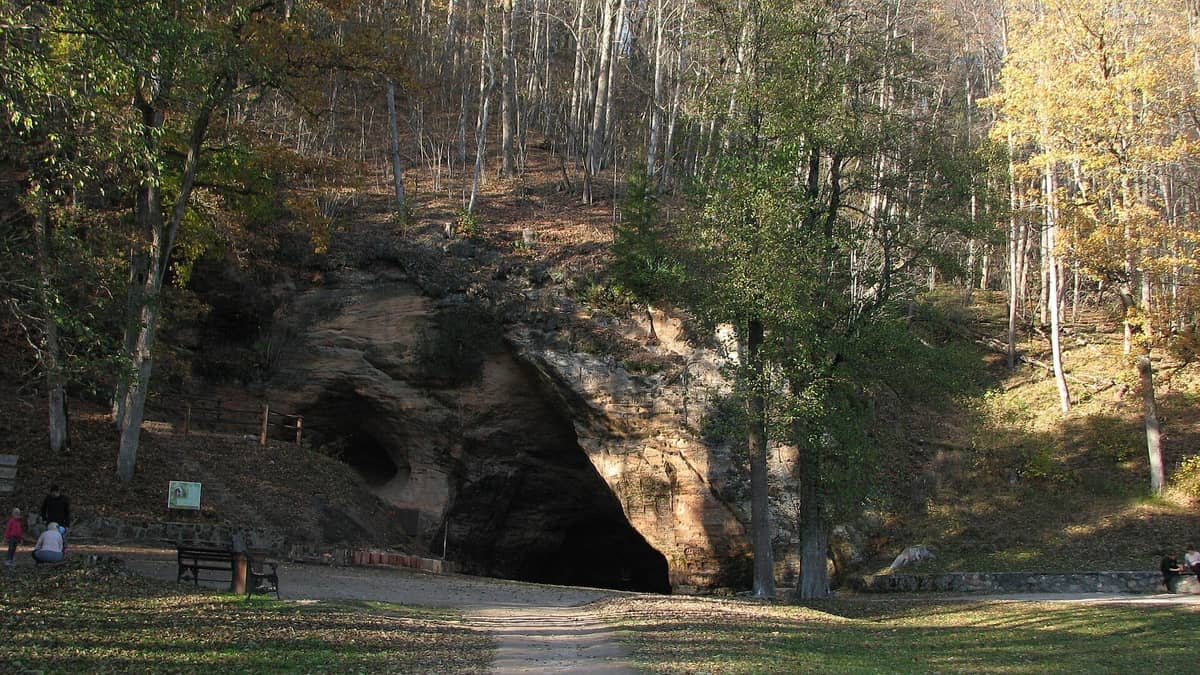
What Is Gutmanis Cave?
Gutmanis Cave (Latvian: Gūtmaņa ala) is the largest cave in the Baltic states, a natural sandstone grotto measuring approximately 18 metres deep, 12 metres wide and 10 metres high. It sits at the foot of a dramatic red sandstone cliff face above the Gauja River valley in Gauja National Park, roughly 50 kilometres northeast of Riga. The cave itself was not formed by human hands: it is the product of thousands of years of gradual erosion, where groundwater and the river slowly dissolved the layered Devonian sandstone into the arching, cathedral-like hollow you see today.
Despite being classified as a cave, it is really a deep, open-fronted alcove rather than a tunnel you walk through. You approach from a forest path, the canopy thins, and suddenly the cliff face opens up ahead of you. The sandstone is a rich ochre-orange, darkened to deep brown at the base where moisture seeps through. On warmer days, a faint mineral coolness drifts out from the interior even when the surrounding forest is warm.
ℹ️ Good to know
Admission is currently free according to official tourism sources. Bring a small amount of cash only if you plan to visit nearby paid attractions.
The Inscriptions: Centuries Written in Stone
The interior walls of Gutmanis Cave are covered in carved inscriptions, and this is what separates the site from a purely geological curiosity. The oldest legible inscription dates to 1667, making this one of the most remarkable open-air historical records in the entire Baltic region. Names, dates, crests, and symbols crowd every reachable surface, layer upon layer, carved by visiting nobility, soldiers, merchants, and ordinary travellers across roughly four centuries.
Reading the walls is a strange, meditative experience. Some inscriptions are crisp and clearly intentional, carved with care in Latin script. Others are barely legible, faded into the porous stone or overwritten by later visitors. The effect is less like a formal monument and more like a palimpsest, a document that keeps rewriting itself. Conservation authorities have worked to protect the most historically significant carvings, and touching or adding new inscriptions is strictly prohibited.
Local legend also ties the cave to a healer named Gutmanis (the name translates roughly as 'good man') who lived nearby and supposedly used spring water from the cave to treat the sick. A natural spring does issue from the cliff face, and for centuries the water was considered to have curative properties. Whether or not you believe that, there is something undeniably atmospheric about the trickle of water running down carved sandstone into a shallow pool below.
Tickets & tours
Hand-picked options from our booking partner. Prices are indicative; availability and final rates are confirmed when you complete your booking.
Canal boat sightseeing tour in Riga
From 13 €Instant confirmationArt and culture walking tour of Riga with a local
From 66 €Instant confirmationFree cancellationSelf-guided discovery walk in Riga - the essential old town and its secrets
From 30 €Instant confirmationFree cancellationExclusive private guided tour of Riga's architecture with a local
From 175 €Instant confirmationFree cancellation
How the Experience Changes Through the Day
Early morning visits, particularly on weekdays, offer near-solitude. The forest path is quiet, the light filters through birch and pine at a low angle, and the cave interior holds a cool, damp stillness. The sandstone appears darker and more saturated in morning light, and you can spend time reading inscriptions without other visitors crowding the narrow interior.
By midday on summer weekends, Gutmanis Cave becomes genuinely crowded. It is a focal point on the most popular day-trip route from Riga, and tour groups, families, and school excursions can pack the approach path and cave entrance simultaneously. The experience is still worthwhile, but it shifts from contemplative to social. If you arrive during peak hours, use the time to walk the trail toward Turaida Castle (visible on the hillside above) and return to the cave in the late afternoon when crowds thin.
💡 Local tip
Visit on a weekday or arrive before 10:00 to have the cave largely to yourself. Summer weekends between 11:00 and 15:00 are the busiest window by a significant margin.
In winter, Gutmanis Cave takes on a completely different character. Snow-dusted sandstone cliffs, bare birch trunks, and the near-silence of the frozen valley make it one of the more memorable cold-weather outings in Latvia. The trail can be icy, so traction devices for shoes are worth considering between December and March.
Getting There from Riga
Sigulda is well connected to Riga by regional train, with the journey taking approximately one hour. Trains run regularly throughout the day. From Sigulda station, the cave is accessible on foot via forest trails (a pleasant walk of approximately 2 km through the valley) or by taxi for those who prefer to save energy for the broader trail network. The cave address is Turaidas iela 2a, Sigulda. If you are planning a fuller day, consider combining the cave visit with Turaida Castle and the Sigulda hiking trails that wind through the Gauja valley between them.
Gutmanis Cave sits within a well-marked section of Gauja National Park. The park has no formal entry gate or ticket booth on this stretch of trail, and the path from Sigulda Castle ruins down to the river valley is signposted. Detailed day-trip planning advice, including train times and what else to see in the area, is available in the day trips from Riga guide.
Practical Notes: Terrain, Weather, and Access
The site is open year-round, and there is no booking required. The approach trail involves uneven forest paths and some descents into the river valley. Footwear with decent grip is strongly recommended; the path becomes muddy after rain and the sandstone near the cave entrance can be slippery when wet. There are no formal accessibility facilities at the site, and the trail is not suitable for wheelchairs or pushchairs in its current form.
One important caveat: Gutmanis Cave has been subject to temporary closure in the past due to landslide risk, as the soft sandstone cliff above the cave is geologically active. Before making it the primary purpose of a trip, check current status via Latvia.travel or local news sources. Closures have not been frequent, but they do occur.
⚠️ What to skip
The sandstone cliffs above the cave are geologically unstable. Do not climb the cliff face or stray beyond marked paths near the cave entrance. Rockfall is a documented hazard.
Photography at the cave is straightforward in overcast conditions, when the diffuse light brings out the texture and color of the sandstone without harsh shadows. On bright sunny days, the contrast between the shaded interior and sunlit exterior can be tricky for cameras to balance. A wide-angle lens helps capture the full scale of the grotto. The spring water running down the wall creates a focal point for close-up detail shots.
Where Gutmanis Cave Fits in a Broader Sigulda Visit
Gutmanis Cave works best as one stop on a longer loop through the Gauja valley rather than a stand-alone destination. Most visitors combine it with Turaida Castle (a 10–15 minute uphill walk through the forest from the cave), which provides elevated views over the valley and a medieval history museum on-site. Together, the cave and castle make a satisfying half-day. Those with a full day can extend the walk to include the wider Sigulda area, which offers one of the most varied natural landscapes within easy reach of Riga.
For context on how to structure a longer visit to the region, the 3 days in Riga itinerary includes a recommended day-trip structure that positions Gutmanis Cave and Sigulda as a natural counterpoint to the city's architecture and museums. Those particularly interested in Latvian natural and cultural heritage will find the Ethnographic Open-Air Museum near Riga a worthwhile complement.
One honest note for managing expectations: the cave itself takes perhaps 20 minutes to examine thoroughly. Its power is not in size or spectacle — other caves elsewhere in Europe are far more dramatic. What makes Gutmanis Cave interesting is the layering of natural geology with centuries of human inscription, the landscape setting in the Gauja valley, and the way it functions as a gateway into one of Latvia's finest stretches of forested trail. Visitors hoping for stalactites or illuminated underground galleries will be disappointed. Those who appreciate understated, historically loaded landscapes will find it genuinely rewarding.
Insider Tips
- The trail from Sigulda Castle ruins down to Gutmanis Cave passes through the valley floor near the Gauja River. If the water level is low in late summer, you can walk along the exposed riverbank for an angle of the sandstone cliffs that most visitors never see.
- Bring a headlamp or phone torch even for a daytime visit. The deeper recesses of the cave interior are shadowed, and a light source lets you read the older inscriptions near the back wall more clearly.
- The spring water issuing from the cave wall is cold and clear. Many locals have drunk it for generations. Whether or not you choose to do the same, the spring creates a natural gathering point and is worth observing closely for the mineral streaks it leaves on the sandstone.
- If you want to avoid tour groups entirely, aim for the shoulder season: May or September offer stable weather, full foliage, and a fraction of the July-August foot traffic.
- Turaida Castle charges an entry fee and has specific opening hours, unlike the cave. Check current times before planning your visit sequence so you do not arrive at the castle after it closes.
Who Is Gutmanis Cave For?
- Day-trippers from Riga looking for a nature and history combination
- Hikers using Gutmanis Cave as the starting point for the Gauja valley trail network
- History enthusiasts interested in centuries-old carved inscriptions
- Photographers drawn to sandstone textures, forest light, and river valley landscapes
- Families with older children who can manage forest paths and uneven terrain
Nearby Attractions
Other things to see while in Sigulda:
- Secret Soviet Bunker (Līgatne)
Hidden beneath a Soviet-era rehabilitation centre near Līgatne, the Secret Soviet Bunker in Līgatne is a preserved Cold War command complex built in the 1980s for Latvia's political elite. Spanning 2,000 square metres and sitting 9 metres underground, it remained classified until 2003 and is now one of the most genuinely surprising historical sites in the Baltics.
- Sigulda Hiking Trails & Gauja Valley Viewpoints
The Sigulda hiking trails cut through the Gauja River Valley, one of Latvia's most dramatic natural landscapes. Sandstone bluffs rise above pine forest, medieval castles crown opposite ridges, and the classic loop from Sigulda town covers 10 to 12 km with around 80 metres of elevation change. This is the most complete day hike accessible by direct train from Riga.
- Turaida Castle
Standing on a forested ridge above the Gauja River, Turaida Castle is Latvia's most photogenic medieval fortress. Founded in 1214 by the Bishop of Riga, the reconstructed red-brick keep anchors a sprawling open-air museum reserve where eight centuries of Baltic history feel tangible.