Troja Chateau: Prague's Baroque Palace Beyond the Tourist Trail
Troja Chateau is a late 17th-century Baroque palace set against the wooded slopes north of the Vltava, serving as a venue for Prague City Gallery exhibitions. Its terraced gardens are free to enter, and the painted interiors rival anything in the city centre — with a fraction of the crowds.
Quick Facts
- Location
- U Trojského zámku 1/4, Prague 7 (Troja district, near Holešovice)
- Getting There
- Metro Line C to Nádraží Holešovice, then Bus 112 to Zoo Praha-Troja. Or Tram 17 to Výstaviště, walk through Stromovka Park and cross the Trojská lávka.
- Time Needed
- 1.5 to 2.5 hours (gardens + interiors)
- Cost
- Gardens: free. Interiors: 200 CZK adults, 90 CZK students/seniors, 50 CZK children (6–10), 450 CZK family. Verify current prices at ghmp.cz.
- Best for
- Art lovers, architecture enthusiasts, families seeking space, and anyone wanting a quieter Prague day out
- Official website
- www.ghmp.cz/en/opening-hours-and-admission/troja-chateau
What Is Troja Chateau and Why Does It Matter?
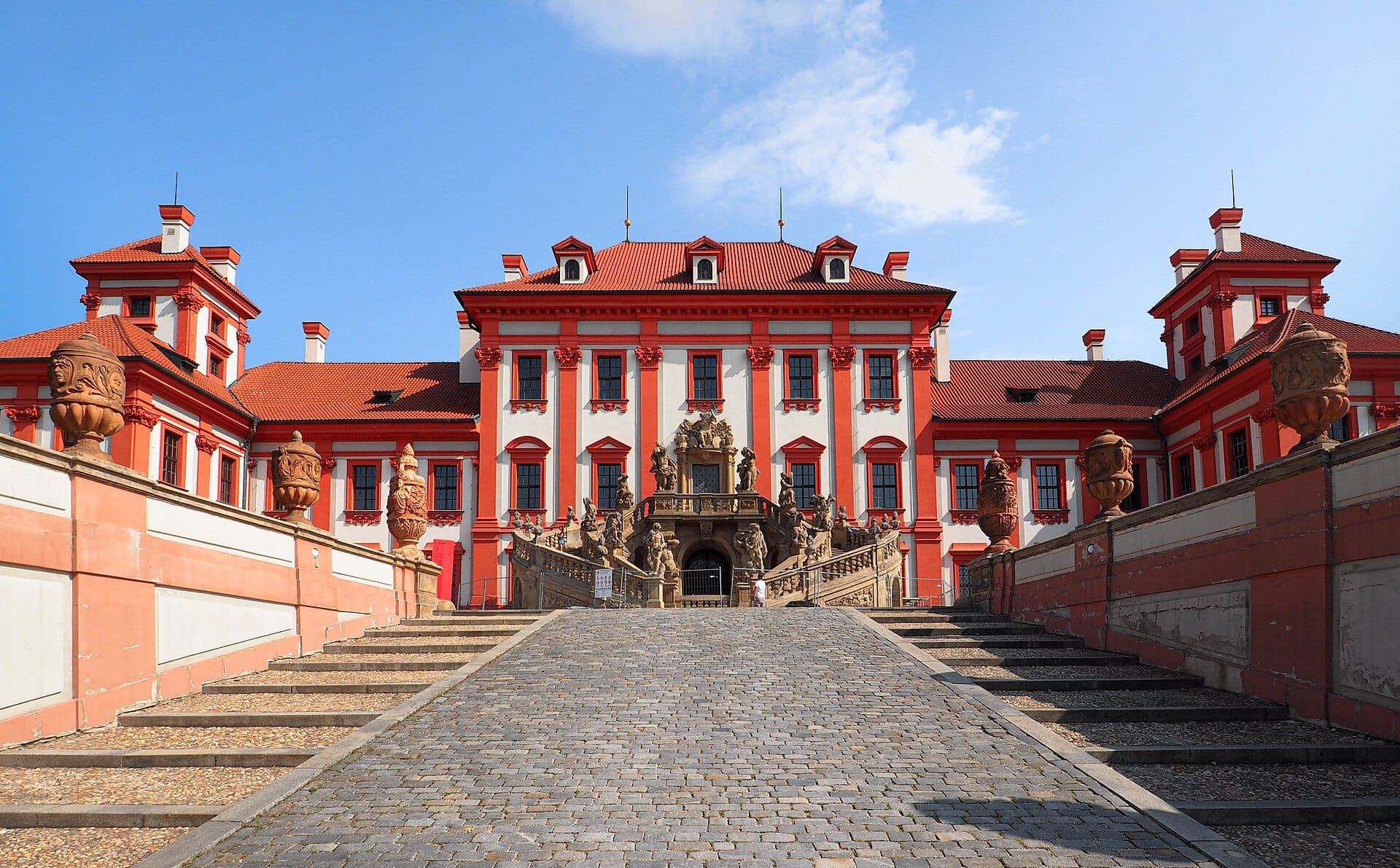
Troja Chateau (Zámek Troja in Czech) is the only Baroque summer palace in Prague, built for Count Václav Vojtěch of Sternberg beginning in the late 17th century. Designed in the Italian Baroque style, the building was intended as a country retreat — a deliberate contrast to the dense urban fabric of the city. It faces south toward the Vltava River, flanked by terraced gardens that descend in symmetrical tiers, punctuated by stone balustrades and mythological sculptures. Designed in the Italian Baroque style, the building was intended as a country retreat — a deliberate contrast to the dense urban fabric of the city. It faces south toward the Vltava River, flanked by terraced gardens that descend in symmetrical tiers, punctuated by stone balustrades and mythological sculptures.
Since 1922 the chateau has belonged to the Czech state, and today it functions as a branch of the Prague City Gallery (GHMP), displaying rotating exhibitions in rooms whose ceilings are covered in elaborate frescoes glorifying the Habsburg dynasty. The contrast between the grand decorative programme and the relatively modest gallery collection makes for an unusual visit: you come for both the art inside the building and the building itself. The contrast between the grand decorative programme and the relatively modest gallery collection makes for an unusual visit: you come for both the art inside the building and the building itself.
Troja sits just north of Holešovice, close to Prague Zoo and Stromovka Park. The neighbourhood context matters: this is not a stand-alone attraction surrounded by cafés and souvenir shops. It is a genuine park destination, quieter and more residential in feel than anywhere inside the historic core.
ℹ️ Good to know
The chateau operates seasonally. For 2026: interiors open Tuesday–Thursday and Saturday–Sunday 10:00–18:00, Friday 13:00–18:00, from 4 April to 29 October. Gardens stay open one hour later. The chateau is closed on Mondays year-round. Always check the official GHMP website before visiting, as hours and closed dates change between seasons.
The Gardens: Free, Formal, and Surprisingly Calming
Entry to the gardens is free during opening hours, which makes Troja accessible even if you skip the paid interiors. The formal French-style terraces rise from the south facade in a series of steps, each level anchored by stone urns and balustrades worn soft by three centuries of Central European winters. The main staircase descending from the palace is decorated with terracotta-coloured figures — not the polished marble of Italian originals, but expressive, slightly rough, and more memorable for it.
On a weekday morning in spring, you are likely to share the lower garden with dog walkers from the surrounding neighbourhood and the occasional art student with a sketchbook. The lawn between the chateau and the garden entrance is generous enough that even on summer weekends it rarely feels packed. By late afternoon, the light hits the pale ochre facade at a low angle, and the whole composition turns golden — this is the best hour for photographs of the exterior.
A small rose garden occupies the western wing of the grounds. It is most rewarding in June when the roses are in full bloom and the fragrance carries all the way to the entrance path. Outside that window, the beds are pleasant but unremarkable. Do not build the visit around them specifically unless you are timing a June trip.
Tickets & tours
Hand-picked options from our booking partner. Prices are indicative; availability and final rates are confirmed when you complete your booking.
Konopiste Chateau tour From Prague
From 65 €Instant confirmationFree cancellationSelf guided tour with interactive city game of Prague
From 5 €Instant confirmationFree cancellationPrague by night city tour
From 27 €Instant confirmationFree cancellationPrague city tour with Vltava River cruise
From 38 €Instant confirmationFree cancellation
Inside the Chateau: Frescoes, Paintings, and the Grand Hall
The interior ticket gives access to the permanent collection of 19th-century Czech painting and, more compellingly, to the Grand Hall on the first floor. The hall ceiling fresco, painted in the 1690s, depicts a triumphal allegory across the ceiling. Standing directly beneath it and tilting your head back, the scale becomes vertiginous.
The 19th-century Czech paintings displayed through the chateau's rooms include landscapes, portraits, and historical scenes from artists of the National Revival period. If you already have a strong interest in Czech art history, the collection rewards close attention. If your primary interest is architecture and decorative arts, you can move through the gallery rooms at a comfortable pace and still spend the majority of your time in the frescoed halls.
For context on what else the Prague City Gallery operates across the city, it is worth knowing that GHMP also manages the House of the Black Madonna in Old Town and the Kampa Museum area. A GHMP combined ticket may offer savings if you plan multiple sites — check the official website.
💡 Local tip
Bring a crick-neck remedy. The Grand Hall ceiling fresco is genuinely impressive but requires sustained upward gazing. The floor has no seating, so visitors with neck or back issues may find it uncomfortable to take in the full composition. Some people sit on the floor to look up — the staff generally tolerate this during quieter periods.
Getting There: The Walk Through Stromovka Is Half the Point
The most direct route is Metro Line C (red) to Nádraží Holešovice, then Bus 112 to the Zoo Praha-Troja stop. The chateau entrance is signposted directly across from the zoo. Total time from the city centre: roughly 25 to 35 minutes depending on connections.
The more enjoyable route, if you have an extra 20 minutes and the weather cooperates, is Tram 17 to Výstaviště (the Exhibition Grounds), then a walk north through Stromovka Park. The park is a broad, tree-lined former royal hunting ground, and crossing it on foot before arriving at Troja turns the journey into a proper half-day excursion rather than a single-stop visit. You cross the Troja footbridge over a channel of the Vltava and follow signs from the far bank, approximately 300 metres to the chateau gardens.
By bicycle, the chateau is also reachable via the riverside cycling paths that run along the Vltava northward from the city centre. There is a parking area for bicycles near the garden entrance. If you are spending time in the Holešovice area, the chateau works naturally as the northern endpoint of a half-day loop.
Seasonal Realities: When to Go and What to Expect
Troja Chateau is closed from late October through early April, which immediately rules it out for most winter visits to Prague. This is not an attraction that can be slotted into a cold-weather itinerary. If you are visiting between November and March, it simply may not be open.
During the open season, the best months are May, early June, and September. Temperatures are comfortable for walking the gardens, the vegetation is either at its freshest or at its most golden, and visitor numbers remain lower than peak July and August. For general timing advice on a Prague trip, the best time to visit Prague guide covers the full seasonal picture across the city.
Summer visits (July–August) are perfectly viable. The gardens are in full leaf, the chateau interiors are cool compared to the outdoor heat, and the longer daylight hours let you extend a garden visit into the early evening. Prague Zoo is immediately adjacent, which makes a combined visit with children highly practical — though note that the zoo is a full-day attraction on its own, and trying to combine it with a thorough chateau visit in a single afternoon will feel rushed.
⚠️ What to skip
The chateau is closed on Mondays throughout the season. The gardens can also close in case of frost during the winter garden opening period. If visiting specifically in early April or late October, check the GHMP website within a few days of your planned visit to confirm the chateau is open.
Photography, Accessibility, and Practical Notes
The exterior of the chateau photographs well from the lower garden, facing north toward the south facade with the terraced staircase in the foreground. The best light is late afternoon. Early morning light catches the building from an awkward angle and the garden gates may still be closed. Interior photography of the frescoes is technically possible but challenging: the Grand Hall is lit primarily by natural light from tall windows, and a phone camera will struggle in lower-light corners. A camera with good low-light performance produces significantly better results.
Accessibility is a genuine limitation here. The chateau is a historic Baroque building, and step-free access throughout the interior is not confirmed publicly. The gardens, which are flat on the lower levels but involve steps on the terraces, offer more accessible space than the building interiors. Visitors with specific mobility requirements should contact GHMP directly before visiting, using the phone and email contacts listed on the official website. Do not assume full access based on the gardens being free to enter.
There is no significant café or restaurant on the chateau grounds. Bring water, especially in summer. The nearest refreshment options are along the road toward Prague Zoo or back toward the Holešovice market area. If you plan a longer day combining Troja with the Holešovice Market Halls, build in time to eat and drink there before or after the chateau visit.
Insider Tips
- The gardens open an hour later than the chateau interiors close on most days. If you arrive at 17:30, you can walk the terraces and photograph the exterior without buying an interior ticket — useful if you only have a short window.
- Bus 112 runs directly from Nádraží Holešovice metro station and drops you at the zoo entrance, directly opposite the chateau signposting. It is more reliable than trying to navigate the park approach on an unfamiliar visit.
- The chateau is frequently used as an event and wedding venue, particularly on summer weekends. On those days, portions of the interior or garden may be closed to regular visitors. Call ahead or check GHMP announcements if visiting on a Saturday between June and September.
- If you cross via the Stromovka route on foot, look for the small baroque greenhouse structure on the northern edge of Stromovka Park just before the footbridge. It is easy to miss and rarely mentioned in guides.
- The family ticket (2 adults plus up to 4 children under 15) at 450 CZK represents considerably better value than individual tickets if you are visiting with two or more children. Confirm current pricing on the GHMP website before arrival.
Who Is Troja Chateau For?
- Visitors interested in Central European Baroque architecture who want to see something beyond Prague Castle
- Families combining the chateau gardens with a morning at Prague Zoo next door
- Art history enthusiasts focused on the Czech National Revival period and 17th-century decorative fresco painting
- Photographers looking for a palatial exterior with genuine garden depth and good afternoon light
- Travellers spending more than three days in Prague who have already covered the historic core and want a calmer, less commercialised destination
Nearby Attractions
Other things to see while in Holešovice:
- DOX Centre for Contemporary Art
Opened in 2008 inside a converted 19th-century factory in Holešovice, DOX Centre for Contemporary Art is a major venue for international contemporary art, architecture, and design. With around 3,000 m² of exhibition space across renovated industrial halls, it stages politically engaged, visually demanding shows that rarely play it safe.
- Holešovice Market Halls (Pražská tržnice)
The Holešovice Market Halls, officially known as Pražská tržnice, The Holešovice Market Halls, officially known as Pražská tržnice, occupy a large heritage complex in Prague 7 that began life as the city's central slaughterhouse in 1895.. Today the red-brick halls host a year-round farmers market, street food vendors, pop-up events, and independent businesses, offering a slice of everyday Prague that most tourists never reach.
- Letná Beer Garden
Perched on the edge of Letná Park above the Vltava River, the Letná Beer Garden is where Prague locals actually drink in summer. No admission charge, plastic cups of cold Pilsner, and a sweeping view across the city's rooftops — it is one of the most genuinely local outdoor experiences in the Czech capital.
- Letná Park
Letná Park occupies a broad plateau above the Vltava in Prague's Holešovice district, offering panoramic views over the Old Town, a famous open-air beer garden, and kilometers of tree-lined paths. Entry is free and the park is open around the clock.