Torrey Pines State Natural Reserve: San Diego's Wild Coastal Escape
Torrey Pines State Natural Reserve protects a rugged stretch of San Diego coastline where ancient sandstone bluffs drop to a broad Pacific beach. It's one of the few places on Earth where the rare Torrey pine grows wild, and the trails here offer something genuinely uncommon for a major American city: silence, solitude, and unobstructed ocean views.
Quick Facts
- Location
- 12600 North Torrey Pines Road, San Diego, CA 92037 — roughly 18 miles north of downtown San Diego
- Getting There
- Car recommended; free street parking on North Torrey Pines Road / Hwy 101 outside the entrance. From I-5, take Carmel Valley Road west, then Torrey Pines Road south.
- Time Needed
- 2 to 4 hours for trails plus beach; budget a full half-day if you plan to swim or linger at the shore
- Cost
- Free on foot (walk-in). Vehicle parking inside the reserve: approximately $10–$25 per day (demand-based pricing). California State Parks annual passes accepted.
- Best for
- Hikers, nature lovers, photographers, families wanting a calm outdoor day, and anyone wanting real coastal wilderness close to the city
- Official website
- http://www.parks.ca.gov/?page_id=657
What Torrey Pines Actually Is
Torrey Pines State Natural Reserve is a California State Park protecting roughly 1,750 acres of coastal mesa, eroded sandstone canyons, and beach at the northern edge of San Diego. Its central ecological reason for existing is the Torrey pine (Pinus torreyana), one of the rarest pine species on the planet. This tree grows naturally in only two places: this narrow strip of San Diego coastline, and Santa Rosa Island off the Santa Barbara coast. That fact alone gives the reserve a scientific weight that most parks in urban California simply don't carry.
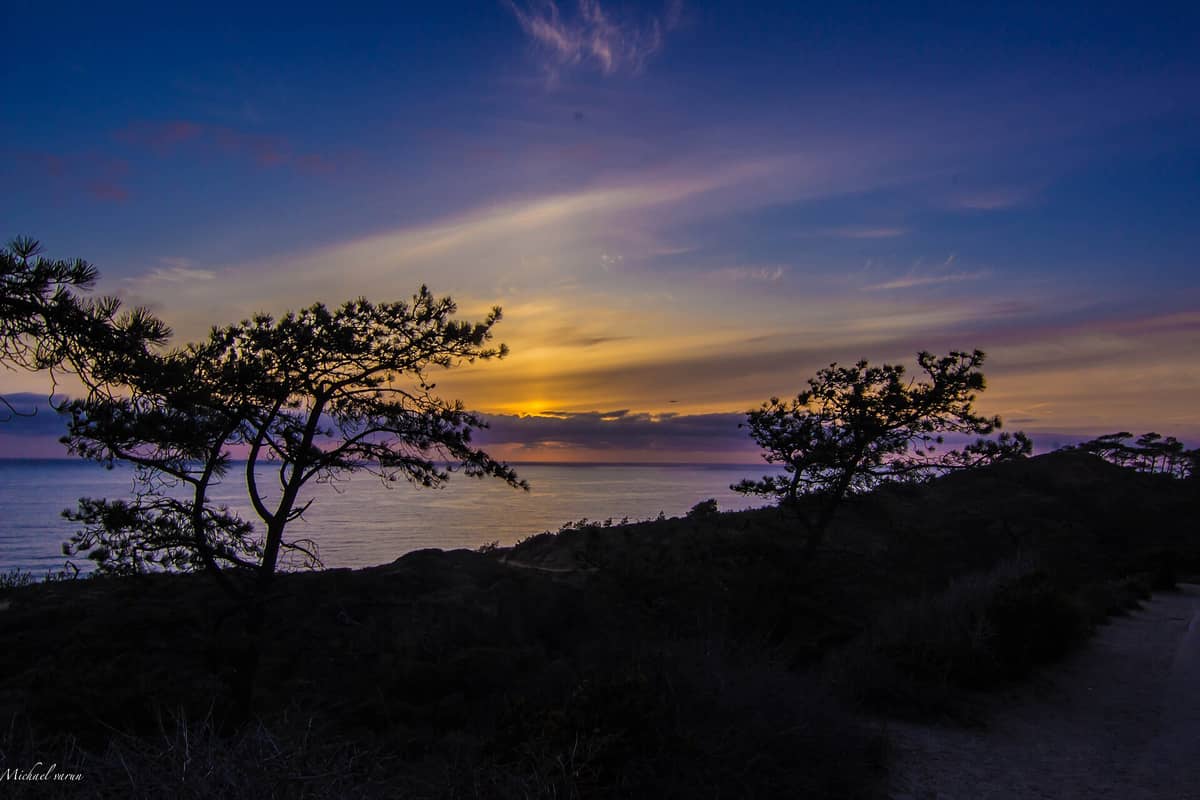
The terrain is dramatic in a quiet way. Wind-sculpted pines cling to crumbling red-orange bluffs, their branches twisted into shapes that look almost architectural. Below, Torrey Pines State Beach stretches south, wide and relatively uncrowded compared to the beaches nearer to the city. On clear days — which, given San Diego's Mediterranean climate, is most of the year — the views from the bluff trails reach across open Pacific water toward the Baja California coast on the horizon.
ℹ️ Good to know
Walk-in access to the reserve is free. If you park on North Torrey Pines Road (Highway 101) outside the entrance gate, you pay nothing. The parking fee applies only to vehicles entering the reserve itself.
The Trails: What You'll See and Where to Go
The reserve has eight marked trails, all originating near the Visitor Center on the bluff. Most are short by hiking standards — the longest loop you can string together is around 6 miles if you descend to the beach and return via a different canyon trail — but the elevation changes and loose sandy footing make them feel more physical than their distances suggest. Signage is clear, and all trails are marked with numbered posts corresponding to a guide available at the Visitor Center.
The Razor Point and Broken Hill trails offer the most dramatic bluff-edge views. From Razor Point, you're standing on eroded sandstone looking directly down at the Pacific, with Torrey pines growing at improbable angles from the cliff face below you. Broken Hill loops through a quieter section of the mesa before emerging at another viewpoint. The Beach Trail descends from the reserve down to the sand, where you can walk north or south along the shore before climbing back up.
The Discovery Trail near the Visitor Center is the most accessible option. It's hard-packed and relatively even, offering a viewpoint along the bluff edge without requiring a full hike. Free beach wheelchairs are available at the parking kiosks on a first-come, first-served basis.
⚠️ What to skip
No dogs are allowed anywhere in the reserve, including the trails and beach within reserve boundaries. No drones. No food on trails or within the reserve boundary. Stay on marked trails — the fragile sandstone and root systems of the Torrey pines are easily damaged by foot traffic.
How the Experience Changes by Time of Day
Arriving at or shortly after the 7:15 a.m. opening gives you a fundamentally different experience than arriving at 11 a.m. In the early morning, the light hits the sandstone bluffs from the east, deepening the reds and oranges in the rock. The air smells of pine resin and salt, and the trails are quiet enough that you can hear the surf from the bluff top. Scrub jays call in the chaparral; occasionally you'll catch movement from a California ground squirrel along the trail edge.
By late morning on weekends, the main parking lot fills fast and the Razor Point trail sees steady foot traffic. The experience is still good — the views don't diminish with company — but the solitude is gone. Midday in summer brings coastal fog that can reduce visibility from the bluffs to near zero. This is San Diego's famous 'June Gloom' pattern, which can persist well into July and sometimes August; mornings may be fully socked in before clearing by early afternoon.
Late afternoon, roughly two hours before sunset, is the other quiet window. Light from the west turns the bluffs gold, photography becomes effortless, and many of the midday visitors have left. The gate closes at sunset, so plan your departure accordingly — vehicles left inside may be cited or towed.
The Beach Below the Bluffs
Torrey Pines State Beach sits at the base of the reserve and is accessible either from the Beach Trail within the reserve or directly from a separate parking area off North Torrey Pines Road. It's a wide, sandy beach backed by the bluffs, with no development visible from the sand in the reserve section. The water is cold by most standards — Pacific Ocean temperatures off San Diego typically sit in the mid-60s to near 70°F even in summer — but the beach draws swimmers, surfers in the north section, and walkers in significant numbers.
The beach connects southward toward La Jolla Shores, making it possible to walk a long stretch of mostly undeveloped coastline if you time your visit to a low tide. North of the reserve, the beach eventually reaches Del Mar. Walking the shoreline at low tide, with the sandstone cliffs rising on your left and the open Pacific on your right, is one of the more quietly impressive coastal walks in Southern California.
Historical and Scientific Context
The Torrey pine was identified as a distinct species in the 1850s by physician and botanist Charles Christopher Parry and later named for John Torrey, a prominent American botanist. The tree's extreme rarity is a product of geography and climate: it's adapted specifically to the dry, sandy, nutrient-poor soils of this coastal bluff environment, conditions that don't appear to have promoted its spread beyond these two isolated populations.
The reserve itself was established in 1921 as a city park, later transferred to the California State Park system. The Ellen Browning Scripps family, whose influence on San Diego's cultural and scientific landscape is substantial, played a role in early preservation efforts here. The Visitor Center, a 1923 Pueblo Revival-style adobe building known as Torrey Pines Lodge, was designed by architects Richard Requa and Herbert Jackson and is itself listed on historical registers.
For visitors interested in San Diego's natural history beyond this reserve, the San Diego Natural History Museum in Balboa Park holds extensive collections and exhibits on Southern California's coastal ecology.
Practical Details Before You Go
The reserve is open daily from 7:15 a.m. to sunset. The Visitor Center keeps hours of 9:00 a.m. to 5:00 p.m. daily and is worth a stop: the staff and volunteer docents know the trails in detail and can point you toward current wildlife activity or trail conditions. The entrance kiosk, where parking fees are collected, operates from 8:00 a.m. to about 30 minutes before sunset, 365 days a year.
Parking inside the reserve costs approximately $10 to $25 per vehicle, with demand-based pricing that rises on weekends and holidays. California State Parks annual day-use passes are accepted here, but day-use passes or camping receipts from other state parks are not valid at this site specifically. Free street parking exists along North Torrey Pines Road outside the entrance — it's limited, fills by mid-morning on weekends, and requires a short walk to the trailhead.
What to bring: water is the most critical item. There are no water fountains on the trails, and the coastal sun combined with sandy footing makes even short hikes more demanding than expected. Wear closed-toe shoes with grip — the trails are sandy and loose in sections, and some sections involve moderate elevation gain. A light layer is useful any time of year; coastal mornings can be 15 degrees cooler than forecasts suggest for inland areas.
💡 Local tip
Photography tip: the Razor Point viewpoint faces generally west and slightly southwest. For the clearest light on the bluffs with the ocean behind them, shoot in the morning with the sun behind you, or in the late afternoon for warm side-lit conditions. Midday light in summer tends to be flat and hazy from marine layer.
If you're planning a broader day that includes coastal San Diego, the reserve pairs naturally with a drive south through La Jolla, where the village, the cove, and the marine reserve offer a contrasting, more developed coastal experience. A guide to the best hikes in San Diego includes Torrey Pines alongside other options if you're building a multi-day outdoor itinerary.
Who This Reserve Suits — and Who It Doesn't
Torrey Pines rewards visitors who are comfortable with a relatively unstructured outdoor experience. There are no food vendors, no audio tours, no carnival-style amenities. If your group needs constant stimulation or is unwilling to walk on uneven terrain, this won't be satisfying. Similarly, if you're traveling with a dog, this is not the place: the no-dog rule is strictly enforced throughout the reserve.
It's also worth setting expectations about the trails themselves. None of them are technically challenging — you don't need special equipment or significant fitness — but the loose sandy surfaces, occasional steep descents, and lack of shade on exposed bluff sections mean this is not a stroller-friendly or flip-flop-friendly outing beyond the Discovery Trail near the Visitor Center.
Families with young children who want a more structured outdoor activity might find Mission Trails Regional Park a better fit, where facilities are more developed and terrain more varied. And if your primary goal is coastal views without a hike, the Cabrillo National Monument at Point Loma offers accessible overlooks with strong historical context.
Insider Tips
- The free street parking on North Torrey Pines Road fills fast on weekend mornings — arrive before 8:30 a.m. or plan to pay the reserve parking fee. Midweek visits, especially Tuesday through Thursday, are noticeably quieter at every hour.
- Ask at the Visitor Center about guided nature walks led by Torrey Pines Docent Society volunteers. These free walks typically run on weekends and cover ecology and geology that would be easy to walk past without knowing what to look for.
- If you descend to the beach via the Beach Trail, check a tide chart before you go. At low tide, the beach beneath the bluffs widens considerably, exposing tide pools and making the walk along the base of the cliffs far more interesting.
- The reserve's trails drain poorly after rain. After any rainfall — which in San Diego mostly means winter months — wait at least a day or two before visiting. Wet sandy clay on the trails becomes slippery and causes significant erosion damage.
- Cell signal is patchy inside the reserve and often unreliable away from the entrance and higher ridges. Download the trail map from the Torrey Pines Docent Society website (torreypines.org) before you arrive, or pick up a paper copy at the Visitor Center.
Who Is Torrey Pines State Natural Reserve For?
- Hikers and trail walkers who want genuine coastal wilderness without driving hours from the city
- Nature photographers, particularly those interested in coastal light, rare flora, and bird life
- Visitors on a budget — the entire reserve is free on foot, with no admission cost
- Travelers who want to combine a bluff hike with beach time in a single half-day outing
- Anyone interested in rare or endemic plant species — the Torrey pine is one of the rarest pines in the world
Nearby Attractions
Combine your visit with:
- Anza-Borrego Desert State Park
Anza-Borrego Desert State Park stretches across more than 600,000 acres of Colorado Desert in eastern San Diego County, making it one of the largest state parks in the United States. From spring wildflower carpets to ancient slot canyons and some of the darkest skies in Southern California, it rewards visitors who plan carefully and respect the terrain.
- Border Field State Park
Border Field State Park occupies the southwestern corner of the continental United States, where Pacific surf meets the U.S.–Mexico border fence. It offers coastal wetlands, a historic marble boundary monument, and views toward Friendship Park — the U.S.-side gathering space has been closed since 2020, so confirm current access before you go.
- Cedar Creek Falls
Cedar Creek Falls is a backcountry waterfall deep inside Cleveland National Forest, reached by a strenuous 6-mile round-trip hike from Ramona. A mandatory day-use permit keeps crowds manageable, but you'll earn every step of the descent into this rugged gorge. This guide covers the permit process, trail conditions, safety warnings, and what to realistically expect.
- Chicano Park
Chicano Park is a National Historic Landmark tucked beneath the San Diego–Coronado Bridge in Barrio Logan, where more than 80 monumental murals cover the concrete pillars of a freeway overpass. Free to enter and open daily, it is one of the most culturally layered outdoor spaces in the American Southwest.