Torre Latinoamericana: The View That Puts All of Mexico City in Perspective
Standing at the corner of Eje Central and Madero in the Centro Histórico, Torre Latinoamericana offers a 44-floor panorama over one of the world's largest cities. Once Latin America's tallest skyscraper, it remains a landmark of mid-century engineering ambition and the clearest way to grasp Mexico City's scale from a single point.
Quick Facts
- Location
- Eje Central Lázaro Cárdenas 2, Centro Histórico, CDMX
- Getting There
- Bellas Artes (Line 2) or Zócalo/Tenochtitlan (Line 2), both a short walk along Avenida Francisco I. Madero
- Time Needed
- 45–90 minutes
- Cost
- Paid entry; prices in MXN vary by age and package. Check miradortorrelatino.com for current rates.
- Best for
- City panoramas, architecture enthusiasts, first-time visitors to Mexico City
- Official website
- www.miradortorrelatino.com
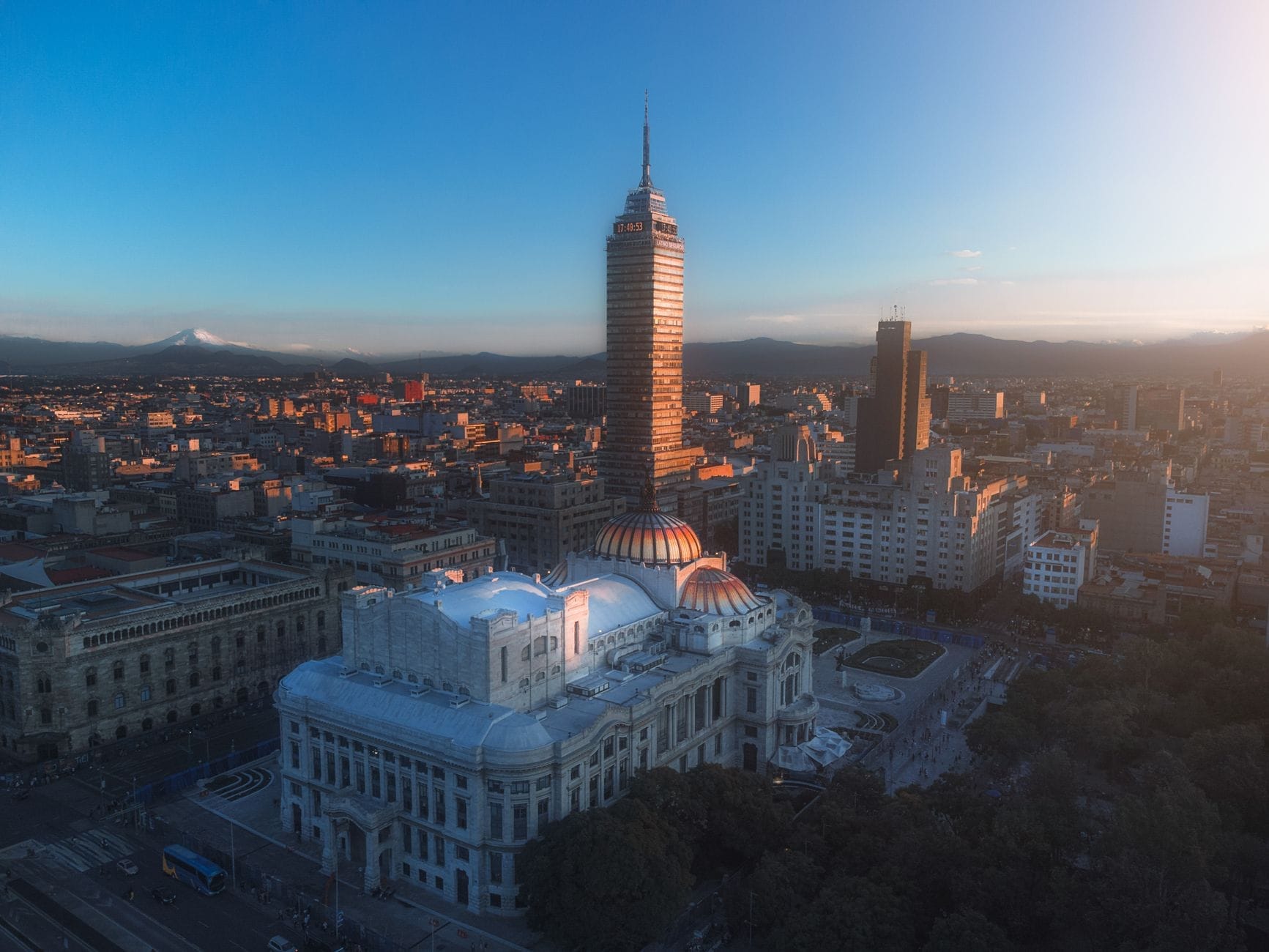
What Torre Latinoamericana Is
Torre Latinoamericana is a 44-floor skyscraper completed in 1956 at the heart of Mexico City's historic center. When it opened, it was the tallest building in Latin America, a title it held for more than two decades. Today it functions primarily as an office tower, but its upper floors house an observation deck, a café, and an aquarium, all accessible to the public under the Mirador Torre Latino brand.
The building sits at the junction of Eje Central Lázaro Cárdenas and Avenida Francisco I. Madero, one of the most trafficked intersections in the entire city. From street level, its glass and steel facade looks almost ordinary beside the Baroque and Neoclassical buildings surrounding it. The contrast is part of its character: a building that announced mid-20th-century ambition in a colonial streetscape.
💡 Local tip
Buy tickets in advance via the official Mirador Torre Latino website to avoid queues at the ground-floor ticket desk, especially on weekends and school holidays.
The Engineering Story Worth Knowing Before You Go Up
Mexico City is built on the drained bed of Lake Texcoco, a layer of soft clay and sediment that shifts and compresses under load. Building anything taller than a few stories here is a genuine structural challenge. When architects Augusto H. Álvarez and Carlos Obregón Santacilia designed Torre Latinoamericana in the late 1940s, they addressed this by sinking 361 concrete piles roughly 34 meters into the ground and excavating a basement to 13.5 meters, using hydrostatic uplift to counteract subsidence. The design proved itself dramatically in 1957, just one year after the tower opened, when a major earthquake struck Mexico City. Torre Latinoamericana swayed but suffered no structural damage, while many surrounding buildings were badly affected.
The 1985 earthquake, one of the most destructive in Mexico City's modern history, produced the same result. The tower stood intact. Engineers still reference it as a case study in seismically adaptive design. That context matters when you are standing on the observation deck watching the city shift slightly in the wind: the movement is intentional.
Tickets & tours
Live prices and dates from our booking partner. If you book, we may earn a commission at no extra cost to you.
The Ascent: What to Expect from Lobby to Rooftop
The public entrance is on Eje Central, and the lobby leads directly to the ticketing area. Two express elevators carry visitors to floor 37, where an enclosed observation level features wraparound windows and display panels on the tower's history and construction. The glass is thick and slightly tinted, which affects photography in lower light conditions. On this floor you will also find a small aquarium, an unusual addition that has been part of the tower's public attraction since the 1950s, making it one of the oldest continuously operating aquariums in Mexico City.
From floor 37, a staircase climbs to floor 38, which has an open-air terrace section. At this height, roughly 140 meters above street level, the noise of the city below has a different texture: you can still hear traffic and horns, but they arrive muted and layered, more like ambient sound than individual events. On clear days, the snow-capped cones of Popocatépetl and Iztaccíhuatl are visible to the southeast, an image that tends to stop visitors mid-conversation.
The top floor, accessible from 38, adds additional viewing area. Wind can be significant on the open levels, so a light jacket is worth carrying even in warm months. The floor surfaces are non-slip metal grating, and the railings are solid. Visitors with vertigo may find the open sections challenging, but those sections are not mandatory: the enclosed floor 37 level provides comparable views.
How the View Changes by Time of Day
Morning arrivals, around 9:00 when the tower typically opens, offer the clearest air. The dry season months from November through April tend to produce the most transparent skies, and early weekday mornings in those months occasionally reveal the full ring of mountains that surrounds the Valley of Mexico. Smog and low cloud accumulate through the day, particularly in the rainy season from May to October, when afternoon thunderstorms build quickly and can reduce visibility to a few kilometers.
Late afternoon, from around 16:00 onward, brings a different reward. The sun moves toward the west and begins to catch the facades of Palacio de Bellas Artes directly below, turning its white marble and colored tile dome gold. The Alameda Central park behind it reads as a rectangle of deep green. Looking north, the grid of the historic center stretches away and the urban canopy thins toward the suburbs.
The night visit, available until around 22:00, is worth serious consideration. The city's street lighting traces every avenue in orange and white lines that converge toward distant vanishing points. The Zócalo, roughly 800 meters to the east, glows as a pale open square, and the floodlit Metropolitan Cathedral and National Palace are clearly distinguishable. Night photography from the enclosed level is possible but requires a steady hand or small tripod; flash is useless at this distance.
⚠️ What to skip
During the rainy season (May–October), afternoon visits are frequently obscured by cloud cover or precipitation. Plan for morning visits in summer months if panoramic views are your priority.
Getting There and Moving Around the Area
The most practical transit option is Metro Line 2 (Blue Line). Exit at Bellas Artes station and the tower is visible within about a three-minute walk heading east along Avenida Juárez. The Zócalo/Tenochtitlan station is also on Line 2, roughly the same walking distance to the east. Either station works well if you are combining the tower with a walk along Calle Madero, the pedestrianized street that runs directly between them and past the tower's base.
Driving is not recommended. The Centro Histórico has severe restrictions on car access during peak hours, parking is limited and expensive, and the surrounding area is best navigated on foot once you arrive. Ride-hailing apps including Uber, DiDi, and Cabify operate in Mexico City and can drop you on Eje Central or nearby Avenida Juárez, but pickup in the immediate area during peak hours can be slow.
If you are combining the tower with other visits, the Palacio de Bellas Artes is directly adjacent, and the Metropolitan Cathedral and Templo Mayor are a ten-minute walk east along Madero. The Centro Histórico rewards extended exploration on foot.
Is the Observation Deck Worth the Ticket Price?
Honest answer: it depends on why you are visiting. For a first-time visitor to Mexico City, the view from Torre Latinoamericana is clarifying. It shows you how enormous the city is in a way that no map or statistic fully communicates. Looking out in any direction, the urban grid continues past the horizon with no visible edge. That experience is worth the admission price for most people.
For architecture enthusiasts or anyone interested in structural engineering, the tower's history adds a layer of meaning that justifies the visit independently of the view. The display materials on floor 37 are reasonably informative, though they are mostly in Spanish.
If you have already visited similar observation decks in other major cities and are primarily looking for a unique or unconventional experience, you may find the tower slightly formulaic. The visit is linear, the crowd flow is efficient rather than contemplative, and the commercial elements (café, souvenir shop) follow a standard model. Travelers seeking depth over altitude may prefer the rooftop of the Gran Hotel Ciudad de México on the Zócalo, which is free and less crowded, albeit lower.
ℹ️ Good to know
The tower's on-site aquarium on floor 37 is a genuine curiosity and often delights families with young children who were not expecting fish tanks near the stratosphere.
Insider Tips
- Weekday mornings between 10:00 and 12:00 see the thinnest crowds. Avoid Saturday and Sunday afternoons, when tour groups and school visits peak simultaneously.
- The enclosed level on floor 37 has slightly better conditions for photography than the open terrace on windy or overcast days. Bring a lens cloth: the thick observation windows accumulate smudges that ruin photos if you don't clean the glass in front of your lens.
- Look for Popocatépetl to the southeast on clear dry-season mornings. If the volcano is emitting a visible plume, which happens periodically, it is visible from the tower's upper levels.
- The small café on the upper floors charges significantly more than street-level options nearby. Have a coffee at ground level before ascending if budget matters.
- Combine the visit with the Museo Mural Diego Rivera, located in Alameda Central park a few minutes' walk away, to add substantial cultural depth to a morning in this part of the city.
Who Is Torre Latinoamericana For?
- First-time visitors to Mexico City who want to understand the city's scale and layout
- Architecture and engineering enthusiasts interested in mid-century seismic design
- Families with children, especially for the unexpected aquarium on the observation floor
- Photographers seeking both daytime panoramas and illuminated city night shots
- Travelers building a Centro Histórico walking itinerary who want an orienting perspective early in the day
Nearby Attractions
Other things to see while in Centro Histórico:
- Alameda Central
Founded in 1592, Alameda Central is the oldest public park in the Americas and the green centerpiece of Mexico City's historic center. Flanked by the Palacio de Bellas Artes and a ring of colonial-era institutions, it offers free entry, shaded walkways, and a front-row seat to everyday city life.
- Calle Madero
Avenida Francisco I. Madero connects the Zócalo to the Torre Latinoamericana along one of the oldest streets in the Americas. Free to walk at any hour, it layers colonial architecture, street performance, and everyday city life into a single corridor that doubles as an open-air history lesson.
- Casa de los Azulejos
Casa de los Azulejos is one of the most photographed facades in Mexico City, its exterior wrapped in blue-and-white Talavera tiles from Puebla. With documented origins in the 16th century and operating as a Sanborns restaurant since 1919, it offers free entry and a rare chance to step inside a baroque palace that has survived centuries of history.
- La Ciudadela Artisan Market
The Mercado de Artesanías de La Ciudadela is one of Mexico City's largest and best-known handicraft markets, with more than 350 vendors selling handmade goods from across 22 states. Entry is free, quality ranges from tourist trinkets to serious collector pieces, and knowing how to navigate the stalls makes all the difference.
Planning a trip? Discover personalized activities with the Nomado app.