Torre Colpatria: Bogotá from 196 Meters Up
Torre Colpatria is Bogotá's most accessible high-rise viewpoint, open on weekends and holidays with panoramic views from the 49th floor. At night, its LED-lit façade transforms it into one of the city's most recognizable skyline landmarks.
Quick Facts
- Location
- Carrera 7 # 24-79, Las Nieves / Centro Internacional, Bogotá
- Getting There
- TransMilenio: Museo Nacional station, then a short walk south along Carrera 7
- Time Needed
- 45 minutes to 1.5 hours
- Cost
- About COP 18,000 for Colombian adults in recent reports; foreign rates may differ. Verify before visiting.
- Best for
- Panoramic city views, photography, understanding Bogotá's urban scale
- Official website
- www.scotiabankcolpatria.com/torre-colpatria
What Torre Colpatria Actually Is
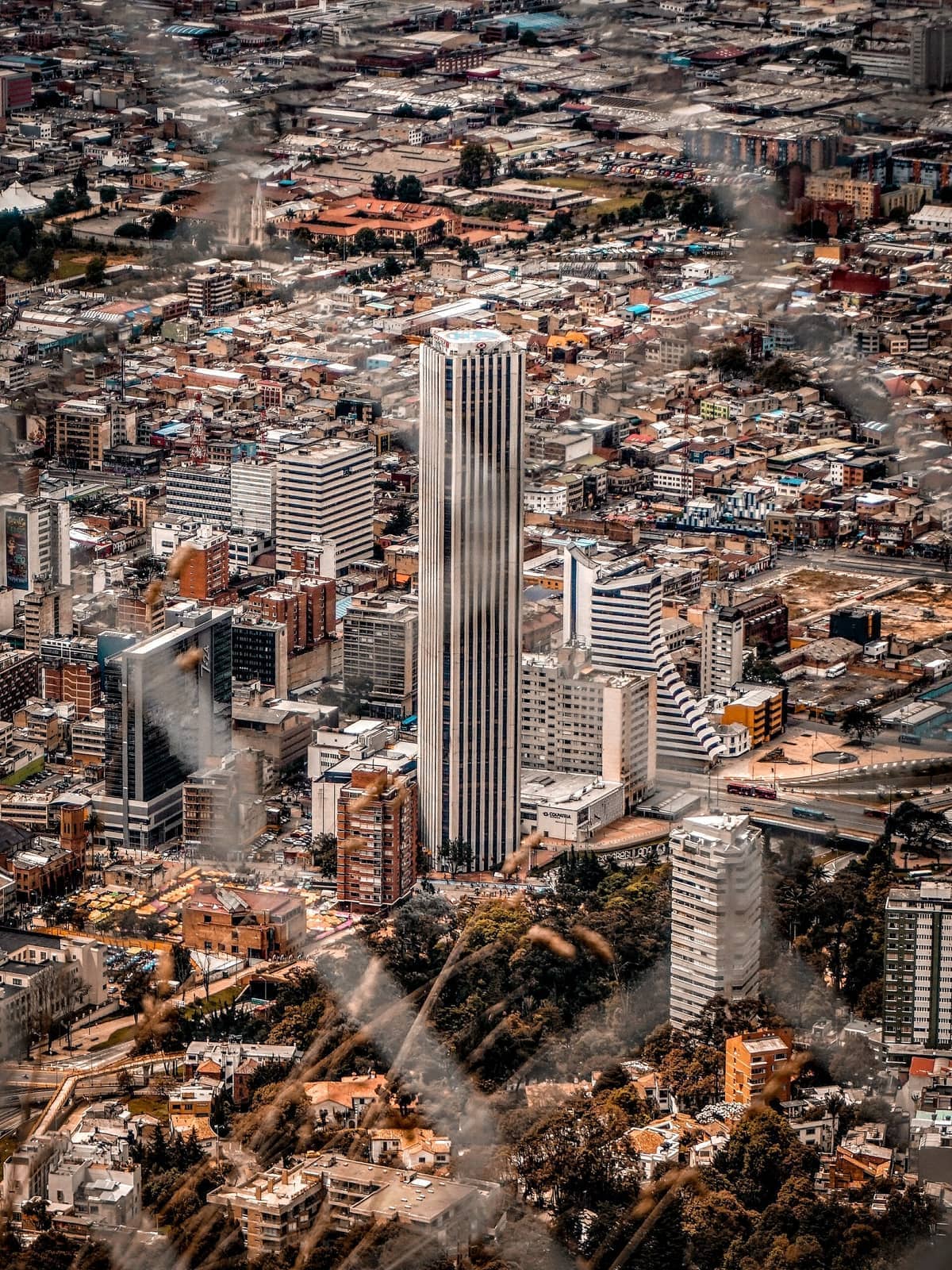
Torre Colpatria is a 50-floor, 196-meter skyscraper at Carrera 7 #24-79 in central Bogotá. Construction began in 1973 and the building was completed in 1979, making it one of Colombia's tallest structures for several decades. Today it functions primarily as a commercial office tower, but on weekends and public holidays it opens its 49th-floor observation deck to the public. That mirador is the reason most visitors come.
The tower is operated under the Scotiabank Colpatria brand and sits at the edge of the Centro Internacional district, close to where central Bogotá transitions into its more modern northern zones. From street level, the building reads as a clean rectangular slab of glass and steel. After dark, its façade becomes something else entirely: a programmable LED grid of more than 40,000 light sources, installed around 2012, that paints the tower in shifting colors visible from much of the city.
ℹ️ Good to know
Opening hours for the mirador: Friday 18:00–20:30, Saturday 12:00–20:30, Sunday and public holidays 11:00–20:30. The tower does not open its observation deck Monday through Thursday. Confirm hours at scotiabankcolpatria.com before your visit, as schedules can change.
The View: What You See from the 49th Floor
At 2,640 meters above sea level, Bogotá already sits high on the Andean plateau, so when you add another 196 meters of building you get a view that genuinely stretches. On a clear day from the observation deck, you can see the full eastern cordillera wall rising to the right, with the white chapel of Cerro de Monserrate clearly visible against the green hillside. To the west and south, the city flattens into a dense gray-brown grid that fades into haze before it ends. Bogotá is enormous, and the mirador makes that scale legible in a way that street-level exploration cannot.
The deck itself is enclosed with glass panels, which protects visitors from Bogotá's frequently cold upper-altitude winds but can introduce glare in photographs. The view southward toward La Candelaria shows the densely packed colonial roofscape giving way to taller concrete structures. Looking north, the city's wealthier districts stretch toward Chapinero and beyond in an unbroken carpet of development. On particularly clear mornings after rain, the snowcapped Nevado del Tolima can sometimes be spotted far to the southwest, though this is not guaranteed.
The observation area is not very large. On busy Saturday afternoons, especially during school holidays and long weekends, the deck can feel crowded, with groups pressing toward the glass and limited space to move around. If personal space matters to you, arriving right when the tower opens on a Sunday morning tends to give you a quieter experience before the midday flow of visitors arrives.
Tickets & tours
Hand-picked options from our booking partner. Prices are indicative; availability and final rates are confirmed when you complete your booking.
Candelaria walking tour
From 35 €Instant confirmationFree cancellationCoffee farm guided tour
From 114 €Instant confirmationFree cancellationZipaquira Salt Cathedral guided tour
From 86 €Instant confirmationFree cancellationBogota full-day bike rental
From 19 €Instant confirmationFree cancellation
Best Time to Visit: Morning, Afternoon, or Night?
Bogotá's weather is the dominant variable here. The city experiences two rainy seasons, roughly April to May and September to November, and afternoon clouds frequently build even during drier months. On many days, the early afternoon offers the clearest skies before cloud cover rolls in from the mountains. If you visit on a Saturday, arriving around 12:00 or 13:00 gives you a reasonable chance of clear visibility before afternoon clouds obscure the cordillera.
The Friday evening opening, from 18:00 to 20:30, is a genuinely different experience. As the light fades, the city's grid of lights activates below, and the tower's own LED façade begins its color cycles around you. Photographing Bogotá's nighttime spread from this height requires a phone or camera that handles low light reasonably well; the deck's glass panels mean you will need to press the lens close to the glass or use a lens hood to reduce internal reflections. Tripods are impractical in the confined space.
💡 Local tip
Bring a layer. The deck is enclosed but the altitude and the building's air systems make it noticeably cooler than street level. Bogotá afternoons can drop quickly, and Friday evenings near the deck closure time feel genuinely cold.
Getting There and Practical Logistics
The nearest TransMilenio station is Museo Nacional, on the Caracas corridor. From there, walk south along Carrera 7 for a few blocks; the tower is hard to miss given its height. The walk passes through a stretch of the Centro Internacional that is active during daytime hours but quieter on Sunday mornings, so stay aware of your surroundings as you would in any dense urban center.
Ride-hailing apps including Uber, Cabify, and Didi operate in Bogotá and can drop you directly at the tower's base on Carrera 7. This is a reasonable option on Friday evenings when you will be leaving after dark. For broader orientation on moving around the city, the getting around Bogotá guide covers TransMilenio routes and app-based transport in detail.
Admission in recent reports was approximately COP $18,000 for Colombian nationals, with reduced rates for children aged 3 to 11 and adults over 60. Prices for foreign visitors and the exact current rates should be confirmed directly with the tower before you visit, as they have changed over the years. Payment logistics on-site follow typical Bogotá ticketing norms; bring cash as a backup.
The observation deck is reached by elevator, making the physical ascent straightforward. However, detailed accessibility information for wheelchair users and visitors with mobility needs is not comprehensively published. If this is a concern, contact the tower directly at +57 (1) 609 0052 before making the trip.
Torre Colpatria in Context: Why It Matters to Bogotá
When Torre Colpatria was completed in 1979, it became a defining piece of Bogotá's evolving skyline at a time when the city was growing rapidly and asserting itself as a modern Latin American capital. For decades it held the title of Colombia's tallest building. While other towers have since surpassed it in height, the Colpatria remains culturally prominent in a way that newer glass towers do not quite match. Locally, it functions almost as a clock tower does in European cities: a fixed reference point that Bogotanos use to orient themselves in the urban landscape. The LED nighttime shows, which cycle through colors on holidays and special occasions, have made it the city's most visible public light installation. For a broader view of how the city has developed architecturally, pairing this visit with a walk through and the colonial core gives useful historical contrast. While other towers have since surpassed it in height, the Colpatria remains culturally prominent in a way that newer glass towers do not quite match. Locally, it functions almost as a clock tower does in European cities: a fixed reference point that Bogotanos use to orient themselves in the urban landscape. The LED nighttime shows, which cycle through colors on holidays and special occasions, have made it the city's most visible public light installation. For a broader view of how the city has developed architecturally, pairing this visit with a walk through Plaza de Bolívar and the colonial core gives useful historical contrast.
The tower's location near Centro Internacional also places it at a node where Bogotá's different urban layers meet. To the south is the colonial and republican-era architecture of La Candelaria and the government district. To the north, the glass-and-concrete commercial city begins in earnest. From the 49th floor, you can see exactly where these zones meet, which tells you something about how the city has grown outward and upward since the 19th century.
Practical Take: Is It Worth Your Time?
Torre Colpatria is not a world-class observation deck experience. The enclosed space is modest, the facilities are functional rather than polished, and Bogotá's frequent cloud cover means the view is not guaranteed. Compared to purpose-built observation decks in cities like New York or Singapore, the infrastructure is basic.
That said, it fills a specific gap: Bogotá has surprisingly few accessible high vantage points within the urban core. Cerro de Monserrate offers a more dramatic mountaintop experience but requires a cable car or a serious uphill walk. Torre Colpatria gives you a central, urban perspective on the city's grid that Monserrate, looking down from the mountain, cannot replicate. For someone spending a few days in Bogotá who wants to understand the city's scale and layout, the mirador makes sense as a 90-minute addition to a Saturday or Sunday itinerary.
Visitors who dislike enclosed spaces, expect a premium architectural experience, or are visiting during heavy cloud cover may come away underwhelmed. It is also not a good option if you are only in Bogotá on weekdays, as the deck does not open Monday through Thursday.
⚠️ What to skip
The observation deck is closed Monday through Thursday. Do not make a special trip without checking the current schedule at scotiabankcolpatria.com. Hours can also change during national holidays or building events.
Insider Tips
- Friday evening visits (18:00–20:30) draw fewer people than Saturday afternoons and let you experience both the daylight view and the transition into Bogotá's lit-up nightscape in a single visit.
- Press your camera lens directly against the glass panels to eliminate reflections. Using a dark jacket or hat as a hood around the lens also helps significantly on bright afternoons.
- Check the LED lighting calendar on the Scotiabank Colpatria website or social media before visiting. On Colombian national holidays the façade runs special color sequences that are worth seeing from the street even if you do not go up.
- The streets immediately around the tower on Carrera 7 have several affordable lunch spots oriented toward office workers. Eating nearby before a Saturday midday opening saves time and money compared to the tourist-facing restaurants further south in La Candelaria.
- If the sky is heavily overcast when you arrive, ask at the entrance whether visibility is reasonable before purchasing your ticket. Staff are generally honest about conditions.
Who Is Torre Colpatria For?
- First-time visitors to Bogotá who want to understand the city's scale before exploring neighborhoods on foot
- Photography enthusiasts interested in urban aerial perspectives, particularly at dusk on Fridays
- Travelers combining a Centro Internacional itinerary with the nearby Museo Nacional or Parque de la Independencia
- Families with older children who can appreciate height and cityscape
- Anyone curious about the LED light shows visible from street level at night
Nearby Attractions
Other things to see while in La Candelaria:
- Centro Cultural Gabriel García Márquez
Designed by celebrated Colombian-French architect Rogelio Salmona and inaugurated in 2008, the Centro Cultural Gabriel García Márquez is La Candelaria's most architecturally refined public building. Entry to the bookstore and courtyard is free, making it one of the few genuinely unhurried cultural stops in the historic center.
- Iglesia de San Francisco
Standing at the corner of Avenida Jiménez and Carrera 7, the Iglesia de San Francisco is one of the most significant colonial-era churches in Bogotá and the city’s oldest surviving church. It anchors La Candelaria with a gilded baroque interior that quietly outlasts every passing tourist group. Entry is free.
- Museo Botero
Housed in a restored colonial mansion in La Candelaria, Museo Botero is one of South America's most significant art museums — and it charges nothing to enter. The collection spans Fernando Botero's voluminous figures alongside international masters including Picasso, Dalí, and Renoir, all donated by the artist himself to the Colombian people.
- Museo del Oro
The Museo del Oro in La Candelaria holds one of the world's largest collections of pre-Hispanic gold artifacts, spanning thousands of pieces from Colombia's indigenous cultures. Operated by Banco de la República, it is the single most significant cultural institution in Bogotá and one of the great archaeological museums of Latin America.