Plaza de Bolívar: Bogotá's Historic Heart Explained
Plaza de Bolívar is the civic and symbolic center of Bogotá, a nearly 13,903 m² open square in La Candelaria ringed by the city's most consequential buildings. Free to enter at any hour, it rewards visitors who understand what they're looking at and when to arrive.
Quick Facts
- Location
- Carrera 7 #11-10, La Candelaria, Bogotá, D.C.
- Getting There
- TransMilenio to Museo del Oro station, then 5 blocks south along Carrera 7
- Time Needed
- 30–90 minutes for the square itself; half a day if visiting surrounding buildings
- Cost
- Free (open public square, no admission fee)
- Best for
- History enthusiasts, architecture, photography, and understanding Bogotá's political identity
- Official website
- visitbogota.co/es/que-hacer-en-bogota/cultura/plaza-de-bolivar
What Plaza de Bolívar Actually Is
Plaza de Bolívar is not a park, a market, or a tourist set piece. It is Bogotá's founding square, the physical and symbolic center from which the city was organized after its establishment in 1539. At close to 13,903 m², it is one of the city's largest historic squares, and it remains in active civic use: political demonstrations, national celebrations, and ordinary weekday foot traffic all share this same stone-paved expanse.
The square has carried three names across its history. Founded as the Plaza Mayor in 1539, it was renamed Plaza de Bolívar in 1846 after a period as Plaza de la Constitución, the year the bronze statue of Simón Bolívar was unveiled at its center. That statue, sculpted by Italian artist Pietro Tenerani, was the first public monument erected in Bogotá, and it remains the square's most photographed focal point.
The plaza sits at the edge of La Candelaria, Bogotá's oldest neighborhood, and the buildings that frame it represent several centuries of political architecture compressed into one block. Understanding those buildings is what transforms a visit from a quick photo stop into something genuinely absorbing.
The Buildings That Frame the Square
The four sides of Plaza de Bolívar each carry a different layer of Colombian history, and the contrast is part of what makes the square architecturally unusual.
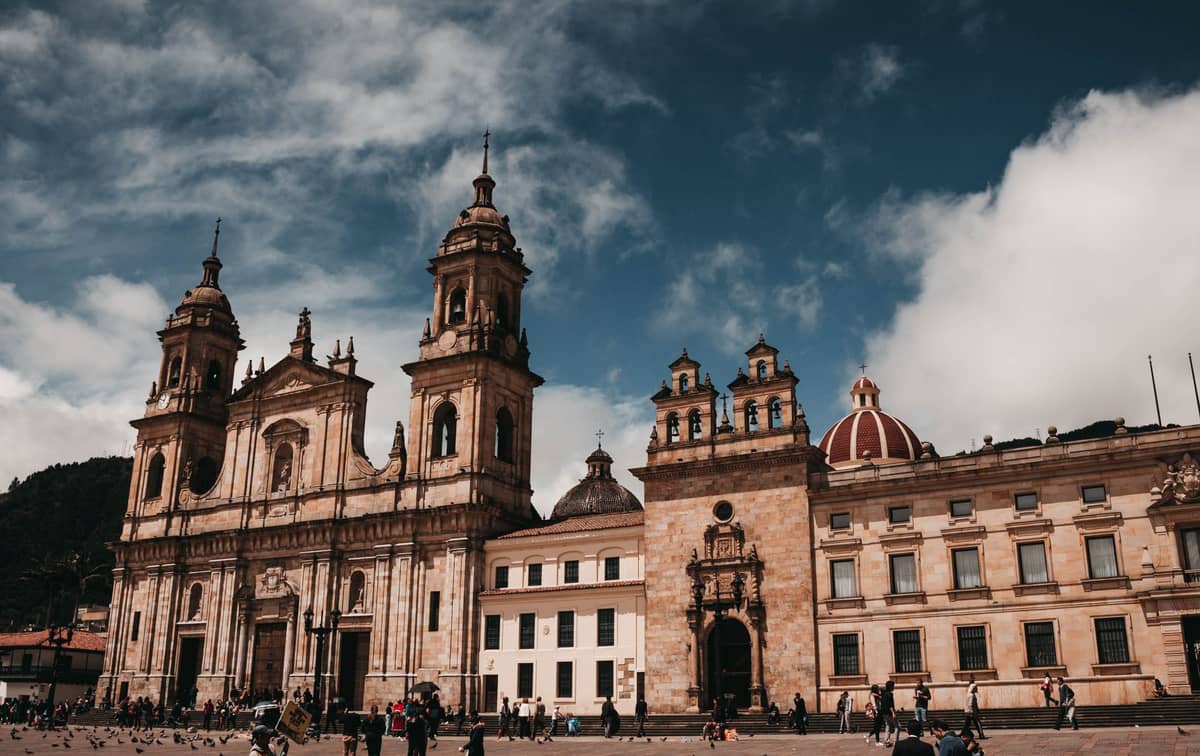
To the east stands the Catedral Primada de Colombia, the country's largest cathedral. The current neoclassical structure was completed in 1823, though a succession of churches had occupied the same site since the colonial era. Its pale stone facade and twin towers anchor the square's eastern edge and catch golden light in the late afternoon. Adjacent to the cathedral is the Capilla del Sagrario, a smaller baroque chapel from the 17th century, its dark, weathered stonework a sharp contrast to its neighbor.
The northern edge is occupied by the Palacio de Justicia, a modernist structure rebuilt after the devastating 1985 siege, during which M-19 guerrillas occupied the building and the Colombian military's response left over 100 people dead. The silence of the current building carries that history without advertising it. To the west, the Palacio de Liévano, the seat of Bogotá's city government, presents a French-influenced republican facade from the late 19th century. The south side holds the Congress of Colombia, where the national legislature meets, giving the square a genuine claim to being the country's political nerve center.
ℹ️ Good to know
None of the surrounding government buildings are generally open for casual tourist entry. The cathedral and Capilla del Sagrario are the most accessible to visitors. Check locally for current visiting hours before planning interior visits.
Tickets & tours
Hand-picked options from our booking partner. Prices are indicative; availability and final rates are confirmed when you complete your booking.
Candelaria walking tour
From 35 €Instant confirmationFree cancellationCoffee farm guided tour
From 114 €Instant confirmationFree cancellationZipaquira Salt Cathedral guided tour
From 86 €Instant confirmationFree cancellationBogota full-day bike rental
From 19 €Instant confirmationFree cancellation
How the Square Changes Through the Day
Early morning, roughly 7 to 9 a.m., is when Plaza de Bolívar belongs almost entirely to locals. Office workers cut across the stones, vendors arrange their carts on the surrounding streets, and the square has a functional, unperformed quality. The pigeons, which gather here in considerable numbers, are most active at this hour, creating an odd, low-level flutter around Bolívar's statue. The air at Bogotá's elevation of 2,640 m is noticeably crisp in the morning.
By midday the square fills with a mix of tourists, students from nearby universities, and people eating lunch on the stone benches near the statue. Street photographers set up near the edges. The light is flat and overhead, making it the worst time for photographing the buildings. From around 3 p.m. onward, as the sun angles west, the cathedral facade begins to glow and the shadows on the Capilla del Sagrario deepen, giving the eastern side considerably more depth and texture.
Evening visits, after 6 p.m., feel different again. The administrative buildings empty, the political energy dissipates, and the square takes on a quieter character under artificial lighting. Some travelers find the evening light especially striking at this hour; others find the periphery less comfortable than the daytime. Visitors should use their own judgment and consult current local safety guidance before visiting after dark.
💡 Local tip
For photography of the buildings, arrive between 3 and 5 p.m. on a weekday. The afternoon light hits the cathedral facade directly, and crowd density is lower than at midday on weekends.
Getting There and Getting Around the Area
The most practical route by public transit is the TransMilenio bus rapid transit network. Take TransMilenio to the Museo del Oro station and walk approximately five blocks south along Carrera 7. The walk itself passes through the historic center and is worth doing slowly, with colonial-era buildings lining both sides of the street.
If you are coming from the northern parts of the city, ride-hailing apps (Uber, Cabify, and Didi all operate in Bogotá) offer a direct route to the plaza and are generally reliable. This is also worth considering if you plan to visit the Museo del Oro or the Museo Botero in the same half-day, both of which are within a short walk of the square.
The plaza is a large, flat, paved space with no steps at its center, making it accessible for most visitors. The surrounding streets in La Candelaria are a different matter: many are cobbled and some are noticeably sloped as you move toward the hills. Comfortable, closed-toe walking shoes are strongly recommended over sandals or dress footwear.
Bogotá sits at 2,640 m above sea level. If you have arrived recently, you may notice shortness of breath during the walk from the TransMilenio station. Take the walk slowly and read our guide to Bogotá's altitude before your visit if this is a concern.
What the Square Tells You About Colombia
More than any museum, Plaza de Bolívar functions as a compressed lesson in Colombian political history. The fact that the Palacio de Justicia, rebuilt after a siege that remains deeply contested in national memory, stands at one corner of the same square where independence was later celebrated and where presidents now address crowds, gives the space a layered quality that is hard to communicate in a photo.
Simón Bolívar's presence at the center is not merely decorative. Bolívar remains a genuinely complex figure in Latin American history: celebrated as the Liberator across multiple countries, but also a leader whose political legacy is still debated. The 1846 decision to rename the square and install his statue came 15 years after his death, during a period of intense nation-building. Seeing his statue in this specific context, surrounded by the architecture of state power, adds a dimension that a visit to the Quinta de Bolívar (his former Bogotá residence, a short distance away) can complement well.
On weekends and national holidays, the square often hosts free public events: concerts, cultural festivals, and civic ceremonies. These can add energy and color to a visit but also bring significant crowds and, occasionally, road closures in the surrounding blocks. Check the Bogotá city government website before visiting on a holiday weekend if you prefer a quieter experience.
Practical Take: What Plaza de Bolívar Is and Is Not
The square itself, without the surrounding buildings, is a flat, open, predominantly grey stone plaza. Visitors expecting manicured gardens, outdoor cafes, or the kind of animated square life found in some European cities will be slightly surprised. Plaza de Bolívar is formal, civic, and unapologetically utilitarian in its layout.
That said, it earns its place on any itinerary focused on understanding Bogotá rather than just photographing it. The combination of the square's historical depth, the architectural variety of its surrounding buildings, and its continued role in Colombia's political life makes it a genuinely significant stop. Travelers who move through quickly without looking at the buildings, or who visit solely for a photo with the Bolívar statue, often come away underwhelmed. Those who allocate time to walk the perimeter and visit at least the cathedral interior tend to find it worthwhile.
If you are building a half-day itinerary in the historic center, Plaza de Bolívar pairs naturally with the Museo del Oro to the north and the Centro Cultural Gabriel García Márquez one block away. For broader context on what to do in the area, the Bogotá attractions overview has a structured route through La Candelaria.
⚠️ What to skip
During large political demonstrations, access to some sides of the plaza may be restricted and the surrounding streets can become crowded and unpredictable. If you notice heightened police or military presence, give the edges of the square more space than usual and follow any instructions from local authorities.
Insider Tips
- The pigeons gathered around Bolívar's statue are a permanent fixture, but the square's real wildlife spectacle is the large flocks of small parakeets that occasionally sweep over the open stone in the early morning. Most visitors miss them entirely. Most visitors miss them entirely.
- The Capilla del Sagrario, the small baroque chapel adjacent to the cathedral on the east side, is significantly less crowded than the cathedral and contains some of the finest colonial-era religious art in the city. It is often overlooked because it sits in the cathedral's shadow.
- Street vendors near the square sell empanadas and roscón from carts, particularly in the morning. These are local staples, inexpensive, and better than most of the sit-down options immediately around the plaza. The cluster of vendors typically sets up on Carrera 8.
- If you want the square almost to yourself, arrive on a weekday morning before 8 a.m. The light is softer, the crowds are minimal, and the surrounding buildings are most atmospheric in the cool morning air.
- Bogotá's city government occasionally opens limited guided tours of the Palacio de Liévano (the city hall on the west side). These are not widely advertised in English but are worth asking about at the tourist information points in La Candelaria.
Who Is Plaza de Bolívar For?
- Travelers interested in Latin American political history and independence-era architecture
- First-time visitors to Bogotá who want a geographic and historical anchor for the rest of the city
- Photography enthusiasts, particularly in the late afternoon when the cathedral facade is well lit
- Anyone building a walking itinerary through La Candelaria that connects multiple historic sites in one route
- Travelers visiting during a national holiday or public festival, when the square becomes a genuine civic gathering place
Nearby Attractions
Other things to see while in La Candelaria:
- Centro Cultural Gabriel García Márquez
Designed by celebrated Colombian-French architect Rogelio Salmona and inaugurated in 2008, the Centro Cultural Gabriel García Márquez is La Candelaria's most architecturally refined public building. Entry to the bookstore and courtyard is free, making it one of the few genuinely unhurried cultural stops in the historic center.
- Iglesia de San Francisco
Standing at the corner of Avenida Jiménez and Carrera 7, the Iglesia de San Francisco is one of the most significant colonial-era churches in Bogotá and the city’s oldest surviving church. It anchors La Candelaria with a gilded baroque interior that quietly outlasts every passing tourist group. Entry is free.
- Museo Botero
Housed in a restored colonial mansion in La Candelaria, Museo Botero is one of South America's most significant art museums — and it charges nothing to enter. The collection spans Fernando Botero's voluminous figures alongside international masters including Picasso, Dalí, and Renoir, all donated by the artist himself to the Colombian people.
- Museo del Oro
The Museo del Oro in La Candelaria holds one of the world's largest collections of pre-Hispanic gold artifacts, spanning thousands of pieces from Colombia's indigenous cultures. Operated by Banco de la República, it is the single most significant cultural institution in Bogotá and one of the great archaeological museums of Latin America.