Museo Botero: Bogotá's Free Art Museum Worth Every Minute
Housed in a restored colonial mansion in La Candelaria, Museo Botero is one of South America's most significant art museums — and it charges nothing to enter. The collection spans Fernando Botero's voluminous figures alongside international masters including Picasso, Dalí, and Renoir, all donated by the artist himself to the Colombian people.
Quick Facts
- Location
- Calle 11 #4-41, La Candelaria, Bogotá, D.C., Colombia
- Getting There
- TransMilenio to Las Aguas or Museo del Oro on the Eje Ambiental corridor; 10–15 min walk into La Candelaria historic core
- Time Needed
- 1.5 to 2.5 hours for a thorough visit
- Cost
- Free admission
- Best for
- Art lovers, first-time visitors to Bogotá, families, travellers on a budget
- Official website
- www.banrepcultural.org/bogota/museo-botero
What the Museo Botero Actually Is
Opened on November 1, 2000, the Museo Botero sits inside a carefully restored colonial-era house on Calle 11, a short walk from Plaza de Bolívar in the heart of La Candelaria. The building itself, with its thick whitewashed walls, interior courtyard, and tiled floors, sets a tone before you see a single canvas. It belongs to the Banco de la República cultural network — the same institution that runs the Biblioteca Luis Ángel Arango next door — which explains why admission has always been free. It is a deliberate public-good policy.
Fernando Botero, Colombia's most internationally recognised artist, donated the entire founding collection to his home country in 2000. The gift included 123 of his own works and 85 pieces by foreign artists he had collected over decades — among them originals by Pablo Picasso, Salvador Dalí, Pierre-Auguste Renoir, Joan Miró, Francis Bacon, and Edgar Degas. For a free museum in a historic district, the quality-to-cost ratio is genuinely difficult to match anywhere in Latin America.
ℹ️ Good to know
The museum is closed on Tuesdays. Hours are Monday and Wednesday through Saturday 9:00 a.m. to 7:00 p.m., and Sunday 10:00 a.m. to 5:00 p.m. Confirm hours on the official Banco de la República site before visiting, as schedules can change on public holidays.
The Collection: What You Will Actually See
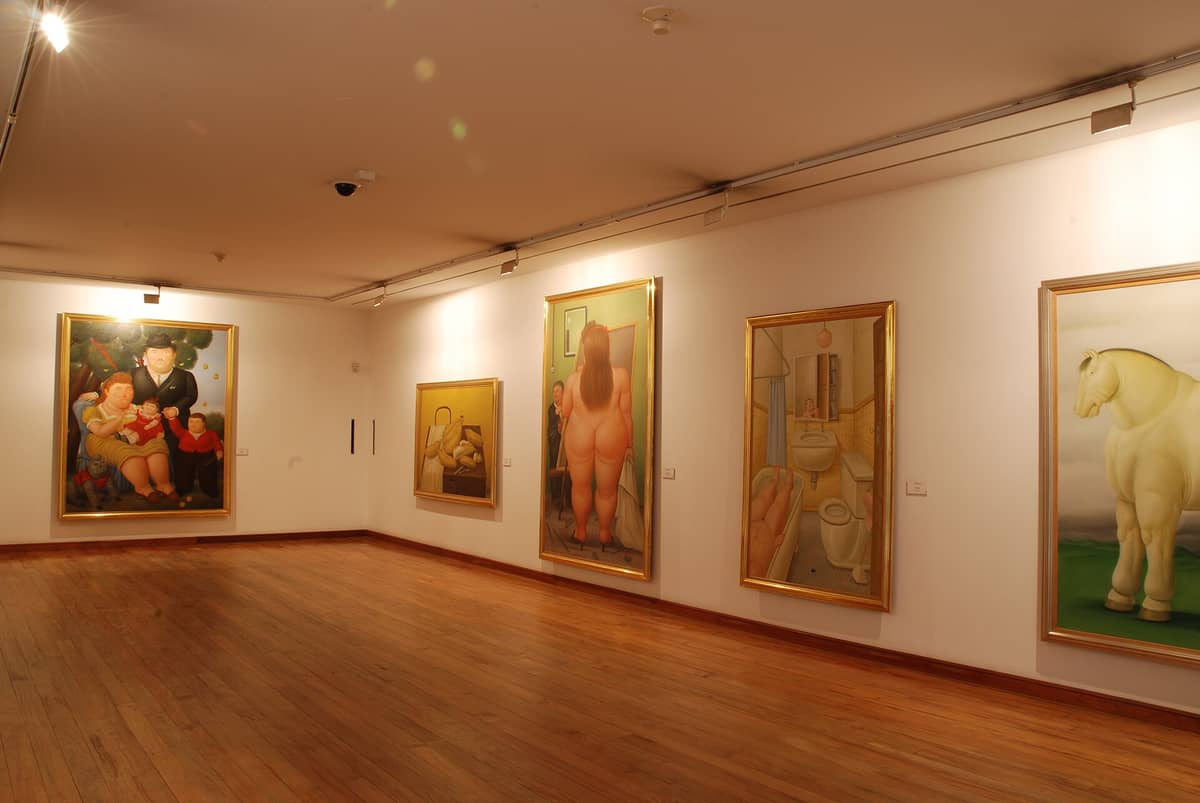
Botero's signature is immediately recognisable: figures inflated into spherical, monumental forms that somehow manage to feel warm rather than grotesque. His paintings and sculptures explore bullfighters, fruit bowls, dancers, politicians, and ordinary domestic scenes, all rendered with a deliberately exaggerated weight that invites you to slow down and reconsider proportion and beauty. Critics have debated for decades whether the style is ironic or sincere. In person, the works read as both simultaneously.
The international collection displayed alongside his own work is the part that surprises most visitors. Seeing a Picasso watercolour or a small Dalí gouache hanging thirty feet from a Botero bronze in the same free municipal institution is the kind of thing that rewards unplanned visits. The rooms are not enormous, so the pacing feels manageable — you are never overwhelmed by scale the way you might be in a major European institution.
The ground-floor courtyard displays several of Botero's large bronze sculptures in natural light, which is the best setting for them. The indoor galleries on the upper floors hold the paintings and works on paper. Signage is in Spanish and English throughout, which is relatively uncommon for Bogotá's older museums.
Tickets & tours
Hand-picked options from our booking partner. Prices are indicative; availability and final rates are confirmed when you complete your booking.
Candelaria walking tour
From 35 €Instant confirmationFree cancellationCoffee farm guided tour
From 114 €Instant confirmationFree cancellationZipaquira Salt Cathedral guided tour
From 86 €Instant confirmationFree cancellationBogota full-day bike rental
From 19 €Instant confirmationFree cancellation
How the Experience Changes by Time of Day
Arriving between 9:00 a.m. and 10:00 a.m. on a weekday gives you the galleries nearly to yourself. The colonial courtyard catches the morning light at a low angle through the open roof, which is particularly flattering for the bronze sculptures. Staff are attentive and unhurried at this hour.
By midday, especially on weekends, tour groups arrive from the Plaza de Bolívar area, and the main rooms can become noticeably crowded. If you are visiting with a specific interest in the international collection, the midday rush tends to concentrate around Botero's own works, leaving the Picasso and Renoir rooms comparatively quieter. Late afternoon on a Sunday, in the final hour before the 5:00 p.m. closing, sees a second crowd surge as families wrap up their day in La Candelaria.
💡 Local tip
Wednesday or Thursday morning is the sweet spot: low foot traffic, full operating hours, and the natural light in the courtyard is at its best before the overcast afternoon clouds typical of Bogotá roll in.
Getting There and Navigating La Candelaria
The museum address is Calle 11 #4-41. TransMilenio serves the area via the Las Aguas and Museo del Oro stations on the Eje Ambiental corridor. From either stop, you are looking at a 10 to 15 minute walk into the historic core. The streets around La Candelaria are hilly and cobblestoned in stretches, so flat shoes matter more than you might expect. If you are using a ride-hailing app such as Uber, Cabify, or Didi, the driver can get close to the door, though traffic on Carrera 4 can be slow during peak hours. For broader context on moving around the city, the guide to getting around Bogotá covers TransMilenio routes and app-based transport in detail.
The neighbourhood itself rewards a longer visit. The museum is a natural anchor point for a half-day in La Candelaria: start at the Museo Botero when it opens, then walk north to the Plaza de Bolívar, and finish with lunch in one of the small restaurants along Carrera 3 or 4. The streets are most comfortable on foot during daylight hours.
Practical Details for a Smooth Visit
Photography is permitted throughout the museum, including in the courtyard with the bronze sculptures. Flash is restricted in the painting galleries. The interior rooms are well-lit without natural light, which means phone cameras perform adequately for documentation, though dedicated camera gear will produce noticeably better results in the sculpture courtyard.
The museum is wheelchair accessible, with ramps and adapted restrooms. Bags larger than a day pack may need to be left at the supervised cloakroom near the entrance, which is free to use. There is no dedicated café inside the museum, though the Banco de la República cultural complex next door has a small seating area.
Bogotá sits at 2,640 metres above sea level, and first-time visitors may feel the altitude as mild breathlessness, particularly when climbing stairs. The museum's layout is manageable, but arriving hydrated and pacing yourself is sensible. Layers are useful year-round: morning temperatures in La Candelaria can be cool, and the museum's thick colonial walls keep the interior slightly chilly regardless of outside conditions.
⚠️ What to skip
The area around La Candelaria requires normal urban awareness. Keep phones and cameras out of sight when not actively using them, particularly on the streets immediately outside the museum entrance. The museum itself is secure and staffed throughout opening hours.
Practical Take: Is It Worth Your Time?
For most visitors to Bogotá, yes, without question. The combination of zero admission cost, a high-quality international collection, and a genuinely beautiful colonial building makes it one of the most defensible uses of two hours in the city. It pairs naturally with the Museo del Oro, which is a 15-minute walk away, and the two together constitute a full morning of world-class cultural tourism at very low cost.
That said, if Botero's aesthetic is not your preference, the international collection alone may not justify the trip for gallery-goers used to major European or North American institutions. The rooms are not large, the collection is curated around a single artist's taste, and the context is primarily Latin American art history. Travellers with only one day in Bogotá and a primary interest in pre-Columbian or indigenous history may find the Museo del Oro a more focused choice. The Botero Museum is free every open day; Museo del Oro is ticketed except on Sundays, so combining them is still easy.
The museum fits comfortably into a broader exploration of Bogotá's museum scene, which ranges from colonial religious art to natural history to contemporary political memory. La Candelaria alone contains enough cultural institutions to fill a full day without repeating yourself.
Context: Fernando Botero and His Gift to Colombia
Fernando Botero was born in Medellín in 1932 and went on to become Colombia's most commercially successful and internationally exhibited artist of the 20th century. His decision to donate the collection to the Banco de la República rather than to a private institution or a foreign museum was both personally significant and politically charged: he wanted the work to be accessible to Colombians regardless of income, in the city at the centre of the country's national life.
That context is worth holding in mind as you walk through the rooms. The free admission policy is not an accident of funding — it is the direct expression of the donor's stated intention. You are seeing work that was specifically placed here, in this building, in La Candelaria, for this purpose. That gives the visit a different quality from a typical museum experience, and it is part of why the place consistently earns high marks from visitors across a wide range of backgrounds and interests.
Insider Tips
- The bronze sculpture courtyard is the single best photography spot in the museum. Visit it twice: once when you arrive for the morning light, and once before you leave to see how the softer afternoon light changes the texture of the patina on the larger pieces.
- The museum shares a block with the Casa de Moneda (the old mint), which is also part of the Banco de la República cultural complex and also free. A combined visit to both takes under three hours and gives you a much fuller picture of the block's historical significance.
- Guided visits in Spanish and English are available at no extra cost. If you have any interest in Botero's biography and technique, joining a guided visit substantially deepens the experience and is worth considering even if you generally skip them.
- The museum bookshop near the exit sells reasonably priced art books and prints. Botero monographs and catalogues available here are hard to find outside Colombia and make distinctive souvenirs that are easy to pack.
- If you visit on a weekday and arrive right at 9:00 a.m., you will often find the courtyard completely empty for the first 20 to 30 minutes. That quiet period, with the morning air still cool and no crowds, is the most atmospheric time in the entire museum.
Who Is Museo Botero For?
- First-time visitors to Bogotá who want a high-quality cultural experience with zero cost
- Art enthusiasts interested in Latin American modernism and its relationship to European influences
- Families with children curious about sculpture — the oversized bronze figures consistently capture children's attention in a way that flat paintings often don't
- Travellers pairing a cultural morning in La Candelaria with an afternoon at the Museo del Oro
- Budget-conscious travellers who want to understand why Bogotá is taken seriously as a cultural capital
Nearby Attractions
Other things to see while in La Candelaria:
- Centro Cultural Gabriel García Márquez
Designed by celebrated Colombian-French architect Rogelio Salmona and inaugurated in 2008, the Centro Cultural Gabriel García Márquez is La Candelaria's most architecturally refined public building. Entry to the bookstore and courtyard is free, making it one of the few genuinely unhurried cultural stops in the historic center.
- Iglesia de San Francisco
Standing at the corner of Avenida Jiménez and Carrera 7, the Iglesia de San Francisco is one of the most significant colonial-era churches in Bogotá and the city’s oldest surviving church. It anchors La Candelaria with a gilded baroque interior that quietly outlasts every passing tourist group. Entry is free.
- Museo del Oro
The Museo del Oro in La Candelaria holds one of the world's largest collections of pre-Hispanic gold artifacts, spanning thousands of pieces from Colombia's indigenous cultures. Operated by Banco de la República, it is the single most significant cultural institution in Bogotá and one of the great archaeological museums of Latin America.
- Plaza de Bolívar
Plaza de Bolívar is the civic and symbolic center of Bogotá, a nearly 13,903 m² open square in La Candelaria ringed by the city's most consequential buildings. Free to enter at any hour, it rewards visitors who understand what they're looking at and when to arrive.