Iglesia de San Francisco: Bogotá's Oldest Church
Standing at the corner of Avenida Jiménez and Carrera 7, the Iglesia de San Francisco is one of the most significant colonial-era churches in Bogotá and the city’s oldest surviving church. It anchors La Candelaria with a gilded baroque interior that quietly outlasts every passing tourist group. Entry is free.
Quick Facts
- Location
- Av. Jiménez #7-10, Bogotá, D.C.
- Getting There
- TransMilenio – Museo del Oro station (short walk)
- Time Needed
- 20–45 minutes for the church; pair with nearby attractions for a half-day
- Cost
- Free entry (active place of worship)
- Best for
- Colonial architecture, religious history, quiet reflection, photography of the exterior
- Official website
- www.facebook.com/SFranciscodeAsisparroquia/
What You're Actually Looking At
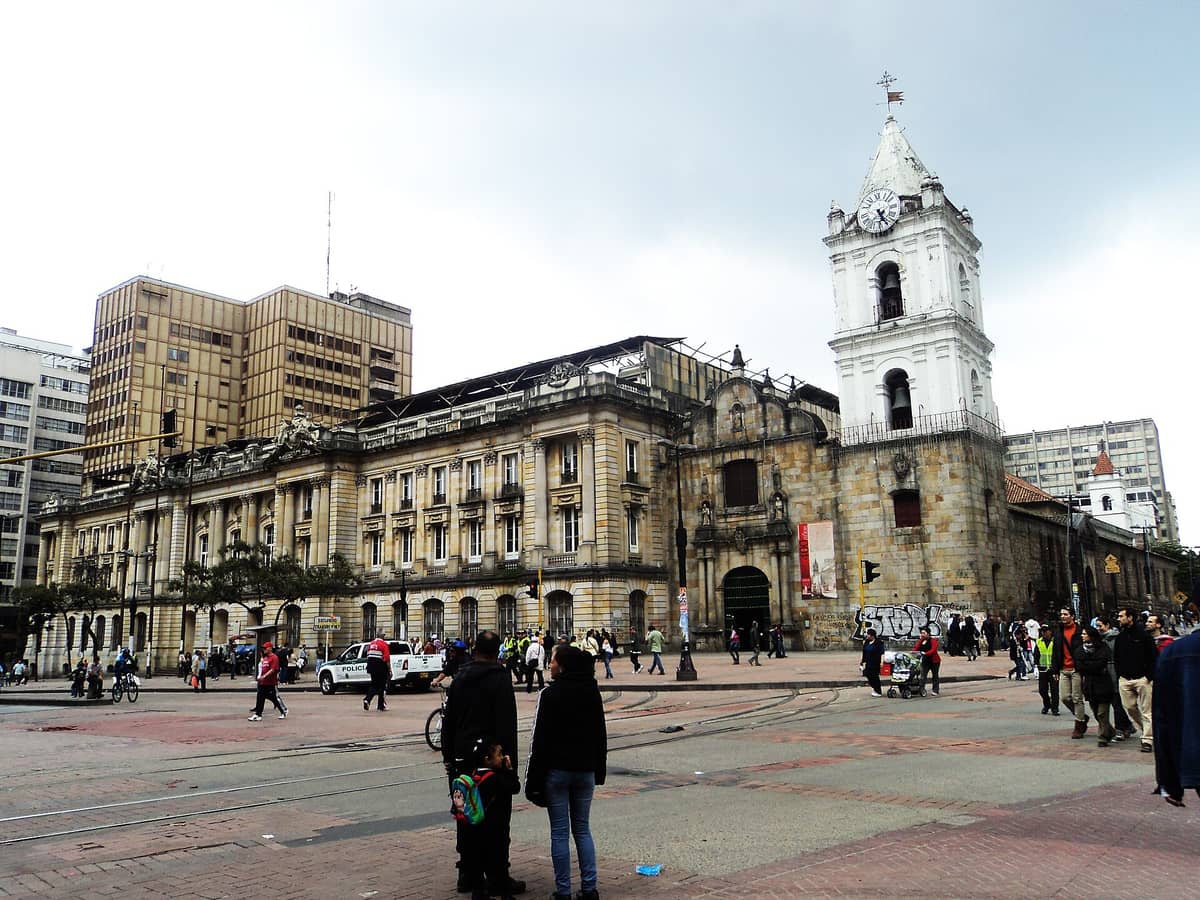
The Iglesia de San Francisco sits at one of the most traffic-saturated intersections in central Bogotá, where Avenida Jiménez meets Carrera 7. From the outside, the contrast is striking: a whitewashed colonial facade, modest by global standards, pressed between lane after lane of TransMilenio buses and the relentless sound of urban commuting. You have to look up, slow down, and step off the sidewalk to really take it in.
Once you cross the threshold, the city noise drops noticeably. The interior is cool, slightly dim at first, and carries a faint smell of incense and old stone. The focal point is an elaborate baroque main altarpiece — a gilded retable that stretches toward the ceiling and commands the entire nave. It is dense with carved figures, ornamental detail, and the unmistakable visual grammar of Spanish colonial religious art. It is the kind of altarpiece that takes a few minutes to fully scan.
⚠️ What to skip
Photography is not permitted inside the church. Exterior shots from the sidewalk and plaza are fine, but leave your camera settings alone once you step through the doors. This is an active parish, not a museum.
History: Nearly Five Centuries in One Building
The Iglesia de San Francisco traces its origins to around 1550, when Franciscan friars — the Friars Minor — arrived in what was then known as Santa Fe de Bogotá, the capital of the New Kingdom of Granada. The Franciscans were among the earliest religious orders to establish a permanent presence in the city, and the church they built on this site became one of the cornerstones of colonial religious life in the region.
That makes this the oldest surviving church in Bogotá. Unlike some Latin American colonial structures that were rebuilt or heavily modified in later centuries, the Iglesia de San Francisco has retained much of its essential character. The baroque altarpiece in particular is considered one of the finest examples of this style in the country, a legacy of the artisans who worked under Franciscan patronage during the colonial period.
To understand this church properly, it helps to know something about the neighborhood that surrounds it. La Candelaria is the historic heart of Bogotá, where the city's oldest streets, government buildings, and cultural institutions are concentrated. Visiting the Iglesia de San Francisco as part of a broader walk through La Candelaria gives it much more meaning than treating it as a standalone stop.
Tickets & tours
Hand-picked options from our booking partner. Prices are indicative; availability and final rates are confirmed when you complete your booking.
Candelaria walking tour
From 35 €Instant confirmationFree cancellationCoffee farm guided tour
From 114 €Instant confirmationFree cancellationZipaquira Salt Cathedral guided tour
From 86 €Instant confirmationFree cancellationBogota full-day bike rental
From 19 €Instant confirmationFree cancellation
How the Experience Changes by Time of Day
Early mornings, particularly on weekdays, are the quietest time to visit. The 7:00 mass draws a small congregation of regulars — mostly older residents of the neighborhood — and the atmosphere is genuinely contemplative. The light that comes through the upper windows at this hour catches the gilding of the altarpiece in a way that photographs would fail to capture even if they were permitted. If you arrive between masses and find the nave mostly empty, take your time.
Midday is the most crowded window, roughly 11:00 to 13:00. University students, office workers cutting through on their lunch break, and tourist groups all converge at around the same time. The noon mass in particular fills the church considerably. If you want space to observe the architecture without bodies in the way, this is the window to avoid.
Late afternoon, especially around 17:00, brings another mass and a different crowd: families, people finishing work, and a slightly quieter street atmosphere outside as the peak TransMilenio rush begins to ease. The light shifts again, and the exterior of the church takes on a warmer tone that makes the facade easier to photograph from across Avenida Jiménez.
💡 Local tip
Visit on a dry-season morning (December to February, or July to August) for the best exterior photography. Bogotá's rainy seasons — April to May and September to November — bring overcast skies that flatten the colonial stonework visually and make the sidewalks around the entrance slippery.
Getting There and Getting Around
The official recommendation from Bogotá's tourism authority is to take TransMilenio to the Museo del Oro station, which puts you within easy walking distance of the church entrance on Avenida Jiménez. The walk from the station takes roughly five to seven minutes and passes through the commercial core of La Candelaria, which is worth seeing in itself.
If you're arriving by ride-hailing app — Uber, Cabify, and Didi all operate in Bogotá — ask to be dropped on Carrera 7 near Avenida Jiménez. Traffic in this area can be unpredictable during weekday rush hours, so give yourself buffer time. For a broader overview of getting around the city, the guide to getting around Bogotá covers TransMilenio routes, fares, and app-based options in detail.
Accessibility information for the church interior is not well-documented in public sources. The building dates to the 16th century, and colonial-era entrances often involve uneven stone thresholds and steps. Visitors with mobility needs should contact the parish directly before visiting to confirm current conditions.
What to Combine It With
The Iglesia de San Francisco is most rewarding when it's part of a structured walk rather than a destination in itself. From the church, it's a short walk to the Museo del Oro, which houses one of the most significant pre-Columbian gold collections in the world and provides essential historical context for understanding why colonial institutions like this church were built with such deliberate grandeur.
Continuing south along Carrera 7 brings you to the Plaza de Bolívar, Bogotá's central civic square, surrounded by the cathedral, the Capitol, and the Palace of Justice. The walk from the Iglesia de San Francisco to the plaza takes about ten minutes on foot and passes several other colonial-era buildings and street vendors worth pausing for.
For a half-day itinerary that takes in the full scope of La Candelaria, including the Iglesia de San Francisco, check the 3-day Bogotá itinerary, which sequences these stops in a practical walking order.
Practical Take: What This Place Is and Isn't
The Iglesia de San Francisco is not a grand cathedral in the European sense. The nave is relatively modest in scale, the exterior is understated, and there is no audio guide, no visitor center, and no curation beyond what a functioning parish naturally provides. If you arrive expecting the scale or spectacle of a major Latin American basilica, you will leave underwhelmed.
What it offers instead is authenticity and age. This building has been at the center of Bogotá's civic and spiritual life for nearly five centuries, and that history is present in the worn stone floors, the patina on the gilded altarpiece, and the fact that local people are here every day for reasons entirely unrelated to tourism. That quality is genuinely rare in a city that has changed as rapidly as Bogotá.
Travelers who are primarily interested in religious art and colonial Latin American history will find it worthwhile. Those who want contemporary culture, street art, or Bogotá's modern identity should anchor their time elsewhere — the street art guide covers the neighborhoods that do that better.
Visiting Hours
The church is generally open to visitors every day from early morning through the late afternoon. Based on the published mass schedule, the doors open by 07:00 on weekdays and 08:00 on Sundays, with masses running at least through early evening. A commonly cited reference, in line with local listings, notes Monday through Saturday from 07:00 to 18:00, and Sunday from 08:00 to 13:00 and again from 17:00 to 19:00, though hours can shift around religious holidays and parish events. Confirm locally or via the parish's official channels before planning a visit around specific timing.
ℹ️ Good to know
Entry is free. The church functions as an active parish, so behavior appropriate to a place of worship is expected at all times — quiet voices, modest clothing, and no photography indoors.
Insider Tips
- Arrive between masses rather than just before one if you want time to study the altarpiece without an incoming congregation filing past you. The gaps between the 09:00 and 10:00 masses, or between 10:00 and 11:00, tend to be the calmest windows on weekday mornings.
- The best exterior photography angle is from the opposite side of Avenida Jiménez, looking south-southeast. Getting there requires navigating the TransMilenio lane barriers, so cross at a designated crossing point and position yourself on the median or far sidewalk for a clean shot of the full facade.
- Dress in layers. Bogotá sits at about 2,640 meters above sea level and mornings can be genuinely cold, but the interior of the church is also noticeably cooler than the street outside even at midday. A light jacket makes the visit more comfortable and is also appropriate attire for entering a place of worship.
- If you're interested in the wider complex of colonial religious architecture in La Candelaria, note that the Iglesia de San Francisco is one of several churches in close proximity. La Veracruz and La Tercera are both within a few blocks, and all three can be visited in a single focused walk.
- The parish's online presence is primarily through their Facebook page (listed as 'SFrancisco de Asís Parroquia') rather than a traditional website. For real-time updates on special masses, closures, or events, that is the most current source.
Who Is Iglesia de San Francisco For?
- Travelers with a serious interest in colonial Latin American religious art and architecture
- History-focused visitors building a full day in La Candelaria around multiple historic sites
- Anyone seeking quiet and reflection in a central but often-overlooked space
- Photographers focused on colonial facades and exterior urban compositions
- Travelers visiting Bogotá during dry season who want to extend a walk between the Museo del Oro and Plaza de Bolívar
Nearby Attractions
Other things to see while in La Candelaria:
- Centro Cultural Gabriel García Márquez
Designed by celebrated Colombian-French architect Rogelio Salmona and inaugurated in 2008, the Centro Cultural Gabriel García Márquez is La Candelaria's most architecturally refined public building. Entry to the bookstore and courtyard is free, making it one of the few genuinely unhurried cultural stops in the historic center.
- Museo Botero
Housed in a restored colonial mansion in La Candelaria, Museo Botero is one of South America's most significant art museums — and it charges nothing to enter. The collection spans Fernando Botero's voluminous figures alongside international masters including Picasso, Dalí, and Renoir, all donated by the artist himself to the Colombian people.
- Museo del Oro
The Museo del Oro in La Candelaria holds one of the world's largest collections of pre-Hispanic gold artifacts, spanning thousands of pieces from Colombia's indigenous cultures. Operated by Banco de la República, it is the single most significant cultural institution in Bogotá and one of the great archaeological museums of Latin America.
- Plaza de Bolívar
Plaza de Bolívar is the civic and symbolic center of Bogotá, a nearly 13,903 m² open square in La Candelaria ringed by the city's most consequential buildings. Free to enter at any hour, it rewards visitors who understand what they're looking at and when to arrive.