Quinta de Bolívar: Inside Simón Bolívar's Bogotá Estate
The Casa Museo Quinta de Bolívar is one of Bogotá's most historically significant sites, a preserved colonial estate where the liberator of South America once lived. Set against the Cerros Orientales hills near La Candelaria, it holds over 3,650 artifacts and offers some of the lowest admission prices of any major museum in the city.
Quick Facts
- Location
- Calle 21 No 4A–30 Este, Bogotá, D.C. — at the foot of the Cerros Orientales, near La Candelaria
- Getting There
- Accessible via TransMilenio and SITP bus services; ride-hailing apps (Uber, Cabify, Didi) also available
- Time Needed
- 1.5 to 2.5 hours including the gardens
- Cost
- Colombian adults 6,000 COP; foreign adults 15,000 COP; children 6–12 from 2,000 COP; free Wednesdays 15:00–17:00 and last Sunday of each month
- Best for
- History enthusiasts, architecture lovers, budget travelers, students of Latin American independence
- Official website
- www.quintadebolivar.gov.co
What the Quinta de Bolívar Actually Is
The Casa Museo Quinta de Bolívar is not a reconstruction or a themed exhibit. It is a genuine colonial-era estate, set on grounds that slope gently toward the Andes foothills east of the old city center, and it is the actual property where Simón Bolívar, the liberator of Venezuela, Colombia, Ecuador, Peru, and Bolivia, stayed during his time in Bogotá. The house dates to the late 18th century and was gifted to Bolívar by the government of Gran Colombia in 1820. He used it as a personal residence on multiple occasions until 1830, the final year of his life.
Today the museum holds approximately 3,650 works and objects connected to Bolívar's life and legacy: portraits, weapons, personal effects, military regalia, documents, and period furniture. The rooms are preserved in a recreated style meant to reflect how they appeared during Bolívar's time. Visitors view the interiors from behind protective railings rather than walking directly through the spaces, which is a deliberate conservation choice that shapes how you experience the place.
ℹ️ Good to know
Opening hours: Tuesday–Friday 09:00–17:00; Saturday–Sunday 10:00–17:00. Closed Mondays, January 1, May 1, and December 25. Free entry on Wednesdays from 15:00–17:00 and on the last Sunday of each month 10:00–17:00.
The Grounds: What You See Before You Enter
The approach to the Quinta de Bolívar is itself part of the experience. The estate sits at the edge of the city where the grid of streets begins to give way to the steep green slopes of the Cerros Orientales. Walking from the direction of La Candelaria, you move through a neighborhood that transitions from colonial archways and university buildings to a quieter residential zone, and then the museum property opens up behind a low wall and gate. There is a sense of stepping slightly out of the city's density.
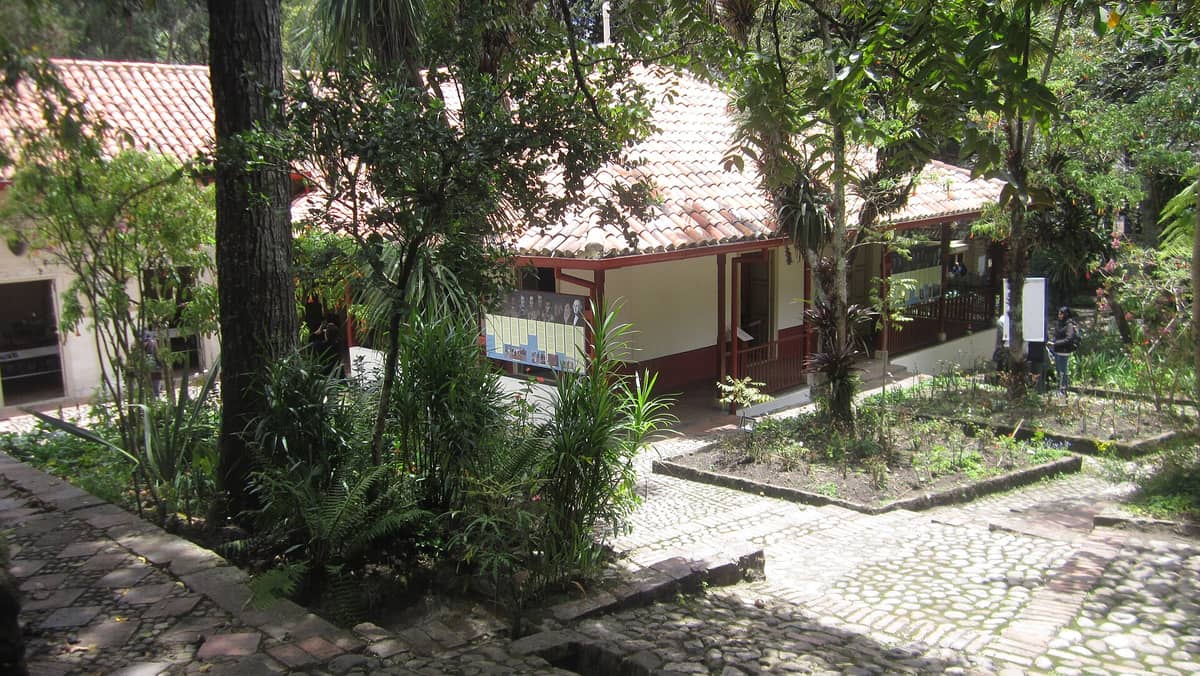
The gardens occupy a substantial portion of the property and are worth taking seriously as part of the visit rather than treating them as a preamble to the house. They are formally laid out, with symmetrical hedges, flowering plants, and stone paths that trace the original garden design from the republican period. In the mornings, the light comes from the east over the hills above, falling directly onto the white-washed facade of the house. By mid-afternoon the gardens settle into shade, which can be welcome given Bogotá's altitude sun, but it also softens the photographic quality of the exterior shots.
The setting near the hills also means you are a short distance from the base of the trail and cable car to Cerro de Monserrate. Many visitors combine both in a single morning, visiting the Quinta first when it opens, then heading uphill. This pairing works well logistically and thematically, as both sites frame how the city's geography shaped its colonial and republican identity.
Tickets & tours
Hand-picked options from our booking partner. Prices are indicative; availability and final rates are confirmed when you complete your booking.
Candelaria walking tour
From 35 €Instant confirmationFree cancellationCoffee farm guided tour
From 114 €Instant confirmationFree cancellationZipaquira Salt Cathedral guided tour
From 86 €Instant confirmationFree cancellationBogota full-day bike rental
From 19 €Instant confirmationFree cancellation
Inside the House: The Collection and How It Is Displayed
The house itself is a single-story colonial structure built around a central courtyard, with thick whitewashed walls, terracotta tile floors, and wooden-beamed ceilings. The rooms open sequentially, each dedicated to a different aspect of Bolívar's life: his personal quarters, reception rooms, a dining space, and rooms housing documents and military artifacts. Interpretation panels in Spanish provide context at each point; English-language information is available but less comprehensive, so visitors who do not read Spanish may want to book a guided tour in advance or use an audio guide if one is offered.
The railing system means you stand at the threshold of each room and look in, which gives the spaces a slightly theatrical quality, like viewing a stage set. This is not a criticism. It preserves the integrity of the recreated environments and keeps the 3,650-object collection protected. The effect, once you adjust to it, is oddly intimate. The furniture, the candlesticks, the portraits of Bolívar and his contemporaries, the military saber on display: all of it sits exactly where the curators intended, undisturbed by foot traffic. You read the room as a whole rather than moving through it piece by piece.
The collection is strongest on material culture from the independence period: weapons, portraits, personal correspondence reproductions, and decorative objects that reflect the republican ideal that Bolívar and his contemporaries were trying to project. If you have already visited the broader political and pre-Columbian history at the Museo Nacional de Colombia, the Quinta functions as a focused, intimate counterpoint, narrowing the lens to a single figure and a single house.
Best Time to Visit and How Crowds Behave
The Quinta de Bolívar draws a noticeably different crowd from Bogotá's larger, better-publicized museums. On weekday mornings, particularly Tuesday through Thursday, visitor numbers are low enough that you can spend several minutes at each room threshold without competing for space or sightlines. School groups visit regularly, especially on weekday mornings, and a group of students moving through the garden and house corridors changes the ambient noise considerably. If you prefer a quieter visit, arriving between 14:00 and 16:00 on a weekday typically yields a calmer experience.
Weekends see more visitors, including Colombian families and tourists staying in the La Candelaria area. The last Sunday of each month, when admission is free for everyone, brings larger crowds than usual. This is worth knowing if you are specifically interested in free entry, but plan to arrive early if you want the garden to yourself.
💡 Local tip
Bogotá's weather is highly changeable. The Cerros Orientales can attract rain quickly, and the estate's gardens offer limited shelter. Bring a light waterproof layer regardless of what the morning sky looks like. The dry seasons (December–March and June–August) give the most reliably pleasant garden conditions.
For broader context on planning around Bogotá's two rainy seasons, the Bogotá weather and climate guide covers month-by-month conditions in detail.
Getting There and Practical Logistics
The museum's official address is Calle 21 No 4A–30 Este. It sits on the eastern edge of the historic center, uphill from the main axis of La Candelaria and below the starting point for the Monserrate ascent. TransMilenio and SITP buses serve the broader Candelaria area; the specific stop and walking distance vary by route, so check current service maps before traveling. Ride-hailing apps including Uber, Cabify, and Didi are the most straightforward option from other parts of the city and are widely used in Bogotá.
The walk from the center of La Candelaria takes roughly 10 to 15 minutes on foot, mostly uphill toward the hills. The streets in this part of the city are generally well-trafficked during the day. The estate has a clearly marked entrance. Parking is limited in the immediate area, so self-driving is not the most practical choice.
The area around the museum is part of the broader eastern hills zone. For context on the neighborhood and what surrounds the site, the Cerros Orientales place guide covers the ecological and urban character of this stretch of hillside Bogotá.
Accessibility, Photography, and Practical Notes
The house museum has original colonial-era architecture, which means uneven floor surfaces, narrow doorways, and stairs in parts of the building. Full accessibility for visitors with mobility limitations may not be possible in all areas of the house. The garden paths are more navigable. If accessibility is a specific concern, contacting the museum in advance via the official website is advisable.
Photography in the gardens is straightforward and the morning facade light is genuinely good. Inside, the railing system means you are always shooting slightly into a room from a fixed distance, which requires patience with angles and available light. Flash and tripods are typically restricted in historic museum settings in Colombia; assume this applies unless signage indicates otherwise.
For visitors thinking about how this site fits into a broader Bogotá itinerary, the Quinta pairs well with the historic center's other major institutions. The Museo Botero and the Museo del Oro are both within walking distance of La Candelaria and cover pre-Columbian and 20th-century Colombian culture that contextualizes the independence-era focus of the Quinta.
Is This Site Worth Your Time?
The Quinta de Bolívar is not a blockbuster museum with dramatic installations or high-tech interpretation. It is a small, precisely preserved historic house with a specific focus and a quiet atmosphere. At 6,000 COP for Colombian adults — or 15,000 COP for foreign adults — the financial ask is modest. The real question is whether Bolívar's story matters to you, or whether colonial-era architecture and republican material culture holds your interest.
If you have no particular connection to Latin American independence history and museums with limited English interpretation leave you cold, this may feel like a pleasant but inessential detour. If you are already visiting Monserrate and the La Candelaria area, however, skipping it entirely means passing within a few minutes' walk of one of the most historically loaded sites in the country. For most visitors with an hour to spare, that is a reasonable trade.
If you are building a full day around the historic center, the 3 days in Bogotá itinerary includes the Quinta alongside the main Candelaria landmarks and suggests a logical walking sequence.
Insider Tips
- Wednesday free entry (15:00–17:00) is the least crowded free period. The last Sunday of the month free entry draws significantly more visitors, especially families. If your schedule is flexible, Wednesday afternoon is the better deal.
- The garden is at its most photogenic in the morning, when eastern light hits the white facade directly. By early afternoon, the hills cast the front of the house into partial shade.
- The museum's Spanish-language interpretation is considerably more detailed than what is available in English. If you have even basic Spanish reading ability, take time with the panels. They provide context that changes how the objects in the rooms read.
- Combine this visit with Cerro de Monserrate in a single morning. Arrive at the Quinta when it opens at 09:00 (Tuesday–Friday; 10:00 Saturday–Sunday), spend 90 minutes, then head uphill. The cable car and funicular to Monserrate are a short walk from the museum entrance.
- Children under 6 enter free, and admission for ages 6–12 is 2,000 COP. The garden, portraits, and military artifacts hold the attention of older children reasonably well, though the railing-only interior viewing format can frustrate younger visitors who want to touch things.
Who Is Quinta de Bolívar For?
- History enthusiasts with an interest in South American independence and the Bolívar legend
- Architecture and colonial heritage travelers who appreciate preserved period interiors
- Budget-conscious visitors seeking meaningful cultural content at minimal cost
- Travelers already visiting Cerro de Monserrate who want to add a substantive stop to the morning
- Students and academics researching the republican period in Colombia and Gran Colombia
Nearby Attractions
Other things to see while in Cerros Orientales:
- Cerro de Monserrate
Cerro de Monserrate is Bogotá's most recognizable landmark, a hilltop sanctuary perched at 3,152 metres above sea level that offers sweeping views over one of South America's largest cities. Whether you ride the century-old funicular, glide up by cable car, or hike the steep pedestrian trail, the experience is one that shapes how you understand the city below.