Museo Nacional de Colombia: Colombia's Oldest Museum in a Former Prison
The Museo Nacional de Colombia tells the full arc of the country's story, from pre-Columbian civilizations through independence to the present day. Housed in the striking former Panóptico de Cundinamarca, the building itself is as compelling as the collection inside. It sits in the Centro Internacional area on Carrera 7 between Calles 28 and 29, and offers free entry on Wednesday afternoons and the last Sunday of every month.
Quick Facts
- Location
- Carrera 7 No. 28-66, Centro Internacional, Bogotá, D.C.
- Getting There
- TransMilenio: Estación Museo Nacional on the Caracas trunk, then a short walk to Carrera 7; or Estación Calle 26
- Time Needed
- 2 to 3 hours for a thorough visit; 1 hour if focused
- Cost
- Foreign adults COP 15,000; Colombian/resident adults COP 6,000. Free Wed 2–5 p.m. and last Sunday of the month. Ages 0–5 always free.
- Best for
- History lovers, architecture buffs, first-time visitors to Bogotá
- Official website
- www.museonacional.gov.co
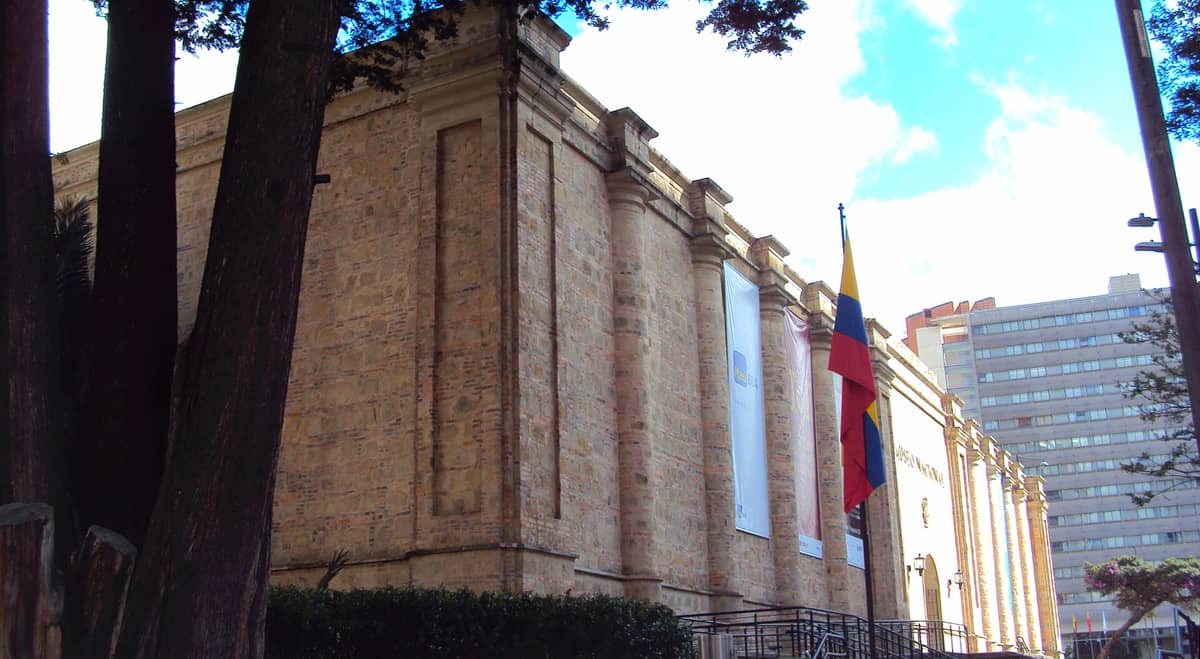
What the Museo Nacional Actually Is
The Museo Nacional de Colombia is the country's oldest museum, and it earns that title without needing to exaggerate. Founded in 1823, four years after the 1819 Battle of Boyacá, it was established with the specific purpose of preserving the material culture of a newly sovereign nation. Today it holds more than 20,000 objects spanning pre-Columbian archaeology, colonial religious art, independence-era portraiture, 20th-century painting, and ethnographic collections from indigenous communities across Colombia.
The building that houses it is equally significant. The former Panóptico de Cundinamarca, a prison designed in the mid-19th century by Danish architect Thomas Reed, was conceived as a panopticon-style building, with a central watchtower from which guards could observe all cells simultaneously. The prison operated until 1946, when the prison closed; the museum opened in the Panóptico in 1948. Walking its corridors, you are literally pacing what were once cellblocks. The iron staircases, the thick stone walls, the cruciform floor plan: all of it remains.
💡 Local tip
Free entry runs every Wednesday from 2:00 p.m. to 5:00 p.m. and on the last Sunday of every month. If your schedule is flexible, these are the best windows to visit without paying admission.
The Building: A Prison That Became a Museum
The Panóptico is one of Bogotá's most architecturally distinctive buildings, and it would be worth visiting even if the galleries were empty. From the street on Carrera 7, the facade reads as austere neoclassical: symmetrical, heavy, with a restrained gravity that signals institution rather than welcome. Step inside and the spatial logic shifts immediately. The central atrium rises through three floors, each ringed by arched corridors that were once cell galleries. Light falls from above through a skylight, and the effect is genuinely impressive, a kind of vertical theater that rewards pausing and looking up.
The repurposing of a prison as a space for cultural memory is not incidental. It adds a layer of historical irony that curators have, to their credit, addressed directly. Some exhibits acknowledge the building's past as a place of confinement, including its use for political prisoners during turbulent periods of Colombian history. That self-awareness gives the museum more intellectual honesty than comparable institutions in the region.
If you are interested in the architecture of Bogotá's historic institutions, the museum makes a natural pairing with a visit to Plaza de Bolívar and the surrounding civic buildings of La Candelaria, which are about 15 minutes south on foot or a short TransMilenio ride.
Tickets & tours
Hand-picked options from our booking partner. Prices are indicative; availability and final rates are confirmed when you complete your booking.
Colombian night experience with salsa, bolirana and tejo in Bogota
From 49 €Instant confirmationFree cancellationCandelaria walking tour
From 35 €Instant confirmationFree cancellationCoffee farm guided tour
From 114 €Instant confirmationFree cancellationZipaquira Salt Cathedral guided tour
From 86 €Instant confirmationFree cancellation
The Collection: Three Floors, Thousands of Years
The permanent collection is organized roughly chronologically across three floors. The ground floor and lower levels deal with pre-Columbian cultures: ceramics, gold work, textiles, and stone objects from civilizations across present-day Colombian territory. These rooms tend to be quieter and more contemplative than the upper floors, and the quality of the pre-Columbian ceramics in particular is underappreciated. Visitors who have already been to the Museo del Oro will recognize some overlapping themes, but the National Museum's treatment of material culture goes beyond metallurgy.
The middle floors move through the colonial period and the independence era. Portrait galleries here document the faces of the republic's founders with a formality that can feel remote until you read the context panels carefully. For deeper engagement with Colombia's gold heritage specifically, the Museo del Oro remains the specialist institution, but the National Museum's historical framing fills in what the Gold Museum leaves implicit.
The upper floor carries the collection into the 20th century, with paintings, sculpture, and documentary material covering modernism, political violence, and contemporary Colombian identity. Works by Alejandro Obregón, Débora Arango, and other major figures appear here. Débora Arango's paintings in particular, bold, often confrontational nudes and political allegories that were censored in her lifetime, are among the most powerful objects in the building.
The museum also hosts temporary exhibitions in dedicated gallery spaces. These rotate regularly and have ranged from photographic surveys of regional Colombia to exhibitions focused on indigenous rights and environmental history. Check the official website before your visit to see what is currently showing.
How the Experience Changes by Time of Day
Tuesday through Friday mornings, roughly between 9:00 a.m. and noon, the museum is at its quietest. School groups begin arriving mid-morning, and by 11:00 a.m. the corridors fill with students moving in organized clusters. If you find that kind of energy distracting, arrive right at opening. The atrium in morning light, before the building warms up, has a cool, stone-scented stillness that suits slow looking.
Wednesday afternoons from 2:00 p.m. onward are free and predictably more crowded, drawing a cross-section of Bogotá residents who might not otherwise visit. That crowd is worth experiencing for its own sake: families with young children, university students, retirees, all moving through spaces that were once a prison. The social texture of those afternoons is distinctly Colombian in a way that a quiet Tuesday morning is not.
The last Sunday of the month follows a similar pattern to free Wednesdays but tends to draw larger numbers. Arrive before 11:00 a.m. if you want manageable crowd levels. The museum closes at 5:00 p.m. on all open days, so afternoon visitors should plan accordingly. Note that the museum is closed on Mondays, including public holidays.
⚠️ What to skip
The museum closes on 25 December and 1 January, and closes early (1:00 p.m.) on 24 and 31 December. Verify current hours on the official website before planning a visit around a holiday.
Getting There and Getting Around the Building
The museum sits on Carrera 7 between Calles 28 and 29, in the Centro Internacional area north of La Candelaria. By TransMilenio, the Museo Nacional station on Carrera 7 is the most direct stop. The Calle 26 station is also within reasonable walking distance.
Ride-hailing via Uber, Cabify, or Didi is straightforward from most parts of the city. For a broader overview of moving around Bogotá, the getting around Bogotá guide covers all transport options in detail.
Inside the building, the three-floor layout is navigable without a guide, but the floor maps available at the entrance desk are worth picking up. Spanish-language labeling dominates, with English translations present in some but not all galleries. Visitors with limited Spanish may find certain context panels difficult to engage with fully. Audio guides or guided tours, when available, are worth checking for on the official site before your visit.
The building's accessibility depends on the specific galleries: the historic structure has limitations in some areas, though the museum provides accessibility information on its official visitor pages. If mobility access is a concern, check the official site or contact the museum directly before visiting.
What to Know Before You Go
Bogotá sits at 2,640 meters above sea level, and the altitude affects some visitors more than others. If you have arrived recently, take the museum's slower pace as an asset: there is no need to rush through. The building is cool inside year-round, which at this altitude feels comfortable rather than cold, but a light layer is useful if you plan to spend more than an hour in the stone-walled lower galleries.
Bogotá's rainy seasons run roughly April to May and September to November. The museum is an obvious refuge on a wet afternoon, making it a sensible choice when outdoor plans fall through. For a broader sense of how to time a trip to the city, the best time to visit Bogotá guide covers seasonal patterns in detail.
Photography is generally permitted in the permanent galleries without flash. Temporary exhibitions may have different rules, so check the signage at each entrance. The museum has a cafe and a small bookshop near the entrance that stocks well-curated publications on Colombian art and history, including titles not easily found elsewhere in the city.
The La Macarena neighborhood immediately east of the museum is one of Bogotá's most interesting eating and gallery districts. After a museum visit, it is worth walking the few blocks into La Macarena to explore its independent restaurants and street-level art spaces.
Who Should Skip This Museum
Visitors with very limited time in Bogotá and a specific interest in pre-Columbian gold work will likely find the Museo del Oro a more focused use of two hours. The National Museum is broader and less curated in the sense of specialist depth: it covers everything but does not go as deep as a specialist collection. Similarly, travelers looking primarily for contemporary art will find more stimulating options in the city's private gallery circuit in La Macarena and Chapinero.
The museum is not a spectacle. There are no immersive installations, no theatrical lighting effects, no interactive technology beyond the basics. It rewards patient, text-engaged visitors. If you are someone who reads the panels, it will give you hours of material. If you prefer a more sensory or experiential format, the building's architecture will interest you but the galleries may not hold your attention.
Insider Tips
- The Calle 29 entrance, accessible from the side street, often has shorter queues than the main Carrera 7 entrance on busy free-entry days. It also puts you directly near the bike rack if you are arriving by bicycle.
- The upper floor's 20th-century galleries close to 4:30 p.m. for staff preparation before the 5:00 p.m. shutdown. If you want to see Débora Arango's paintings without being rushed, plan to reach the upper floor by 3:30 p.m. at the latest.
- The museum bookshop stocks serious academic and illustrated publications on Colombian art history that are hard to find in general bookstores. It is small but well-selected, and prices are reasonable in COP terms.
- On free Wednesday afternoons, the temporary exhibition spaces are often less crowded than the permanent galleries because most visitors head directly to the permanent collection. If there is a temporary show during your visit, go there first.
- The atrium's central space, directly under the skylight, is the best spot in the building for photography of the architecture. Mid-morning on a clear day, the light falls straight down and illuminates all three gallery levels simultaneously.
Who Is Museo Nacional de Colombia For?
- First-time visitors to Bogotá wanting a structured introduction to Colombian history and culture
- Architecture enthusiasts interested in adaptive reuse and 19th-century institutional design
- Travelers with a half-day to fill on a rainy afternoon
- Anyone studying or researching Colombian art, independence history, or indigenous cultures
- Budget travelers: free Wednesday afternoons and the last Sunday of the month make this one of the best-value experiences in the city
Nearby Attractions
Other things to see while in La Macarena:
- Parque Nacional Enrique Olaya Herrera
Inaugurated in 1934 and declared a national monument, Parque Nacional Enrique Olaya Herrera is Bogotá's most historically significant urban park. Free to enter and open daily, it blends century-old landscape design with access to the Eastern Hills, making it a genuine refuge for locals and a rewarding detour for travelers.