Toronto Music Garden: Where Landscape Meets Bach on the Waterfront
The Toronto Music Garden is a free, three-acre public park on Queen's Quay West that translates Bach's First Cello Suite into living landscape. Designed in collaboration with cellist Yo-Yo Ma and landscape architect Julie Moir Messervy, it opened in 1999 and remains one of the most thoughtfully conceived green spaces on Toronto's inner harbour.
Quick Facts
- Location
- 475 Queen's Quay W, Toronto, ON (Toronto Waterfront)
- Getting There
- TTC streetcar to Rees Street (509/511); short walk west along Queen's Quay
- Time Needed
- 30–60 minutes for a relaxed visit; longer if you attend a summer concert
- Cost
- Free admission
- Best for
- Peaceful waterfront walks, photography, summer outdoor concerts, design enthusiasts
What the Toronto Music Garden Actually Is
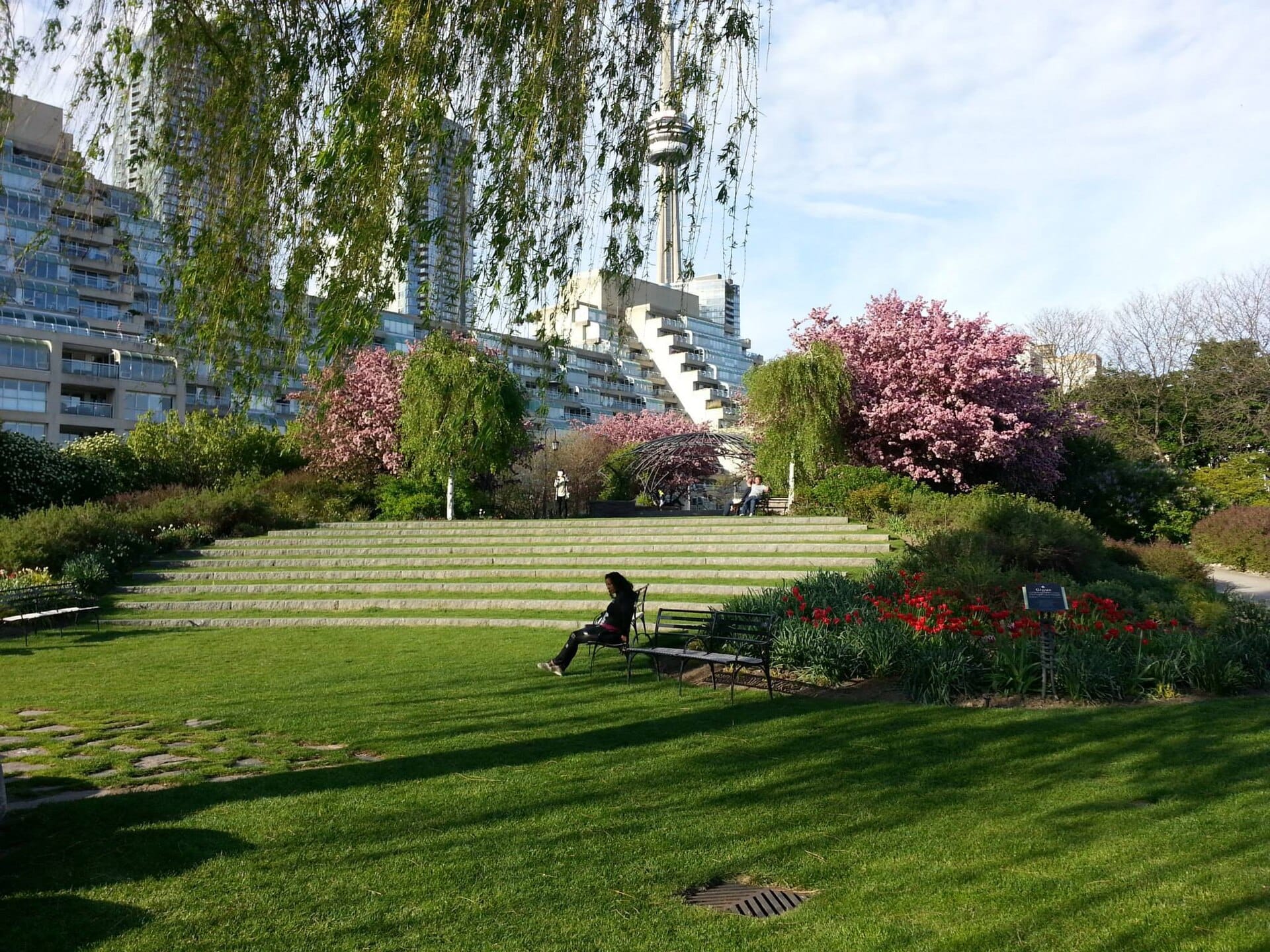
The Toronto Music Garden is not a garden in the conventional sense, and it is worth setting that expectation before you arrive. There are no labeled botanical beds, no greenhouse, and no formal horticultural displays. What you find instead is a three-acre public park whose entire physical form, from its winding gravel paths to its swirling amphitheatre hollow, was conceived as a direct visual translation of Johann Sebastian Bach's First Suite for Unaccompanied Cello in G major.
The project began as a collaboration between cellist Yo-Yo Ma and landscape architect Julie Moir Messervy, originally intended for Boston. When that project fell through, the City of Toronto and Harbourfront Centre stepped in. The garden was completed and officially opened in 1999, making it one of the most intellectually ambitious public parks constructed in North America in the last three decades.
Each of the suite's six movements is assigned a distinct section of the garden. The allemande becomes a forest grove of conical conifers; the courante is a spiraling meadow that sweeps downhill like a musical run; the sarabande is a shaded grove evoking slow, meditative movement; the minuets are expressed through formal hedged areas; and the gigue, the final joyful movement, is a wildflower meadow near the water's edge. You do not need to know Bach to enjoy the space, but the design rewards visitors who do.
💡 Local tip
Download or stream Bach's First Cello Suite before your visit and press play as you enter the garden. The experience of walking the spiral meadow while the courante unfolds is unlike anything a sign or pamphlet can convey.
How the Garden Changes Through the Day
Morning visits, roughly before 9 a.m., offer the garden in its quietest state. The inner harbour reflects pale light onto the rock surfaces near the water's edge, and the wildflower meadow section carries a soft, green smell after rain or heavy dew. Cyclists pass on the nearby Martin Goodman Trail but rarely stop, which means you often have the spiral meadow entirely to yourself. The sound of lake water against the stone embankment is constant and surprisingly close.
By midday in summer, the garden fills with a mixed crowd: office workers from Harbourfront Centre eating lunch on the granite steps of the amphitheatre hollow, tourists photographing the curved grass terraces, and the occasional yoga or stretching session. The amphitheatre section, a shallow grass bowl surrounded by curved wooden benches, functions as a natural gathering point even when no concert is scheduled. It is the one part of the garden that can feel crowded on a warm weekday.
Late afternoon, particularly from 4 p.m. onward in summer, is arguably the strongest time to visit. The sun drops toward the west and catches the texture of the grass terraces at a low angle, deepening shadows in the conifer grove and turning the wildflower meadow gold. Foot traffic thins noticeably after 5 p.m. on weekdays once the Harbourfront office crowd disperses.
Tickets & tours
Live prices and dates from our booking partner. If you book, we may earn a commission at no extra cost to you.
Toronto Old Town: Dark Side Exploration Game and Tour
From 12 €Instant confirmationFree cancellationLEGOLAND Discovery Centre Toronto tickets
From 16 €Instant confirmationFree cancellationToronto 'Little Canada' entrance tickets
From 27 €Instant confirmationFree cancellationNiagara Falls tour with local winery visit from Toronto
From 70 €Instant confirmationFree cancellation
The Summer Concert Series
Between June and September, the Toronto Music Garden hosts free outdoor concerts on its amphitheatre stage, typically on Thursday evenings and Sunday afternoons. The programming leans toward chamber music and solo recitals that echo the garden's Bach origins, but folk, world music, and jazz performances also appear in the schedule. Audience members bring blankets and sit on the surrounding grass terraces, which act as natural stadium seating.
The acoustic quality of the outdoor amphitheatre is genuinely good for an open-air space. The curved grass banks surrounding the stage focus sound reasonably well, and the nearest residential towers are set back enough that ambient noise is manageable on calm evenings. On particularly windy days, however, sound dissipates quickly, and higher-frequency instruments can be hard to follow from the upper terrace edges.
Guided tours are offered on Wednesdays from June through September, departing from the garden itself. These are free and last roughly 45 minutes, covering the design concept and the correspondence between each garden section and its Bach movement. If you have any interest in landscape architecture or urban design, this tour adds real depth to what might otherwise be a pleasant but opaque visit.
ℹ️ Good to know
Concert schedules and tour times are posted by Harbourfront Centre and the City of Toronto. Check both sources before visiting, as programs vary each season and specific dates are not guaranteed.
Getting There and Moving Around
The garden sits at 475 Queen's Quay West, directly on Toronto's inner harbour waterfront. The most straightforward transit approach is the TTC 509 or 511 streetcar westbound from Union Station, alighting at Rees Street and walking two minutes west. The journey from Union Station takes roughly ten minutes under normal conditions.
If you are already on the waterfront, the Martin Goodman Trail runs directly past the garden's eastern edge, making it easy to incorporate into a longer cycling or walking route. From the Harbourfront Centre complex to the east, the walk is under ten minutes along the lakeside path.
Parking along Queen's Quay West is metered and often scarce on summer weekends. If you are driving, the Harbourfront Centre parking garage on York Street is the most reliable option. Cycling is easy: there is a dedicated bike lane along Queen's Quay West in both directions, and bike rings are available near the garden entrance.
The park is handicapped-accessible, with paved paths connecting the main sections. Some of the inner grass terraces on the curved slope sections are not paved, and wet weather makes them slippery. The amphitheatre area and the waterfront promenade that borders the garden are fully level and smooth.
Photography and Practical Considerations
The garden photographs well in almost any season, but the two strongest periods are late May to mid-June, when the meadow plantings are lush and the conifers have new growth, and October, when the surrounding maples along Queen's Quay turn and frame the park in amber and orange. Winter is underrated: the spiral mound under snow with the lake grey behind it has a stark, graphic quality that summer visitors never see.
The best single composition point is from the upper edge of the spiral meadow section looking southwest toward the lake, with the curved grass terraces descending to the promenade and the CN Tower visible to the east behind the trees. A standard 24-35mm lens captures this without distortion. The conifer grove section is darker and requires either exposure compensation or a faster aperture, particularly in the morning when the sun is still low and behind the trees.
⚠️ What to skip
The wildflower meadow section is not maintained as a manicured lawn. It can look overgrown and brown in late summer. If you are visiting specifically for photography, late spring is considerably more rewarding than August.
Bring layers even in summer. The garden sits directly on the lake, and the waterfront is consistently 3-5 degrees cooler than the city interior, with a persistent breeze off Lake Ontario. On overcast days, this can feel noticeably cold even when temperatures inland are comfortable.
Context: Where the Garden Fits on the Waterfront
The Toronto Music Garden occupies a specific stretch of the Toronto waterfront that was part of a broader post-industrial redevelopment beginning in the 1990s. The industrial port uses that once defined this section of the harbour had been relocated or abandoned, leaving a long stretch of concrete and gravel between the city and the lake. The Music Garden was one of the first cultural installations on this western stretch of Queen's Quay and preceded the larger Harbourfront redevelopment activity that continued through the 2000s and 2010s.
Today it sits within easy walking distance of several other waterfront destinations, including Sugar Beach to the east and the ferry terminals that serve the Toronto Islands. The combination of the Music Garden, the Harbourfront Centre programming, and the waterfront trail makes this stretch of the lake accessible and genuinely worth an afternoon rather than just a quick stop.
The garden is one of the few attractions on the waterfront that requires nothing from you financially and rewards slowing down. It is not particularly large, and you can walk its perimeter in ten minutes. Its value is in how it uses those three acres, not in what it contains.
Who May Not Enjoy This
Visitors expecting a traditional botanical garden with labeled plants and horticultural variety will be disappointed. The planting palette is restrained and largely composed of grasses, wildflowers, and conifers rather than showy specimen plantings. If you are traveling with young children looking for active play space, the garden has limited facilities of that kind and the grass slopes are not designed for running games. Families with children might pair it with the broader Harbourfront Centre grounds nearby, which have more open areas.
On humid summer weekday lunchtimes, the amphitheatre and nearby benches fill with people eating, which reduces the meditative quality of the space considerably. If the design concept is what draws you, a visit outside of midday hours will serve you better.
Insider Tips
- The Wednesday guided tours are genuinely excellent and rarely crowded. Even if you are not usually a guided-tour person, this one is compact, free, and led by people who clearly understand both the music and the landscape design.
- The granite steps of the amphitheatre face slightly southwest, making them a comfortable place to sit and watch the sun drop toward Mississauga across the lake on clear evenings in July and August.
- If you visit during a Thursday evening concert in summer, arrive 20 minutes early to secure a spot on the upper grass terrace. The lawn fills quickly and latecomers end up standing on the promenade path behind the main seating area.
- The park's eastern edge connects directly to the waterfront promenade path. From the garden, you can walk east past the row of residential towers to Harbourfront Centre in about eight minutes without crossing any traffic.
- In October, the red maples lining Queen's Quay West directly behind the garden create a strong colour contrast with the lake. This is one of the better spots on the central waterfront for autumn foliage photography in context with the water.
Who Is Toronto Music Garden For?
- Architecture and landscape design enthusiasts interested in the translation of music into spatial form
- Visitors seeking a quiet, no-cost waterfront stop that rewards thoughtful exploration
- Classical music listeners who want to experience the Bach connection in person, especially during the summer concert series
- Photographers looking for composed waterfront scenes with layered foreground, midground, and skyline
- Walkers and cyclists using the Martin Goodman Trail who want a natural pause point with genuine design interest
Nearby Attractions
Other things to see while in Toronto Waterfront:
- BMO Field
BMO Field at Exhibition Place is Toronto's premier outdoor soccer stadium, home to Toronto FC and the Toronto Argonauts. Originally built in 2007 and expanded since, it will serve as a FIFA World Cup 2026 venue. Here is everything a first-time visitor needs to know before heading to a match or event.
- Budweiser Stage
Formerly known as Budweiser Stage, the RBC Amphitheatre is a major outdoor concert venue on the Lake Ontario waterfront at Ontario Place. With a capacity of around 16,000, it draws major international acts from May through October each year. Here is everything you need to know before attending a show.
- Exhibition Place
A 192-acre event and heritage campus on Toronto's western waterfront, Exhibition Place has anchored the city's civic and cultural life since 1879. Home to the Canadian National Exhibition, major concerts, trade shows, and several sports venues, the grounds offer free outdoor access year-round with a remarkable collection of early 20th-century buildings.
- Harbourfront Centre
Harbourfront Centre is a 10-acre arts and cultural campus on Toronto's waterfront, open year-round with free public access to outdoor spaces, plus ticketed performances, exhibitions, and events. It sits about a 15-minute walk from Union Station and offers a direct view across Lake Ontario.
Planning a trip? Discover personalized activities with the Nomado app.