Tiscali Nuragic Village: The Bronze Age Settlement Hidden Inside a Mountain
Concealed within a vast sinkhole on Mount Tiscali in the Supramonte highlands, this Nuragic village is one of Sardinia's most extraordinary archaeological sites. Reaching it demands a real hike through wild limestone terrain, but the reward is a Bronze Age settlement that feels untouched. This is not a polished heritage park — it is archaeology in its raw landscape.
Quick Facts
- Location
- Mount Tiscali, between Oliena and Dorgali, Barbagia / Nuoro province (NU 08022)
- Getting There
- Car essential; nearest towns are Dorgali and Oliena. No public transit to the trailhead. Guided tours depart from Dorgali.
- Time Needed
- 4–6 hours total, including the hike (roughly 10–12 km round trip with significant elevation gain)
- Cost
- €5 standard / €3 reduced / €4 groups (verify current rates at time of visit)
- Best for
- Archaeology enthusiasts, serious hikers, travelers seeking sites with minimal crowds
- Official website
- http://www.ghivine.com
What Tiscali Actually Is
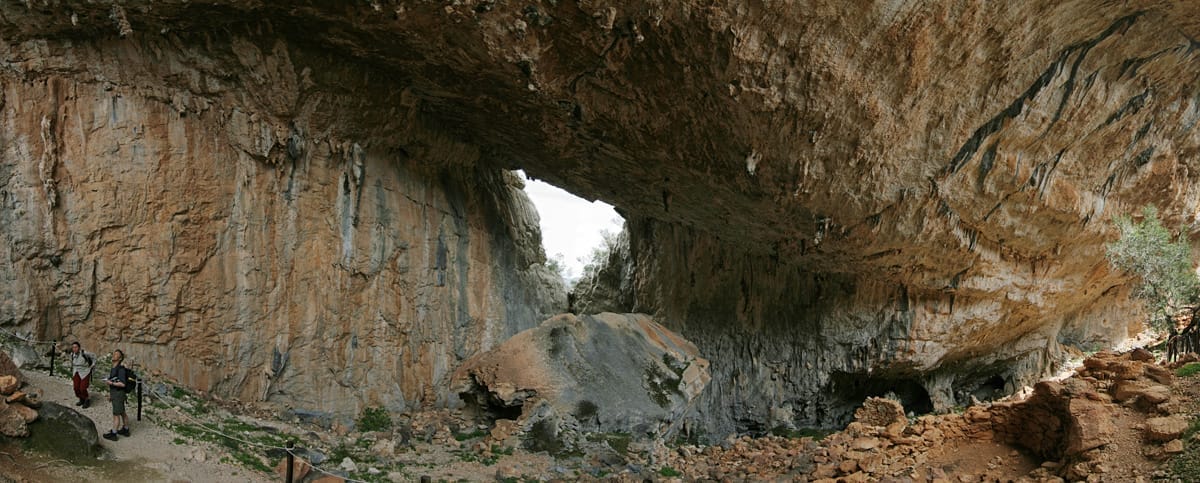
The Tiscali Nuragic Village is not a ruin sitting in an open field. It occupies the floor of a colossal natural sinkhole, formed when the roof of an ancient cave in the limestone mass of Mount Tiscali partially collapsed thousands of years ago. The result is a hidden bowl in the rock, open to the sky but enclosed on all sides by sheer cave walls and overhanging limestone. Bronze Age communities recognized exactly what this place offered: near-total concealment, natural shelter, and a defensible position in the deep Supramonte interior.
The settlement dates to the Bronze Age, with origins placed between approximately 1600 and 900 BC, though some sources describe activity as early as the 15th century BC. The village was reused or reoccupied during the Roman period, likely as a refuge for communities resisting Roman expansion into the Sardinian interior. What remains today are the stone foundations and partial walls of dozens of circular and oval huts, pressed against the inner face of the cave walls and built partly under the overhanging rock. Some huts still show their original doorways. Fragments of wall plaster survive in sheltered corners.
ℹ️ Good to know
Official opening hours: January–April and October–December, 10:00–16:00. May–September, 9:00–19:00. The site is managed in connection with the Museo Archeologico di Dorgali. Admission: €5 standard, €3 reduced, €4 for groups.
The Hike: What to Expect on the Trail
There is no road to Tiscali. The site is reachable only on foot, via a trail that winds through the Supramonte — a highland limestone plateau in central-eastern Sardinia that is among the most geologically dramatic landscapes on the island. The round trip covers roughly 10 to 12 kilometers depending on your starting point, with meaningful elevation gain and some scrambling over exposed rock near the top. Most walkers allow four to six hours for the full excursion.
The path follows old shepherd routes and is not always clearly signposted. In dry summer conditions, the limestone reflects heat intensely and exposed sections offer no shade at all. In spring and autumn, the scrubland alongside the path smells of wild rosemary, myrtle, and sun-baked thyme — an unmistakably Sardinian combination that is actually pleasant in cooler temperatures. The final approach to the sinkhole involves a short, steep climb with fixed ropes in some sections. At the rim, the scale of the cavity becomes apparent before you descend inside.
Official guidance from Italia.it and the Museo Archeologico di Dorgali strongly recommends using an experienced local guide, and for good reason. The Barbagia and Nuoro interior is remote territory. Guides know the path variations, can explain the archaeology in context, and carry the safety margin that solo walkers on unmarked limestone terrain should not skip. Guided tours can be arranged through the museum in Dorgali.
⚠️ What to skip
Do not attempt Tiscali without adequate water (at least 2 liters per person in summer), sturdy closed-toe footwear with ankle support, and sun protection. The trail offers almost no shade between June and September. Check weather forecasts — the Supramonte receives occasional sudden thunderstorms in spring and autumn that make limestone surfaces dangerously slippery.
Tickets & tours
Hand-picked options from our booking partner. Prices are indicative; availability and final rates are confirmed when you complete your booking.
Tiscali village trekking tour from Oliena with local food tasting
From 132 €Instant confirmationFree cancellationSardinian pasta workshop and wine experience in an ancient village
From 122 €Instant confirmationFree cancellationCity tour of the medieval village of Castelsardo with tasting
From 35 €Instant confirmationFree cancellationVineyard Guided Tour and 7 Wine Tasting in Palau
From 84 €Instant confirmationFree cancellation
Inside the Sinkhole: The Site Itself
Descending into the sinkhole is the moment the site earns its reputation. The temperature drops noticeably. The sound of wind disappears. Light enters from above through the broken cave ceiling in shafts that shift through the morning, casting different sections of the ruins into clarity and shadow depending on when you arrive. Early morning visits in summer produce the most striking light — the sun clears the eastern rim first and illuminates the upper hut walls while the floor remains in cool shadow.
The huts cluster primarily along the northern inner wall, where the overhanging rock provided the most shelter. Construction is dry-stone, fitted without mortar, using the flat limestone slabs found throughout the Supramonte. Some walls stand to chest height; others are reduced to a single course of stones. Doorways are narrow — roughly 60 to 80 centimeters wide — which reflects both the construction logic of the period and the cramped conditions that life inside a mountain would have imposed. The overall village is compact rather than sprawling, perhaps accommodating a few dozen families at its peak.
For broader context on how Tiscali fits within Sardinia's extraordinary Nuragic heritage, the guide to Nuragic sites in Sardinia covers the range from the iconic Su Nuraxi towers to more obscure highland settlements like this one.
Historical and Archaeological Context
The Nuragic civilization flourished in Sardinia from roughly the 18th century BC onward and produced the thousands of stone tower structures — nuraghi — that remain one of Mediterranean prehistory's great puzzles. Tiscali represents a different architectural expression from the familiar towers: a village built for concealment rather than visibility, suggesting that by the later Bronze Age and into the Iron Age, certain Sardinian communities prioritized defensible seclusion over the territorial signaling that towers provided.
The reuse of the site during the Roman period adds another layer. Rome's pacification of Sardinia was drawn-out and contested, particularly in the mountainous interior where local communities maintained resistance long after the coastal cities had been absorbed. The Supramonte's inaccessibility made it a natural zone of refuge, and Tiscali's concealed position would have made it nearly impossible to locate for an army without local knowledge. This history of deliberate hiddenness is part of what makes the place feel significant beyond its architectural remains.
The surrounding gorge landscape is also notable in its own right. The Gola di Su Gorropu, one of Europe's deepest gorges, lies within the same Supramonte system and can be combined with a Tiscali visit for a full day in the Barbagia interior — though only for walkers with solid fitness and experience on rough terrain.
How the Experience Changes by Time of Day and Season
In summer (June through August), start as early as possible — ideally leaving the trailhead by 7:00 or 7:30. By midday the exposed sections of the trail become punishing, and the sinkhole itself traps heat in the afternoon. The site is at its quietest and most atmospheric in the first hour after it opens. Visitor numbers are moderate compared to coastal attractions, but guided groups from Dorgali tend to arrive mid-morning.
May and September are arguably the best months overall. Temperatures on the trail are tolerable throughout the day, the surrounding scrubland is green or transitioning, and afternoon light in the sinkhole is warmer and more textured. October sees the first autumn rains in Sardinia and brings the risk of slippery limestone, but also dramatically empty trails. Winter visits are possible within the reduced opening hours but require preparation for cold temperatures at altitude and the possibility of snow on the upper sections of the Supramonte.
If you are planning a multi-day itinerary in the region, the Cala Gonone coastal base, about 10 kilometers from Dorgali, makes a practical overnight stop that allows an early morning departure for Tiscali while still leaving the afternoon for the sea.
Practical Walkthrough: Getting There and Organizing the Visit
The site is administered in connection with the Museo Archeologico di Dorgali, located at Via Lamarmora in Dorgali (NU 08022). The museum is a logical first stop: it holds finds from Tiscali and surrounding Supramonte sites, providing context that the ruins themselves cannot supply, since there are no interpretive panels inside the sinkhole. Visiting the museum first takes about an hour and significantly improves what you take away from the site.
There is no public transport to the trailhead. A car is essential. The main trail access points lie between Oliena and Dorgali; the road is partially unpaved and requires normal passenger car clearance rather than high-clearance vehicles, though conditions can vary after rain. Parking at the trailhead is limited and informal. Guided tours arranged through the Dorgali museum include transport logistics and are the simplest option for visitors without their own vehicle or local knowledge.
Dorgali and Oliena sit within the broader Barbagia interior, a region worth exploring beyond Tiscali alone. The Valle di Lanaittu and its associated archaeological sites are within a short drive and reward a second day in the area.
Photography Notes
The interior of the sinkhole is a genuine photographic challenge. Contrast between the bright sky above and the shaded ruins below is extreme, particularly around midday. Early morning offers the most even light inside the cavity. A wide-angle lens captures the cave walls and ruins together; a standard lens isolates individual hut doorways and wall textures well. The approach trail through the Supramonte limestone, particularly near the sinkhole rim, produces strong landscape frames.
Accessibility
Tiscali is not accessible to visitors with limited mobility. The trail involves uneven limestone, elevation gain, and the final scramble to the sinkhole requires physical agility. There are no adapted facilities at the trailhead or within the site. Visitors with young children should assess the trail difficulty carefully before committing — it is not a suitable walk for small children or strollers.
Insider Tips
- Book a guided tour through the Museo Archeologico di Dorgali even if you are an experienced hiker. The guides know trail variations that cut distance, can identify hut structures that are easy to miss among collapsed rubble, and carry basic first aid. The fee is worth it for the archaeology alone.
- Visit the Museo Archeologico di Dorgali the afternoon before your Tiscali hike. The finds — pottery, obsidian tools, personal ornaments — give you a mental image of who lived in the sinkhole. Without this context, the ruins read as interesting but anonymous stonework.
- Bring more water than you think you need. The trail from the most common access points involves roughly two hours of walking before you reach the cool interior of the sinkhole. In summer, three liters per person is not excessive.
- The sinkhole floor is uneven and sometimes muddy near the base of the cave walls, even in dry weather, because the enclosed space traps moisture. Waterproof or water-resistant footwear is useful even in July.
- If you want the sinkhole to yourself for even fifteen minutes, arrive right at opening time in the shoulder season (May or September). Guided groups from Dorgali typically reach the site between 10:30 and 11:30. The gap between opening and the first group arrival is the quietest window of the day.
Who Is Tiscali Nuragic Village For?
- Archaeology travelers who want Nuragic history in its actual landscape rather than a reconstructed or museum setting
- Experienced hikers looking for a trail with a rewarding destination rather than views alone
- Travelers already basing themselves in Dorgali, Oliena, or Cala Gonone who want a full-day inland excursion
- History-focused visitors interested in Bronze Age Mediterranean cultures and Roman-era resistance in Sardinia
- Photographers seeking dramatic natural architecture combined with prehistoric ruins
Nearby Attractions
Other things to see while in Barbagia & Nuoro:
- Giara di Gesturi
Rising to around 550 metres above central Sardinia, the Giara di Gesturi is a 45-square-kilometre basalt plateau formed by Oligocene volcanic activity. Cork oak forests, seasonal wetlands, and an extraordinary population of small wild horses make it one of the most ecologically singular landscapes on the island.
- Gola di Su Gorropu
Gola di Su Gorropu is a karst canyon in Sardinia's Supramonte massif with walls rising over 500 metres and passages as narrow as 4 metres across. It's a serious hiking destination that rewards physical effort with one of the most dramatic landscapes in the Mediterranean.
- Monte Ortobene
Reaching a maximum elevation of 955 metres above sea level near the inland city of Nuoro, Monte Ortobene is a forested mountain with panoramic views across central Sardinia, a landmark bronze statue of Cristo Redentore, and walking paths through fragrant Mediterranean scrubland. Access is free, the road reaches the summit, and the atmosphere is unlike anything on the coast.
- Murales di Orgosolo
Orgosolo, a small hill town in the Barbagia region of central Sardinia, has covered its streets in around 150 murals since the late 1960s. Free to visit at any hour, the Murales di Orgosolo form one of the most politically charged and visually striking open-air art experiences in Italy.