Tianguis Cultural: Guadalajara's Saturday Alternative Market
Every Saturday from around 10:00 to 19:00 at Plaza Juárez, the Tianguis Cultural de Guadalajara transforms a downtown plaza into a sprawling counter-culture marketplace. Free to enter, it draws vendors selling vintage clothing, zines, handmade jewelry, records, and local art alongside live performances and street food. It has been doing this since 1995.
Quick Facts
- Location
- Plaza Juárez, Guadalajara (across from Parque Agua Azul)
- Getting There
- City bus or ride-hail to Plaza Juárez / Parque Agua Azul; ask drivers for 'Tianguis Cultural'
- Time Needed
- 1 to 3 hours depending on how deep you browse
- Cost
- Free entry; individual vendors set their own prices
- Best for
- Independent shoppers, music lovers, cultural explorers, budget travelers
- Official website
- tianguiscultural.org
What the Tianguis Cultural Actually Is
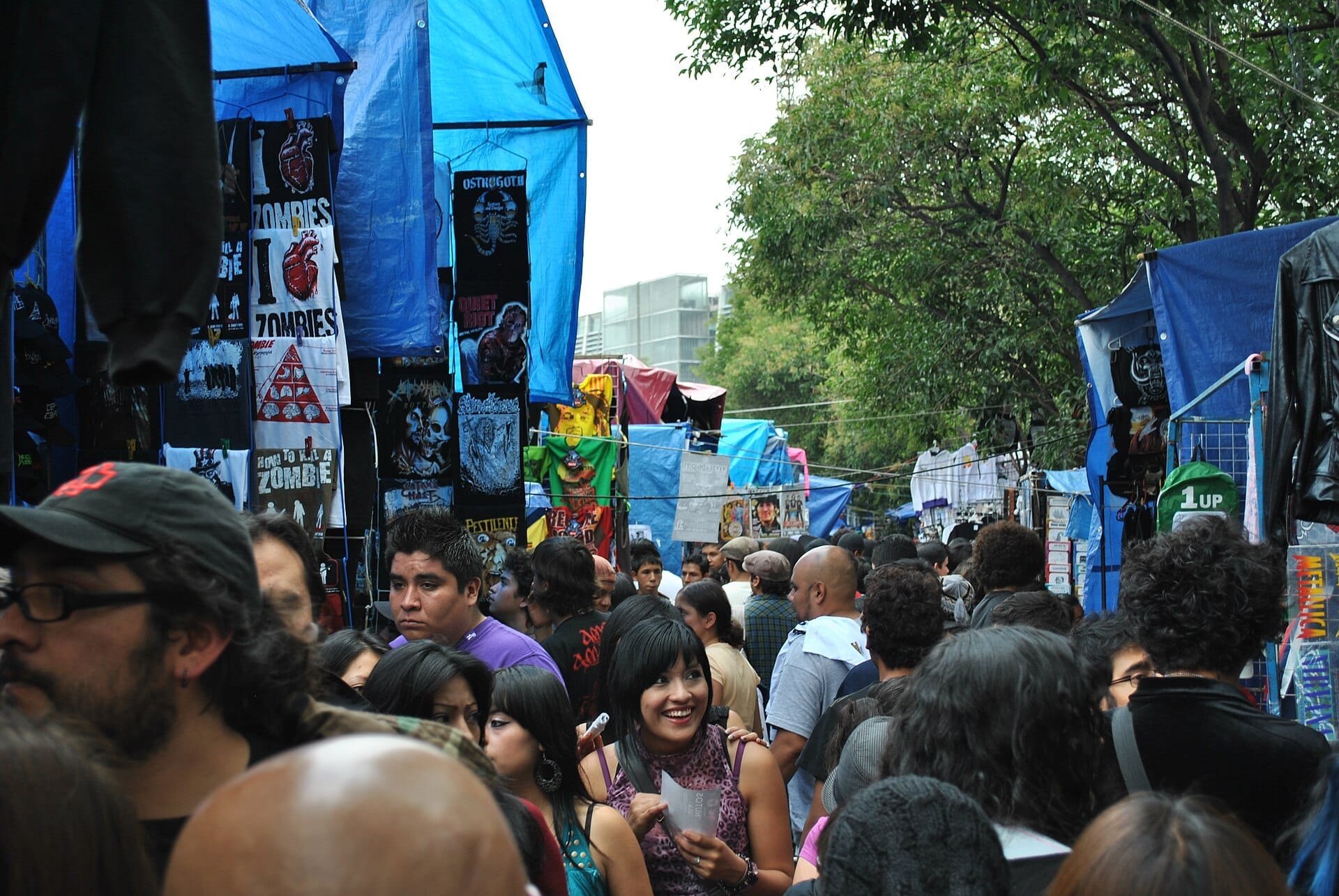
The Tianguis Cultural de Guadalajara is a free, open-air Saturday market held at Plaza Juárez, directly across from Parque Agua Azul. It is not a craft fair in the tourist-market sense. Since its founding in 1995, when a group of young tapatíos set up stalls in Plaza José Rolón as a counter-culture alternative to mainstream commerce, the tianguis has grown into one of Guadalajara's most consistent weekly cultural events, with hundreds of vendors spreading across the plaza each Saturday.
The word tianguis comes from the Nahuatl word for marketplace, and the format here is deliberately low-barrier: independent sellers pay to rent a stall space, the plaza stays open to the public, and the result is an unfiltered cross-section of Guadalajara's independent creative scene. Expect second-hand clothing, vinyl records, hand-bound zines, locally designed patches and pins, handmade jewelry, alternative cosmetics, tarot readers, and vendors selling homemade food and drinks. It shifts from week to week, which is part of the appeal.
💡 Local tip
Arrive before noon if you want the best selection from vendors and lighter foot traffic. By early afternoon the plaza fills considerably and browsing becomes slower.
The Setting: Plaza Juárez and Parque Agua Azul
Plaza Juárez sits on the southern edge of Guadalajara's historic center, a broad public square that connects the downtown street grid to the green expanse of Parque Agua Azul. The location is not accidental. Parque Agua Azul is one of the city's better-known central urban parks and includes cultural institutions within its grounds, creating a corridor that on Saturdays effectively links the tianguis with a wider zone of public leisure.
The plaza itself is flat paved concrete, which makes walking through stalls straightforward but offers no shade of its own. Vendors use canopies and tarpaulins over their tables. On clear mornings the light is strong and direct, which is good for examining items but means sun protection is worth thinking about. Guadalajara sits at roughly 1,560 meters above sea level, so temperatures are moderate year-round, but the combination of sun exposure and mid-afternoon heat in the dry season (roughly November to April) can be tiring. During the rainy season (June to September), Saturday afternoon downpours are possible. For more on planning around the weather, see the best time to visit Guadalajara.
Tickets & tours
Hand-picked options from our booking partner. Prices are indicative; availability and final rates are confirmed when you complete your booking.
Lake Chapala and Ajijic guided tour from Guadalajara
From 68 €Instant confirmationFree cancellationGuadalajara and Tlaquepaque guided tour
From 73 €Instant confirmationFree cancellation
What You'll Find Among the Stalls
The vendor mix at the Tianguis Cultural skews independent, young, and locally rooted. Clothing stalls tend toward vintage finds, repurposed garments, and band merchandise from local punk, metal, and ska scenes. Record stalls carry used vinyl across a wide range of genres, with Mexican rock, cumbia, and jazz appearing regularly alongside international titles. Prices at these stalls are generally negotiable, though not always dramatically so.
On the craft and art side, you'll find handmade silver and copper jewelry, leather goods, screen-printed posters and tote bags, and small-run illustrated publications. There is typically a section with esoteric and New Age items: crystals, incense, tarot decks, and herbal preparations. Food and drink vendors operate throughout, selling esquites, agua fresca, coffee, and various antojitos. The food quality varies stall to stall; choosing vendors with visible turnover is a reasonable approach.
Live musical performances and occasional spoken word or performance art happen in and around the market, particularly in the late morning and early afternoon. The sound environment is layered: competing music from adjacent stalls, conversation, and the ambient noise of the surrounding streets. It is a loud, stimulating place rather than a tranquil one.
ℹ️ Good to know
Payment at individual stalls is almost entirely cash-based. Bring Mexican pesos in small denominations. ATMs are available in the surrounding Centro Histórico but not necessarily within immediate walking distance of the plaza.
How the Market Changes Through the Morning
Setup begins in the early morning, and the market tends to reach something close to full capacity by mid-morning. Early arrivals, roughly before 10:00 or 11:00, find vendors still arranging merchandise, a quieter atmosphere, and a more relaxed pace for browsing. This is when serious shoppers and collectors tend to show up, particularly those hunting vinyl or vintage clothing.
By midday the plaza is at its most crowded. Foot traffic from the broader Centro Histórico adds to the regular market crowd. Browsing becomes slower and more compressed. This is also when street performances tend to peak. If you are primarily there for the social and cultural atmosphere rather than focused shopping, midday to early afternoon captures the event at its most energetic.
By mid-afternoon, some vendors begin packing up. The energy shifts toward the food stalls, which often stay open longer. If you plan to combine a visit with time in Parque Agua Azul or other nearby attractions in the Centro Histórico, starting at the tianguis in the morning and moving outward from there makes practical sense.
Getting There and Around
Plaza Juárez is accessible by several city bus routes that pass through the southern end of the Centro Histórico. If you are using a ride-hailing app such as Uber or DiDi, asking for 'Plaza Juárez frente a Parque Agua Azul' gives drivers a clear reference point. The plaza is also walkable from the main cathedral and government palace area in around 15 to 20 minutes on foot, depending on your starting point.
There is no dedicated parking at the plaza itself. Street parking in the surrounding blocks exists but is competitive on Saturdays. Public transit or ride-hailing is the more practical option for most visitors.
If you want to combine the market with other Centro Histórico landmarks, the Parque Agua Azul is directly adjacent. The Hospicio Cabañas, a UNESCO World Heritage Site with José Clemente Orozco's monumental murals, is about a 15-minute walk north and well worth including in the same day.
Cultural Context: Why This Market Exists
The tianguis format has deep pre-Hispanic roots in Mexican civic life, but the Tianguis Cultural represents a specifically modern urban phenomenon. It emerged in the mid-1990s as part of a broader counter-culture movement among young people in Guadalajara who wanted a space for independent commerce and cultural exchange outside formal retail channels. The founding in December 1995 placed it within a decade that saw significant growth in Mexico's independent music, zine, and subcultural scenes.
Guadalajara's status as a city with a strong creative and musical tradition, recognized by UNESCO as part of its Creative Cities Network, has contributed to the durability of events like this one. The tianguis functions as an informal cultural institution, one that doesn't appear on the formal museum circuit but plays a real role in how the city's independent creative community organizes and makes itself visible. For visitors exploring this side of the city, it pairs naturally with the street art and independent venues in Colonia Americana.
Honest Assessment: Who This Is For and Who It Isn't
The Tianguis Cultural rewards visitors who are curious about Guadalajara's local youth culture and independent creative scene, or who are genuinely looking to shop for second-hand and independent goods. It is a real, functioning market rather than a curated tourist experience, which means quality and selection vary significantly from one Saturday to the next and from one stall to another.
Travelers who prefer structured experiences, air-conditioned spaces, or who have limited tolerance for crowds and noise will find it uncomfortable. The market is not designed for tourists and doesn't cater to them specifically, which is either an attraction or a deterrent depending on what you're looking for. Families with young children can visit, but the crowded, compact layout with narrow gaps between stalls is not easy to navigate with a stroller.
If your interest is traditional Mexican craft, the dedicated artisan markets in Tlaquepaque and Tonalá offer a more focused selection of regional ceramics, textiles, and glasswork. The Tianguis Cultural is something different: a Saturday ritual for a particular segment of tapatío culture, open to anyone who wants to observe or participate.
⚠️ What to skip
Hours and market size can vary without notice. Holidays, weather, and municipal events occasionally affect the schedule. Check the official website at tianguiscultural.org or the Facebook page before making a special trip.
Insider Tips
- The record vendors tend to cluster toward specific sections of the plaza. If vinyl is your priority, scan the layout quickly when you arrive rather than working stall by stall from one end.
- Small denomination bills (MXN 20 and 50) make transactions faster and avoid the awkward situation of vendors not having change. The ATMs nearest the plaza may have queues on Saturday mornings.
- Some of the more interesting independent publishers and zine makers only appear sporadically, not every week. If you find something you like, buy it then rather than planning to return.
- Combining the tianguis with a morning in Parque Agua Azul next door works well. The park has shaded seating, which makes a good break if you need to step away from the market noise.
- The Facebook page for Tianguis Cultural Guadalajara tends to post updates about special events or vendor callouts more regularly than the main website. Follow it for accurate weekly information.
Who Is Tianguis Cultural (Saturday Alternative Market) For?
- Independent shoppers looking for vintage clothing, records, and locally made goods
- Travelers interested in Guadalajara's counter-culture and youth creative scene
- Budget-conscious visitors wanting a free Saturday activity in the city center
- Photographers drawn to candid urban scenes and market textures
- Anyone combining a downtown Saturday with Parque Agua Azul or Centro Histórico landmarks
Nearby Attractions
Other things to see while in Centro Histórico:
- Calandrias (Horse-Drawn Carriage Rides)
Calandrias are Guadalajara's traditional horse-drawn carriages, operating through the colonial streets of the Centro Histórico since the early 20th century. A slow, unhurried circuit past cathedral facades, plazas, and pedestrian corridors, they offer a different pace from the city's foot traffic. This guide covers what to expect, when to go, and whether it's worth your time.
- Guadalajara Cathedral (Catedral de Guadalajara)
The Catedral Basílica de la Asunción de María Santísima anchors Guadalajara's historic center, surrounded by four plazas and centuries of layered history. Its twin neo-Gothic spires are the city's most recognized silhouette, and entry is free. Here is everything you need to know before you go.
- Instituto Cultural Cabañas (Hospicio Cabañas)
A UNESCO World Heritage Site at the heart of Guadalajara's Centro Histórico, Hospicio Cabañas houses José Clemente Orozco's most celebrated murals inside a neoclassical complex of staggering scale. This is the single most significant cultural site in western Mexico, and one of the most important in all of Latin America.
- Lienzo Charro de Jalisco
The Lienzo Charro Charros de Jalisco, on Av. R. Michel near Parque Agua Azul, is one of Mexico's most storied charro arenas. Home to one of Mexico's oldest charro associations, this is where Jalisco's equestrian traditions are kept alive through competitive charreadas, pageantry, and music.