Tianfu Square: Chengdu's Civic Core Explained
Tianfu Square sits at the geographic and symbolic center of Chengdu, covering roughly 88,000 square meters above a major metro interchange. Free to enter at any hour, it shifts in character from a quiet morning exercise ground to a floodlit evening gathering point.
Quick Facts
- Location
- No. 86, Section 1, Renmin South Road, Qingyang District, Chengdu
- Getting There
- Tianfu Square Station — Metro Line 1 and Line 2 interchange, directly beneath the square
- Time Needed
- 30–60 minutes for the square itself; 2–3 hours if combining with nearby museums
- Cost
- Free — CNY ¥0, open 24 hours daily
- Best for
- City orientation, evening atmosphere, architectural photography, transit convenience
What Tianfu Square Actually Is
Tianfu Square (天府广场) is the formal public plaza at the center of Chengdu, covering approximately 88,000 square meters in Qingyang District. First established in 1951, it functions as the city's ceremonial axis: a broad expanse of paving, central fountains, flagpoles, and surrounding public institutions. The square is not a park in the green, leafy sense. It is an open civic space, built to be seen across and to signal the weight of the city around it.
What gives Tianfu Square its practical value for travelers is position. Metro Lines 1 and 2 cross directly beneath it at Tianfu Square Station, making it one of the easiest transit hubs in central Chengdu. The Chengdu Museum faces the west side of the square, so even visitors with little interest in grand plazas tend to pass through here. The Sichuan Provincial Museum is a separate site about 5 km west, near Du Fu Thatched Cottage. It is also the logical place to get your bearings when arriving in the city center for the first time.
💡 Local tip
If you are visiting the Chengdu Museum, Tianfu Square Station drops you within a few minutes' walk. The Sichuan Provincial Museum is a separate trip west toward Huanhua Creek and Du Fu Thatched Cottage.
A Brief History: From Imperial Grounds to Civic Plaza
The land beneath Tianfu Square carries a long history. The area was historically known as Huangchengba (皇城坝), a term referring to the imperial-city complex built by the Ming dynasty's Shu princes. That complex, a regional echo of Beijing's Forbidden City, dominated this part of Chengdu for centuries before being demolished during the upheavals of the late imperial and early Republican periods.
The current square was first built in 1951, in the years immediately following the founding of the People's Republic. Its layout reflects the civic planning priorities of that era: broad, unobstructed, oriented around a central axis, and framed by monumental public buildings. Several rounds of reconstruction have occurred since, with the most significant expansions and renovations reshaping the fountain systems, underground metro infrastructure, and surrounding streetscapes. The square you walk across today reads as a product of that layered history, part socialist civic space, part modern transit node, part tourist landmark.
For visitors wanting deeper context on Chengdu's history, the Chengdu Museum, which faces the square directly, covers the region's development from prehistoric times to the present. It is one of the better-curated city history museums in western China, and the proximity makes a combined visit straightforward.
Tickets & tours
Hand-picked options from our booking partner. Prices are indicative; availability and final rates are confirmed when you complete your booking.
Panda Base and city highlights private day tour in Chengdu
From 302 €Instant confirmationFree cancellationFull day private tour Giant Panda Base and city highlights
From 365 €Instant confirmationFree cancellationChengdu to Yibin private tour with Wuliangye Liquor Museum visit
From 300 €Instant confirmationChengdu private evening tour with hot pot dinner
From 247 €Instant confirmationFree cancellation
How the Square Changes Throughout the Day
Early mornings are the most local version of the square. From around 6 to 8 a.m., groups of residents gather near the fountain area for tai chi, stretching, and casual walking circuits. The light at this hour is softer, the crowds are thin, and the scale of the place is easier to absorb when you are not navigating around tour groups. The smell of street food from vendors on the adjacent roads drifts in, mostly fried dough and warm soy milk, which is how much of Chengdu starts its day.
By mid-morning, the square fills with organized tour groups, school excursions, and transit commuters cutting across to the station entrances. Photography becomes more difficult as the crowd density increases and the midday haze, which is a regular feature of Chengdu's humid basin climate, flattens the light. If architectural photography is the goal, arrive before 8 a.m. or return after sunset.
Evenings represent the most photogenic window. The central fountain system is illuminated, and the surrounding buildings are lit in ways that transform the daytime's concrete-and-pavement mood into something more theatrical. Local families use the space for evening walks. Kite flying happens here on weekends, with long strings pulling high above the square, visible from blocks away. The temperature drop after dark in spring and autumn makes this genuinely comfortable rather than just tolerable.
ℹ️ Good to know
Chengdu is famously overcast. The city sits in the Sichuan Basin and sees limited direct sunlight for much of the year, particularly in winter. Clear-sky days do occur, mainly in autumn, but plan around the possibility of flat grey light rather than assuming blue skies.
What You Actually See: A Walkthrough
The square's surface is dominated by wide paved walkways radiating from a large central fountain complex. The fountain is the visual anchor: tiered jets arranged in geometric patterns, with benches and low barriers around the perimeter. On weekday afternoons, pigeons and small children compete for the same territory near the water's edge.
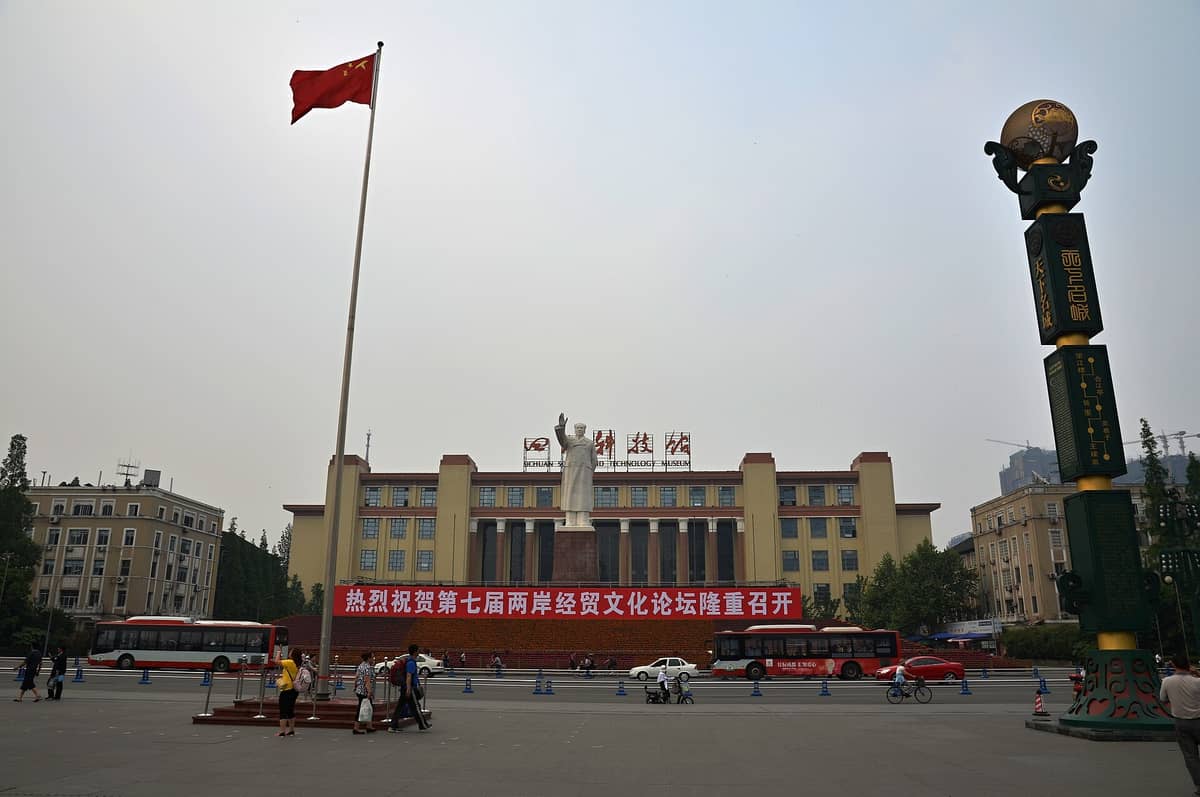
On the northern edge of the square, a large standing statue of Mao Zedong faces southward in front of the Sichuan Science and Technology Museum. It is one of the more prominent public Mao statues remaining in a major Chinese city center and gives the northern boundary a particular visual weight that frames the entire space.
On the western side, the Chengdu Museum is housed in a striking contemporary structure completed in the 2010s, its exterior referencing the bronzeware aesthetic of Sichuan's ancient Sanxingdui culture. It is a natural extension of a Tianfu Square visit. The Sichuan Provincial Museum is not on the square — it sits about 5 km west on Huanhua South Road.
The Sichuan Provincial Museum holds one of the region's most comprehensive collections of Sichuan artifacts, including Buddhist sculptures, silk brocade, and ancient documents. Entry is free. Plan at least 90 minutes if you intend to cover the core galleries.
Getting There and Getting Around
Metro access could not be more direct. Tianfu Square Station is the interchange point for Line 1, running north-south through the city center, and Line 2, running roughly east-west. Multiple exits surface at different edges of the square, so check exit signs against which side of the plaza you are heading to before climbing the stairs. The station is well signed in both Chinese and English.
For anyone planning a full day in central Chengdu, Tianfu Square works well as a home base for radiating outward. Kuanzhai Alley is reachable by metro or a short ride to the northwest, while Chunxi Road and the surrounding commercial district are a few stops east on Line 2. The square itself does not require much time, but its position makes it an efficient anchor for planning a city-center itinerary.
⚠️ What to skip
During national holidays, particularly Golden Week in October and the Chinese New Year period, Tianfu Square draws very large crowds for flag-raising ceremonies and public events. Expect significant congestion around the square and at the metro station beneath it. Build extra time into your plans if visiting during these periods.
Is It Worth Your Time? An Honest Assessment
Tianfu Square is not an attraction in the conventional sense. There is no entry, no guided narrative, no curated experience. What it offers is scale, context, and convenience. If you want to understand how Chengdu presents itself as a city — the civic ambition embedded in its layout, the mix of historical symbolism and modern infrastructure — then spending 30 minutes crossing and circling the square is genuinely useful.
If you are expecting the intimate atmosphere of a neighborhood plaza or a historically preserved streetscape, the square will feel impersonal. It is large, formal, and purpose-built for public ceremony as much as daily use. Visitors drawn to Chengdu primarily for its food scene, its ancient towns, or its temples will likely find themselves passing through rather than stopping here intentionally.
Travelers with children may find the fountain area entertaining briefly, but the square offers limited shade on warm days and no dedicated play facilities. For a more engaging outdoor experience with kids, People's Park to the northwest offers more variety: tea houses, rowboats, and green space in a setting that rewards lingering.
Photography Notes
The square rewards wide-angle composition. From the central fountain area, you can frame the Mao statue to the north, the Chengdu Museum facade to the west, and the receding lines of Renmin South Road to the south in a single sweep. Evening hours, when the fountain lights are active, give the flattest space its most dynamic quality.
The surrounding roads carry significant traffic, and the square sits at a major intersection. Long-exposure shots of the avenue from the square's southern edge can produce effective light-trail images at dusk. A compact tripod is useful here, as the paving provides stable ground but the wind that funnels through the open plaza can cause vibration at slower shutter speeds.
Insider Tips
- The West 1 North/South exits of Tianfu Square Station place you closest to the Chengdu Museum entrance. If that is your primary destination, skip the walk across the square surface entirely and save 5 to 10 minutes.
- The fountain system does not run continuously throughout the day. Choreographed fountain shows with lights are most reliably active in the evening, typically after dark. Arriving mid-afternoon to photograph the fountains in motion is often disappointing.
- Street food vendors along the side streets immediately adjacent to the square, particularly to the south along Renmin South Road, are a practical option for a quick breakfast or snack before heading into the museums. The stalls are most active before 9 a.m.
- If you visit during a national holiday, check whether any public ceremonies or political events are scheduled at the square. Access to certain areas may be restricted during official gatherings, and security presence increases noticeably.
- The Chengdu Museum directly facing the square is free and generally less crowded than major attractions like Wuhou Shrine. Its permanent collection covering Sichuan's ancient Bronze Age cultures is genuinely substantial and often overlooked by visitors focused on the panda base or historic streets.
Who Is Tianfu Square For?
- First-time visitors to Chengdu wanting a quick spatial orientation to the city center
- Museum-goers using the square as a transit anchor for the Chengdu Museum
- Evening walkers and photographers seeking lit fountains and a large, open urban space
- History enthusiasts interested in how Chinese civic space has evolved since the 1950s
- Transit users moving between metro lines in central Chengdu
Nearby Attractions
Other things to see while in Qingyang District:
- Chengdu Museum
Chengdu Museum sits directly west of Tianfu Square in Qingyang District and holds one of the most comprehensive collections of Sichuan civilization under one roof. Free to enter and easy to reach by metro, it covers everything from ancient Bronze Age artifacts to Sichuan opera costumes, across roughly 20,000 square meters of exhibition space. Whether you have two hours or a full day, this guide tells you exactly how to use your visit.
- Du Fu Thatched Cottage
The Chengdu Du Fu Thatched Cottage Museum preserves the site where Tang dynasty poet Du Fu lived and wrote during a period of exile in the 8th century. Set within a composed garden landscape in Qingyang District, it offers a reflective contrast to Chengdu's busier attractions — best suited to travelers who appreciate literary history, classical Chinese garden design, or simply a slower morning away from the crowds.
- Huanhua Creek Park
Huanhua Creek Park is a free, 32-hectare urban park in Qingyang District, woven around the historic creek that inspired Tang dynasty poet Du Fu. It offers shaded walkways, open lawns, lotus ponds, and a rare sense of calm within reach of central Chengdu.
- Wide and Narrow Alleys (Kuanzhai Alley)
The Wide and Narrow Alleys, known in Chinese as 宽窄巷子 (Kuanzhai Xiangzi), form one of Chengdu's most recognizable historic districts: three parallel Qing-dynasty lanes in Qingyang District packed with teahouses, Sichuan snack stalls, courtyard restaurants, and craft shops. Entry is free and the alleys are open around the clock, but the experience varies dramatically depending on when you arrive.