Cheong Wa Dae (Blue House): Seoul's Presidential Compound
Cheong Wa Dae, South Korea's Blue House, sits behind Gyeongbokgung against Bugaksan. Public tours ended on 1 August 2025; the presidency returned in December 2025. In 2026 you can still photograph the gates from the plaza and visit the free Cheongwadae Sarangchae museum across the street.
Quick Facts
- Location
- 1 Cheongwadae-ro, Jongno-gu, Seoul (behind Gyeongbokgung Palace)
- Getting There
- Gyeongbokgung Station (Line 3, Exit 4)
- Time Needed
- 30–60 minutes for the plaza and Sarangchae museum
- Cost
- Compound closed to general entry; Sarangchae museum is free
- Best for
- Travelers pairing Gyeongbokgung with a look at the presidential gates and nearby museum
- Official website
- english.visitkorea.or.kr
What Is Cheong Wa Dae, and Why Does It Matter?
Cheong Wa Dae, written in Korean as 청와대 and literally meaning 'pavilion of blue tiles', served as the official residence and executive office of South Korea's presidents from 1948 until 2022, then again from late 2025. For the better part of a century, it was among the most tightly guarded and least accessible sites in the entire country. The surrounding streets were patrolled, the views were deliberately obscured, and ordinary Seoulites could spend their whole lives in this city without ever setting foot on the grounds. In May 2022, President Yoon Suk-yeol relocated the presidential office to Yongsan and opened Cheong Wa Dae to the public. That public-park era ended on 1 August 2025; the presidency returned to the compound in December 2025, and interior grounds are closed to general visitors in 2026.
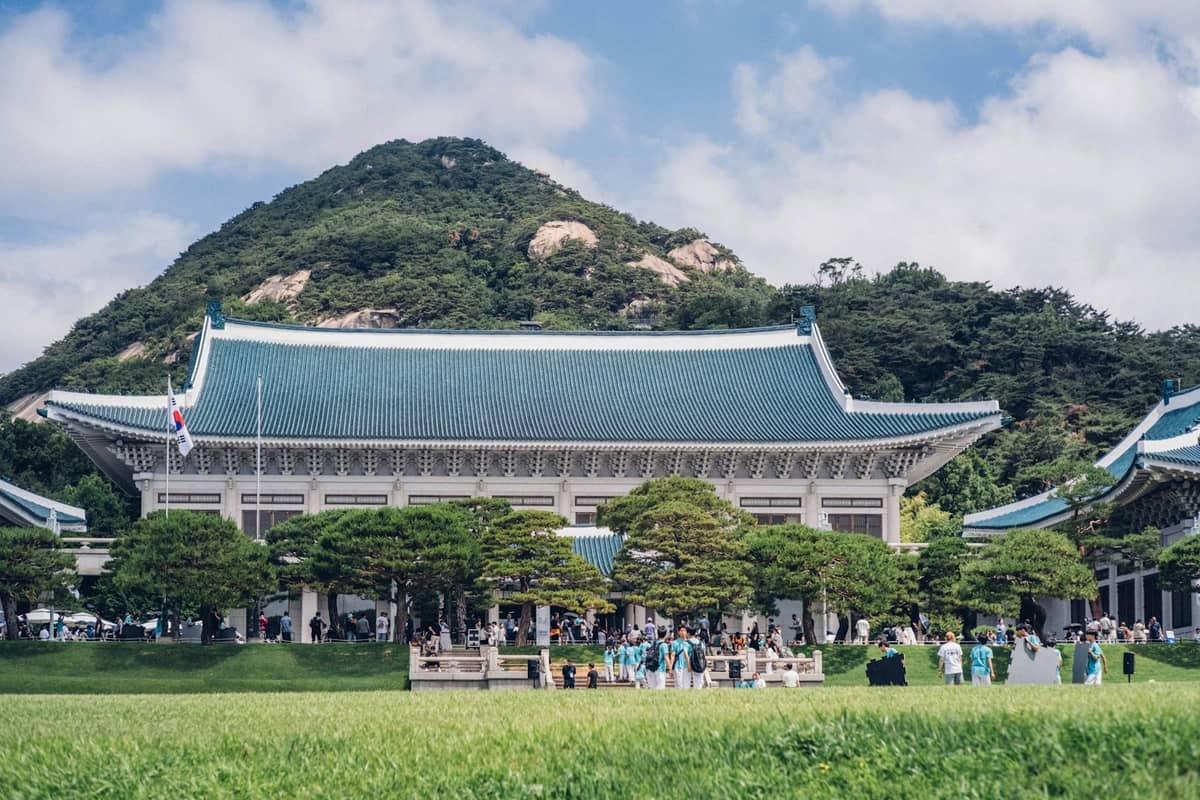
The name derives from The name derives from the blue roof tiles that cover the main hall, the Bon-gwan (main building). Seen from the right angle, especially when morning light catches the tiles at a low angle, the roof produces a deep luster that reads almost turquoise against the forested slopes of Bugaksan Mountain behind it. The effect is striking, and it is one of the few photographic moments in Seoul where the composition essentially arranges itself.
The complex sits directly north of Gyeongbokgung Palace, and the spatial relationship is not coincidental. Korea's royal court occupied this northern axis for centuries, and the placement of the presidential compound in the same corridor carried deliberate symbolic weight. Visitors who approach from Gwanghwamun and walk north through the palace grounds arrive at Cheong Wa Dae as part of a natural historical sequence, moving from Joseon dynasty to the modern republic in roughly forty minutes on foot.
💡 Local tip
The most efficient route from central Seoul: Take Line 3 to Gyeongbokgung Station, walk through the palace grounds (budget extra time if you want to explore), then exit via the north gate toward Cheong Wa Dae. Check the palace's opening hours before building your schedule, as they differ from Cheong Wa Dae's own hours.
The Grounds: What You Actually See
Cheong Wa Dae is not a single building. It is a compound of several structures spread across a broad, heavily landscaped estate. The main attraction is the Bon-gwan (main building), the blue-roofed main hall that appears in every photograph. Flanking it are secondary buildings that housed offices, reception rooms, and meeting facilities during the presidential era. The estate also includes a Cheong Wa Dae is not a single building. It is a compound of several structures spread across a broad, heavily landscaped estate. The main attraction is the Bon-gwan (main building), the blue-roofed main hall that appears in every photograph. Flanking it are secondary buildings that housed offices, reception rooms, and meeting facilities during the presidential era. The estate also includes formal garden areas and wooded paths that wind toward the base of Bugaksan, where a section of the old Seoul City Wall still runs along the ridge.
The working compound is closed to general visitors in 2026. History of the site and the presidency is covered at Cheongwadae Sarangchae, the free museum across the street, rather than in interior exhibits on the grounds. Photograph the gates from the plaza; do not plan on walking the lawns or collecting an audio guide at a public entrance.
The outdoor areas are the real draw. The lawn in front of the main hall is immaculately kept, and the framing of the blue roof against the mountain creates a composition that rewards patience. The surrounding trees are mature and dense, and in autumn they turn in ways that transform the scene entirely. Spring brings blossoming trees to the gardens, and the crowds respond accordingly.
Tickets & tours
Hand-picked options from our booking partner. Prices are indicative; availability and final rates are confirmed when you complete your booking.
DMZ and Lake Majang Suspension Bridge Tour from Seoul
From 57 €Instant confirmationFree cancellationHalf Day DMZ Tour from Seoul, 3rd Tunnel, Observatory and More
From 47 €Instant confirmationFree cancellationSeoul zombie city exploration game and private tour
From 10 €Instant confirmationFree cancellationLuggage Storage in Seoul
From 7 €Instant confirmationFree cancellation
Timing Your Visit: How the Experience Changes by Hour
The compound itself is closed to general visitors in 2026. Photograph the gates from the plaza and visit Cheongwadae Sarangchae, the free museum across the street. Weekday mornings are calmer for photos from outside the gates; do not plan on walking the interior lawns.
Midday in summer presents the most challenging conditions. The compound offers less shade than it might appear from maps, and the stone and concrete surfaces retain heat. The forested paths toward Bugaksan provide some relief, but the central lawn and the area immediately in front of the main hall can feel exposed between roughly 11:00 and 14:00 in July and August. Carrying water is not optional in that season.
Late afternoon visits, arriving around 15:30 to 16:00, offer a secondary sweet spot. Crowds begin to thin as the day progresses, and the light shifts to a warmer angle that flatters the blue tiles. The gardens also feel calmer at this hour. If you plan to combine Cheong Wa Dae with a walk along the nearby sections of the Hanyangdoseong city wall, the afternoon window allows time for both before dusk.
⚠️ What to skip
Do not plan an interior visit; the working compound is closed to tours. Arriving on a Tuesday is one of the most common planning mistakes for visitors combining this with a Gyeongbokgung visit, since the palace is also closed on Tuesdays. Double-check both schedules before planning this corridor for your trip.
Historical and Political Context Worth Knowing
The site where Cheong Wa Dae stands has political significance stretching back well before the modern republic. During the Joseon dynasty, this area served as a rear garden for Gyeongbokgung Palace. The Japanese colonial administration later used the location for official functions, and after liberation in 1945 and the establishment of the Republic of Korea in 1948, it transitioned into the presidential residence. The current main hall was constructed in 1991, The site where Cheong Wa Dae stands has political significance stretching back well before the modern republic. During the Joseon dynasty, this area served as a rear garden for Gyeongbokgung Palace. The Japanese colonial administration later used the location for official functions, and after liberation in 1945 and the establishment of the Republic of Korea in 1948, it transitioned into the presidential residence. The current main hall was constructed in 1991 in a style that blends traditional Korean architectural forms with a modernized structural approach.
Several South Korean presidents faced significant political turbulence that played out in this compound. The 1979 assassination of President Park Chung-hee occurred elsewhere, but the impeachment, removal, and subsequent conviction of Park Geun-hye in 2017, following mass candlelight protests in Gwanghwamun Square, is the episode most directly linked to the decision to eventually relocate the presidential office and open this site to the public. These events give the grounds a weight that goes beyond architectural tourism. The resignation and subsequent conviction of Park Geun-hye in 2017, following mass candlelight protests in Gwanghwamun Square, is the episode most directly linked to the decision to eventually relocate the presidential office and open this site to the public. These events give the grounds a weight that goes beyond architectural tourism.
Understanding this history makes a subsequent visit to Gwanghwamun Square more meaningful. The square where those 2016 and 2017 protests gathered is directly south of Gyeongbokgung, visible from the palace gate, and now an open civic space. The physical proximity of protest site to presidential compound is part of the urban geography of Korean democracy.
Photography, Accessibility, and Practical Details
Photography is permitted throughout the grounds, including in front of the main hall. The central lawn axis, with the Bon-gwan (main building)'s blue roof centered against the mountain, is the standard shot and it works because the composition is genuinely good. Wider lenses capture the full frame including the flanking trees; longer focal lengths isolate the roof tiles and allow detail shots of the distinctive ceramic texture. Overcast days, common in Seoul's shoulder seasons, produce even and flattering light that works better for this subject than harsh midday sun.
The main paths through the compound are paved and generally accessible. The estate is large, and visitors who have difficulty with extended walking should plan their route carefully and prioritize the central buildings over the more distant forested paths toward the mountain. Wear comfortable shoes regardless: the grounds are larger than they appear from the entrance, and the full perimeter walk involves meaningful elevation changes near the mountain trails. Official accessibility information is limited in currently available sources, so visitors with specific requirements should check the official site at en.president.go.kr before visiting.
The surrounding neighborhood, part of the broader Jongno and Bukchon area, rewards wandering before or after your visit. The streets west of the compound, particularly along Hyoja-ro, have traditional cafes, small restaurants, and a quieter residential atmosphere that contrasts with the tourist intensity of Insadong further south. This pocket of the neighborhood is sometimes overlooked precisely because visitors rush between the major palace and Blue House sites.
Who Will Get the Most From This Visit (and Who Might Not)
Cheong Wa Dae rewards visitors who arrive with some prior knowledge of modern Korean political history. The site is genuinely significant, and the main hall is architecturally striking, but the compound does not have the layered sensory richness of a place like Changdeokgung Palace, which has centuries of garden design and a deeper interior experience. If you are primarily drawn to historic atmosphere, traditional Korean architecture, and quiet contemplation, the nearby royal palaces may offer more per hour of your time.
For travelers with a serious interest in how modern democracies work, how political power is spatially organized, or how a country processes its own turbulent recent history, Cheong Wa Dae is among the more unusual experiences Seoul offers. It is also genuinely free, which is worth noting for anyone following a budget-conscious Seoul itinerary. The combination of no admission cost, a striking visual centerpiece, and direct connections to Gyeongbokgung makes it easy to justify even on a tight schedule.
Visitors primarily interested in shopping, food markets, or nightlife will find little here to hold their attention. Children who have not been prepared for the historical context may find the grounds pleasant but not particularly engaging compared to other Seoul attractions designed with younger visitors in mind. The site is also not ideal in heavy rain: the open lawns and paths become slippery, and the reflective quality of the blue tiles is largely lost under grey skies.
Combining Cheong Wa Dae With the Surrounding Area
A full day in this part of Jongno-gu can reasonably cover Gyeongbokgung Palace, Cheong Wa Dae, and a portion of the Hanyangdoseong Seoul City Wall trail that runs north from the compound toward Bugaksan. The wall section in this area is one of the better-preserved stretches in the city, and the ridge views over Seoul from the wall path are among the most dramatic available without a dedicated hike. This extension adds approximately one to two hours depending on pace and fitness.
East of the compound, Bukchon Hanok Village is within walking distance and provides a strong visual contrast: where Cheong Wa Dae is monumental and modern-institutional, Bukchon is intimate, residential, and historically layered in a different way. The two sites complement each other well on the same afternoon, though Bukchon's lanes can be very crowded on weekends and public holidays.
Insider Tips
- Photograph the blue-tiled main hall and gates from the plaza; weekday mornings are quieter.
- Cross the street to Cheongwadae Sarangchae, the free museum that covers the compound's history without entering the working grounds.
- Pair the plaza stop with Gyeongbokgung the same morning — both are typically closed on Tuesdays.
- Bugaksan trails above the compound still give a mountain backdrop without walking the interior lawns.
- In late October the ginkgo along the approach streets turn gold against the blue roof — all visible from outside the gates.
Who Is Cheong Wa Dae (The Blue House) For?
- Travelers with an interest in modern Korean political history and the architecture of power
- Visitors on a tight budget who want a substantive, free attraction in the historic palace district
- Photography-focused travelers looking for an iconic and freely accessible architectural subject
- Those combining multiple Jongno-gu sites into a full-day historical walk
- Anyone curious about the public face of the presidential compound — the plaza, gates, and the free Sarangchae museum
Nearby Attractions
Other things to see while in Jongno & Bukchon:
- Bukchon Hanok Village
Bukchon Hanok Village (북촌한옥마을) is a preserved residential district of roughly 860 traditional Korean hanok houses in central Seoul, situated between Gyeongbokgung and Changdeokgung palaces. Unlike a museum or theme park, it is a real neighborhood where people still live, which shapes every aspect of visiting it. Entry is free, but access to certain alleys is restricted to protect residents.
- Changdeokgung Palace & Secret Garden
Changdeokgung Palace is the best-preserved of Seoul's five Joseon-era royal palaces, and its rear garden — the Huwon, known as the Secret Garden — remains one of the most atmospheric green spaces in the entire city. Together, they form a UNESCO World Heritage Site that rewards visitors who plan ahead.
- Changgyeonggung Palace
One of Seoul's five grand Joseon-era palaces, Changgyeonggung Palace sits in Jongno-gu and offers a quieter royal grounds experience. With late evening opening hours, low admission, and centuries of layered history, it rewards visitors who arrive without high expectations and leave with quiet satisfaction.
- Gwanghwamun Square
Gwanghwamun Square stretches 40,300 square meters through the center of Seoul, framed by Gyeongbokgung Palace to the north and the distant peaks of Bugaksan beyond. It is free, open 24 hours, and carries more historical weight than most visitors realize on first pass.