Teufelsberg: Berlin's Cold War Spy Station on a Hill of Rubble
Teufelsberg is a former U.S. signals intelligence station perched on a man-made hill of wartime rubble in the Grunewald Forest. No longer used for military purposes, it now hosts street art, panoramic views, and one of Berlin's most layered histories. Equal parts ruin, art gallery, and Cold War monument.
Quick Facts
- Location
- Teufelsseechaussee 10, 14193 Berlin, within Grunewald Forest
- Getting There
- S-Bahn S7 to Grunewald, then approx. 30-min walk or bus; free public parking at Teufelsberg parking lots on Teufelsseechaussee (not on the access road or station grounds)
- Time Needed
- 1.5 to 2.5 hours including the forest walk
- Cost
- Adults €12, Concessions €10, Children & teenagers €5, Under 7 free
- Best for
- Cold War history, street art, photography, panoramic views
- Official website
- http://teufelsberg-berlin.de
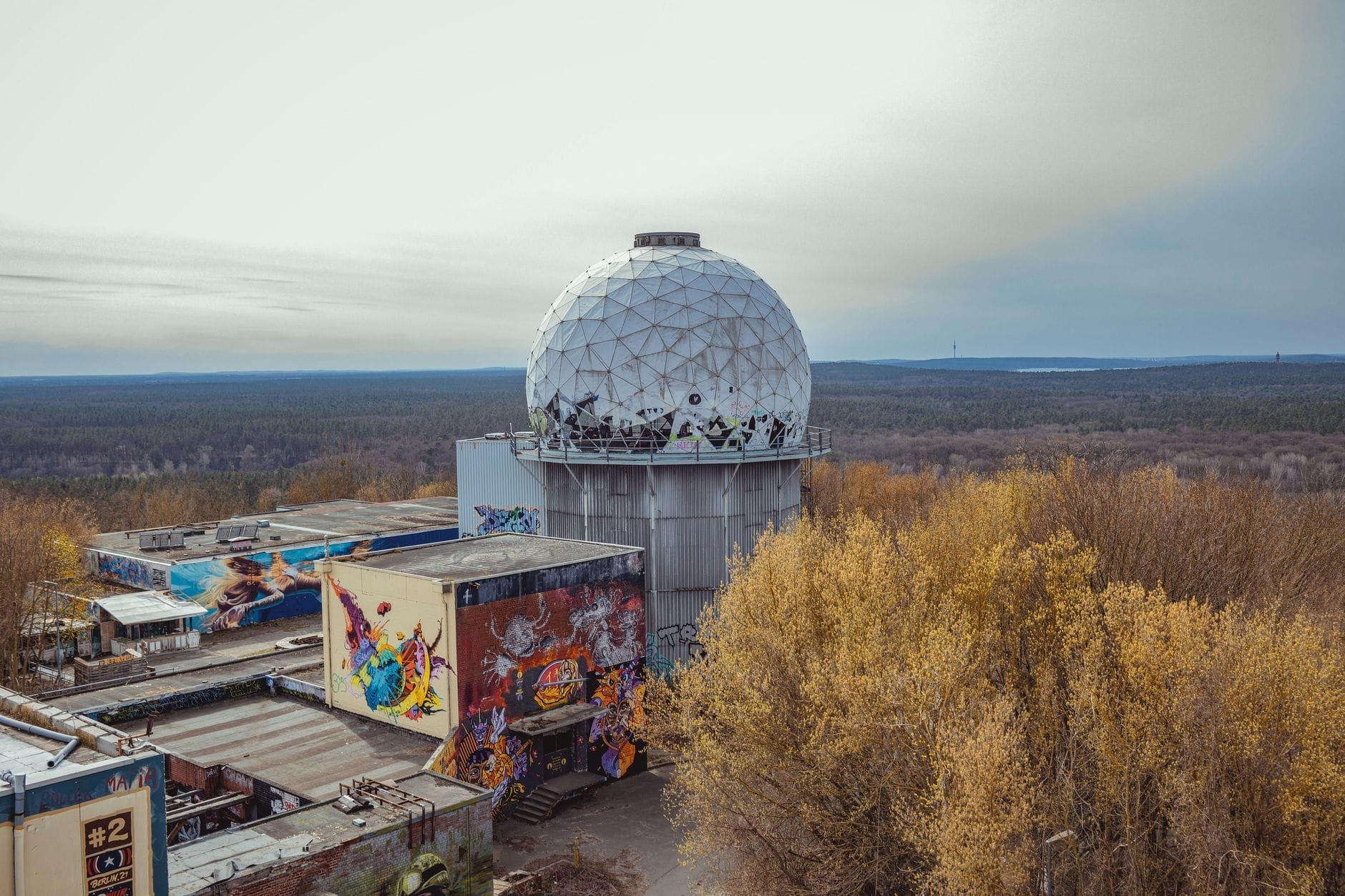
What Teufelsberg Actually Is
Teufelsberg, which translates literally as Devil's Mountain, is one of the most structurally strange sites in Europe. The hill itself is not natural. It is a man-made mound of rubble, roughly 26 million cubic metres of it, dug from the ruins of bombed-out Berlin after World War II and piled over an unfinished Nazi military-technical college (the Wehrtechnische Fakultät) that engineers decided was too costly to demolish. That buried structure still sits underneath, essentially entombed. Rising to 120.1 metres above sea level, Teufelsberg is one of the highest elevations in Berlin, and the panoramic view it offers stretches across the Grunewald Forest canopy toward the city skyline.
On top of this Cold War-era rubble hill, the United States National Security Agency and its British counterpart GCHQ operated Field Station Berlin, a signals intelligence post that monitored Soviet and Warsaw Pact military communications throughout the Cold War. The radomes, those distinctive white geodesic domes that resemble giant golf balls, were designed to conceal listening antennae from visual and satellite observation. The station was shuttered around 1989 to 1990 following German reunification, and the complex has been deteriorating, evolving, and accumulating street art ever since.
ℹ️ Good to know
Opening hours follow sunset: the site opens daily at 11:00, with last admission one hour before sunset. Closing time varies seasonally; check the official site before visiting, as closures for private events do occur.
The Approach: Forest Walk and First Impressions
Getting to Teufelsberg is part of the experience. From the public parking area on Teufelsseechaussee, a roughly 10-minute uphill walk on a private gravel road brings you through a dense section of Grunewald Forest before the structures emerge through the tree line. In the morning, the path is quiet and shaded, with birdsong replacing city noise entirely. On weekends, small groups tend to cluster at the base waiting to enter together, which can create a mild bottleneck around midday.
The forest setting is not incidental. Teufelsberg sits within the Grunewald Forest, one of Berlin's largest green lungs, and the contrast between dense woodland and the sudden appearance of crumbling concrete towers creates an atmosphere that photographs struggle to capture accurately. Wear sturdy, flat shoes; the uphill path and uneven site surfaces are not suitable for sandals or dress shoes.
Tickets & tours
Hand-picked options from our booking partner. Prices are indicative; availability and final rates are confirmed when you complete your booking.
Skip-the-line ticket for Gemaldegalerie Berlin
From 14 €Instant confirmationPanoramapunkt Berlin ticket with skip-the-line option
From 9 €Instant confirmation1-Hour Berlin Spree River Cruise with On-Board Guide
From 21 €Instant confirmationFree cancellationSamurai Experience Berlin skip-the-line ticket
From 15 €Instant confirmation
Inside the Station: Ruins, Radomes, and Street Art
The admission fee of €12 for adults covers entry to the site, access to street art installations across the complex, and exhibitions about the Allies housed within several of the remaining buildings. The structures themselves are in a state of managed decay: graffiti and murals cover nearly every concrete surface, the result of over three decades of open-air art accumulation. This is not a polished gallery space. Paint peels from walls that were once classified military installations. Broken glass was cleared from many interior corridors, but the atmosphere is deliberately raw.
The radome towers are the visual centrepiece. You can climb inside the main dome structures, where the curved interior walls create an extraordinary acoustic effect: even a whisper at one side of the circular chamber carries clearly to the opposite wall. This is not an advertised feature, but it surprises almost every visitor who stumbles onto it. The effect is strongest when the dome is not crowded, which means early weekday mornings offer the best version of this encounter.
Street art ranges from enormous panoramic murals to smaller stencil work tucked into doorframes and stairwells. The quality varies significantly. Some pieces are genuinely accomplished; others are tagging. If you approach Teufelsberg expecting a curated art experience, you will find it partially. If you expect pure ruin aesthetics with art layered on top, that is more accurate.
💡 Local tip
Photography tip: the interior of the main radome is exceptional for wide-angle and fisheye lens work. Midday produces the harshest light on exterior walls. Overcast days or the hour before closing in summer give the most atmospheric results with even light across the murals.
The View from the Top
The observation platform near the summit delivers one of the more unusual panoramas in Berlin. Rather than the urban density you see from the Fernsehturm, this view is largely green: the Grunewald canopy stretches in every direction, with the city skyline emerging at the edges. On clear days you can identify the Berliner Dom, the television tower, and on exceptional winter days with low humidity, the Muggelberge hills to the east.
For context on how Teufelsberg fits into Berlin's broader skyline options, the Berlin viewpoints guide covers the full range from the Reichstag dome to rooftop bars, which helps put this wilder, more remote vantage point in perspective.
Sunset visits are popular and justifiably so, but note that the last admission is one hour before sunset. If you arrive too late, you will be turned away at the entrance. Plan to arrive at least 90 minutes before sunset to have adequate time inside.
Cold War Context: Why This Place Matters
The history layered into Teufelsberg is genuinely remarkable and runs in three distinct directions. First, the buried Nazi building beneath the hill: the Wehrtechnische Fakultät was planned as a technical faculty for military engineering and was still under construction when the war ended. The decision to simply bury it rather than demolish it resulted in a large artificial hill that has complicated redevelopment plans for the site, which is part of why development proposals have repeatedly collapsed. Second, the Cold War listening apparatus above it: Field Station Berlin was one of the most sophisticated signals intelligence operations the Western alliance ran in Europe, positioned specifically because the elevated site gave clear radio line-of-sight over the Iron Curtain. Third, the post-reunification years of artistic squatting, investment collapses, and eventual current management that turned the ruin into a ticketed attraction.
Visitors with deeper interest in Cold War Berlin will find it worth combining Teufelsberg with the Stasi Museum in Lichtenberg and the Cold War Berlin guide, which maps the full geography of surveillance, division, and military infrastructure across the city.
Practical Walkthrough: How to Visit
There is no U-Bahn stop close to Teufelsberg. The most reliable public transport option is the S7 S-Bahn line to Grunewald station, followed by a roughly 30-minute walk through the forest. Alternatively, driving or cycling to the free gravel parking lots on Teufelsseechaussee near the start of the hill cuts the total walking distance significantly. Parking is not permitted on the private access road to the station or on the grounds themselves.
Tickets can be purchased at the entrance. The site is generally open daily from 11:00 until sunset, but private events and holiday closures (such as 24 and 31 December) can limit public access; checking the official site before a long journey out is sensible. There are basic facilities on-site including a small café area, but nothing elaborate. Bring water, particularly in summer, as the uphill walk and exposed summit can be warmer than the forest paths.
Accessibility is a genuine limitation here. The uphill forest path, uneven rubble surfaces, and multi-level interior structures make the site difficult for wheelchair users or visitors with significant mobility constraints. This is not a venue where accessibility workarounds are available; the physical character of the ruin is inseparable from the experience.
⚠️ What to skip
Teufelsberg is occasionally closed for private events without much advance public notice. Check the official site or call ahead if you are making a special trip, especially on weekends.
Who Will Love It and Who Should Skip It
Teufelsberg rewards visitors who are comfortable with ambiguity: it is part ruin, part art space, part history site, and none of these completely. If you need polished interpretation, clean exhibits, and clear narrative signage, this will disappoint. The Allied museum exhibitions add some context, but the site does not hold your hand through its history. For that kind of structured Cold War experience, Topography of Terror or the Berlin Wall Memorial are significantly more informative.
Visitors who find the combination of forest hike, architectural decay, street art, and Cold War atmosphere compelling will leave satisfied. Photographers, urban explorers, and history-minded travelers who already have the basic Berlin narrative in hand will find Teufelsberg genuinely distinctive. Families with very young children should weigh the uphill walk and uneven surfaces; the children's ticket price reflects that younger visitors can attend, but it is not a designed family attraction.
Insider Tips
- The acoustic whispering gallery effect inside the main radome dome is not advertised anywhere. Walk to one side of the circular interior, whisper toward the wall, and someone standing at the opposite side of the dome will hear you clearly. It works best when the space is not crowded, so try it early or on a weekday.
- Weekday mornings, particularly Tuesday through Thursday, see a fraction of the weekend crowds. The forest walk feels genuinely solitary and the site allows real contemplation of the space without tour groups filling every stairwell.
- If the light is flat or overcast, the street art murals photograph far better than in harsh midday sun. Overcast days are actually preferable for interior and mural photography at Teufelsberg.
- The Teufelssee, a small lake the hill is named after, is a short walk from the parking area through the Grunewald. Combining a summer visit with a swim in the lake makes for a full half-day in the forest without needing to return to the city centre.
- The site's unusual origins, with a buried Nazi building beneath a massive rubble hill, have contributed to decades of contested redevelopment proposals. Mentioning this to staff occasionally sparks a more detailed conversation about the site's contested future.
Who Is Teufelsberg For?
- Cold War and espionage history enthusiasts who want physical context beyond plaques and glass cases
- Photographers seeking unusual textures, decay aesthetics, and panoramic forest views
- Urban explorers and architecture-minded travelers drawn to adaptive reuse and ruin
- Travelers who want a counterpoint to central Berlin's dense tourist circuit
- Street art followers looking for large-scale murals in an unconventional setting
Nearby Attractions
Combine your visit with:
- Grunewald Forest
Grunewald Forest is Berlin's largest forested area, stretching across 3,000 hectares in the city's west. Free to enter and open at all hours, it offers lakes, woodland trails, a Renaissance hunting lodge, and genuine quiet within one of Europe's great capital cities.
- House of the Wannsee Conference (Gedenk- und Bildungsstätte)
On 20 January 1942, fifteen Nazi officials met in a lakeside villa southwest of Berlin and coordinated the systematic murder of European Jews. The House of the Wannsee Conference is now a permanent memorial and educational site. Admission is free. The experience is unforgettable.
- Olympiastadion Berlin
Built for the 1936 Summer Olympics and thoroughly renovated in 2004, the Olympiastadion Berlin is one of Europe's most architecturally significant sports venues. With a capacity of about 74,500, it hosts Hertha BSC matches, major concerts, and regular sightseeing visits that take you from pitch level to the roof walkway.
- Sanssouci Palace and Park (Potsdam)
Built for Frederick the Great between 1745 and 1747, Sanssouci Palace is Germany's most celebrated royal summer retreat. Set within a UNESCO-listed park of terraced vineyards, fountains, and baroque pavilions just outside Potsdam, it rewards visitors who arrive early and stay long.