Terezín Memorial: A Complete Visitor's Guide to Prague's Most Sobering Day Trip
Located 70 km north of Prague, the Terezín Memorial preserves the site of the Nazi-era Theresienstadt Ghetto and concentration camp. This is not a casual sightseeing stop, but for travelers seeking to understand 20th-century European history at its darkest, it is one of the most important sites in Central Europe.
Quick Facts
- Location
- Principova alej 304, 411 55 Terezín, Czech Republic — approx. 60 km north of Prague
- Getting There
- Bus from Prague's Letňany station on bus line 413 toward Litoměřice; alight at Terezín stop. Small Fortress is a short walk from the bus stop.
- Time Needed
- 4–6 hours minimum to cover the main sites meaningfully; a full day is recommended
- Cost
- Approx. 310 CZK per adult (Small Fortress + Ghetto Museum + Magdeburg Barracks); family/group discounts available. Free on 27 January and the third Sunday in May. Verify current prices at the official site.
- Best for
- History travelers, students of WWII and the Holocaust, those seeking context beyond Prague's Old Town
- Official website
- www.pamatnik-terezin.cz/?lang=en
What Is Terezín Memorial?
The Terezín Memorial (Czech: Památník Terezín) stands on the site of one of the most cynically constructed deceptions of World War II. The town of Terezín, built in 1780 as an 18th-century military fortress by the Habsburg Emperor Joseph II and named after his mother Maria Theresa, was converted by Nazi authorities in 1941 into the Theresienstadt Ghetto and concentration camp. Approximately 150,000 Jewish men, women, and children were imprisoned here during the war. For tens of thousands, it was a transit point to Auschwitz and other extermination camps to the east.
Nazi propaganda officials used Theresienstadt as a showpiece, staging a visit for International Red Cross inspectors in 1944 to argue that Jewish deportees were being treated humanely. A propaganda film was even shot here. The gap between that fabricated image and the starvation, disease, and death that defined life inside the walls is central to what the Memorial now works to document and preserve.
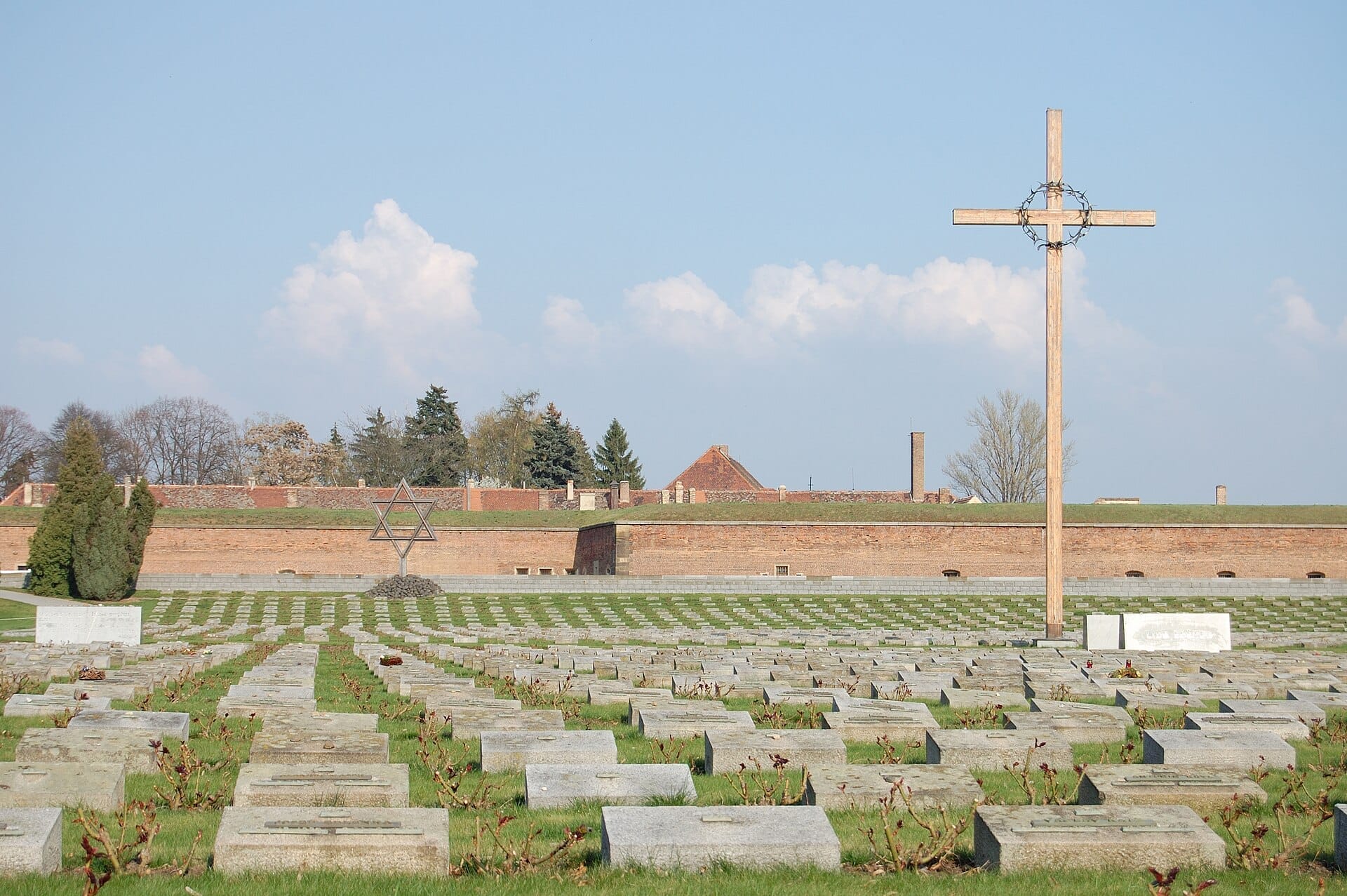
A Czechoslovak government decision in May 1947 established a Memorial to National Suffering at the site. It was officially renamed the Terezín Memorial in 1964 and has since grown into a complex of interconnected sites: the Small Fortress, the Ghetto Museum, the Magdeburg Barracks, the Old Jewish Cemetery, and the Crematorium, among others. Each tells a different part of the story.
ℹ️ Good to know
Opening hours are seasonal. Summer (approx. April–October): 09:00–17:00. Winter: 09:00–16:00. The Memorial is closed 24–26 December and 1 January. Always confirm current hours at the official website before your visit.
The Three Main Sites and What Each Contains
Small Fortress (Malá pevnost)
The Small Fortress is the most viscerally striking part of the complex. Used as a prison for political detainees under the Habsburgs — and the place where Gavrilo Princip, the assassin of Archduke Franz Ferdinand, was held and died — it became a Gestapo prison during the Nazi occupation. The stone-walled corridors, isolation cells, and execution grounds are largely preserved in their original state. The entrance gate carries the notorious inscription "Arbeit Macht Frei" (Work Makes You Free), identical in tone to the signs at other camps.
Walking through the Small Fortress, the scale is unnerving. The walls are thick and the light is low in the cell blocks. There is almost no ornamentation, no softening of any surface. Many visitors walk these corridors quietly, often stopping at the display boards without speaking. The space earns that silence without demanding it.
Ghetto Museum (Muzeum Ghetta)
Located in the town itself, the Ghetto Museum uses documents, photographs, and personal objects to reconstruct the daily life of those imprisoned in the ghetto that occupied Terezín's residential streets. It is less architecturally confronting than the Small Fortress, but arguably more emotionally complex. The museum documents the cultural life that prisoners managed to maintain: clandestine art classes, concerts, theatrical productions, even a children's opera (Brundibár) performed dozens of times under impossible conditions.
This tension, between the creativity prisoners sustained and the death that awaited most of them, is what distinguishes Terezín's history from a simple narrative of victimhood. The Ghetto Museum handles it with precision rather than sentimentality, which makes it more, not less, affecting.
Magdeburg Barracks and Other Sites
The Magdeburg Barracks served as the seat of the Jewish Council of Elders during the ghetto period. Today, one wing is reconstructed to show a women's dormitory as it would have appeared, and another houses an exhibition specifically devoted to the cultural life of the ghetto: music, fine art, cabaret, and literature created in the shadow of deportation. Artists whose work is displayed here include Pavel Friedman, Petr Kien, and dozens of others, most of whom were later killed. The Old Jewish Cemetery, the Crematorium, and the National Cemetery are also accessible within the memorial complex and require walking between sites.
💡 Local tip
A combined adult ticket (approx. 310 CZK) covers the Small Fortress, Ghetto Museum, and Magdeburg Barracks. Guided tours are included in the ticket price, which is worth noting since the commentary at each site adds significant context you won't get from the display boards alone.
Tickets & tours
Hand-picked options from our booking partner. Prices are indicative; availability and final rates are confirmed when you complete your booking.
Tour of Terezin Concentration Camp Memorial from Prague
From 55 €Instant confirmationFree cancellationTerezin Monument guided tour from Prague
From 63 €Instant confirmationFree cancellationTerezin and Ghetto Museum guided tour from Prague
From 73 €Instant confirmationFree cancellationTerezin tour from Prague including ticket and audio guide
From 59 €Instant confirmationFree cancellation
How to Get There from Prague
Terezín sits about 70 km north of Prague, making it a natural day trip from Prague. The most practical public transport option is a bus from Prague's Nádraží Holešovice station toward Litoměřice or Ústí nad Labem, with the Terezín bus stop serving the town directly. Journey time is typically around one hour. From the bus stop, the Small Fortress is a short walk.
Organized coach tours from Prague are widely available and usually include round-trip transport, a guided tour of the main sites, and commentary in English. For travelers who prefer to arrange their own schedule, the public bus is reliable and considerably cheaper. Driving is also straightforward via the D8 motorway north from Prague.
Plan your departure from Prague early. The last bus back to the city departs in the afternoon, and if you intend to spend four to six hours on site, an 08:00 or 09:00 departure from Prague is sensible. Do not try to fit Terezín into a half-day.
⚠️ What to skip
The sites spread across the town and surrounding area. Walking between the Small Fortress, Ghetto Museum, and the cemetery involves outdoor stretches of 1–2 km in each direction. Wear comfortable, flat shoes. In wet weather, some surfaces become slippery, and there is limited shelter between buildings.
What the Visit Feels Like: Atmosphere and Sensory Reality
Terezín does not look like most people's mental image of a concentration camp. The town is a real grid of streets, late-Baroque fortification walls, and pale ochre buildings. On a sunny morning, the town square looks almost peaceful, with a few local residents and cyclists passing through. That normality is precisely what makes it disorienting. This was a place where people lived, were imprisoned, suffered, and were sent to their deaths, inside what looks like a provincial Czech town.
Inside the Small Fortress, the atmosphere changes sharply. The air in the cell blocks is cool even in summer, with a faint smell of damp stone. The courtyards are open to the sky, which makes the enclosing walls feel taller. Morning visits, before larger groups arrive, allow you to move at your own pace through the exhibitions without crowding. By early afternoon, organized tour groups begin to cycle through, which can make the cell blocks congested and reduce the ability to read display panels carefully.
Photography is permitted throughout most of the site, but the Memorial naturally encourages discretion. Visitors who arrive expecting a dramatic visual experience may find Terezín quieter and more austere than they anticipated. The power of the place is cumulative, built from small details: a list of names, a child's drawing, the dimensions of a cell shared by dozens of people. It takes time, and it is worth giving it time.
Practical Intelligence: Before You Go
Terezín Memorial is open daily (with the noted holiday closures), with summer hours running approximately 09:00 to 17:00 and winter hours to 16:00. The exact schedule for each individual site within the complex is listed on the official Memorial website, and it is worth checking this before your visit since different buildings may have slightly different closing times.
Admission is free on 27 January, International Holocaust Remembrance Day, and on the third Sunday in May, which is the date of the annual Terezín Commemoration ceremony. These dates draw larger attendances, including official delegations and survivors' families. Visiting on a commemoration date is meaningful, but it is a different kind of visit than a standard weekday.
There is a small café and toilet facilities on site. There are no restaurants inside the Memorial complex itself. The town of Terezín has limited food options. If you plan a full day, bring water and snacks, particularly if visiting in summer.
For travelers planning a broader itinerary, Terezín pairs logically with Prague's own Holocaust-related sites in Josefov, including the Pinkas Synagogue, where the names of nearly 78,000 Bohemian and Moravian Jewish victims are inscribed on the walls, and the Old Jewish Cemetery. Visiting Josefov before or after Terezín gives the trip a coherent historical arc.
Accessibility and Who Should Plan Carefully
The Memorial encompasses preserved historic fortifications and older buildings. Some interiors have stairs, and outdoor surfaces can be uneven, particularly in the Small Fortress courtyards and along the paths connecting sites. Visitors with limited mobility should contact the Memorial directly before their visit to get current information about accessible routes and facilities.
The content throughout the Memorial is intense by nature. Parents should consider whether younger children are prepared for detailed accounts of suffering, starvation, and mass death. The Memorial does not soften its material. Some families visit with children as part of deliberate Holocaust education, and the staff are experienced with school groups, but this is a decision individual families need to make thoughtfully.
Travelers who are short on time and focused exclusively on Prague's architectural and cultural highlights may find Terezín requires more emotional and physical energy than their itinerary allows. If you are working through a 3-day Prague itinerary, be realistic about the commitment this site demands. It is not an attraction you visit between two others on the same afternoon.
Why This Site Matters Beyond the History Books
The Terezín Memorial is not a reconstruction or a museum built to resemble a historical site. Much of what you walk through is the original structure, the actual cells, the actual walls, the actual gateway. That is the difference between reading about this period and standing inside it. For anyone who has engaged with the history of the Holocaust through books, film, or the broader history of Prague, the Memorial translates that knowledge into physical, spatial reality in a way nothing else replicates.
The Memorial also does something many comparable sites struggle with: it treats visitors as adults capable of engaging with complexity. The exhibitions do not simply catalogue atrocity. They document resistance, creativity, community, and the individual humanity of people who were systematically denied it. That balance is harder to achieve than it sounds, and it is one reason Terezín remains one of the most significant memorial sites in Central Europe.
Insider Tips
- Arrive at the Small Fortress when it opens, around 09:00 in summer. The first hour before organized tour groups arrive gives you the cell blocks and courtyards almost to yourself, which significantly changes the quality of the experience.
- The guided tours included in the ticket price are available in multiple languages. If your visit coincides with an English-language tour, join it even if you prefer to explore independently, the guides at Terezín are notably knowledgeable and provide context not covered in the wall panels.
- Visit the Pinkas Synagogue in Prague's Josefov quarter either before or after your Terezín trip. The 78,000 names inscribed on its walls include many who passed through Terezín, and the connection between the two sites is deeply clarifying.
- Bring more food and water than you think you need. The walk between the Small Fortress, Ghetto Museum, and other outlying sites is longer than maps suggest, especially in summer heat. There is no reliable food option inside the complex.
- On 27 January (International Holocaust Remembrance Day), admission is free and the Memorial holds commemorative events. It is a more crowded visit but a genuinely moving one, and if your Prague trip coincides with that date, it is worth rearranging your schedule to go.
Who Is Terezín Memorial For?
- Travelers with a serious interest in WWII history and the Holocaust
- Students and educators on educational travel
- Visitors who have already explored Prague's Josefov Jewish Quarter and want deeper context
- Anyone spending a week or more in Prague who wants to move beyond the central city
- Those visiting on 27 January or the third Sunday in May for the annual commemoration
Nearby Attractions
Combine your visit with:
- Český Krumlov
Český Krumlov is a medieval South Bohemian town wrapped in a horseshoe bend of the Vltava River, home to the second-largest castle complex in the Czech Republic and a UNESCO-protected historic centre. It makes for one of the most rewarding day trips or overnight stays from Prague, though it demands some planning to do properly.
- Divoká Šárka Nature Reserve
Divoká Šárka is a protected nature reserve on Prague's northwestern edge where limestone gorges, steppe grasslands, and a reservoir beach sit just 30 minutes from the city centre. Entry is free, trails are open year-round, and the landscape shifts dramatically with the seasons.
- Karlovy Vary
Karlovy Vary (historically Carlsbad) sits in a steep river valley about 120 km west of Prague, its colonnades and pastel-colored Grand Hotels reflected in the Teplá River. A UNESCO World Heritage site and the oldest spa town in Bohemia, it rewards a full day — or longer — with thermal springs, ornate promenades, and an atmosphere unlike anything in the Czech capital.
- Karlštejn Castle
Founded in 1348 by Holy Roman Emperor Charles IV as a treasury for the Imperial Regalia and Bohemian crown jewels, Karlštejn Castle rises from a limestone ridge above a quiet Bohemian village. Roughly 30 km southwest of Prague and 40 minutes by train, it is one of the most architecturally intact Gothic royal complexes in Central Europe. All interior visits are guided tours only, and the hilltop setting demands a 20-minute uphill walk from the station.