Tennessee Performing Arts Center (TPAC): Nashville's Home for Live Performance
Founded in 1980 and located in the heart of downtown Nashville, the Tennessee Performing Arts Center is the city's premier destination for Broadway touring productions, opera, ballet, and contemporary performance. Four distinct venues — from the 2,472-seat Andrew Jackson Hall to the intimate 264-seat Andrew Johnson Theater — mean there is almost always something worth catching here.
Quick Facts
- Location
- 505 Deaderick Street, Downtown Nashville, TN 37243
- Getting There
- Central downtown location; walkable from most Downtown hotels. WeGo bus routes serve the Capitol area on Deaderick Street. Rideshare drop-off is straightforward.
- Time Needed
- 2.5–3 hours for an evening performance; allow extra time for pre-show dining nearby
- Cost
- No charge to enter the building; ticket prices vary by show and seat. Check tpac.org for current pricing.
- Best for
- Broadway fans, date nights, classical music lovers, families with older children
- Official website
- www.tpac.org
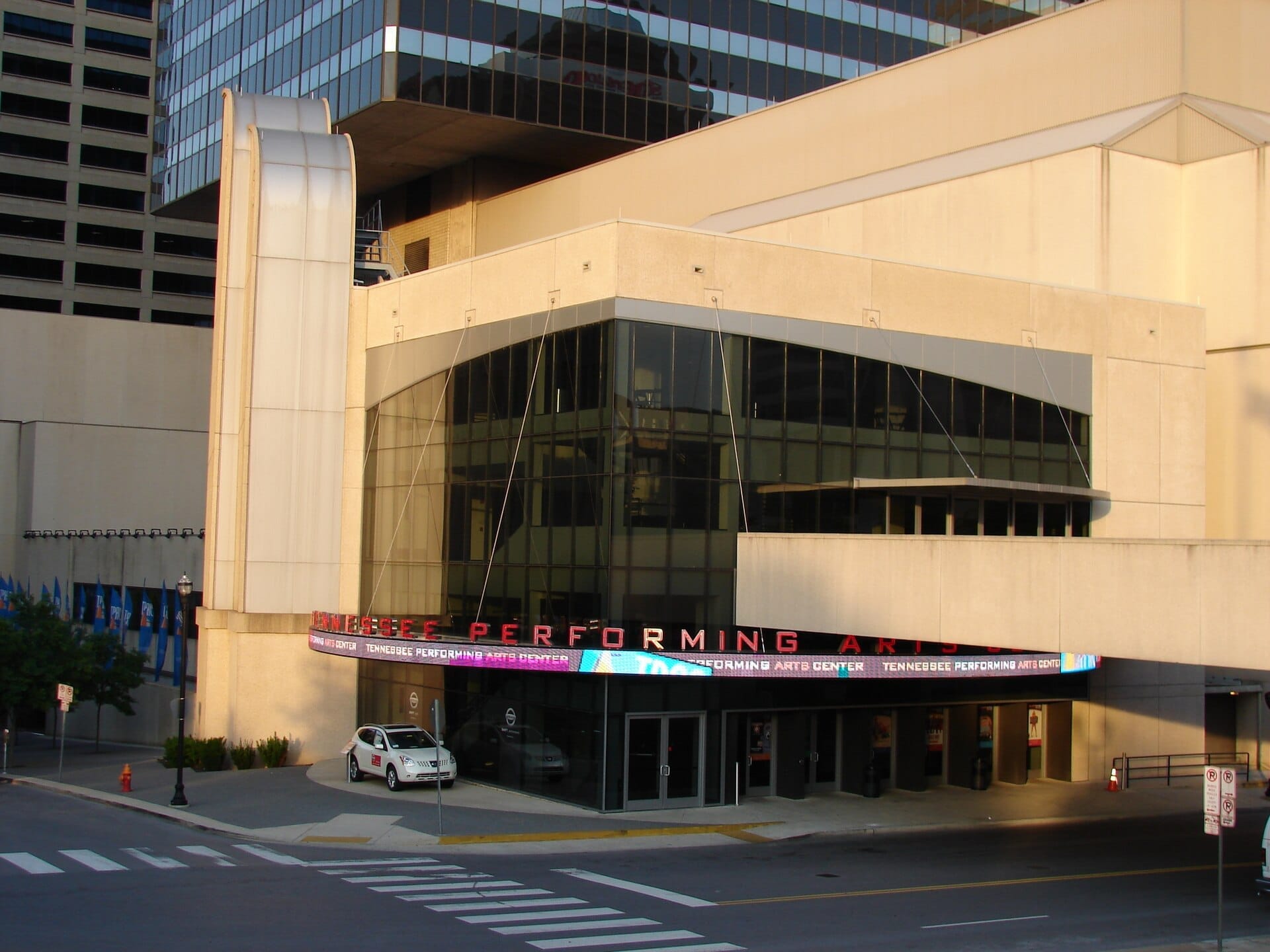
What TPAC Actually Is
The Tennessee Performing Arts Center is not a single theater. It is a complex of four separate performance venues housed inside the James K. Polk Cultural Center on Deaderick Street in downtown Nashville, with the historic War Memorial Auditorium — a fourth venue formerly managed by TPAC — located directly across the street. Since opening in 1980, TPAC has welcomed several hundred thousand audience members each year, making it one of the most prominent performing arts institutions in the American South.
For visitors who associate Nashville primarily with country music and honky-tonks, TPAC comes as a genuine counterpoint. This is where you catch a touring Broadway production of Hamilton or Hadestown, an evening with the Nashville Ballet, a Nashville Opera performance, or a touring comedian filling the main hall. The programming calendar is wide enough that a given weekend might have a children's matinee running in the smallest theater while a full orchestral show fills Andrew Jackson Hall the same evening.
💡 Local tip
Box office hours follow the performance schedule, not fixed daily hours. Always check tpac.org or call 615-782-4040 before visiting, especially if you want to pick up tickets in person on the day of a show.
The Four Venues: Knowing Which Room You're In
Andrew Jackson Hall is the anchor of the complex. With 2,472 seats arranged across orchestra, mezzanine, and balcony levels, it handles the biggest Broadway tours and large-scale productions. The scale is comparable to a mid-tier Broadway house in New York — large enough to feel like a proper event, close enough that the upper balcony doesn't feel detached from the stage. Sight lines are generally good throughout, though the upper balcony does add some distance from the action.
The James K. Polk Theater, at 1,075 seats, is the sweet spot for many performances. Productions here feel more focused, and even mid-range seats have a direct connection to the stage. This is where Nashville Ballet and Nashville Opera frequently perform, and where many touring shows that don't need a 2,500-seat room are programmed.
The Andrew Johnson Theater, with 264 seats, is a black-box-style space where the programming tends toward experimental work, new plays, and smaller touring productions. Seating can be arranged in different configurations depending on the show. If you want something less conventional than a polished Broadway tour, this is the room to watch.
Across Deaderick Street, the War Memorial Auditorium is a historic concert hall that was formerly operated under TPAC management. The building dates to 1925 and was constructed as a memorial to Tennesseans who died in World War I. The interior retains its original grandeur — coffered ceilings, ornate plasterwork, and a proscenium stage that predates the modern TPAC complex by more than five decades. It hosts a mix of concerts, comedy shows, and special events. Stepping inside it feels notably different from the contemporary design of the Polk building.
Tickets & tours
Live prices and dates from our booking partner. If you book, we may earn a commission at no extra cost to you.
Nashville City Center audio-guided walking tour
From 9 €Instant confirmationOld Town trolley tour of Nashville
From 54 €Instant confirmationFree cancellationHatch Show Print guided tour
From 21 €Instant confirmationFree cancellationDowntown walking tour of Nashville
From 21 €Instant confirmationFree cancellation
Arriving and Orienting Yourself
TPAC sits at the intersection of Deaderick Street and 6th Avenue North, directly adjacent to the Tennessee State Capitol and close to the Tennessee State Museum. The surrounding blocks have a distinctly governmental character during the day — state office buildings, courthouses, and plazas that clear out by early evening. By 6:30 or 7 p.m. on a show night, the foot traffic shifts entirely to theatergoers. The area is well-lit and easy to navigate on foot if you're coming from most downtown hotels.
WeGo Public Transit buses serve the Capitol area, and the Deaderick Street corridor is reachable from several routes. For most visitors, however, rideshare is the most practical option, and drop-off on Deaderick Street itself is straightforward. There is a parking garage connected to the complex, which fills up quickly on popular show nights — arriving 45 minutes early is a reasonable habit. For a broader picture of how to get around the city, the getting around Nashville guide covers all the main options.
⚠️ What to skip
Street parking on Deaderick Street and the surrounding blocks is extremely limited on show nights. If you're driving, budget time for the parking garage and factor in the walk to the building.
The Experience Before and After the Show
The lobbies of the Polk building are modern and functional rather than ornate. During intermission, the main lobby fills quickly — the bar concessions are in high demand, and the space gets genuinely crowded if the house is full. The acoustics in the common areas aren't designed for conversation, so expect a fairly loud pre-show buzz. It's more pleasant to arrive early, find your seat, and absorb the pre-curtain atmosphere inside the theater itself.
The immediate surroundings on Deaderick Street aren't dense with restaurant options, but downtown Nashville is close enough that pre-show dining works well. The SoBro area just south of Broadway and the Gulch are both within a 10–15 minute walk or a short rideshare ride. If you're building a full evening around a TPAC show, it pairs naturally with a meal in downtown Nashville before curtain.
After a show, the lobby empties fast. Rideshare pickup can be a bottleneck on nights when multiple shows end at similar times — requesting your car before the final curtain call, or walking a block or two away from the main entrance before requesting pickup, reduces wait times noticeably.
Programming: What to Expect Year-Round
TPAC's season typically runs from September through June, with reduced but not absent activity in summer. The Broadway at TPAC series is the anchor of the programming calendar and typically brings five to eight touring Broadway productions each season. Past seasons have included major national tours at roughly the same scale and production quality as the original Broadway runs, though without the original casts.
Nashville Ballet, Nashville Opera, and Tennessee Repertory Theatre are among the resident companies that use TPAC's venues throughout the year, giving the calendar depth beyond Broadway touring shows. For travelers particularly interested in Nashville's live performance culture more broadly, the Nashville live music guide covers the full range of venues across the city.
Family programming, particularly through the StarStruck series aimed at younger audiences, runs at various points during the season — typically matinees in the Johnson Theater or Polk Theater. These are worth noting if you're traveling with children who are too old for the adventure-science type of attraction but might respond to live theater.
ℹ️ Good to know
Broadway season subscriptions at TPAC often sell quickly. If you're planning a Nashville trip around a specific show, book tickets well in advance at tpac.org — popular productions regularly sell out weeks or months ahead.
Historical and Cultural Context
TPAC was established in 1980 as part of a broader civic effort to give Nashville a dedicated performing arts infrastructure. The Polk Cultural Center building itself is a product of that era's institutional architecture: concrete and glass, built for function and scale rather than visual drama. It lacks the architectural grandeur of older American opera houses, but that is a deliberate trade-off for acoustic engineering, modern staging capabilities, and the flexibility to accommodate multiple simultaneous productions.
The contrast with the War Memorial Auditorium across the street is instructive. That building, completed in 1925, was designed by architects Emile Weil and Edward Dougherty as both a civic monument and a performance space. The result is one of downtown Nashville's most architecturally significant interiors. TPAC's stewardship of the War Memorial has helped preserve a building that might otherwise have struggled to find consistent use. Nearby, the War Memorial Auditorium is worth checking out in its own right, particularly if historic architecture interests you.
Nashville's identity as a music city is primarily built on country, Americana, and recording industry history — the domain of the Ryman Auditorium, the Country Music Hall of Fame, and the Grand Ole Opry. TPAC represents a different but equally genuine strand of Nashville's cultural life: a city that has long supported classical performance, dance, and theater alongside its commercial music industry.
Practical Notes for Visitors
Dress code is smart casual to dressed up — the audience on most Broadway nights leans toward business casual, with a meaningful proportion dressed more formally. Nobody will turn you away for wearing jeans, but showing up in a collared shirt or a simple dress is consistent with the general atmosphere.
Accessibility services including mobility access, assistive listening devices, and accessible seating are available. Contact the box office directly at 615-782-4040 to arrange specific accommodations ahead of your visit, as requirements vary by venue and seat configuration.
Photography policies vary by production — most Broadway touring shows prohibit cameras during the performance. The lobbies and exterior are photographable without restriction.
Who should skip it: if you're in Nashville primarily for honky-tonk bars, live country music, and whiskey trails, TPAC isn't in your itinerary. It also won't appeal to travelers looking for low-cost or free entertainment, since even the most modest productions carry ticket prices consistent with professional theater. And if you don't have a specific show to attend, there is nothing to see inside the building beyond the lobby.
Insider Tips
- The James K. Polk Theater generally offers better value for money than Andrew Jackson Hall for the same production — the seats feel closer to the stage and the acoustic experience is more immediate. If a show is running in the Polk Theater, mid-orchestra seats in the center section are among the best in any Nashville venue.
- Parking in the TPAC-connected garage fills up 30–40 minutes before curtain on sold-out nights. The Bicentennial Capitol Mall State Park area a few blocks north often has available street parking on evenings and weekends — it's a 7–10 minute walk to the building.
- The War Memorial Auditorium across the street has a different box office and ticketing system from the main TPAC building. Check both tpac.org and the specific event listing to confirm where your tickets are redeemed.
- TPAC's Broadway season subscriptions typically go on sale in spring for the following fall season. Subscribers get priority access and often better pricing than single-ticket buyers — worth considering if you visit Nashville regularly or plan to catch more than two shows in a season.
- If you're in Nashville in late spring, check whether any TPAC performances overlap with CMA Fest or other major events — hotel prices surge and downtown parking becomes even more constrained during festival weekends.
Who Is Tennessee Performing Arts Center (TPAC) For?
- Broadway fans who want to catch a major touring production in a proper theater setting
- Couples looking for a date night with more structure than a bar or concert venue
- Families with children aged 8 and up, particularly for the family programming series
- Travelers who want to experience Nashville's classical and contemporary performance scene alongside its music heritage
- Nashville regulars who follow Nashville Ballet or Nashville Opera through their seasons
Nearby Attractions
Other things to see while in Downtown Nashville:
- 3rd & Lindsley
Since 1991, 3rd & Lindsley has been the venue where Nashville musicians play when they want to be heard, not just seen. Located half a mile south of Broadway in the SoBro district, it is an intimate, no-frills room that draws touring acts, local legends, and serious audiences in equal measure.
- Acme Feed & Seed
Housed in a landmark 1943 building at the corner of 1st Avenue and Broadway, Acme Feed & Seed is a multi-level bar, restaurant, and music venue with a rooftop overlooking the Cumberland River. It offers a more layered experience than the typical honky-tonk strip, with a rooftop that earns its reputation for views and a ground floor that still delivers the Broadway energy.
- Adventure Science Center
Adventure Science Center is Nashville's premier interactive science museum, offering 44,000 square feet of hands-on exhibits, a 75-foot adventure tower, and a 63-foot dome planetarium. It has served the city since 1945 and remains one of the most engaging family destinations near downtown Nashville.
- Bicentennial Capitol Mall State Park
Bicentennial Capitol Mall State Park is a free, 19-acre outdoor park in downtown Nashville built to commemorate Tennessee's 200th anniversary of statehood. Anchored by a 200-foot granite map of the state, a 95-bell carillon, and the Rivers of Tennessee Fountains, it doubles as one of the most informative and peaceful green spaces in the city center.
Planning a trip? Discover personalized activities with the Nomado app.