Tenayuca Archaeological Zone: Mexico City's Forgotten Pyramid
Tenayuca is one of the most complete pre-Columbian pyramids in the greater Mexico City area, yet it draws only a fraction of the visitors who flock to Teotihuacan. Built by Chichimec-related Hñähñu and Otomí groups and later expanded by the Mexica, this 17-meter double-staircase pyramid sits in a working-class neighborhood north of the city, encircled by a dramatic serpent wall and accompanied by a small on-site museum.
Quick Facts
- Location
- Calle Quetzalcóatl, San Bartolo Tenayuca, Tlalnepantla de Baz, State of Mexico
- Getting There
- Metrobús Line 3 to northern terminal 'Tenayuca'; short walk to site
- Time Needed
- 1 to 2 hours including the on-site museum
- Cost
- Approx. 55 MXN; reportedly free on Sundays for some visitors. Verify current fees before visiting.
- Best for
- Pre-Columbian history, archaeology, off-the-beaten-path sightseeing
- Official website
- mexicocity.cdmx.gob.mx/venues/tenayuca-ruins/?lang=en
What Is Tenayuca and Why Does It Matter?
The Tenayuca Archaeological Zone is a pre-Columbian Mesoamerican site containing one of the best-preserved double-staircase pyramids in the Mexico City metropolitan area. It sits in the municipality of Tlalnepantla de Baz, a dense, industrial suburb directly north of the capital, and it almost never appears on mainstream tourist itineraries. That absence is a mistake.
The pyramid served as the political and ceremonial core of a Chichimec capital that rose to prominence after the collapse of Tula in the late 13th century. Chichimec‑related migrants, including Hñähñu and Otomí groups often labeled “Chichimeca,” seminomadic peoples from the north of Mesoamerica, established Tenayuca as a regional power during the Postclassic period. Over subsequent generations the site was expanded and ultimately absorbed into the Mexica (Aztec) sphere of influence. The result is a layered structure: archaeologists have identified multiple construction phases built one over the other, a practice common across Mesoamerica known as superimposition.
For context on how Tenayuca fits into the broader pre-Columbian landscape around the capital, the guide on Mexico City's pyramid sites is useful reading before you go.
The Pyramid Up Close: Scale, Structure, and the Serpent Wall
The pyramid's final Mexica-period form stands approximately 17 meters high; published dimensions describe a large rectangular base similar in scale to major Postclassic temples. Those numbers may not sound dramatic on paper, but standing at the base changes the impression entirely. The dual staircases rise steeply on the western facade, flanked by serpent heads carved in stone. The twin-staircase design mirrors the layout of the Templo Mayor in Tenochtitlan, reflecting a shared cosmological framework between Tenayuca's builders and the later Mexica rulers who expanded it.
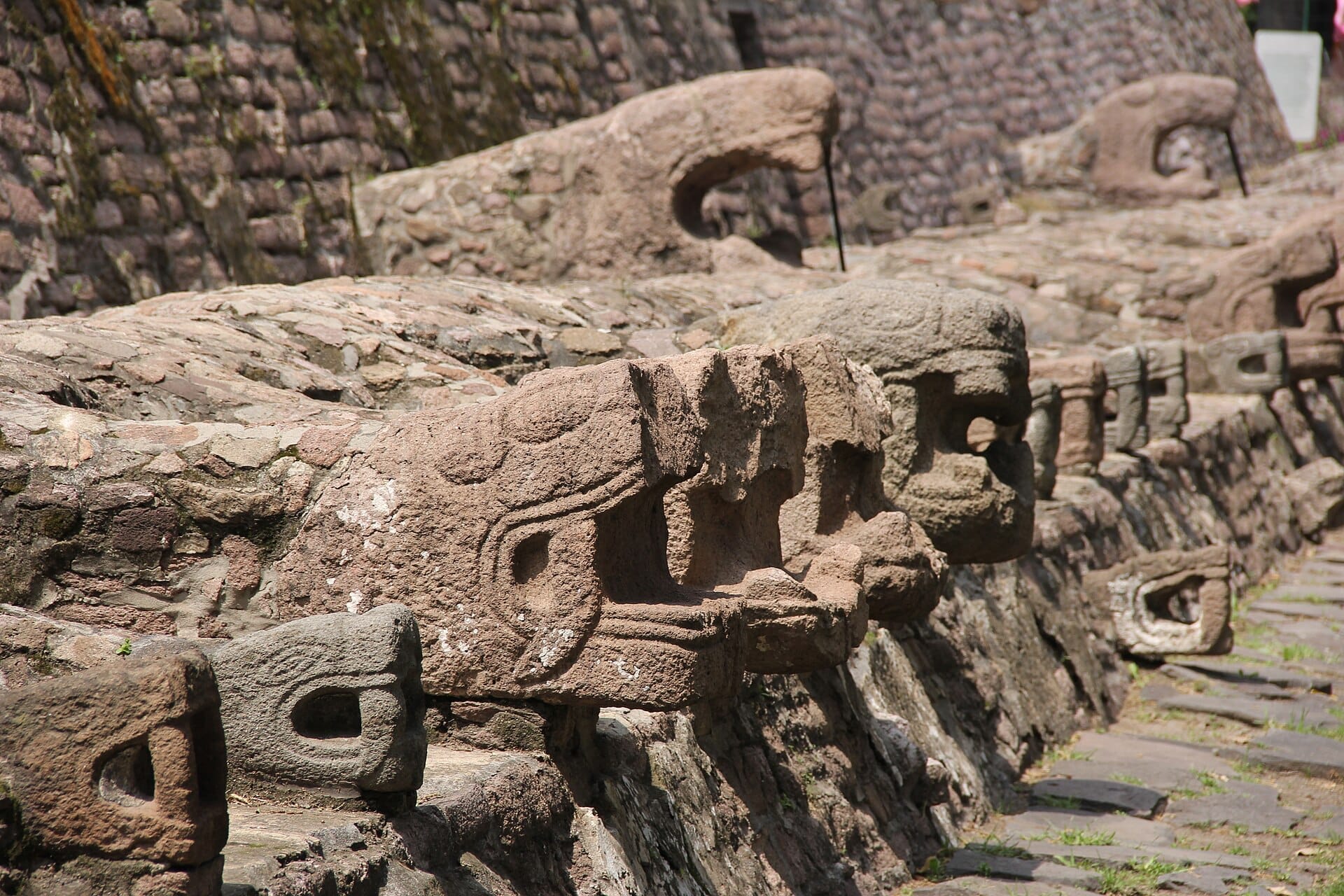
The most visually striking feature of the site is not the pyramid itself but the coatepantli: a low ceremonial wall encircling the base, lined with stone serpent sculptures. These are not decorative flourishes. The serpents carry religious and cosmic meaning rooted in Mesoamerican belief systems, representing cycles of time and the boundary between the sacred precinct and the ordinary world. Dozens of these stone figures remain in situ, weathered but still readable, and you can walk along the exterior of the coatepantli at close range.
ℹ️ Good to know
Climbing the pyramid is not permitted. You can walk the perimeter and observe the structure from ground level, which actually gives you excellent angles on the serpent wall and the dual staircase facades.
The archaeological remains are divided into two sections, referred to as Tenayuca I and Tenayuca II, with separate entrance points. The signage on-site is in Spanish, so visitors without reading knowledge of Spanish may find the museum's exhibits easier to parse than the outdoor panels.
Tickets & tours
Live prices and dates from our booking partner. If you book, we may earn a commission at no extra cost to you.
Puebla and Cholula guided tour from Mexico City with optional lunch
From 43 €Instant confirmationFree cancellationXochimilco, Coyoacan and Frida Kahlo Museum with skip-the-line tickets
From 63 €Instant confirmationFree cancellationMexico City exploration game and tour in Chimalistac
From 10 €Instant confirmationFree cancellationCuernavaca and Taxco Guided Tour with Optional Lunch
From 40 €Instant confirmationFree cancellation
The On-Site Museum: Small but Specific
Immediately at the entrance and exit of the site sits a small museum that documents the excavation history and provides context for what you are looking at outside. The collection is modest by the standards of major institutions, but the exhibits are focused and relevant. Carved stone pieces recovered from the site are displayed here, including fragments of sculpture and ceramic artifacts from the Postclassic period.
If you are building a day around pre-Columbian archaeology, the Museo Nacional de Antropología covers the broader civilizational context in far greater depth, and makes an excellent complement to a Tenayuca visit rather than a substitute.
What Visiting Actually Feels Like
Arrive on a weekday morning and you may find yourself nearly alone on the grounds. The surrounding neighborhood is quiet at that hour, and the site feels removed from the urban noise outside its low walls. The air at this elevation carries a slight chill in the mornings from November through February, so a light jacket is worth packing even when afternoon temperatures are mild. In the dry season (roughly November to April) the light is sharp and the sky tends to stay clear, which makes for particularly good photography.
The site is compact. The perimeter walk around the pyramid and serpent wall takes roughly 15 to 20 minutes at a relaxed pace. The museum visit adds another 20 to 30 minutes. Budget around 90 minutes total to avoid feeling rushed, with time to sit, observe the stonework closely, and review the museum exhibits without hurrying.
There is no food or drink available inside the site. The surrounding streets have small local eateries and convenience stores within a few minutes' walk, but bring water, especially if you are visiting between March and October when midday temperatures climb into the low-to-mid 20s Celsius. Rainy season afternoon downpours (common May through October) can roll in quickly, so a compact rain layer is smart from late spring onward.
💡 Local tip
Morning light hits the western staircase facade directly, making the carved serpent heads and the dual staircases easier to photograph without harsh shadows. Aim to arrive close to opening time at 10:00 for the best light and smallest crowds.
Getting There: A Practical Walkthrough
Tenayuca sits just outside Mexico City's administrative boundary, in the municipality of Tlalnepantla de Baz in the State of Mexico. It is reachable without a car. Metrobús Line 3 runs from the city northward to its northern terminal, called 'Tenayuca,' and the ruins are a short walk from there. Check current Metrobús maps for the Line 3 terminus, as urban transit routes can be adjusted.
For a full overview of public transit options in the capital, the guide to getting around Mexico City covers the Metro, Metrobús, and ride-hailing options in practical detail.
Ride-hailing apps including Uber, DiDi, and Cabify operate in the greater metro area and can reach the site from central Mexico City in roughly 25 to 45 minutes depending on traffic. Traffic northbound from downtown can be heavy during morning rush hours (7:00 to 10:00) and afternoon rush (17:00 to 20:00), so the Metrobús option often ends up being faster and more predictable.
Historical Context: Chichimecs, the Mexica, and Layered Time
The city of Tenayuca was likely founded by Chichimec migrants following the decline of Tula (Tóllan), the great Toltec capital, around the late 12th to early 13th century. The Chichimecs were not a single unified group but rather a collection of semi-nomadic peoples from Mexico's northern plateau, and their arrival in the Valley of Mexico marked a new political order in the region.
At its height, Tenayuca was a significant urban center and a model for later Aztec ceremonial architecture. When the Mexica rose to power and consolidated control over the Valley of Mexico, they absorbed and expanded the site, adding construction phases and leaving their own cosmological imprint on the structure. The coatepantli, or serpent wall, reflects a design that the Mexica later echoed at Tenochtitlan. Studying Tenayuca is, in part, studying the roots of Aztec urban planning.
To see how the Mexica themselves built at the center of their empire, the Templo Mayor in the historic center is the direct urban successor to the architectural tradition that took shape here.
Worth Your Time?: Who This Site Is and Is Not For
Tenayuca is not a spectacle site. There are no dramatic cliffside views, no grand museum halls, no surrounding park infrastructure. It is an archaeological zone in a working-class urban neighborhood, with a single well-preserved pyramid, a well-maintained serpent wall, and a small focused museum. For travelers with a serious interest in pre-Columbian history, Mesoamerican archaeology, or architectural layering, it is worth an afternoon. For travelers looking for a sensory or scenic experience, it is likely to feel underwhelming.
Visitors hoping to compare it to Teotihuacan should recalibrate expectations: Tenayuca is roughly the size of a single structure at Teotihuacan, not an entire city. What it offers instead is intimacy, historical specificity, and genuine archaeological integrity, without the crowds or the commercial infrastructure that surround the larger site.
If Teotihuacan is your primary interest, the dedicated Teotihuacan day trip guide covers logistics in detail and is the better starting point.
⚠️ What to skip
Opening hours (Tuesday to Sunday, 10:00 to 17:00, closed Mondays) and admission fees (55 MXN; free on Sundays for some visitors) should be verified directly with INAH or the official Mexico City tourism site before your visit, as these details change periodically.
Insider Tips
- Pair Tenayuca with the nearby Santa Cecilia Acatitlan ruins, another small Postclassic site a short distance away in the same municipality. Together, they make a coherent half-day archaeology itinerary without requiring a full day trip.
- The serpent wall is best observed from the outer perimeter path rather than from a single angle. Walk the full circuit and watch how the stone sculpture quality and preservation varies by section.
- If you read Spanish, the on-site museum panels contain specific excavation dates and artifact provenance details that go well beyond what most general travel sources report.
- Weekday mornings, particularly Tuesday through Thursday before noon, see the lightest foot traffic. Weekends attract more local family visits, which makes the atmosphere livelier but the photographic compositions busier.
- The site is technically in Tlalnepantla de Baz, State of Mexico, not Mexico City proper. If you are using a ride-hailing app, confirm the destination address (Calle Quetzalcóatl, San Bartolo Tenayuca) in the app before setting off to avoid being taken to an incorrect location.
Who Is Tenayuca Archaeological Zone For?
- Travelers with a specific interest in Chichimec and Aztec history who want depth over spectacle
- Archaeology enthusiasts who have already visited Teotihuacan and want a contrasting, more intimate site
- Budget travelers: at approximately 55 MXN, the site is one of the most affordable archaeological visits near the capital
- Photographers seeking pre-Columbian stonework without crowds
- Visitors combining Mexico City sightseeing with a day trip north who want to add a cultural stop without going far
Nearby Attractions
Combine your visit with:
- Acuario Inbursa
Built beneath Plaza Carso in the Nuevo Polanco district, Acuario Inbursa holds 1.6 million litres of seawater and roughly 14,000 specimens across more than 230 species. It opened in 2014 and remains one of the most technically ambitious aquariums in Latin America. Here is what the visit actually involves, and whether it is worth your time.
- Arena México
Inaugurated in 1956 and holding up to roughly 16,800 spectators, Arena México is the home of CMLL and the most storied lucha libre venue in the world. Matches run on Tuesday, Friday, and Sunday evenings in Colonia Doctores, making it one of the most accessible live spectacles in Mexico City.
- Basilica of Our Lady of Guadalupe
The Basilica of Our Lady of Guadalupe is one of the most visited Catholic shrines on earth, receiving over 20 million pilgrims and visitors each year. Built around the 1531 apparition site on Tepeyac Hill, it holds the venerated tilma of Juan Diego and offers a rare encounter with living Mexican faith at its most intense.
- Cineteca Nacional
The Cineteca Nacional de México is the country's national film archive and its most important arthouse cinema complex. Rebuilt after a devastating 1982 fire and transformed in 2012 into a world-class cultural campus, it combines 10 indoor screens, a large open-air screening forum, galleries, a bookshop, and restaurants in a single destination that attracts cinephiles, students, and casual visitors alike.
Planning a trip? Discover personalized activities with the Nomado app.