Temple of Aphrodite, Rhodes: Ancient Ruins in the Heart of the Old Town
One of Rhodes Old Town's oldest surviving ancient structures, the Temple of Aphrodite dates to the 3rd century BC and once stood as a sacred landmark near the ancient port. Today its scattered columns and stone blocks offer a quiet, contemplative encounter with classical Greece, steps from the medieval city's main gates.
Quick Facts
- Location
- Symi Square, Old Town of Rhodes, near Eleftheria Gate
- Getting There
- 10-minute walk from the Tourist Harbour; accessible on foot from most Old Town entry gates
- Time Needed
- 20–30 minutes
- Cost
- Free to view from outside the protective fence
- Best for
- History enthusiasts, archaeology fans, Old Town walkers
What the Temple of Aphrodite Actually Is
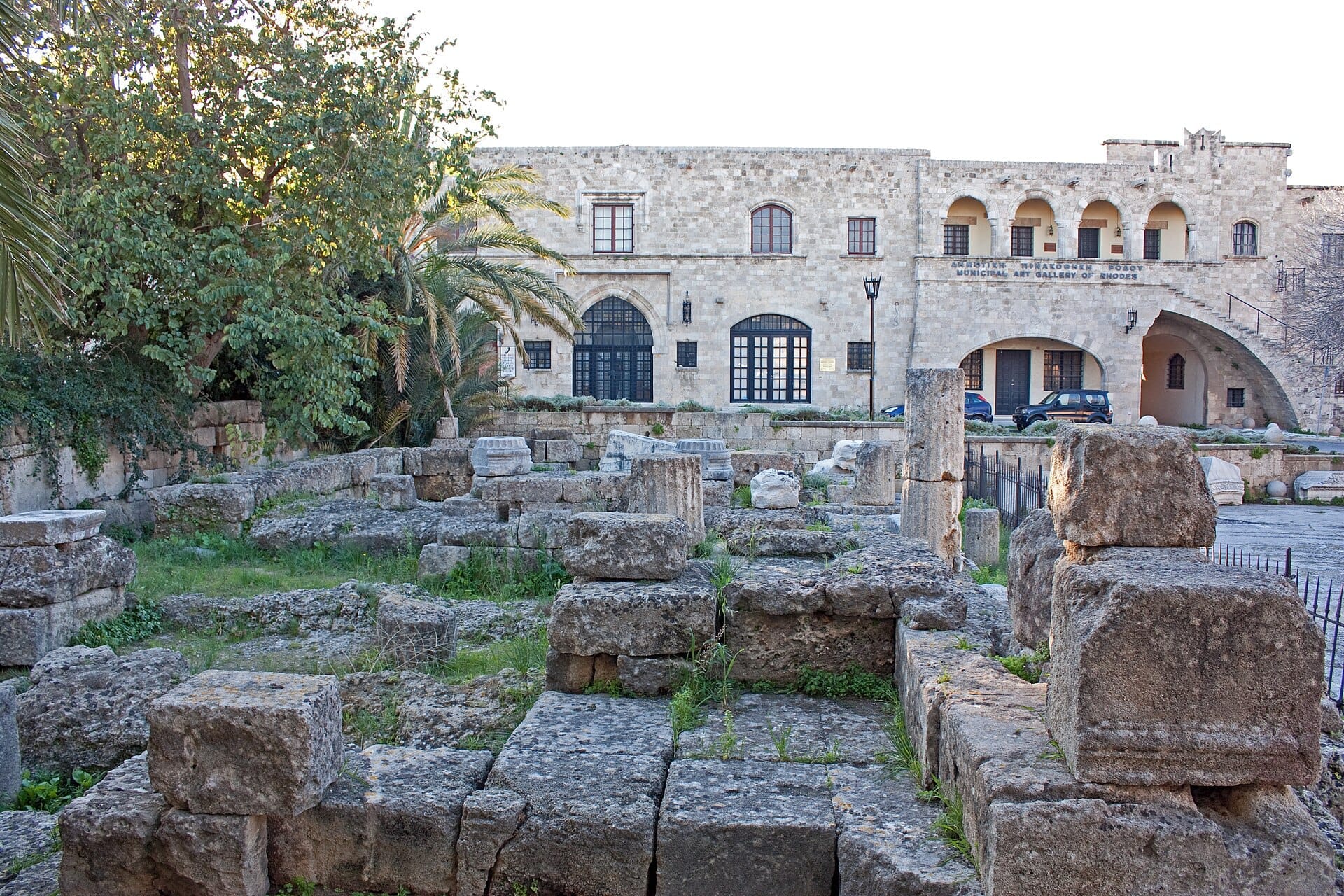
The Temple of Aphrodite is one of the oldest surviving remnants of ancient Rhodes city, constructed in the Ionic order during the 3rd century BC. It was dedicated to Aphrodite, the Greek goddess of love and beauty, whose patronage extended to sailors and seafarers. That connection to the sea was not incidental: the temple was deliberately positioned near the ancient port, placing it at one of the most strategically and symbolically significant points in the city.
What visitors see today is a modest but atmospheric set of ruins: fallen column drums, stone blocks worn smooth by centuries, and carved architectural fragments enclosed within a protective fence in Symi Square. It is not a reconstructed monument with soaring columns. It is the honest remains of something that once mattered enormously to this city.
ℹ️ Good to know
You cannot walk inside the fenced ruins, but the viewing distance is close enough to read the stonework clearly. An information panel on-site provides descriptions in both Greek and English.
History and Cultural Context
Rhodes was founded as a unified city-state in 408 BC through the synoikismos of three earlier settlements: Ialyssos, Kamiros, and Lindos. The city was planned according to the Hippodamian grid system, and the Temple of Aphrodite was part of the original religious and civic infrastructure. By the 3rd century BC, when the temple was built, Rhodes had become one of the most powerful maritime and commercial centers in the eastern Mediterranean.
The placement near the port was theological as much as practical. Aphrodite, in her maritime aspect, was worshipped across the Greek world as a protector of ships and voyages. For a trading city whose wealth depended entirely on safe passage across the Aegean and beyond, her temple at the harbor entrance carried real civic weight. This same harbor district is where the legendary Colossus of Rhodes is believed to have stood, making this quarter one of the most mythologically loaded areas in the ancient city.
The temple survived various occupations and transformations of the island before eventually falling into ruin. The Knights of St. John, who controlled Rhodes from 1309 to 1522, built their own religious and administrative architecture directly over and around many ancient structures. The Old Town you walk through today is layered history in the most literal sense: medieval stone set into ancient foundations, Ottoman additions layered over Crusader buildings.
For deeper context on how all these periods fit together, the Rhodes Medieval Old Town guide gives a useful overview of the city's archaeological and architectural stratigraphy.
Tickets & tours
Hand-picked options from our booking partner. Prices are indicative; availability and final rates are confirmed when you complete your booking.
Sunset catamaran cruise with dinner in Rhodes
From 70 €Instant confirmationFree cancellation3-Hour All Inclusive Sun and Sea Swimming Cruise in Rhodes
From 55 €Instant confirmationFree cancellationRhodes Sunset Cruise with Greek BBQ and Unlimited Drinks
From 65 €Instant confirmationFree cancellationPalace of the Grand Master Ticket and Audio Tour by App
From 30 €Instant confirmation
What You See On the Ground
The ruins occupy a small fenced area in Symi Square, which itself sits just inside the Eleftheria Gate, one of the main pedestrian entry points into the Old Town from the harbor. The square is open and reasonably well-lit, with the ruins visible from multiple angles as you pass through. Column drums in the Ionic style are the most recognizable elements, identifiable by their smooth cylindrical form and horizontal fluting at the edges.
Stone inscription fragments are also present, though weathering has made most of them difficult to read without specialist knowledge. The overall footprint of the temple is small compared to surviving Greek temples elsewhere in the country, but its state of preservation is consistent with a site that spent centuries buried beneath a medieval city. The excavation itself, done carefully to expose rather than restore, is worth noting.
Early morning, before tour groups reach this part of the Old Town, Symi Square is quiet. The light at that hour catches the texture of the limestone blocks and the pale dust of the surrounding square in a way that the harsh midday sun simply does not. If photography is your reason for visiting, arrive before 9am in summer.
The Connection to the Archaeological Museum
One of the most compelling reasons to visit this site is the thread it pulls to the Archaeological Museum of Rhodes, a 15-minute walk deeper into the Old Town. Housed there is the Aphrodite Pudica, also known as the Crouching Venus of Rhodes, a marble statue widely believed to be the cult statue originally placed inside this very temple. Seeing the ruins first, then the statue in the museum, creates a coherent narrative: you are following the goddess from her house to her current shelter.
The Aphrodite Pudica depicts the goddess crouching, as if caught in a private moment. It is one of the finer examples of Hellenistic sculpture on the island and gives the otherwise modest ruins of the temple a much richer imaginative anchor. The museum visit is strongly recommended as a companion to this site, not an alternative.
Practical Walkthrough: Getting There and Managing Expectations
The Temple of Aphrodite sits in the northern section of Rhodes Old Town, close to the Eleftheria Gate and Symi Square. If you are arriving from the harbor side, enter through Eleftheria Gate and the ruins are almost immediately visible on your left. The walk from the Tourist Harbour takes around 10 minutes on flat ground along the harbor promenade and through the gate.
There is limited parking in Symi Square, with additional spaces on roads approaching the harbor. In high summer, driving into this area is rarely worth the effort. The Old Town is best explored on foot, and this site is naturally incorporated into any walking route through the northern quarter.
⚠️ What to skip
Opening hours listed on various third-party travel sites have proven inconsistent and unreliable. The ruins are visible from outside the fence at all times, but if you want to confirm access to the immediate perimeter, contact the Rhodes tourist office or check with your accommodation before visiting.
Admission is free. The site is outdoors and exposed, so in July and August the midday heat can make lingering uncomfortable. Comfortable walking shoes are standard for any Old Town itinerary, and the ground around Symi Square is flat and paved, making this one of the more accessible sites in the Old Town for visitors with limited mobility.
Honest Assessment: Is It Worth Your Time?
The Temple of Aphrodite rewards visitors who arrive with context and curiosity. If you are expecting a dramatic, photogenic ancient site like the Acropolis of Lindos or a well-preserved temple interior, you will be disappointed. The ruins are fragmentary, the setting is urban, and you view them through a fence. The experience is closer to encountering an archaeological footnote than a headline attraction.
That said, for anyone genuinely interested in how ancient Greek cities were organized, how religion intersected with commerce, and how layers of history accumulate in a single location, this is a worthwhile stop. It takes 20 minutes, costs nothing, and pairs naturally with a walk along the Street of the Knights or a visit to the Archaeological Museum. Treat it as part of a wider Old Town walk rather than a destination in itself, and it will not disappoint.
Travelers who want polished, tourist-ready ancient sites will likely find little here to hold their attention. Those who appreciate archaeology in its less curated form, a genuine remnant left where it fell, will find something honest and quietly moving about these stones in the middle of a living city.
Insider Tips
- Visit the site first, then walk to the Archaeological Museum of Rhodes to see the Aphrodite Pudica statue believed to have originally stood in this temple. The two visits work best as a single itinerary.
- The square is at its most atmospheric in early morning light, before the Old Town fills with foot traffic. Arrive before 9am in summer for the best photography conditions and genuine quiet.
- The Eleftheria Gate is one of the least-congested entry points into the Old Town from the harbor side. Using it gives you a logical approach to the ruins without battling the main tourist corridor.
- The information panel on-site is in Greek and English, but it is brief. Download a short background on Hellenistic Rhodes before visiting if you want to understand what you are looking at in real time.
- If you are building a full Old Town archaeology route, combine this stop with the Ancient Stadium, the Acropolis of Rhodes on Monte Smith hill, and the Archaeological Museum for a coherent half-day itinerary.
Who Is Temple of Aphrodite For?
- History and archaeology enthusiasts who appreciate ruins in their unrestored state
- Travelers doing a comprehensive Old Town walking tour who want to cover ancient, medieval, and Ottoman layers
- Photography visitors who are up early and want a quiet, textured subject in good morning light
- Anyone pairing the visit with the Archaeological Museum of Rhodes to see the Aphrodite Pudica statue
- Curious travelers who want to understand how a classical Greek city functioned before the Knights arrived
Nearby Attractions
Other things to see while in Rhodes Old Town:
- Archaeological Museum of Rhodes
Housed in the 15th-century Hospital of the Knights, the Archaeological Museum of Rhodes brings together artifacts spanning the Archaic to Roman periods, including celebrated Hellenistic marble statues and intricate floor mosaics. It is one of the most historically layered museum experiences in the Aegean, where the building itself is as compelling as the collection inside.
- Hammam Turkish Baths
Built in 1558 during the Ottoman occupation, the Great Hamam is the sole surviving bathhouse within Rhodes' UNESCO-listed Medieval Town. Currently closed to the public but recently restored, it remains one of the most architecturally distinctive buildings in Arionos Square, worth understanding in context before you arrive.
- Harbour Gates
The Harbour Gates mark the medieval boundary between Mandraki Harbour and the walled city built by the Knights of Saint John. Free to visit at any hour, they are the most atmospheric entry point into Rhodes Old Town, framing a view that has barely changed in six centuries.
- Palace of the Grand Master of the Knights of Rhodes
The Palace of the Grand Master of the Knights of Rhodes is the most architecturally commanding structure in the medieval city. Built in the early 14th century and dramatically restored under Italian rule, it anchors the northwestern corner of the Old Town with towers, colonnaded courtyards, and a permanent collection that spans antiquity to the Ottoman period.