Teatro La Fenice: Inside Venice's Legendary Opera House
Teatro La Fenice is one of Europe's most storied opera houses, twice destroyed by fire and twice rebuilt in Venice's San Marco district. Whether you visit for a daytime tour of its gilded interior or attend a live performance, the theatre offers a window into centuries of Italian musical culture.
Quick Facts
- Location
- Campo San Fantin, San Marco 1965, Venice
- Getting There
- Vaporetto Line 1 to San Marco or Rialto; Vaporetto Line 2 to Rialto, then walk
- Time Needed
- 1 hour for a daytime tour; 2.5–3 hours for a full performance
- Cost
- Daytime visits from €12; student rates from €7; under 6 free
- Best for
- Architecture lovers, opera fans, first-time visitors to Venice
- Official website
- www.teatrolafenice.it
What Is Teatro La Fenice?
Teatro La Fenice (officially Gran Teatro La Fenice di Venezia) sits in a small campo just a few minutes' walk from Piazza San Marco, tucked into the dense fabric of the San Marco sestiere. The name means 'The Phoenix', and it was not chosen by accident. The theatre has burned to the ground twice and risen again both times, a literal embodiment of its own mythology.
Designed by architect Gian Antonio Selva, La Fenice was built between 1790 and 1792 and inaugurated on 16 May 1792. Within five decades it suffered a catastrophic fire in 1836, was rebuilt, hosted world premieres of works by Verdi and Bellini, then burned again in 1996 under circumstances that led to criminal arson convictions. The restored theatre reopened on 14 December 2003, with the painstaking reconstruction following the principle of 'com'era, dov'era': as it was, where it was.
ℹ️ Good to know
The theatre is generally open for daytime visits from around 9:30 am to 6:00 pm. Hours may change during technical rehearsals or special events, so checking the official website before you go is always worthwhile.
The Interior: What You Actually See on a Daytime Tour
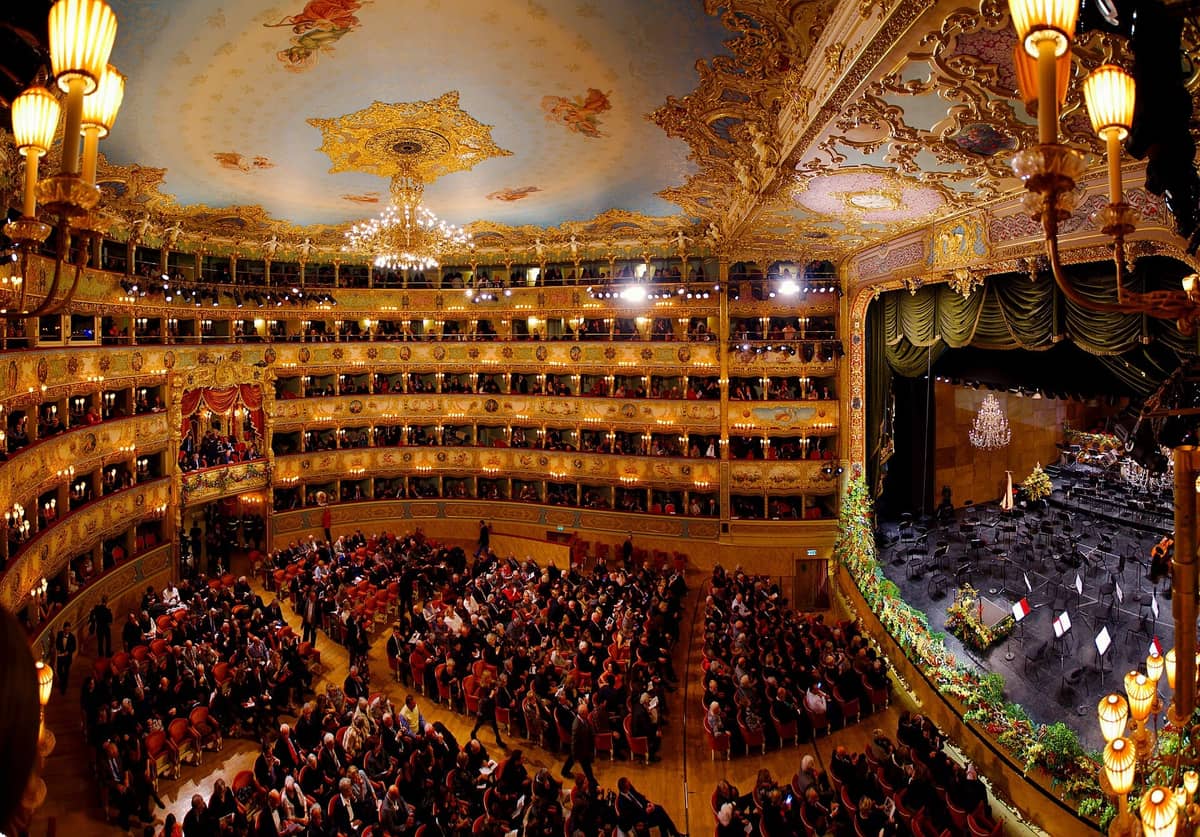
Most visitors come during the day on a guided or self-guided tour, and the experience is anchored by the auditorium itself. Walking in from the entrance on Campo San Fantin, you pass through corridors of ivory and gold before entering the horseshoe-shaped main hall. The effect is immediate and slightly theatrical even when the stage is dark: five tiers of private boxes curve around the room, upholstered in red and trimmed with gilded plasterwork, rising toward a painted ceiling fresco and an enormous chandelier.
La Fenice seats approximately 1,000 people. The scale is more intimate than you might expect for a famous opera house, which is exactly the point. In the 18th century, Venetian nobles did not just come to hear music; they came to be seen. The box tier system meant that attending an opera was a social event played out simultaneously on stage and in the audience. The architecture encodes that social logic, and it is still readable in the room today.
Audio guides are available in multiple languages and do a reasonable job of covering the history without overloading you with dates. The tour typically takes around 45 minutes to an hour at a measured pace. You can move between the stalls floor, the lobby spaces, and some of the upper corridors, though access to the stage and backstage is not generally part of standard daytime visits. Photography is permitted in most areas without flash.
Tickets & tours
Hand-picked options from our booking partner. Prices are indicative; availability and final rates are confirmed when you complete your booking.
Tickets for La Fenice Theatre with audio guide
From 11 €Instant confirmationTickets for La Fenice Theatre with audio guide
From 7 €Instant confirmationTickets for La Fenice Theatre with audio guide
From 26 €Instant confirmationTickets for La Fenice Theatre with audio guide
From 0 €Instant confirmation
History and Cultural Weight
La Fenice is not just architecturally significant; it is one of the primary sites where Italian opera was shaped. The theatre hosted the world premieres of Vincenzo Bellini's 'La straniera' and 'Beatrice di Tenda', as well as several Verdi operas including 'Ernani', 'Attila', 'Rigoletto', 'La traviata', and 'Simon Boccanegra'. These were not minor works, and the connection between the house and the composers who wrote for it gives the space a different kind of weight from a purely decorative interior. For broader context on the cultural landscape of Venice, the best museums in Venice guide covers the city's major cultural institutions across all disciplines.
The 1996 fire remains a painful chapter in recent Venetian cultural memory. Electrical contractors working in the theatre left the building in a state of serious fire hazard; the blaze destroyed virtually everything except the exterior walls. The subsequent legal proceedings, the fundraising, and the decade-long reconstruction all became part of a broader conversation about Venice's relationship with its own heritage. When the doors reopened in 2003, the restored hall was deliberately faithful to the pre-1996 appearance, rather than updated or modernized.
Since reopening, La Fenice’s New Year's Concert has become an annual event that is broadcast across Italy and internationally. Attending or watching the concert has become a ritual that anchors the theatre firmly in the present as well as the past.
How the Experience Changes by Time of Day
On a morning visit, the auditorium is often empty or nearly so, and the quality of light coming through the lobby and corridors is flat and cool. This is actually a good time to look carefully at the plasterwork, the painted ceilings, and the upholstery details, since there is no performance crowd and no noise. The gilded surfaces look slightly more muted in daylight than under stage lighting, but the craftsmanship is clearer.
In the late afternoon, particularly in spring and summer, tour groups tend to peak. The corridors outside the auditorium can feel cramped, and the Campo San Fantin outside fills with people waiting. If you prefer a quieter experience, arriving close to opening time at 9:30 am is reliably calmer.
An evening performance is a fundamentally different experience. The auditorium comes alive under the chandelier, the boxes fill with formally dressed audience members, and the acoustic properties of the horseshoe shape become immediately apparent. The theatre is small enough that there is genuinely no bad seat, and the sound has a warmth and directness that larger opera houses often sacrifice. If your schedule allows, choosing an evening performance over a daytime tour is worth the additional cost.
💡 Local tip
For evening performances, dress code is smart to semi-formal. There is no strict enforcement, but the audience generally dresses up, and arriving in shorts and trainers will make you conspicuous. Check the official ticket office page for current production schedules and seating categories before booking.
Getting There and Practical Logistics
La Fenice is about 400 metres from Piazza San Marco, reachable on foot in around five minutes through a series of narrow calli. Coming from Piazza San Marco, head west toward Calle del Fruttariol and follow signs to Campo San Fantin. The route involves no bridges with significant steps, though the streets are uneven stone throughout.
By vaporetto, take Line 1 or Line 2 and disembark at either the San Marco or Rialto stops, then walk. Lines 1 and 2 run along the Grand Canal and connect from Santa Lucia train station and Piazzale Roma. Journey times vary depending on your starting point and direction of travel.
Daytime visit tickets currently cost around €13 for adults, with reduced rates of about €10 for visitors over 65 and some affiliated cardholders. Students aged roughly 7 to 26 pay around €10, and young children enter free. Family passes are available at a slightly higher combined rate. A special 'Promenade Theatre' format, which includes a theatrical performance element, starts from around €45 plus VAT. All prices should be confirmed with the theatre or via the FestFenice booking portal before your visit, as rates are subject to change.
⚠️ What to skip
The theatre closes to visitors during rehearsals and in the hours before evening performances. On performance days, daytime access may end earlier than the stated 6:00 pm. Always verify the schedule on the official website, particularly in peak opera season.
Who Should Skip This Attraction
La Fenice is not a hands-on or immersive museum experience in the conventional sense. If you are primarily interested in interactive exhibits, artefacts, or a detailed historical narrative, the daytime tour may feel thin. The audio guide covers the basics, but the visit is essentially a walk through a beautiful room. For travellers who want depth, context, and extended engagement, the experience can feel brief for the ticket price.
Those with significant mobility difficulties should contact the theatre in advance to confirm current accessibility arrangements, as specific details about step-free access and lift provision are not consistently published online.
Combining La Fenice with the Surrounding Area
The area immediately around La Fenice is one of the less trafficked parts of central San Marco. Campo San Fantin itself is small and relatively quiet compared to the main tourist routes. From here, Piazza San Marco, Doge's Palace, and St Mark's Basilica are all within a ten-minute walk. Planning La Fenice as a morning visit before heading to the more crowded Piazza San Marco sights works well logistically.
If you are spending multiple days in Venice and want to see how the city's cultural institutions fit together, the 3-day Venice itinerary covers a structured route that includes the San Marco area alongside other neighbourhoods.
Insider Tips
- Book performance tickets well in advance for popular productions, particularly the New Year's Concert. This event sells out months ahead and is not the kind of thing you can pick up at the door.
- The foyer and outer corridors are visible to daytime visitors even on performance days, but the auditorium access is cut off from around two hours before curtain. If you arrive late in the afternoon without checking the schedule, you may find yourself turned away from the main hall.
- The Campo San Fantin outside the theatre has a small number of cafe tables. It is a reasonable place to sit for ten minutes before or after a visit, and significantly less crowded than anywhere near Piazza San Marco.
- For the sharpest photographs of the auditorium interior, come on a clear morning when natural light filters in and the room is empty. The chandelier creates strong contrast in low-light conditions, and without flash the images tend to be warmer and more accurate to how the space actually looks.
- If you are attending an evening performance, note that the nearest vaporetto stops can be congested after curtain call. Walking toward Rialto and boarding there rather than at San Marco is often quicker late at night.
Who Is Teatro La Fenice For?
- Architecture and design enthusiasts who want to study historic Italian theatre construction
- Opera and classical music lovers, particularly those attending a live performance
- First-time Venice visitors with a serious interest in the city's cultural history
- Couples looking for a formal evening out with a genuinely distinctive setting
- Travellers with a specific interest in architectural restoration and the challenges of preserving historic buildings
Nearby Attractions
Other things to see while in San Marco:
- Bridge of Sighs (Ponte dei Sospiri)
The Ponte dei Sospiri is one of Venice's most photographed structures, an enclosed white limestone bridge linking the Doge's Palace to the New Prisons over the narrow Rio di Palazzo canal. You can see it for free from the Ponte della Paglia, or cross it from the inside as part of a Doge's Palace ticket. Here is everything you need to visit it well.
- Doge's Palace (Palazzo Ducale)
Doge's Palace is the Gothic heart of Venice's political history, rising at the edge of Piazza San Marco with a facade unlike anything else in Italy. This guide covers what you'll actually experience inside, when to visit for smaller crowds, and how to make the most of one of Europe's most significant civic buildings.
- Grand Canal (Canal Grande)
The Canal Grande is the main artery of Venice, a reverse-S shaped waterway stretching 3.8 km through the heart of the city and lined with more than 170 palaces spanning six centuries of Venetian architecture. Free to view at any hour, it rewards visitors who know when and how to travel it.
- Museo Correr
Occupying the grand Napoleonic Wing and part of the Procuratie Nuove above Piazza San Marco, the Museo Correr holds centuries of Venetian civic history, Renaissance painting, and lavishly decorated royal apartments. It rewards visitors who take their time, and it's consistently overlooked by crowds fixated on the Doge's Palace next door.