Isola Tavolara: Sardinia's Dramatic Island Kingdom
Isola Tavolara is a sheer limestone massif rising 565 metres from the Tyrrhenian Sea, just off the north-eastern coast of Sardinia near Olbia. Accessible only by boat, it sits within a protected marine area of startling clarity and carries the quirky legacy of a self-proclaimed 19th-century kingdom. This is not a beach destination in the conventional sense — it rewards those who come for the water, the scale, and the strangeness.
Quick Facts
- Location
- Gulf of Olbia, north-eastern Sardinia — approximately 3–4 km offshore from Porto San Paolo
- Getting There
- By boat only — excursions depart from Porto San Paolo, Olbia, and nearby marinas (mainly spring to autumn)
- Time Needed
- Half-day to full day, depending on boat excursion format
- Cost
- No island entrance fee; shared RIB boat excursions to Tavolara start from around €60 per person (verify with operators for season and inclusions)
- Best for
- Snorkellers, history-curious travellers, hikers with experience, and anyone who wants dramatic coastal scenery without a beach resort atmosphere
- Official website
- www.amptavolara.it
What Is Isola Tavolara, Exactly?
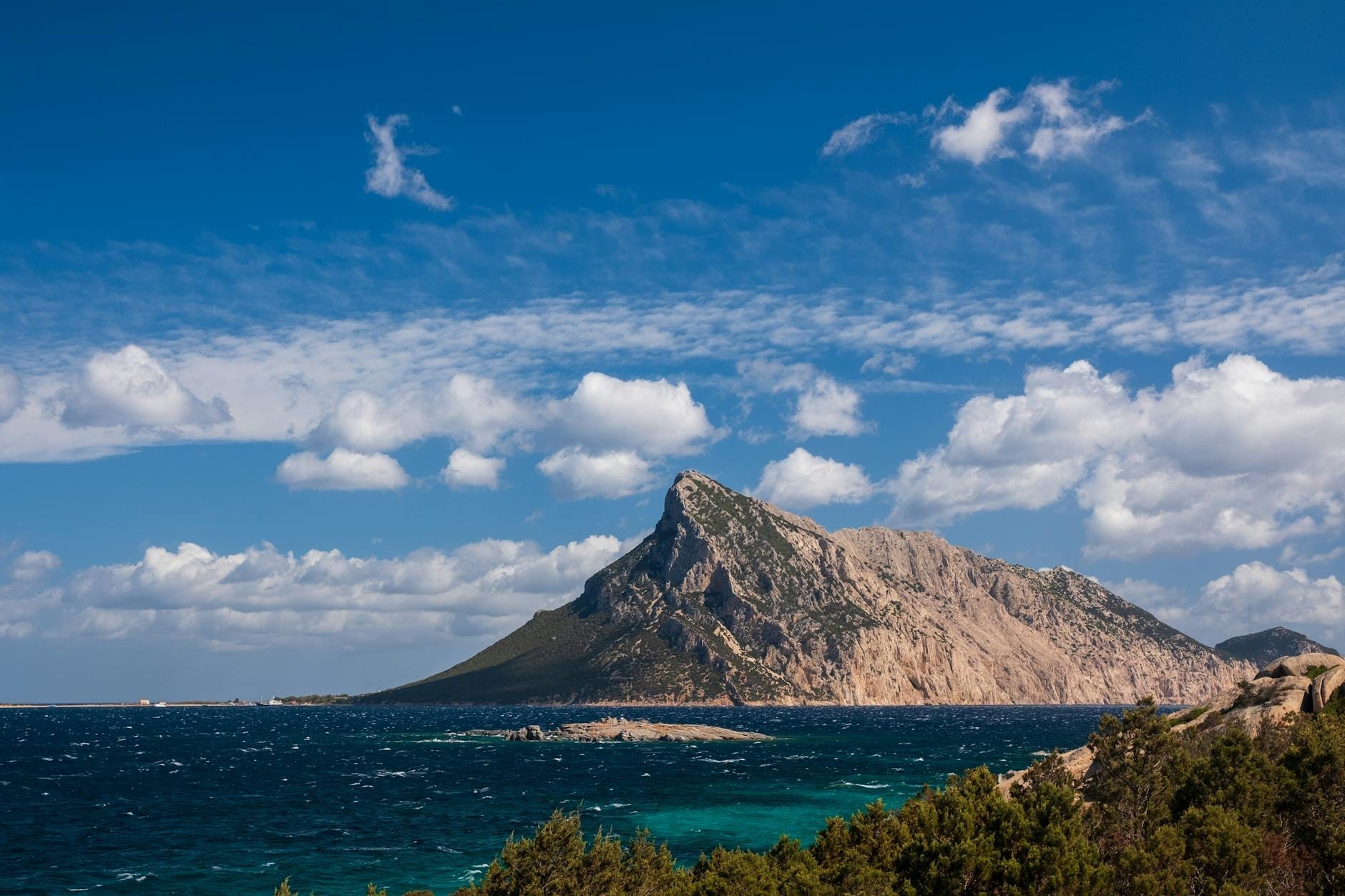
Isola Tavolara is a limestone island that rises from the sea with the abruptness of a table that has been turned on its side — which is, more or less, what its name suggests. The island is approximately 4–7 kilometres long and about 1 kilometre wide, with Punta Cannone reaching about 564–565 metres above sea level. Its western and southern faces drop almost vertically into the sea, while the northern shoreline offers the only real approachable beach areas. The whole island sits within the Tavolara–Punta Coda Cavallo Marine Protected Area, which controls and limits human activity across the surrounding water.
From a distance — from the coast road near Porto San Paolo or from the ferry into Olbia — Tavolara looks almost geological rather than inhabitable. The white limestone cliffs catch the afternoon light and glow amber at dusk. Up close, that impression only intensifies. The water around the island is the kind of colour that makes you second-guess whether it is real: a deep aquamarine fading to pale turquoise over the sandy patches, and clear enough that you can watch the sea floor from the boat before you even anchor.
ℹ️ Good to know
Tavolara is not a day resort. There are no sunlounger rows, no beach bars with cocktail menus, and no shuttle infrastructure. A handful of small restaurants and a cemetery make up the island's permanent facilities. That is largely the point.
The Kingdom Nobody Forgot
The island's most enduring story begins in the early 19th century, when a Genoese man named Giuseppe Bertoloni settled on Tavolara. According to the popular account — which blurs into legend at the edges — his family eventually came to regard themselves as rulers of the island, and the 'Kingdom of Tavolara' entered local mythology as one of the smallest kingdoms in the world. The tale includes a visit from King Carlo Alberto of Sardinia, who is said to have recognised Bertoloni's authority over the island in exchange for a particular breed of white-toothed goat found only on Tavolara.
Whether the royal recognition was formal or simply a courtesy, the kingdom branding has stuck. A small open‑air photo display near the landing area touches on the family history, and the cemetery contains graves marked with the title 'King of Tavolara'. It sounds faintly ridiculous until you are standing in front of the headstones, at which point it becomes quietly moving. The Bertoloni family's connection to the island continued across multiple generations, and descendants remained on the island well into the 20th century.
Beyond the royal story, Tavolara has Neolithic-era evidence of human habitation, and the island was settled more continuously from the late 18th century onwards. The military also used portions of the island during the 20th century; restricted areas remain today, and the interior above the small settlement is largely off-limits to casual visitors.
Tickets & tours
Hand-picked options from our booking partner. Prices are indicative; availability and final rates are confirmed when you complete your booking.
Dinghy tour with snorkeling to Tavolara Island from Olbia
From 64 €Instant confirmationFree cancellationCatamaran tour from Olbia to Tavolara Marine Protected Area
From 142 €Instant confirmationFree cancellationHalf-day diving excursion in the Protected Marine Area of Tavolara
From 118 €Instant confirmationFree cancellationTavolara protected area snorkeling experience from San Teodoro
From 66 €Instant confirmationFree cancellation
Getting There: The Boat Logistics
There is no bridge, no causeway, and no helicopter pad open to tourists. You arrive by sea, and the most common starting point is the small port of Porto San Paolo, roughly 15 kilometres south of Olbia. Boat excursions also depart from Olbia itself and from various marinas along the Gallura coast. In high season (roughly June to September), multiple operators run daily trips, often combining a stop at Tavolara with the submerged 'pools' near Molara island or the coves of the Punta Coda Cavallo coast.
Most visitors arrive on semi-rigid inflatable boats (RIBs), which can thread into the narrower coves and anchor in shallow water. Full-day excursions including snorkelling stops, a lunch break at one of the island restaurants, and a circuit of the island typically cost from around €60 per person, though prices vary by operator, boat size, and what is included. For context on planning your wider Gallura itinerary, the Gallura region guide covers the broader area, including coastal bases and accommodation options.
Private boat owners can also enter the marine protected area, subject to regulations governing anchoring zones and restricted areas. The Consorzio di Gestione at amptavolara.it publishes current rules for navigation and anchoring within the protected zone. These rules change periodically, so check before you go, especially if you are planning to enter the area on your own vessel.
⚠️ What to skip
Boat excursions to Tavolara are highly seasonal. Most commercial operators run from around May to October, with the densest schedule in July and August. Outside those months, services are sporadic and weather conditions can make crossings uncomfortable or impossible. Always verify availability with operators before planning around a Tavolara visit in shoulder season.
The Water: Why People Actually Come
The marine protected area designation is not decorative. Fishing is restricted, anchoring is controlled, and the result is a marine environment that has recovered noticeably compared to the surrounding unprotected coastline. Posidonia seagrass meadows extend across the sandy seafloor in the shallower bays, which in turn supports fish populations large enough to be visible in real numbers — not just the occasional flicker of silver you see over degraded reefs.
Snorkelling is the dominant activity, and the conditions are excellent for it: water clarity of 20–30 metres on a calm day, minimal current in the sheltered bays, and plenty to look at near the surface. For divers, the underwater topography becomes more dramatic further from the landing area, with submerged cliffs and caves. The Sardinia snorkelling and diving guide covers the wider context, but Tavolara is consistently listed among the island's best diving sites for good reason.
Morning light, roughly 8am to 11am, is when the water has the strongest colour contrast and the lowest boat traffic. By early afternoon in August, the anchorage near the landing beach can feel crowded with day-trip boats, and the water takes on a choppier texture from engine wash. If your excursion operator gives you a choice of departure times, go early.
Hiking and the Interior: For the Prepared Only
The limestone plateau at the top of Tavolara is accessible via a route that includes the Via Ferrata degli Angeli — a fixed-rope climbing route requiring harness, helmet, and genuine experience with via ferrata terrain. This is not a waymarked walking trail for casual visitors. The ascent involves exposed sections on near-vertical rock, and the consequences of a mistake are severe. Italia.it notes explicitly that the via ferrata is suitable only for experienced hikers with proper equipment.
For those who complete it, the summit plateau reportedly offers a perspective over the Gulf of Olbia and the Gallura coastline that is difficult to match from any other vantage point in the region. The white limestone karst of the plateau, the silhouette of the island visible from 30 kilometres away on clear days — these are details that belong to the category of views you remember. But most day-trippers will not reach the top, and that is the right decision for most day-trippers.
The flat areas near the landing beach and the small settlement are accessible on foot — a short walk along the foreshore, the cemetery, the restaurant terrace, the fringe of the pine scrub behind the beach. For anyone with reduced mobility or who simply wants a gentler afternoon, the island experience at sea level is complete in itself.
Timing, Weather, and What to Expect
Tavolara in July and August is not a secret. The island receives a significant volume of day-trippers, and the small beach area near the restaurant and cemetery can become crowded between 11am and 3pm. If you are coming during peak summer and the solitude of a remote island is your primary motivation, recalibrate. The experience is still worthwhile, but you will share it with many other boats. May, early June, September, and October offer the same water quality with markedly fewer people. The September in Sardinia guide makes a detailed case for the shoulder season, and Tavolara is one of the clearest examples of why that argument holds.
Wind is a significant variable in this part of Sardinia. The Gallura coast is exposed to the Mistral and the Tramontane, and when either is blowing hard, the crossing from Porto San Paolo becomes rough and excursion operators cancel departures. The Sardinian interior and south tend to have more forgiving conditions, but this north-eastern coast can shift from glassy to choppy within a few hours. Check the marine forecast the evening before your trip, and have a backup plan.
For broader planning of your time in north-eastern Sardinia, the Olbia travel guide covers the mainland base, including accommodation, and is a practical companion to a Tavolara day trip.
Who Should Skip Tavolara
This is worth being direct about. If your ideal beach day involves a sunlounger, a cocktail service, and flat easy walking, Tavolara will disappoint. The beach area is small and coarse, facilities are extremely limited, and the boat journey adds time and cost that some travellers will find disproportionate for what is, at sea level, a fairly simple experience. Travellers with significant mobility limitations will also find the boat boarding and disembarking — typically onto open beaches or basic jetties — difficult depending on sea conditions. The island is also not appropriate for visitors expecting a scenic walk without any physical challenge: even the flat areas near the settlement involve uneven ground.
Travellers visiting Sardinia purely for beach resort infrastructure are better directed to Villasimius, Costa Smeralda, or the beaches of the Sinis Peninsula. Tavolara belongs to a different category of experience.
Insider Tips
- Book your boat excursion at least 24 hours in advance during July and August — operators reach capacity quickly on calm days, and the best spots on smaller RIB boats fill first.
- Bring your own snorkel gear if you have it. Rental equipment on excursion boats is functional but basic, and having a well-fitting mask makes a meaningful difference in a place where the underwater visibility is this good.
- The small restaurant on the island serves fresh fish and is good, not just convenient. It gets busy from midday; if your operator gives you flexibility, arrive for lunch before noon or plan to eat back on the boat.
- The cemetery near the landing area is a ten-minute detour from the beach and is quietly extraordinary — small, immaculately kept, and containing the graves of the Bertoloni 'kings'. It is almost always overlooked by visitors heading straight for the water.
- If you are sea-sick prone, take medication before departure. The crossing from Porto San Paolo is short (under 20 minutes) but in choppy conditions it is energetic, especially on a RIB.
Who Is Isola Tavolara For?
- Snorkellers and divers looking for protected, high-clarity marine conditions in north-eastern Sardinia
- Travellers with a passing interest in offbeat European history and the legend of the Kingdom of Tavolara
- Experienced hikers equipped for via ferrata who want a dramatic ascent
- Photographers working in morning light, when the limestone cliffs and the colour contrast of the water are at their most striking
- Visitors based in Olbia or along the Gallura coast who want a full-day excursion that is meaningfully different from a standard beach day
Nearby Attractions
Other things to see while in Gallura:
- Basilica di San Simplicio (Olbia)
The Basilica di San Simplicio is the oldest surviving building in Olbia and one of the finest Romanesque churches in Sardinia. Built between the late 11th and mid-12th centuries on a site with origins in a Roman necropolis and a Palaeo-Christian church, it offers a rare, unhurried encounter with pre-medieval Gallura — around ten minutes' walk from the ferry port crowds.
- Capo Testa
Capo Testa is a rugged granite promontory jutting into the Strait of Bonifacio near Santa Teresa Gallura, in Sardinia's far north. The headland is free to visit and rewards exploration with wind-sculpted rock formations, secluded sea pools, and the eerily beautiful Valle della Luna. It is one of northern Sardinia's most distinctive natural landscapes.
- Coddu Vecchiu Giants' Tomb (Arzachena)
The Giants' Tomb of Coddu Vecchiu is one of Sardinia's best-preserved Nuragic funerary monuments, featuring a roughly 4-metre granite entrance stele that has stood in the Gallura countryside for roughly 4,000 years. Located about 10 km from the Gulf of Arzachena, it offers a absorbing encounter with the island's prehistoric past in under an hour.
- Costa Paradiso
Costa Paradiso is a striking stretch of northern Sardinian coastline where ancient red and orange granite cliffs drop into transparent turquoise water. Largely a seasonal holiday settlement with under 200 year-round residents, it offers raw scenery, natural rock pools, and sheltered coves without the infrastructure of larger resorts.