Ta' Pinu Basilica: Gozo's National Shrine That Stops You in Your Tracks
Rising from the quiet farmland outside Għarb in northwestern Gozo, Ta' Pinu Basilica is Malta's most revered Marian shrine. Its 61-metre bell tower is visible for kilometres around, and the interior holds centuries of devotion in marble, votive offerings, and candlelight. Whether you visit for faith or architecture, the experience lingers.
Quick Facts
- Location
- Near Għarb village, northwestern Gozo, Malta
- Getting There
- Bus routes serve Għarb from Victoria (Rabat); a short walk or taxi from the village square
- Time Needed
- 45 minutes to 2 hours, depending on whether you walk the Stations of the Cross
- Cost
- Free entry to the basilica
- Best for
- Pilgrims, history seekers, architecture lovers, and anyone wanting a quiet counterpoint to the coast
- Official website
- www.tapinu.org
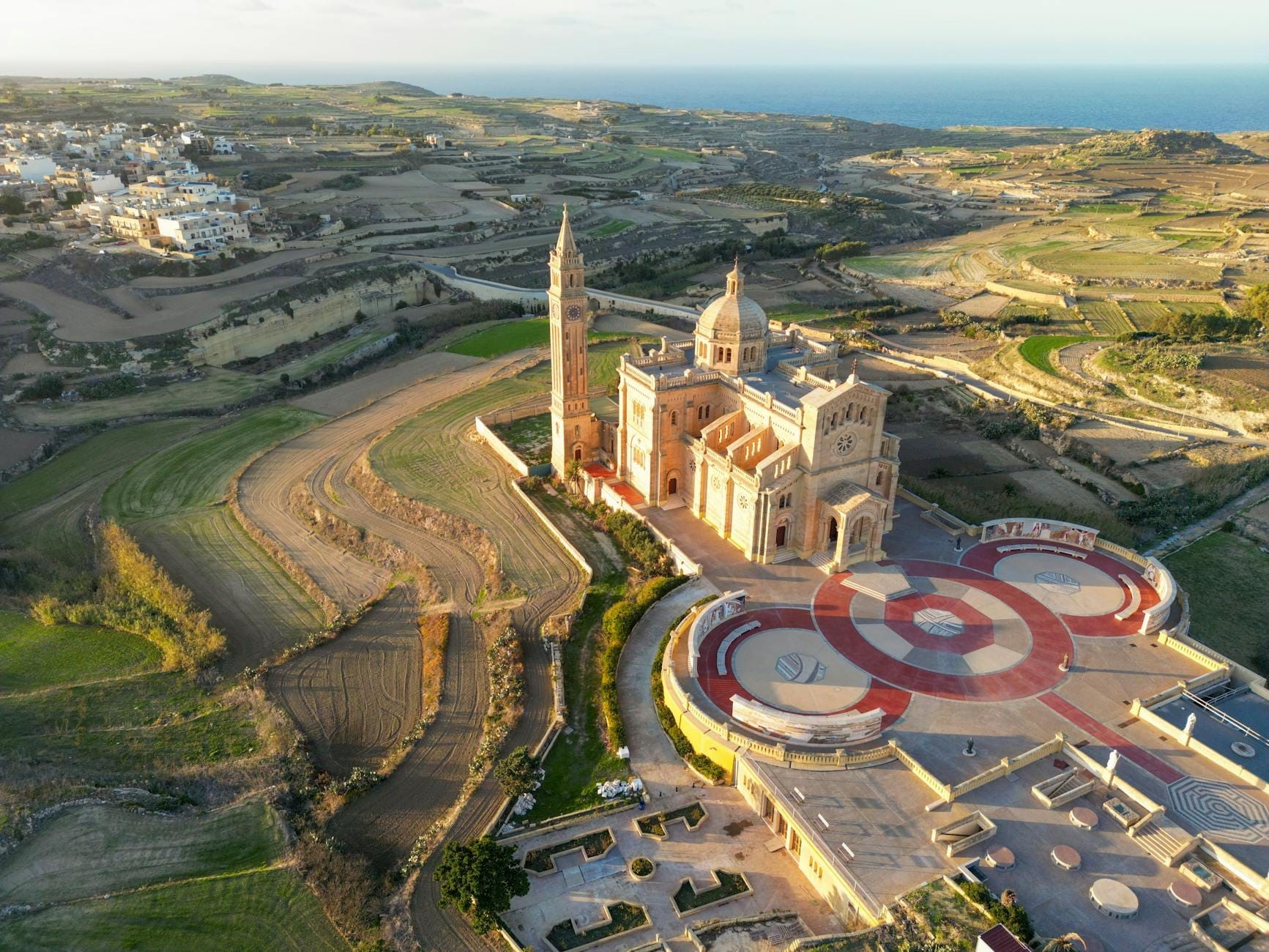
First Impressions: A Basilica That Commands the Landscape
The Basilica of the National Shrine of the Blessed Virgin of Ta' Pinu announces itself long before you arrive. Driving or cycling through Gozo's interior, you will spot its 61-metre bell tower rising above fields of dry stone walls and carob trees. There is nothing else of comparable scale in this part of the island, and that contrast, rural quietness interrupted by soaring Neo-Romanesque stone, sets the tone for what is inside.
The approach on foot from Għarb is short but deliberate. The path opens onto a forecourt framed by low colonnaded wings, and the facade's pale limestone glows differently depending on the hour. At midday in summer, the stonework is almost bleached white. In the late afternoon, it turns a warm amber that makes the carved details read more clearly. Neither is wrong. Both reward the visit.
💡 Local tip
Dress modestly before you arrive. The basilica is an active place of worship and a national shrine: covered shoulders and knees are expected. A scarf or light layer in your bag solves this quickly.
The History Behind the Stone
The site's origins go back to around 1545, when a small chapel was built here in honour of the Assumption of the Blessed Virgin. It stayed obscure for decades until a man named Pinu Gauci began restoring it from 1615 onward and commissioned an altarpiece, completed in 1619 by the painter Amadeo Perugino. The chapel took his name, and the 'Ta' Pinu' designation has stayed ever since. In Maltese, Ta' Pinu simply means 'of Philip,' a vernacular form of Pinu.
The real turning point came in 1883, when a local woman named Karmela Grima reported hearing a voice in the chapel urging her to pray. Her neighbour Francesco Portelli, suffering from serious illness, subsequently recovered after praying there. Word spread. Devotion intensified. Votive offerings accumulated. By the early twentieth century, the original chapel was far too small for the crowds, and plans were drawn up for something grander.
The foundation stone was laid on 30 May 1920. The basilica was consecrated on 13 December 1931 and completed the following year. Crucially, the architects preserved the original chapel intact inside the new structure: it sits at the back of the main nave, a small, older room within the larger Romanesque shell, and stepping into it feels like moving through layers of time.
The basilica's status as a national shrine is not just ecclesiastical. Pope John Paul II visited on 26 May 1990, and Pope Francis made his own visit in 2022, cementing Ta' Pinu's standing in the wider Catholic world. For context on Malta's deep religious culture, the ancient temples of Malta predate Christianity by millennia, but the island's Catholic identity runs just as deep as its prehistoric heritage.
Tickets & tours
Hand-picked options from our booking partner. Prices are indicative; availability and final rates are confirmed when you complete your booking.
City Sightseeing hop-on hop-off bus tour of Gozo
From 20 €Instant confirmationFree cancellationThe Malta Experience Audio-Visual Show and La Sacra Infermeria Tour
From 20 €Instant confirmationFree cancellationLuggage Storage in Malta
From 6 €Instant confirmationFree cancellation6-day heritage and attractions pass in Malta
From 80 €Instant confirmationFree cancellation
Inside the Basilica: What You Actually See
The nave is long, calm, and cool, a relief on hot summer afternoons. Light enters through tall arched windows, and the stone columns have a weight that keeps the atmosphere grounded rather than theatrical. This is not a baroque explosion of gilded excess; the interior is comparatively restrained, which makes the details that do exist, the marble floors, the carved stonework, the painted ceiling sections, feel more considered.
The original chapel at the rear is where most visitors slow down. It is a markedly different space: older, smaller, and thick with the specific atmosphere that accumulates in places people have prayed in for centuries. The altarpiece by Perugino, completed in 1619, holds the image of the Blessed Virgin that drew Karmela Grima back in 1883. The votive offerings covering the walls around it, crutches, photographs, handwritten notes, ex-votos in silver and brass, constitute an informal archive of personal gratitude and desperation across many decades. Even if you are not a believer, this room is worth standing in quietly.
The votive room adjacent to the main nave extends this further. Glass cases hold hundreds of offerings from people who believed their prayers were answered here. The range is striking: items left by fishermen, soldiers, mothers, children. It reads as a kind of social history of Gozitan life as much as a devotional display.
The Stations of the Cross on Ta' Għammar Hill
Across from the basilica, the hillside of Ta' Għammar carries a series of life-size white Carrara marble statues marking the Stations of the Cross. Installed in the early 1980s, they are positioned along a path that rises gently and offers progressively wider views over the surrounding countryside. The walk takes around 20-30 minutes at a reflective pace.
In practical terms, this is also one of the quieter viewpoints in Gozo, away from the tourist concentration at the cliffs and bays. On a clear day, you can see across to Malta in the south and out toward the open Mediterranean. Early morning is the best time to make this walk: the light is soft, the path is empty, and the marble statues have a stillness that the midday heat tends to flatten.
ℹ️ Good to know
The Stations of the Cross path is unpaved in sections and involves a gentle incline. Comfortable walking shoes are advisable, particularly after rain when the ground can be slippery.
If you are building a wider Gozo itinerary, Ta' Pinu pairs naturally with a visit to the Citadella in Victoria, Gozo's fortified hilltop capital, about 4 kilometres to the east. The two form a satisfying half-day loop covering both the island's spiritual and strategic heritage.
When to Visit and How to Get There
Ta' Pinu is meaningful to visit year-round, but the character of the visit shifts considerably by season. In summer, particularly around the Feast of the Assumption on 15 August, the basilica and surrounding area fill with pilgrims and local families. This is genuinely moving to witness if you are comfortable with crowds, but it is a very different experience from an early-morning visit in April or October, when the forecourt may be almost entirely yours.
Spring and autumn offer the most comfortable visiting conditions. Temperatures between 18 and 26 degrees Celsius, low rainfall, and good light for photography make April through June and September through October the practical sweet spots. Avoid visiting in the peak midday hours of July and August unless you are there for the feast specifically: the heat on the Stations of the Cross path is considerable.
Getting to Għarb from Victoria, Gozo's main town, is straightforward by bus, though services are less frequent than the main island routes. A taxi or rental car gives you more flexibility. If you are exploring Gozo for a full day, the area around Ta' Pinu includes several other worthwhile stops. For broader planning, the Gozo travel guide covers transport, accommodation, and the island's key sites in detail.
⚠️ What to skip
There is limited shade in the forecourt and on the hillside path. A hat and water are essential in summer. The nearest village facilities, including cafes, are in Għarb, a short walk or drive away.
Photography, Atmosphere, and Honest Assessment
For photography, the exterior rewards two specific windows: the first hour after sunrise and the two hours before sunset. The west-facing facade catches late afternoon light particularly well, and the surrounding countryside, with its low stone walls and sparse vegetation, gives the basilica a landscape context that photographs cleanly. Interior photography is possible but should be done discreetly and with awareness of worshippers.
An honest note for secular visitors: Ta' Pinu is not a heritage museum. It is an active national shrine where people come specifically to pray, often in personal distress or gratitude. The atmosphere is respectful and generally welcoming to all visitors, but this is not a place to treat as a backdrop for casual social media content. Those who approach it with corresponding seriousness will find it considerably more affecting.
If the religious dimension holds little interest for you, the architectural and historical value alone may not justify a long detour. In that case, other Gozo attractions may better suit your time: Ggantija Temples nearby offer genuine world-class prehistoric significance, and the Dwejra coastline on the western shore delivers dramatic geology and seascape.
Accessibility within the main basilica is generally manageable for wheelchair users, as the nave floor is level. The Stations of the Cross path on the hillside is not paved uniformly and involves inclines that may be difficult for visitors with mobility limitations.
Insider Tips
- The original 15th-century chapel is preserved inside the basilica at the rear of the nave. Many visitors walk through the main church and leave without finding it. Look for the smaller doorway behind the main altar and step through.
- The annual Feast of the Assumption on 15 August draws large crowds of pilgrims from across Malta and Gozo. If you want to experience the basilica at its most alive culturally, this is the day. If you want solitude, this is the day to avoid.
- Babies born in the preceding year are traditionally presented to Our Lady of Ta' Pinu in a ceremony that takes place annually. Ask locally about the date if this is something you want to witness.
- The drive or cycle approaching from the south via the interior of Gozo gives the most dramatic first view of the bell tower emerging above the fields. Approaching from Għarb itself is shorter but less visually striking.
- The votive room is often overlooked by visitors who spend all their time in the main nave. It is arguably the most historically textured part of the entire complex: the collection of offerings spans generations and tells a genuinely human story.
Who Is Ta' Pinu Basilica For?
- Pilgrims and Catholic visitors for whom Ta' Pinu holds deep devotional significance
- Architecture enthusiasts interested in early 20th-century Neo-Romanesque ecclesiastical design
- Travellers wanting a calm, interior Gozo experience away from the island's beaches and coastal crowds
- History-minded visitors interested in how a local devotional tradition grew into a national shrine visited by two popes
- Photographers seeking strong landscape-architecture compositions, particularly in early morning or late afternoon light
Nearby Attractions
Other things to see while in Gozo:
- Citadella (Victoria)
Rising from a rocky promontory above Victoria, the Citadella is Gozo's most significant historical site. Inside its 17th-century bastions you'll find a cathedral with a famous trompe-l'oeil ceiling, small but thoughtful museums, and panoramic views stretching across the entire island. It rewards a half-day of exploration.
- Dwejra & Blue Hole
Dwejra on Gozo's west coast is the site of the Blue Hole, a natural limestone sinkhole that funnels divers into one of the Mediterranean's most celebrated underwater landscapes. Above water, the Inland Sea, surrounding cliffs, and the rubble of the lost Azure Window make this one of the most geologically dramatic corners of Malta.
- Ġgantija Temples
Standing on the Xagħra plateau in Gozo, the Ġgantija Temples are among the oldest freestanding structures on Earth, predating both Stonehenge and the Egyptian pyramids. This UNESCO World Heritage Site offers a rare encounter with Neolithic craftsmanship on a scale that continues to baffle archaeologists and awe visitors.
- Ramla Bay
Ramla Bay (Ir-Ramla l-Ħamra, meaning 'the red sands') is Gozo's largest and most distinctive beach, stretching 360 metres across the island's north-east coast. Its warm-toned sand, clear Blue Flag water, and surrounding dunes of endemic flora make it unlike anything on the main Malta island.