Mosque of Suleiman: Rhodes' Most Visible Ottoman Landmark
Rising above the rooftops of Rhodes Old Town, the Mosque of Suleiman is the most prominent Ottoman structure in the medieval city. Built in 1522 to mark the conquest of Rhodes and reconstructed in 1808, its rose-colored minaret and domed silhouette are impossible to miss. Interior access is limited, but the exterior alone rewards a visit.
Quick Facts
- Location
- Central Rhodes Old Town, near the Clock Tower, Sokratous Street
- Getting There
- Walk from any Old Town gate; nearest entry points are St. John's Gate or D'Amboise Gate. Taxis stop outside the walls.
- Time Needed
- 15–30 minutes for exterior; longer if the interior is open
- Cost
- Free to view from outside. Interior admission fees (if open) unconfirmed — check locally on arrival.
- Best for
- History enthusiasts, architecture lovers, photographers, and anyone walking the Old Town
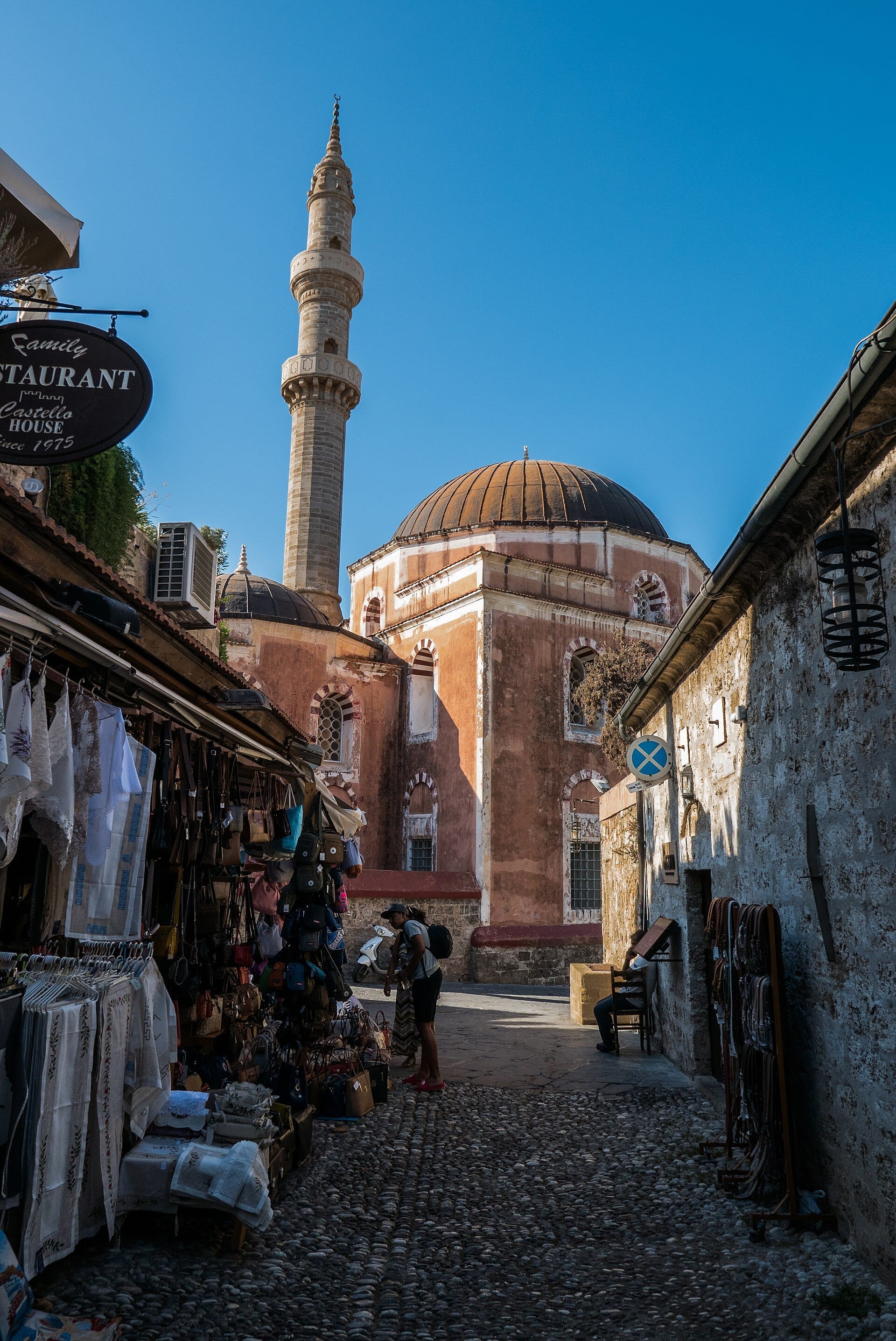
What You're Looking At
The Mosque of Suleiman (Süleymaniye Camii in Turkish) is the largest and most architecturally significant Ottoman building in Rhodes Old Town. It stands at the top of Sokratous Street, the main commercial artery of the medieval city, where the street widens into a small square before climbing toward the Palace of the Grand Master. The building's scale and position make it a genuine focal point of the Old Town, not a peripheral curiosity.
The facade is finished in a warm rose-pink render that catches the afternoon sun with particular intensity. The main dome is flanked by smaller semi-domes, and a single minaret rises cleanly above the surrounding rooflines. The proportions are Ottoman classical: measured, deliberate, and confident. Compared to the Gothic stonework of the Knights-era buildings nearby, the mosque reads as a completely different architectural grammar, which is exactly what it was intended to convey.
ℹ️ Good to know
Interior access is not guaranteed. The mosque has been closed for worship since 2014, pending further restoration, and is not currently used for active worship. Before making the interior a priority, ask at your accommodation or check with the local tourist office upon arrival.
History: Built on a Statement, Rebuilt from Memory
Suleiman the Magnificent ordered the construction of this mosque in 1522, the same year his Ottoman forces besieged and captured Rhodes from the Knights of St. John. The building was both a place of worship and a political act: a physical declaration that the island's medieval Christian order had ended and a new era had begun. It was the first mosque built in the city after the conquest.
The original 1522 structure was built using materials salvaged from earlier Christian buildings on the site, a common Ottoman practice of architectural incorporation that added symbolic weight to the new construction. What stands today is largely the result of a substantial reconstruction completed in 1808, which preserved the original layout and orientation while renewing much of the fabric of the building. The minaret and the dome configuration visible today largely reflect the 1808 work, though the site's Ottoman identity has remained continuous since the conquest.
The mosque sits within a neighborhood that layers history in nearly every building. A short walk downhill brings you to the Street of the Knights, the best-preserved medieval street in Europe, and uphill toward the Palace of the Grand Master. Understanding the mosque as the Ottoman response to those Knights-era monuments gives the whole neighborhood a much richer context.
Tickets & tours
Hand-picked options from our booking partner. Prices are indicative; availability and final rates are confirmed when you complete your booking.
Sunset catamaran cruise with dinner in Rhodes
From 70 €Instant confirmationFree cancellation3-Hour All Inclusive Sun and Sea Swimming Cruise in Rhodes
From 55 €Instant confirmationFree cancellationRhodes Sunset Cruise with Greek BBQ and Unlimited Drinks
From 65 €Instant confirmationFree cancellationPalace of the Grand Master Ticket and Audio Tour by App
From 30 €Instant confirmation
The Experience on the Ground
Approaching from Sokratous Street, you hear the mosque before the full building comes into view. The street is lined with shops selling ceramics, leather, and souvenirs, and the noise level is consistent throughout the day. Then the street opens, and the mosque occupies the upper end of the square with a quiet authority that the commerce below does not diminish.
The exterior courtyard, enclosed by a low wall, includes the remains of an Ottoman fountain (şadırvan) used historically for ritual washing before prayer. The stonework around the entrance portal shows both Ottoman carved detail and fragments of earlier material, visible if you look closely at the lower sections of the wall. The rose-pink plasterwork is smooth to the eye but shows fine weathering cracks up close, the honest texture of a building that has absorbed nearly five centuries of Aegean sun and winter rain.
If the interior is open during your visit, you will find a single prayer hall beneath the main dome, with limited original furnishings remaining. The acoustic inside the dome is notably different from the street outside: sounds are rounded and absorbed rather than echoing. Natural light enters through arched windows set into the drum of the dome. The space is not ornate by Ottoman imperial standards, but it has the serene geometry typical of classical mosque interiors.
How the Light and Crowds Change Through the Day
Early morning is the quietest window. Before 9am, Sokratous Street is largely empty of tourists, and the mosque square feels like a different place entirely. The pink facade picks up warm light from the east, and you can photograph the minaret against a clear sky without other visitors in the frame. The only sounds are from local residents and the occasional delivery scooter navigating the cobblestones.
By mid-morning, cruise ship visitors and hotel guests fill the street. The area around the mosque becomes a natural bottleneck because the square is where several Old Town lanes converge. Midday in summer is genuinely hot on the exposed cobblestones, and the lack of shade around the mosque makes extended standing uncomfortable. Bring water.
Late afternoon, roughly 4pm to 6pm, is arguably the most photogenic time. The sun moves to the southwest, and the rose-pink plasterwork glows against a deepening blue sky. The crowds thin slightly as day-trippers return to their ships, and the pace of the square slows. The minaret throws a long shadow across the courtyard wall.
💡 Local tip
The best elevated view of the minaret is from the terrace of the Clock Tower (Roloi), a short walk uphill. From there you look almost directly level with the top of the minaret and can see the dome-and-minaret composition against the Old Town roofscape.
Getting There and Practical Notes
The mosque is in the center of Rhodes Old Town, and nearly every walking route through the medieval city passes near it. If you enter through the main gate on Mandraki side and walk down Sokratous Street, you will reach the mosque square naturally in about ten minutes. The Old Town is pedestrian-only inside the walls, so all approaches are on foot.
The cobblestone streets leading to the mosque are uneven, and the square itself slopes noticeably. Mobility-impaired visitors may find the approach manageable but should be aware there are no ramps or smooth surfaces in this section of the Old Town. Sturdy, flat-soled shoes are strongly recommended for the entire neighborhood regardless of the distance walked.
If you are planning a full day in the Old Town, the mosque pairs logically with the Roloi Clock Tower immediately adjacent and the Archaeological Museum of Rhodes a few minutes' walk away. Combining these three creates a compact half-day route that covers Greek, Knights-era, and Ottoman history in sequence.
Honest Assessment: Is It Worth Your Time?
The Mosque of Suleiman is not a richly curated attraction. There are no explanatory panels outside, no audio guide, and interior access is inconsistent. If you arrive expecting a museum experience, you may be disappointed. What it offers instead is something harder to manufacture: a genuinely significant piece of architecture in an extraordinary location, surrounded by the living fabric of a medieval city that has absorbed four centuries of Ottoman history without erasing it.
Travelers focused purely on beaches or nightlife can skip it without regret. But for anyone trying to understand how Rhodes accumulated its layers of conquest, culture, and identity, the mosque is one of the most direct and readable artifacts in the city. It takes fifteen minutes to absorb properly from outside. If the interior is open, give it thirty.
Rhodes Old Town as a whole is a UNESCO World Heritage Site, and the mosque is one of its defining monuments. If you are doing any kind of serious exploration of the medieval city, the Rhodes Medieval Old Town guide gives useful context for situating the mosque within the broader urban sequence.
Insider Tips
- The Clock Tower terrace next door gives you the best elevated angle on the minaret and dome. The small admission fee for the tower is worth it for photographers.
- Look at the base of the exterior walls for carved stonework that clearly predates the Ottoman period. These are fragments incorporated from earlier Christian structures on the site, visible evidence of the building's layered origins.
- If the interior happens to be open, step inside even briefly. The acoustic difference between the dome interior and the street outside is striking, and the geometry of the prayer hall reads very differently from inside than the exterior suggests.
- Sokratous Street directly below the mosque is densely commercial. If you want a quieter approach, come from the upper lanes near the Palace of the Grand Master and enter the square from above, which also gives you a better first view of the facade.
- The mosque is most photographable in late afternoon light and least photographable at noon, when the overhead sun flattens the dome and washes out the pink facade. Plan accordingly if photography matters to you.
Who Is Mosque of Suleiman For?
- Architecture and history travelers exploring the Ottoman and medieval layers of Rhodes
- Photographers working the Old Town circuit, particularly in late afternoon
- First-time visitors to Rhodes wanting to understand the city's full historical sequence
- Travelers combining a half-day Old Town walking route with the nearby Clock Tower and Archaeological Museum
- Anyone with a particular interest in Ottoman architecture outside of Turkey
Nearby Attractions
Other things to see while in Rhodes Old Town:
- Archaeological Museum of Rhodes
Housed in the 15th-century Hospital of the Knights, the Archaeological Museum of Rhodes brings together artifacts spanning the Archaic to Roman periods, including celebrated Hellenistic marble statues and intricate floor mosaics. It is one of the most historically layered museum experiences in the Aegean, where the building itself is as compelling as the collection inside.
- Hammam Turkish Baths
Built in 1558 during the Ottoman occupation, the Great Hamam is the sole surviving bathhouse within Rhodes' UNESCO-listed Medieval Town. Currently closed to the public but recently restored, it remains one of the most architecturally distinctive buildings in Arionos Square, worth understanding in context before you arrive.
- Harbour Gates
The Harbour Gates mark the medieval boundary between Mandraki Harbour and the walled city built by the Knights of Saint John. Free to visit at any hour, they are the most atmospheric entry point into Rhodes Old Town, framing a view that has barely changed in six centuries.
- Palace of the Grand Master of the Knights of Rhodes
The Palace of the Grand Master of the Knights of Rhodes is the most architecturally commanding structure in the medieval city. Built in the early 14th century and dramatically restored under Italian rule, it anchors the northwestern corner of the Old Town with towers, colonnaded courtyards, and a permanent collection that spans antiquity to the Ottoman period.