Roloi Clock Tower: Rhodes Old Town's Best Viewpoint
The Roloi Clock Tower rises above the rooftops of Rhodes Old Town at the junction of Sokratous and Orfeos streets. A 53-step climb through Ottoman and Byzantine history rewards visitors with a sweeping 360-degree panorama over the medieval city. Entrance includes a complimentary drink at the open-air terrace café.
Quick Facts
- Location
- Orfeos 1, corner of Sokratous & Orfeos St, Rhodes Old Town
- Getting There
- Walk from any Old Town gate; closest approach via Sokratous Street, turn right onto Orfeos
- Time Needed
- 30–45 minutes
- Cost
- €5 entrance fee; includes one complimentary drink at the terrace café
- Best for
- Panoramic views, Ottoman architecture, photographers, history enthusiasts
What Is the Roloi Clock Tower?
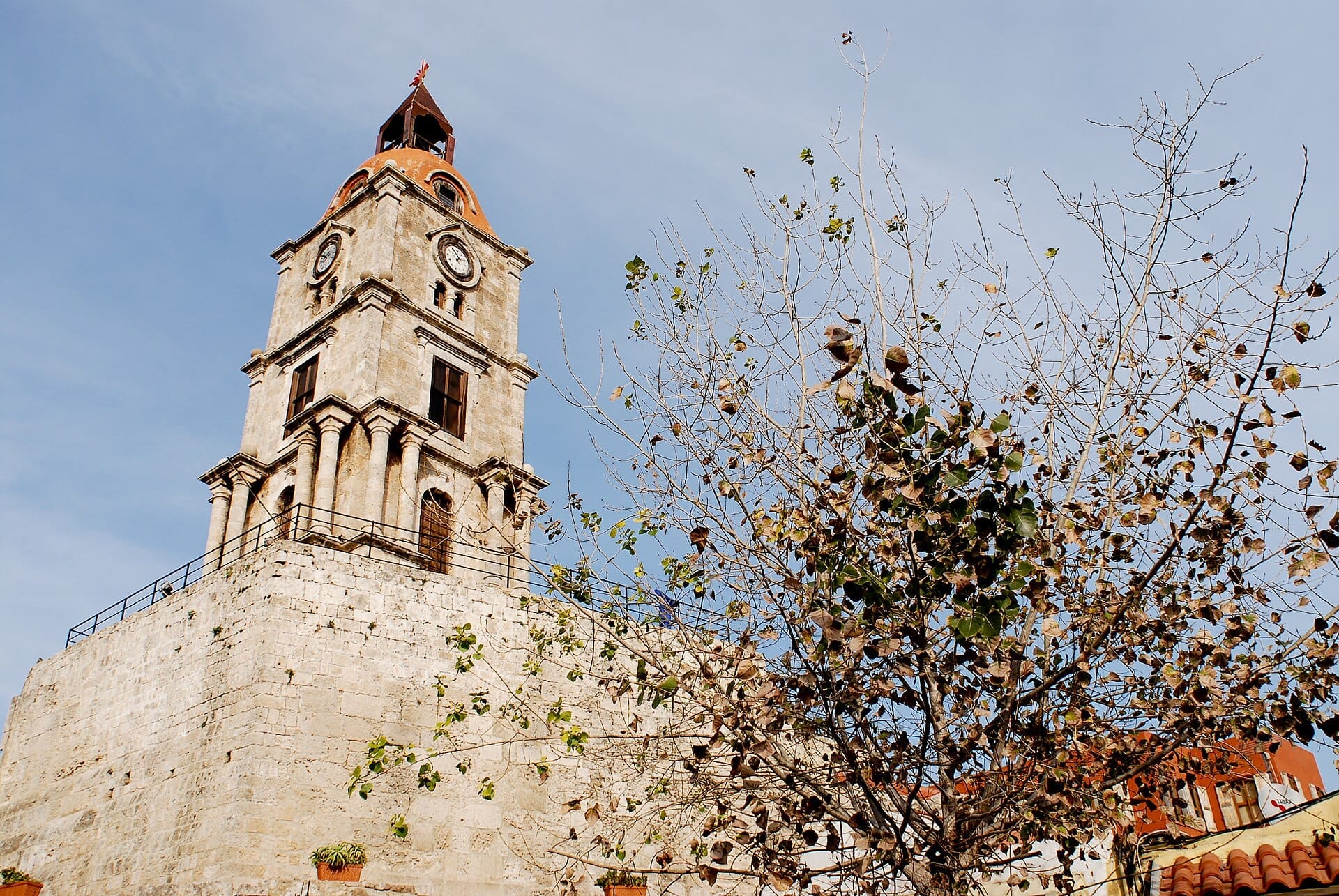
The Roloi Clock Tower, officially known as the Medieval Clock Tower, stands at the highest point in Rhodes Old Town. It sits at the intersection of Sokratous and Orfeos streets, making it impossible to miss once you wander up from the main market street below. The tower is one of the very few structures in the Old Town where you can actually climb to a rooftop terrace, which makes it genuinely useful rather than purely decorative.
Its origins trace back to a 7th-century Byzantine defensive structure, though the building you see today is largely a 19th-century Ottoman reconstruction. After significant damage from an 1856 explosion, the tower was rebuilt by Fethi Pasha around 1857 with baroque stylistic touches that distinguish it from the purely medieval architecture surrounding it. The clock mechanism itself was imported from Edward Prior and Co. in London, a detail that says a great deal about the cultural crosscurrents at work in 19th-century Rhodes.
The tower sits within the broader context of the Rhodes Old Town, a UNESCO World Heritage Site that layers Hellenistic, Byzantine, Crusader, and Ottoman history into a single walkable district. Understanding this layering helps explain why a clock tower commissioned by an Ottoman governor incorporates baroque detail and houses an English clockwork mechanism.
💡 Local tip
The original 19th-century clockwork mechanism is displayed on the terrace level. Take a moment to examine it before fixating on the view — it is more intricate than most visitors expect.
The Climb: 53 Steps and What You Find at the Top
Access is through a modest entrance on Orfeos Street. The interior staircase consists of 53 steep wooden steps. They are narrow, the treads are worn smooth from years of foot traffic, and the handrail is functional rather than elegant. Anyone with mobility limitations should skip this one entirely; the steps are genuinely demanding and there is no lift or alternative route to the top.
The terrace itself is not large. On a busy summer afternoon it can feel crowded with only eight or ten people on it, so arrival timing matters. What you get for the effort is a full 360-degree view over the medieval rooftops, the minarets of the Old Town, the surrounding sea, and on clear days the Turkish coastline to the east. The view looking north toward Mandraki Harbour is particularly striking, giving you a visual sense of how the Old Town wall meets the water.
If you have already visited the Palace of the Grand Master, the clock tower gives you a completely different perspective on the Old Town's scale. From the palace walls you look out; from the tower you look down across the entire settlement.
⚠️ What to skip
The wooden steps are steep and slippery in spots. Wear closed-toe shoes with grip. Sandals are not ideal. The staircase is also too narrow for two people to pass comfortably, so expect brief waits.
Tickets & tours
Hand-picked options from our booking partner. Prices are indicative; availability and final rates are confirmed when you complete your booking.
Sunset catamaran cruise with dinner in Rhodes
From 70 €Instant confirmationFree cancellation3-Hour All Inclusive Sun and Sea Swimming Cruise in Rhodes
From 55 €Instant confirmationFree cancellationRhodes Sunset Cruise with Greek BBQ and Unlimited Drinks
From 65 €Instant confirmationFree cancellationPalace of the Grand Master Ticket and Audio Tour by App
From 30 €Instant confirmation
Historical and Cultural Context
Rhodes has been ruled by Greeks, Romans, Byzantines, Crusading Knights of St. John, Ottomans, Italians, and finally reunited with Greece in 1947. Each period left physical traces in the Old Town, and the Roloi Clock Tower is one of the more interesting examples of Ottoman-era imprint on a medieval fabric.
Fethi Pasha, who commissioned the tower's reconstruction after the 1856 explosion, also funded a junior high school (rüşdiye) adjacent to the tower, completed in 1853. This school building still stands alongside the tower and forms part of the same architectural complex. The choice to import a London-made clock movement for an Ottoman structure in a Greek city reflects Rhodes's position as a trading crossroads rather than an isolated outpost.
Visitors with an interest in this layered history will find that the clock tower pairs well with a walk along the Street of the Knights, which represents the Crusader period, and a stop at the Süleyman Mosque nearby, another prominent Ottoman landmark in the Old Town.
The tower's clock still marks time audibly. Hearing it strike the hour from somewhere down in the labyrinth of Old Town lanes is one of those small atmospheric details that lodge in memory long after a trip ends.
How the Experience Changes by Time of Day
Morning visits, roughly between 9am and 11am, offer the quietest experience. The lanes around Sokratous Street are not yet at full commercial volume, and the light falls at an angle that makes the stonework of the surrounding rooftops glow. The view eastward toward the Turkish coast is often clearest before midday haze builds.
Midday in July and August is the least rewarding window. The staircase traps heat, the terrace is at its most crowded, and the glare makes photography flat and difficult. If that is the only time available, go anyway, but temper expectations for both comfort and photo quality.
Late afternoon and early evening transform the experience significantly. As the sun drops toward the west, the Old Town takes on a warmer tone, minarets and domes catch the directional light, and the complimentary drink at the terrace café becomes genuinely pleasant rather than just a marketing incentive. The tower is also lit at night, which makes it worth locating from street level even if you visit the top during the day.
💡 Local tip
For photography, arrive within the 90 minutes before sunset. The westward view catches the golden hour light directly, and the eastern view shows the medieval rooftops in sharp relief.
Practical Information
The tower is located at Orfeos 1, reachable on foot from any of the Old Town gates. The most direct approach is to walk up Sokratous Street, the main commercial artery of the Old Town, until you reach Orfeos Street on your right. The tower becomes visible as you turn up the slope. There are no official public bus stops inside the Old Town walls; all access is pedestrian once you enter through one of the gates.
If you are arriving from the New Town or Mandraki area, consult the getting around Rhodes guide for bus and taxi options to the Old Town gates.
Exact opening hours were not confirmed at time of writing; the tower appears to operate on a daytime schedule consistent with other Old Town attractions. Verify locally on arrival, particularly outside peak season (October to April) when hours can shorten or close entirely. A small entrance fee applies, and this includes one complimentary drink at the open-air terrace café, which represents reasonable value given what cafés in the Old Town typically charge per drink on their own.
The tower is not accessible to visitors with mobility impairments, pushchairs, or young children unable to manage steep unassisted steps. There is genuinely no workaround for this; the architecture predates any accessibility provision by several centuries.
Is the Roloi Clock Tower Worth Your Time?
This is a compact attraction and it delivers clearly on one promise: the best elevated view inside the Old Town walls. It does not offer museum-depth interpretation, interactive exhibits, or a lengthy experience. You will spend 30 to 45 minutes in total including the climb, the terrace, and the drink.
Visitors expecting a major museum or a long structured tour will leave underwhelmed. The Archaeological Museum of Rhodes nearby offers significantly more content for those seeking depth. But for anyone building a walking route through the Old Town, the clock tower functions as a natural midpoint and the terrace gives you the spatial overview that makes the rest of the district easier to understand.
People who are specifically uncomfortable with heights, confined stairwells, or steep wooden steps should skip this one without guilt. The experience is almost entirely about the climb and the rooftop, and neither can be experienced at ground level.
Insider Tips
- The adjacent building, Ahmed Fethi Pasha's former junior high school from 1853, is worth a brief look before or after climbing. Most visitors walk past it without realising its connection to the tower's history.
- Buy your entrance ticket and head up immediately if you see fewer than five other people waiting. The terrace fills quickly and the experience degrades noticeably above a dozen visitors.
- Bring a wide-angle lens or use your phone's panorama mode on the terrace. The view is too wide for a standard lens to capture in a single frame.
- Listen for the clock striking the hour while you are on the terrace. Hearing the mechanism work from directly beside it is a different experience than hearing it echo through the lanes below.
- If the terrace café is quieter than the lanes below, consider ordering your included drink and staying for 10 to 15 minutes past the initial view-taking. The atmosphere on the terrace in the late afternoon is one of the calmer spots in the Old Town during peak season.
Who Is Roloi Clock Tower For?
- Photographers seeking elevated Old Town rooftop perspectives
- History enthusiasts interested in Ottoman-era Rhodes
- First-time visitors who want a spatial overview of the Old Town before exploring on foot
- Travellers on a short visit who want a single high-impact viewpoint without a lengthy commitment
- Couples looking for a quiet late-afternoon stop with a drink included
Nearby Attractions
Other things to see while in Rhodes Old Town:
- Archaeological Museum of Rhodes
Housed in the 15th-century Hospital of the Knights, the Archaeological Museum of Rhodes brings together artifacts spanning the Archaic to Roman periods, including celebrated Hellenistic marble statues and intricate floor mosaics. It is one of the most historically layered museum experiences in the Aegean, where the building itself is as compelling as the collection inside.
- Hammam Turkish Baths
Built in 1558 during the Ottoman occupation, the Great Hamam is the sole surviving bathhouse within Rhodes' UNESCO-listed Medieval Town. Currently closed to the public but recently restored, it remains one of the most architecturally distinctive buildings in Arionos Square, worth understanding in context before you arrive.
- Harbour Gates
The Harbour Gates mark the medieval boundary between Mandraki Harbour and the walled city built by the Knights of Saint John. Free to visit at any hour, they are the most atmospheric entry point into Rhodes Old Town, framing a view that has barely changed in six centuries.
- Palace of the Grand Master of the Knights of Rhodes
The Palace of the Grand Master of the Knights of Rhodes is the most architecturally commanding structure in the medieval city. Built in the early 14th century and dramatically restored under Italian rule, it anchors the northwestern corner of the Old Town with towers, colonnaded courtyards, and a permanent collection that spans antiquity to the Ottoman period.