Son Marroig & Sa Foradada: Mallorca's Most Dramatic Coastal Viewpoint
Son Marroig is a 19th-century archduke's estate turned museum perched above the Tramuntana cliffs. Below it, a rugged 6.7km trail descends to Sa Foradada, a rocky peninsula with an 18-metre hole punched clean through it. Together, they make one of the most rewarding half-days in northwest Mallorca.
Quick Facts
- Location
- Ma-10 between Valldemossa and Deià, Serra de Tramuntana, northwest Mallorca
- Getting There
- Car recommended via Ma-10; excursion boats from Port de Sóller reach Sa Foradada by sea
- Time Needed
- 2.5–4 hours (museum + full hike round-trip); 45 min for viewpoint only
- Cost
- €4 museum entry; hiking trail is free
- Best for
- Hikers, history enthusiasts, photographers, and anyone who wants coast without crowds
What Son Marroig and Sa Foradada Actually Are
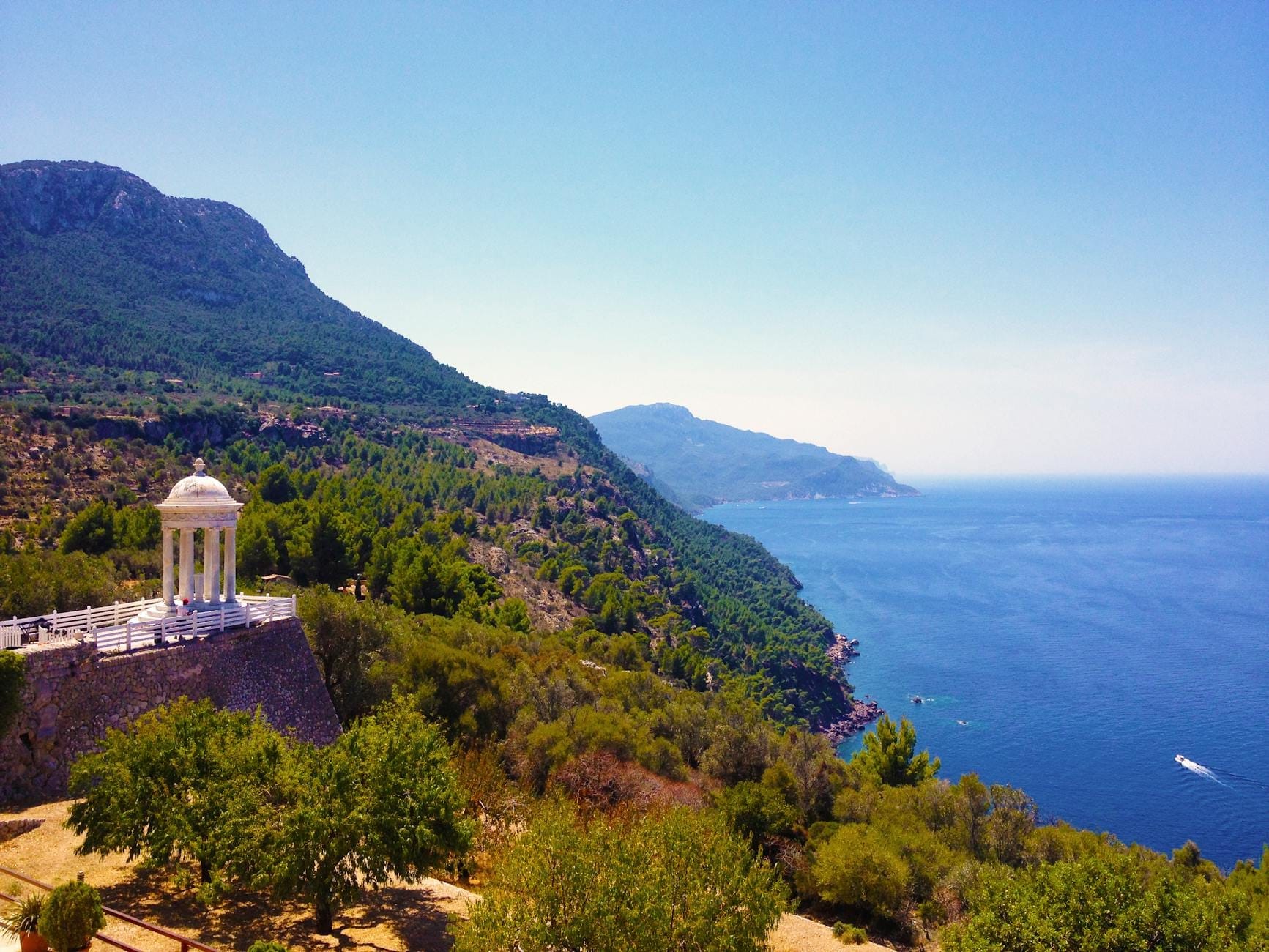
Son Marroig is a traditional Mallorcan country estate, a 'posesió', that the Austrian Archduke Ludwig Salvator acquired in the late 19th century. He had the place significantly remodeled, adding a white marble rotunda on the clifftop terrace that frames one of the most photographed views on the island. Today the estate operates as the Casa Museo de Son Marroig, a small but genuinely interesting museum dedicated to the archduke's life, his obsessive love of the Balearics, and the natural history he spent decades documenting.
Sa Foradada, meaning 'the pierced one' in Catalan, is the spear-shaped rocky peninsula that juts roughly 400 metres into the Mediterranean directly below the estate. Its defining feature is a circular hole approximately 18 metres in diameter punched through its base by centuries of wave erosion. From above, it looks almost surreal, like a geological accident that should not exist. Getting down to it requires a proper hike, which is precisely why it rewards those who make the effort.
ℹ️ Good to know
You can enjoy the view of Sa Foradada from Son Marroig's terrace in under an hour. The full round-trip hike to the peninsula adds another 2 to 3 hours and significant elevation change. Decide which you want before you park.
The Museum: A Habsburger on the Edge of the Mediterranean
Archduke Ludwig Salvator of Austria was a restless polymath who dedicated much of his adult life to cataloguing the Balearic Islands in extraordinary detail. His 14-volume work 'Die Balearen' remains a foundational document on the archipelago's natural history, culture, and geography. Son Marroig was his primary Mallorcan residence, and the museum reflects both the man and his era.
The €4 entry fee is honest value. Inside, rooms are arranged with period furniture, photographs, maps, and artefacts that trace the archduke's connection to the island. The collection is modest by major museum standards, but the context it provides makes the surrounding landscape feel layered in a way that a viewpoint stop alone never could. Allow 30 to 45 minutes to move through the rooms without rushing.
The real centrepiece is not indoors. The neoclassical rotunda on the clifftop terrace, built in Carrara marble, frames a direct sightline down to Sa Foradada and out across the sea toward the mainland. On clear mornings, the water shifts between steel blue and deep green. By late afternoon, it catches gold. The terrace is accessible during museum hours without paying admission if you only want the view, though checking current policy at the gate is worthwhile.
The estate sits within the Serra de Tramuntana, a UNESCO World Heritage landscape that stretches along Mallorca's northwest spine. For more on the broader mountain region, see our guide to the Serra de Tramuntana.
Tickets & tours
Hand-picked options from our booking partner. Prices are indicative; availability and final rates are confirmed when you complete your booking.
RCD Mallorca Son Moix Stadium Guided Tour
From 18 €Instant confirmationFree cancellationDinosaurland and Caves of Hams combined ticket
From 25 €Instant confirmationFree cancellationShuttle Boat from Cala Millor to Cala Ratjada
From 26 €Instant confirmationFree cancellation3-hour Es Trenc Boat Tour in Mallorca
From 39 €Instant confirmationFree cancellation
The Hike Down to Sa Foradada
The trail to Sa Foradada begins at the Son Marroig parking area and descends through terraced olive groves and scrubland to the peninsula below. The round-trip distance is 6.7 kilometres with approximately 260 metres of elevation change. That number sounds manageable, and the descent is, but the return climb on a warm afternoon tests anyone who has underestimated it.
The path surface is primarily stone and compacted gravel, irregular enough that sandals or flat-soled shoes will make you regret them. Wear proper hiking or trail-running shoes. The trail is well-worn and generally easy to follow, though signage is minimal in places. Most of the descent takes 45 to 60 minutes at a moderate pace.
⚠️ What to skip
Bring more water than you think you need. The trail offers no shade in the lower section, and the climb back is genuinely strenuous in summer heat. A minimum of one litre per person is recommended; two litres if you are visiting between June and September.
At the bottom, a small seasonal restaurant, Restaurant Sa Foradada, operates on the rocky shore during the warmer months. Arrival by boat is also possible: excursion vessels from Port de Sóller anchor nearby, meaning the peninsula occasionally has visitors who arrived without ever touching the trail. The boats add life to the scene but rarely create real crowds at the water's edge.
Standing on the peninsula itself, the hole in the rock is more impressive up close than from the estate above. You can walk partway out onto the formation and look directly through the arch to the open sea beyond. The sound changes here too, the slap and draw of waves echoing through the cavity, louder on days with any swell. It is the kind of place that earns its difficulty.
How the Experience Changes by Time of Day
Morning visits, arriving at or shortly after 9:30 when the museum opens, offer the best combination of cool temperatures, lower light on the cliffs, and a near-empty car park. The terrace is quiet enough that you can hear the wind and the sea below. This is also the best window for photography, when the angle of the sun catches the limestone in warm, raking light rather than the flat midday glare.
Midday in summer is the one time to avoid the hike. The lower trail offers almost no tree cover, and temperatures between 11:00 and 16:00 in July and August can make the climb back genuinely unpleasant. The museum itself is a reasonable midday refuge given the relative cool of its thick stone walls.
Late afternoon, roughly from 17:00 onward, brings softer light and, in spring and autumn, dramatically long shadows across the Tramuntana ridgeline. The museum closes before sunset, so if you want the terrace view in the golden hour, time your arrival accordingly and factor in the closing time for the season.
Son Marroig is on the Ma-10, which is one of Mallorca's most scenic drives and connects directly to Valldemossa to the south and Deià a few kilometres to the north. Both are worth building into the same day if you have a car.
Historical Depth: Beyond the Archduke
The estate's history predates Ludwig Salvator considerably. Son Marroig takes its name from the Masroig family, from whom the archduke purchased it. The broader area around Sa Foradada carries its own historical footnote: in 1582, the peninsula was reportedly the site of a defensive engagement in which around 50 local defenders repelled a raiding force of approximately 150 Moorish invaders. The coastal geography, the same rocky terrain that makes the hike demanding today, was a tactical asset then.
Ludwig Salvator's legacy is more immediately visible. He is widely credited with helping to preserve sections of the Tramuntana coast from the kind of development that transformed other parts of Mallorca in the 20th century, largely because he purchased and maintained large stretches of land. Whether you find the museum rooms compelling or simply use them as context for the view, his imprint on this corner of the island is real and lasting.
Photography, Accessibility, and Getting There
For photography, the marble rotunda functions as a natural frame and appears in a significant proportion of images taken from this stretch of coast. A standard wide-angle lens or phone camera captures the composition well. From the hike, the most striking shots come from above the peninsula looking down through the hole to the water beneath, best achieved by scrambling slightly to the left of the main trail as you approach the formation.
Accessibility on the museum level is workable for most visitors. The estate grounds and terrace are on relatively flat terrain. The hike to Sa Foradada is unsuitable for pushchairs or wheelchairs and requires reasonable physical fitness due to the uneven rocky surface and elevation gain on the return.
By car, the approach is via the Ma-10 from either Valldemossa or Deià. The estate has its own ample parking area. There is no practical public transport directly to Son Marroig. If you are travelling without a car, the most realistic option is to hire a vehicle for the day or to join a boat excursion from Port de Sóller that includes Sa Foradada as a stop, though this gives access to the peninsula only, not the museum.
If renting a car is your plan, see our guide on renting a car in Mallorca before you book. The Ma-10 is narrow in sections and benefits from a driver who has had some island orientation first.
💡 Local tip
Museum hours: Monday to Saturday, 9:30 to 18:00 in winter and 9:30 to 20:00 in summer. Closed Sundays. Admission €4. Phone: +34 971 639 158. Verify current seasonal hours before visiting, as they do shift.
Honest Assessment: Is This Worth Your Time?
For travellers who have only a few days in Mallorca and are primarily interested in beaches or city culture, Son Marroig is probably not the priority. The museum is small, the hike is physically demanding relative to many beach day-trips, and the reward is scenic rather than spectacular in the way that, say, the Drach Caves or Palma's cathedral are. If your time is genuinely limited, the viewpoint stop alone gives you a satisfying payoff in under an hour.
For anyone spending a week or more, or for travellers who respond to wild coastal landscape, history with some substance behind it, and a hike that earns its views, this is close to a perfect half-day. The combination of museum, terrace, trail, and rocky shoreline is coherent in a way that many Mallorca attractions are not. Everything here connects.
The Ma-10 corridor through the Tramuntana is genuinely one of the most scenic stretches of road in the Balearics. Our Mallorca road trip guide covers the full route if you want to turn this into a longer drive.
Insider Tips
- Park at Son Marroig rather than pulling over on the Ma-10 roadside. The estate parking is free and much safer than the narrow road shoulder where some visitors attempt to stop.
- The seasonal restaurant at the base of the trail, Restaurant Sa Foradada, is only reachable by foot or boat and is not always open. Do not plan your day around eating there without confirming in advance.
- If the hike feels too demanding, the view from the marble rotunda at the top is genuinely excellent and requires no trail at all. Do not skip the estate entirely just because you are not hiking.
- Spring visits, particularly between February and April, often coincide with almond blossom on the terraced hillsides along the trail. The white flowers against the grey limestone and blue sea is one of the quieter visual rewards of coming in the low season.
- The Ma-10 is a single-carriageway mountain road and coach tour buses use it regularly in high season. If you are driving a hire car, give yourself extra time and do not rush the bends.
Who Is Son Marroig & Sa Foradada For?
- Hikers and walkers who want a trail with genuine payoff rather than just elevation
- Photographers looking for Tramuntana coastal shots beyond the standard Deià village frame
- History-minded travellers with an interest in 19th-century naturalism and Habsburg eccentrics
- Visitors spending several days in the Tramuntana who want to connect Valldemossa and Deià into a single scenic drive
- Couples or small groups who prefer atmosphere over crowds
Nearby Attractions
Other things to see while in Serra de Tramuntana:
- Deià
Perched above olive groves on the northwestern cliffs of Mallorca's Serra de Tramuntana, Deià has drawn artists, writers, and travelers for decades. The honey-colored stone houses, the smell of wild rosemary on the lane up to the church, and the long views over the Mediterranean make it genuinely special. But it rewards slow visitors, not quick stop-and-snap day-trippers.
- Fornalutx
Perched in the Serra de Tramuntana above Sóller, Fornalutx is a compact stone village of about 700 people that has won national recognition for how well it has been preserved. The streets are steep, the buildings are honey-coloured, and the orange groves press in close on every side. Entry is free, the walk takes one to two hours, and it pairs naturally with a day in Sóller.
- Jardines de Alfabia
Set against the Serra de Tramuntana mountains, Jardines de Alfabia is a layered estate with roots in 13th-century Moorish Mallorca. Its terraced gardens, vaulted cistern, famous water pergola, and Baroque manor house make it one of the island's most rewarding half-day visits for anyone interested in history, botany, or architecture.
- Mallorca Cycling (Sa Calobra & Tramuntana Routes)
The Sa Calobra climb is the centerpiece of road cycling in Mallorca, winding 9.5 km through 26 hairpin bends into the heart of the UNESCO-listed Serra de Tramuntana. Whether you're a seasoned climber chasing Strava times or a touring cyclist exploring one of Europe's most dramatic mountain landscapes, these routes deliver scenery and challenge in equal measure.