Skogskyrkogården (Woodland Cemetery): Stockholm's Most Contemplative UNESCO Site
Skogskyrkogården, the Woodland Cemetery, is a UNESCO World Heritage Site carved into a former gravel pit south of Stockholm. Free to enter and open year-round, it is one of the world's most influential works of landscape architecture and an active cemetery that rewards slow, unhurried exploration.
Quick Facts
- Location
- Sockenvägen 492, 122 33 Enskede, Stockholm
- Getting There
- Skogskyrkogården station (green metro line, T-bana)
- Time Needed
- 1.5 to 3 hours
- Cost
- Free entry; guided tours approx. SEK 150 (verify current price)
- Best for
- Architecture lovers, slow walkers, history seekers, photography
- Official website
- skogskyrkogarden.stockholm/en
What Is Skogskyrkogården?
Skogskyrkogården, which translates directly as the Woodland Cemetery, is an active cemetery and UNESCO World Heritage Site located in the Gamla Enskede district, roughly five kilometres south of central Stockholm. It covers approximately 250 acres of pine forest, open meadow, and carefully shaped landforms, all designed to blur the boundary between nature and sacred space.
The site was created beginning in 1917 following a design competition won by architects Gunnar Asplund and Sigurd Lewerentz. Their vision replaced a depleted gravel pit with one of the twentieth century's most quietly radical works of landscape design. It was officially inaugurated in 1920 and inscribed on the UNESCO World Heritage List in 1994, recognised for its profound influence on cemetery design worldwide. It remains in active use today as a functioning burial site for Stockholm residents.
ℹ️ Good to know
Skogskyrkogården is an active cemetery. Visitors are welcome, but quiet, respectful behaviour is expected at all times. Funeral services take place regularly, particularly on weekday mornings.
The Design: What Asplund and Lewerentz Actually Built
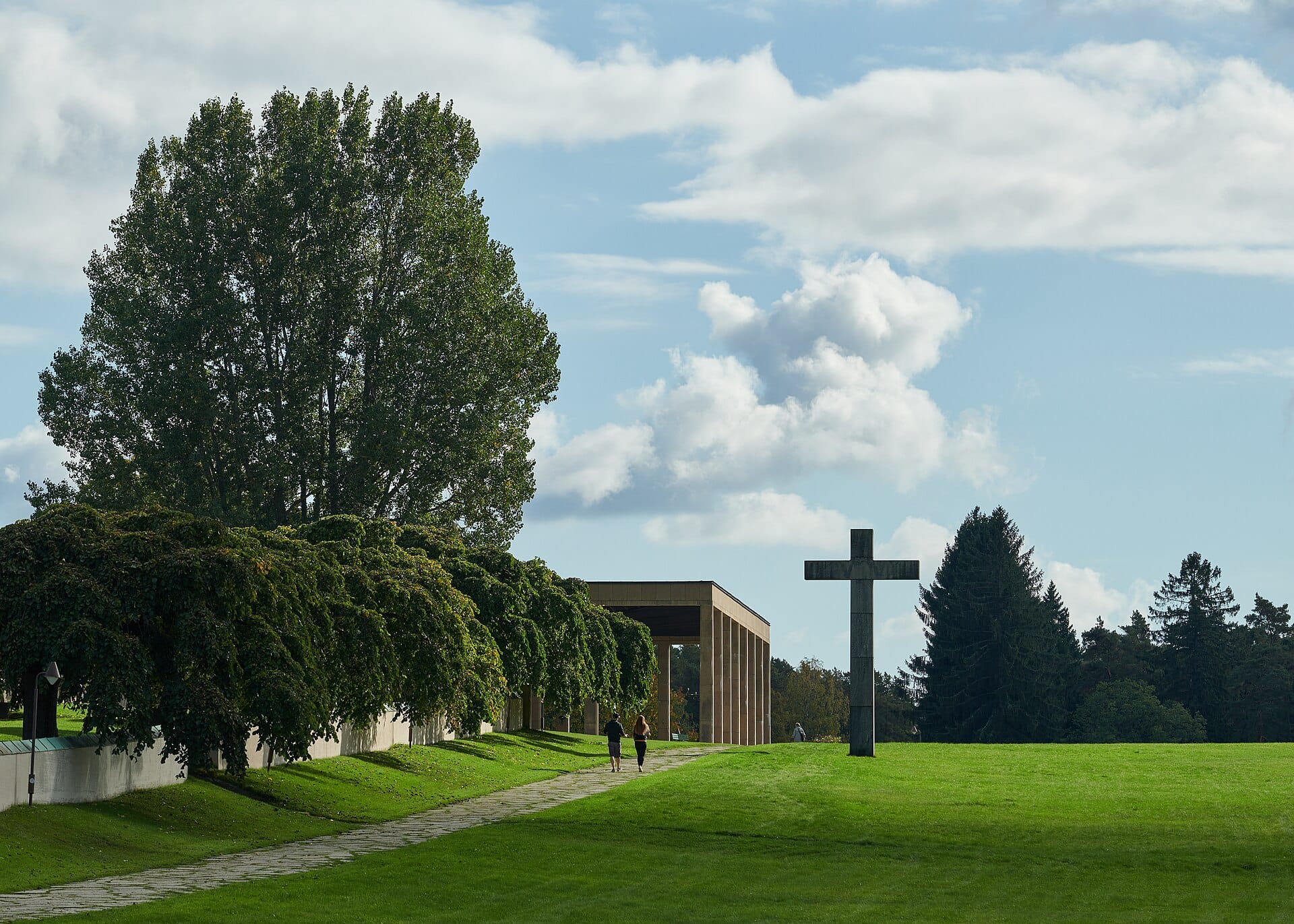
The genius of Skogskyrkogården lies in what it refuses to do. There are no grand avenues of mausoleums, no showpiece monuments competing for attention. Instead, the landscape itself is the architecture. A long, gently rising gravel path called the Way of the Seven Wells leads visitors from the entrance through open meadow toward a low granite cross that dominates the skyline. The cross is massive in scale but simple in form, and the effect of walking toward it across open ground changes depending on the light and season.
Three chapels punctuate the site: the Chapel of Hope, the Chapel of Faith, and the larger Chapel of the Holy Cross, completed in 1940 to Asplund's design and widely considered his masterpiece. Its portico of slender columns facing a reflecting pool is one of the most photographed architectural compositions in Sweden, though photographs consistently fail to capture the scale of silence around it.
Lewerentz contributed the Resurrection Chapel, a smaller structure with an asymmetrical portico that reveals Lewerentz's interest in tension and deliberate unease. The interiors of all chapels are austere, with natural light doing most of the work. If the chapels are unlocked during your visit, step inside, even briefly. The quality of light inside the Chapel of the Holy Cross at midday is unlike anything else in Stockholm.
Tickets & tours
Live prices and dates from our booking partner. If you book, we may earn a commission at no extra cost to you.
2-hour archipelago tour on a RIB speedboat
From 122 €Instant confirmationFree cancellationHaunted Stockholm exploration game and tour
From 12 €Instant confirmationFree cancellationFotografiska Stockholm entrance tickets
From 0 €Instant confirmationFree cancellationStockholm: Nature Reserve Hiking Tour with Campfire Lunch
From 102 €Instant confirmationFree cancellation
How the Experience Changes by Season and Time of Day
Skogskyrkogården is genuinely different across the seasons, in ways that matter for planning your visit. In summer, the tall Scots pines cast long-striped shadows across the footpaths by late afternoon, and the meadows near the main approach are bright with grass. Families and architecture students mix with mourners. The visitor centre and its small exhibition are most likely to be open, and guided tours run regularly.
Autumn is widely considered the most atmospheric period. Fallen needles soften the gravel paths, the light turns low and amber, and the site empties of casual tourists after mid-September. There is a smell of pine resin and damp earth on cool mornings that fits the place better than any other season. Winter brings snow that settles over the granite cross and the chapel rooflines with an effect that looks composed rather than accidental. Come in the early afternoon in winter, when the low sun briefly illuminates the south-facing portico of the Chapel of the Holy Cross.
Early mornings on weekdays are the quietest time overall. By 10 am on weekends in summer, tour groups begin arriving. If you want the site largely to yourself, arrive at opening or on a weekday afternoon in spring or autumn.
💡 Local tip
Visit on a weekday morning outside July and August for the fewest crowds. The gravel paths can be uneven and slightly soft after rain, so flat, closed-toe shoes are a practical choice.
Getting There and Getting Around the Site
Getting to Skogskyrkogården is straightforward. Take the green line (line 18) of Stockholm's Tunnelbana metro to Skogskyrkogården station. The main entrance is a short, signposted walk from the station exit. The entire journey from central Stockholm takes roughly 15 minutes.
Inside the site, navigation is intuitive but not obvious. There are no strict routes marked out, which is intentional: Asplund and Lewerentz designed the landscape to be discovered at walking pace, with views and structures appearing gradually rather than all at once. Pick up a map at the visitor centre near the main entrance, or download one from the official website before you arrive. The site is large enough that without a rough sense of direction, it is easy to spend an hour in the forest section without reaching the chapels.
Limited parking is available for those arriving by car. Cycling to the site is feasible from central Stockholm along the cycling network, though the route requires some navigation.
The Visitor Centre and Guided Tours
The visitor centre near the main entrance provides context that genuinely deepens the experience. A permanent exhibition covers the design competition, the working relationship between Asplund and Lewerentz (which grew increasingly strained over time), and the site's influence on cemetery design internationally. Panels are available in English. The centre is seasonal, so check current opening hours on the official site before visiting, particularly outside summer.
Guided tours are offered at a published price of approximately SEK 150, though this figure should be verified on the official website as it may have changed. The tours are worth considering even for visitors who generally prefer to explore independently. The guides cover specific details about construction choices, the relationship between the buildings and the surrounding terrain, and personal stories of notable people buried here, including Greta Garbo, whose grave is one of the more quietly located spots on the site.
💡 Local tip
Greta Garbo is buried at Skogskyrkogården. Her grave is not prominently signposted, so ask at the visitor centre for directions if you want to find it.
Cultural Significance and UNESCO Recognition
UNESCO inscribed Skogskyrkogården on the World Heritage List in 1994, citing it as a work of outstanding universal value that demonstrates how landscape design can achieve a profound integration of natural and human-made elements. The citation also recognises the site's influence: its approach to blending forested landscape with restrained modernist architecture shaped cemetery design across Scandinavia, Europe, and beyond. For visitors interested in architectural history, Skogskyrkogården belongs in the same conversation as the most significant early twentieth-century civic projects in Northern Europe. You can find more architectural context in our guide to Stockholm's best museums, where Asplund's influence also surfaces in civic building design.
The site is also significant as a working institution. It is not preserved as a historic monument frozen in time. People are buried here regularly, and the landscape continues to function as it was intended: as a place for grief, remembrance, and the long passage of time. That dual status, as heritage site and active cemetery, gives it a weight that is difficult to articulate but immediately felt when you walk through the forest section and encounter a fresh grave among the pines.
Photography and Practical Notes
The site offers exceptional photographic possibilities, but standard rules of respect apply. Do not photograph active funeral services or mourners. The Chapel of the Holy Cross and its reflecting pool photograph well in early morning light when the surface is still. The granite cross on the ridge reads most dramatically in overcast conditions, when the diffused light flattens shadows and emphasises mass. In bright summer sun, the same composition can look flat and overexposed.
Accessibility across the site varies. The main paths and the approach to the chapels are surfaced with compacted gravel and are generally manageable for wheelchairs and pushchairs, though some sections of the forest paths are rougher. The visitor centre itself is accessible. For current details on step-free routes and accessible facilities, check the official website before visiting.
Skogskyrkogården works well as part of a day that combines reflective, slower-paced experiences. Fotografiska and Moderna museet are popular additions for visitors interested in design and visual culture, though both are on the other side of the city. If you want to stay closer to the southern districts, Fjällgatan offers a completely different but equally considered vantage point over Stockholm.
Who Should Skip This
Skogskyrkogården is not for visitors in search of conventional tourist activity. There is no café on site, no gift shop with postcards, and no audio-guided route that delivers highlights efficiently. If you have a single day in Stockholm and need to choose between this and the Vasa Museum or Gamla Stan, the other options will deliver more density of experience per hour for most travellers.
Visitors with limited mobility should check accessibility details carefully before making the trip, as the forest sections in particular involve uneven terrain. Those interested in a broader introduction to what Stockholm offers outdoors might find Hagaparken or Stockholm's free outdoor attractions a better fit for a first visit.
Insider Tips
- The Way of the Seven Wells, the long gravel path leading from the entrance toward the granite cross, is deliberately designed to slow your pace. Walk it without stopping at the wells and you miss the cumulative effect the architects intended. Budget at least 20 minutes just for this approach.
- The Resurrection Chapel by Sigurd Lewerentz is less visited than the Chapel of the Holy Cross but architecturally more challenging and, for many, more interesting. It sits in the eastern part of the site and is easy to miss without a map.
- If you visit in autumn or winter, bring a warm layer. The pine forest blocks wind in some areas but creates cold pockets in others, and the site is large enough that you will be outdoors for an extended period.
- The official site lists specific dates for guided tours in English. Book in advance during summer, as group sizes are limited and popular tour slots fill weeks ahead.
- There are no food or drink facilities inside the cemetery. The area around Skogskyrkogården metro station has a small number of cafés and convenience stores if you need to pick up supplies before entering.
Who Is Skogskyrkogården For?
- Architecture and design enthusiasts, particularly those with an interest in Nordic modernism and landscape architecture
- Slow travellers who prioritise depth of experience over volume of sights
- Photographers seeking architectural and natural subjects with genuine atmosphere
- Visitors with a specific interest in twentieth-century cultural history or UNESCO heritage sites
- Anyone visiting Stockholm on a longer trip who has already covered the central highlights
Nearby Attractions
Combine your visit with:
- Birka Viking Town
Founded around AD 750 on a remote island in Lake Mälaren, Birka was one of Scandinavia's earliest true urban trading centers. Today it survives as part of the UNESCO World Heritage Site Birka and Hovgården, reached only by seasonal boat from Stockholm, where around 2,000 Viking-age graves still dot the surrounding landscape. It is one of the most historically significant half-day excursions available from the Swedish capital.
- Drottningholm Palace
Drottningholm Palace is Sweden's most complete royal domain, a UNESCO World Heritage Site on Lovön island just about 10 km west of Stockholm. The baroque complex includes the palace, a working 18th-century theatre, a Chinese Pavilion, and formal gardens that shift in character across every season.
- Royal National City Park (Ekoparken)
The Royal National City Park, known locally as Ekoparken, is the world's first national urban park and one of Stockholm's most remarkable features. Stretching around 27 km² from Djurgården in the south to Ulriksdal in the north, it wraps around the city in a continuous arc of ancient oak forests, royal palaces, museum islands, and open waterways. Entry is free and the park never closes.
- Hagaparken
Hagaparken is a 144-hectare English landscape park just north of central Stockholm, laid out for King Gustav III in the late 18th century. Free to enter year-round, it offers a rare combination of royal history, open meadows, and waterside walking paths within easy reach of the city. Individual attractions inside the park, including the Butterfly House and royal pavilions, charge their own fees.
Planning a trip? Discover personalized activities with the Nomado app.