Shawan Ancient Town: Guangzhou's Best-Preserved Cantonese Village
Shawan Ancient Town (沙湾古镇) in Panyu District is one of the oldest settlements near Guangzhou, founded during the Song dynasty over 800 years ago.. Its cobblestone lanes, ancestral halls, and living Cantonese folk music tradition make it a genuinely different day out from the city center. The open-air streets are free to enter, and the paid exhibition halls open daily with a small fee, except for regular Monday closures.
Quick Facts
- Location
- Shawan Subdistrict, Panyu District, Guangzhou, Guangdong Province
- Getting There
- Metro Line 3 to Shiqiao Station, then bus Fan 67 / Fan 12 / K349 to Shawan Cultural Center or Shawan Ancient Town South Gate
- Time Needed
- 3–4 hours for a thorough visit
- Cost
- Open-air streets: free. Exhibition halls combined ticket: ¥30–40 RMB, depending on ticket type
- Best for
- Cantonese history, traditional architecture, folk music, slow travel, photography
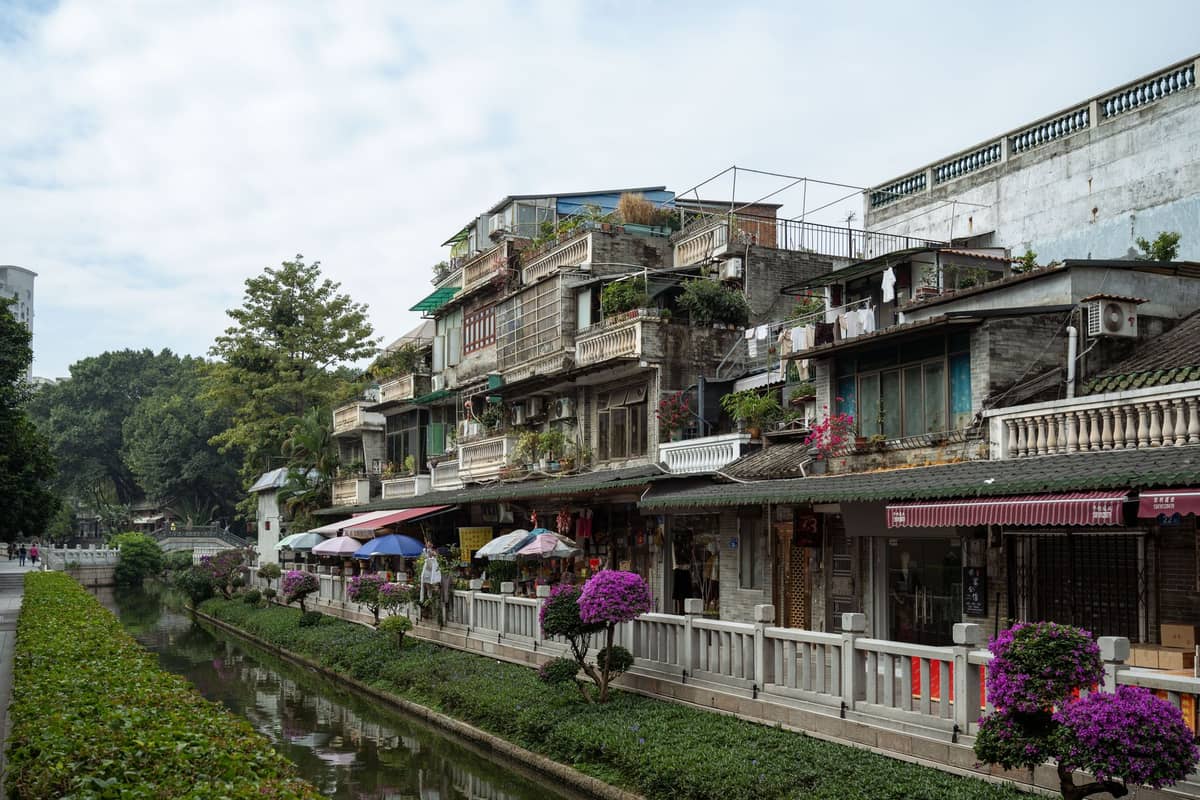
What Shawan Ancient Town Actually Is
Shawan Ancient Town (沙湾古镇) is a real residential settlement in Panyu District that has been continuously occupied since its founding in the Song dynasty, making it over 800 years old. Covering roughly 1.53 square kilometers, the old core is a web of narrow flagstone lanes, grey-brick walls, carved stone doorways, and multi-generational clan halls — most of them intact rather than restored to a tourist polish.
The dominant clan here is the He family (何氏), whose ancestral halls form the architectural spine of the old quarter. Their presence shaped Shawan's identity for centuries, and the town is officially classified as a national historical and cultural town by Chinese heritage authorities. Today the town is officially classified as a national historical and cultural town by Chinese heritage authorities.
Shawan sits well south of central Guangzhou in Panyu District, a part of the city that rewards visitors willing to look beyond the main tourist corridor. If you are planning a fuller exploration of Guangzhou's heritage sites, the Guangzhou temples guide covers complementary religious architecture around the city.
💡 Local tip
The open-air lanes and courtyards are accessible 24 hours and free to enter year-round. The indoor exhibition halls generally open 09:00–17:30, with admission checking stopping at 17:00. Halls are typically closed on Mondays except statutory public holidays. Verify current hours at the entrance on the day.
The Architecture: What You'll Actually See
The most striking thing about Shawan at first glance is the consistency of the color palette: grey brick, dark timber, pale limestone carvings, and the occasional flash of ceramic tile figurines along rooflines. This is classic Lingnan residential architecture, the style native to the Pearl River Delta, and Shawan is one of the most complete surviving examples near Guangzhou.
The He Clan Ancestral Hall (留耕堂, Liugeng Tang) is the centerpiece and the oldest major structure in the complex. Its triple-courtyard layout, carved stone columns, and layered roof brackets represent some of the finest Lingnan craftsmanship in the region. The scale of the hall communicates clearly how powerful the He family was at its peak — this is not a modest prayer space but a civic and ceremonial complex that once governed community life.
Elsewhere, look at the doorway carvings closely. Floral motifs, symbolic animals, and calligraphic panels are cut into granite and brick at eye level throughout the lanes. Many of these carvings date from the Qing dynasty and have survived without restoration — you can see where the stone has weathered unevenly, which is more interesting than any replica.
Shawan's architectural character fits within the broader tradition of Lingnan design explored in the Guangzhou architecture guide. For another outstanding example of clan-hall architecture in the city, Chen Clan Ancestral Hall in Liwan District offers a more elaborately decorated interior in an urban setting.
Cantonese Folk Music: Shawan's Living Tradition
Shawan is credited as the birthplace of Guangdong music (广东音乐), the instrumental folk tradition distinct from Cantonese opera. The He family produced several musicians who helped develop this genre, and the town has leaned into this heritage with a dedicated folk music museum inside the old quarter.
If you visit on a weekend or public holiday, there is a reasonable chance of hearing live performances in one of the ancestral halls. The sound of erhu (two-stringed fiddle), guzheng (zither), and dizi (bamboo flute) filling a stone courtyard is genuinely atmospheric. Even without a scheduled performance, the music museum displays historical instruments, annotated scores, and photographs of past performers that convey why this town mattered musically.
If traditional Cantonese performing arts are a specific interest, the Guangzhou Cantonese opera guide and the Cantonese Opera Art Museum in Liwan cover the theatrical side of this cultural tradition.
How the Visit Changes by Time of Day
Early morning, before 09:00, is when Shawan looks most like itself. Local residents move through the lanes on daily routines: older men carrying birdcages, women returning from the wet market, the smell of congee and fried dough drifting from a kitchen window. The light at this hour is soft and low, catching the texture of the grey brick walls in a way that afternoon sun flattens out completely.
By mid-morning on weekends, tour groups arrive in waves. The lanes narrow enough that groups of 20 or more create genuine bottlenecks at popular corners, particularly near the main ancestral hall entrances and the painted walls. If you are visiting for photography, arrive before 09:00 or come on a weekday. The experience between 10:00 and 14:00 on a Saturday is still worthwhile, but expect company.
Afternoons are calmer again after 15:00 as tour groups thin out. The light becomes golden toward late afternoon, useful for photographing the carved doorways and roofline ceramic figures. The streets take on a quieter, residential feel as the day cools down, especially in autumn and winter when temperatures in Panyu are mild and comfortable.
⚠️ What to skip
Summer visits (June to August) are genuinely uncomfortable here. The lanes are narrow and the grey masonry absorbs heat. Humidity regularly exceeds 80% in this part of Panyu. If you visit in summer, come early morning and plan to leave by noon. Autumn (October to November) is the best season for this site.
Getting There and Navigating the Site
Shawan Ancient Town is not on any metro line directly. The standard approach is Guangzhou Metro Line 3 to Shiqiao Station, then a bus transfer to the town. Buses Fan 67, Fan 12, and K349 are commonly cited routes that stop at or near Shawan Ancient Town or the Shawan Cultural Center (南门, south gate). Journey time from Shiqiao varies with traffic but expect 20 to 40 minutes on the bus.
Ride-hailing via DiDi is a practical alternative if you are travelling with others or find the bus transfer confusing. The address to enter is Daxiangyong Road (大巷涌路) in the Shawan Ancient Town Cultural Center area. Confirm with your accommodation that DiDi or another app is accessible, as availability can change.
The site itself is compact enough to cover on foot without a map. The main lanes radiate from the central ancestral hall area and most loop back to the entrance area. Signage is primarily in Chinese, with some English at the main paid hall entrances. Comfortable flat shoes are appropriate — the flagstone lanes are uneven in places.
If you are planning your time in Guangzhou and want to combine Shawan with other sites, the day trips from Guangzhou guide covers how to structure a full day in outer districts like Panyu.
Food, Snacks, and What Locals Eat Here
Shawan has its own local specialty that is genuinely worth trying: Shawan ginger milk pudding (姜撞奶), a warm dessert made from buffalo milk and fresh ginger juice that sets semi-solid in the bowl. It is sold at shops in the old town and costs only a few yuan. The texture is silky and the ginger heat is real, not decorative.
Beyond the pudding, the street food along the main tourist lane leans toward sweet snacks: pineapple cake, traditional glutinous rice sweets, and preserved fruit. These are consistent with Cantonese snack culture and are fine as light refreshments. For a full meal, the restaurant options inside the old town are limited; the more practical choice is to eat before you arrive or after you return to Shiqiao, where options are better.
Practical Assessment: Who This Is For and Who Should Skip It
Shawan Ancient Town rewards visitors who are genuinely interested in how Cantonese communities lived and built. The architecture is real, the clan hall history is substantive, and the folk music connection is unusual. If that framing appeals, Shawan will likely exceed expectations.
Visitors who are primarily interested in entertainment, shopping variety, or modern Guangzhou will find it underwhelming. The old town has souvenir shops along its tourist lanes that are indistinguishable from those at a dozen other heritage towns in southern China. The site has also been commercialized to a degree that breaks the atmosphere in certain sections, particularly the main entrance corridor on busy days.
Travellers with mobility limitations should note that the flagstone lanes are uneven and the exhibition halls may have steps at entry points. There is no confirmed step-free access information available publicly, so anyone with specific accessibility requirements should inquire directly before visiting.
Insider Tips
- Visit on a weekday morning to experience the residential streets without tour groups. By late morning on weekends, the main ancestral hall area can become crowded with organized groups.
- The combined ticket for exhibition halls is worth buying if you plan to visit multiple halls, especially the folk music museum and the main ancestral halls.
- Look up at the rooflines throughout the town. The ceramic figurine scenes (shiwan pottery figures) running along the ridge tiles are among the most detailed in the Pearl River Delta and are easy to miss at street level.
- Shawan ginger milk pudding is best eaten at a shop that prepares it fresh to order rather than pre-poured. Ask for it warm (热的, rè de) — the cold version loses much of the texture.
- If you hear music coming from a courtyard, follow it. Weekend folk music demonstrations happen informally and are rarely announced on entrance signage. They tend to draw small crowds rather than large groups.
Who Is Shawan Ancient Town For?
- Architecture and heritage travelers interested in Lingnan clan-hall design
- Visitors curious about Cantonese folk music history and its origins
- Photographers working in early morning light on quiet residential streets
- Slow travelers who prefer exploring on foot without a fixed itinerary
- Families with older children who have an interest in Chinese cultural history
Nearby Attractions
Other things to see while in Panyu:
- Baomo Garden
Baomo Garden (宝墨园) in Panyu District is one of the most ornate classical gardens in Guangdong, fusing Lingnan architectural traditions with sculpted waterways, intricate ceramic murals, and Qing-dynasty decorative arts. Originally built in the late Qing era and extensively rebuilt from 1995, it rewards visitors who appreciate craft and detail over theme-park spectacle.
- Chimelong Paradise
Chimelong Paradise is Guangzhou's large themed amusement park, located in Panyu District and home to more than 60 attractions. From white-knuckle roller coasters to family-friendly rides and seasonal shows, it attracts visitors from across the region. Here is what to expect before you arrive.
- Chimelong Safari Park
Spread across more than 2,000 mu (about 330 acres) in Panyu District, Chimelong Safari Park is one of the largest safari-style wildlife parks in Asia. This guide covers how to get there, what the experience is actually like, and how to make the most of a full day.
- Chimelong Water Park
Spanning over 300,000 square meters in Panyu District, Chimelong Water Park is one of Asia's largest water parks. Whether you're chasing record-breaking slides or looking for a lazy river afternoon, here's everything you need to know before you go.