Seven Magic Mountains: Neon Boulders Rising from the Mojave
Twelve miles south of the Strip, seven towers of fluorescent-painted boulders stand 30 feet tall against the raw Mojave Desert. Swiss artist Ugo Rondinone's Seven Magic Mountains is free, always open, and unlike anything else near Las Vegas.
Quick Facts
- Location
- S Las Vegas Blvd, near Jean Dry Lake, NV 89054 — approx. 10–20 miles south of the Strip via I-15
- Getting There
- Car only: I-15 south to Sloan Road (Exit 25), east on Las Vegas Blvd; free parking on site. No public transit currently serves this location.
- Time Needed
- 30–60 minutes on site; budget 45–90 minutes round-trip from the Strip
- Cost
- Free — no tickets, no reservations, no gates
- Best for
- Photography, art lovers, desert scenery, families, budget travelers
- Official website
- sevenmagicmountains.com
What Is Seven Magic Mountains?
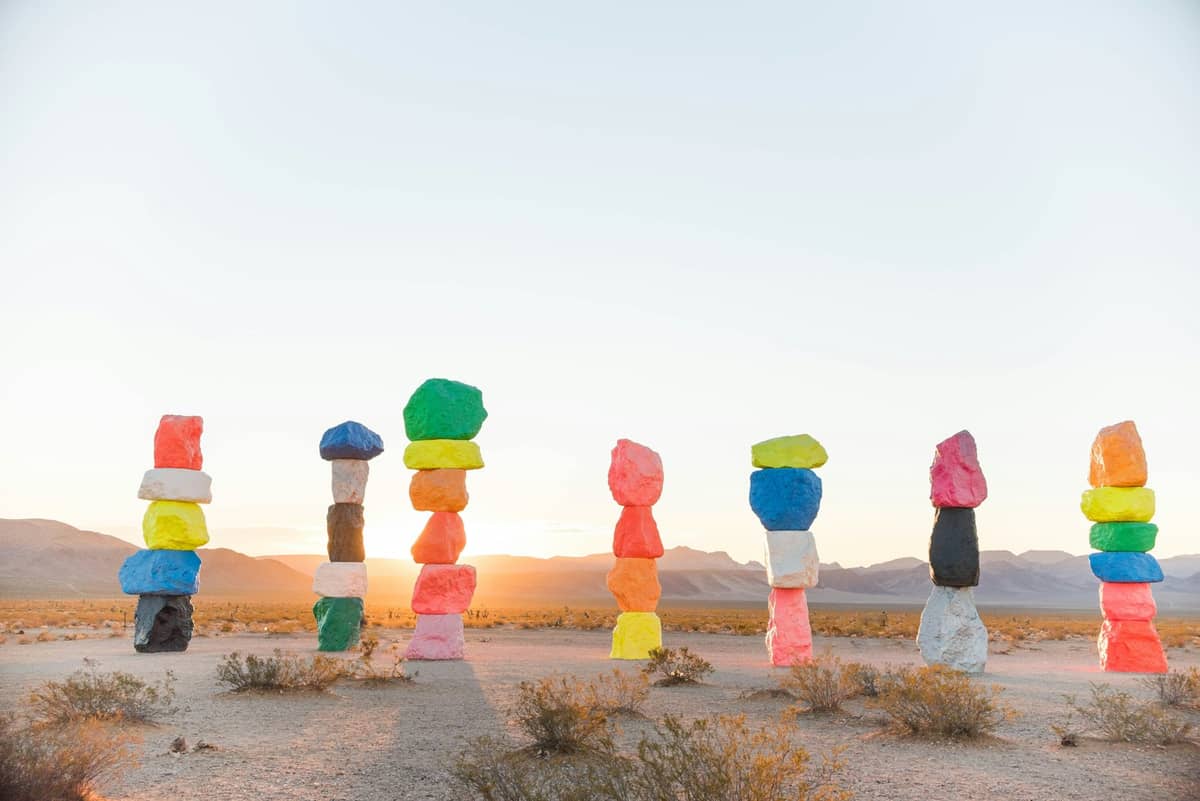
Seven Magic Mountains is a large-scale public art installation by Swiss artist Ugo Rondinone, set on open desert land alongside South Las Vegas Boulevard, about ten to twenty miles south of the Strip. The work consists of seven towers of stacked boulders, each painted in vivid dayglo colors — acid yellow, electric orange, hot pink, cobalt blue — and rising roughly 30 feet into the sky. Against the pale khaki of the Mojave and the jagged Spring Mountains in the distance, the effect is a genuine visual jolt.
The installation opened in May 2016, produced jointly by the Art Production Fund (New York) and the Nevada Museum of Art (Reno). It was originally planned as a temporary display, but its extended run reflects both public enthusiasm and the logistical reality that dismantling multi-ton painted limestone boulders is no small undertaking. As of 2026, the towers remain standing and remain free to visit at any hour.
💡 Local tip
The site has no gate, no ranger, and no fee. Arrive, park in the free gravel lot, walk 100 yards across flat desert ground, and you're there. It takes about two minutes from car door to base of the towers.
The Experience: What You Actually See and Feel
The towers cluster close enough together that you can walk around all seven in ten minutes, but most visitors spend considerably longer. Each tower is unique in color combination and boulder arrangement — some feel precarious, gravity-defying stacks; others are more squat and pyramidal. The boulders are natural limestone sourced from the surrounding Mojave, which gives the work its central tension: material that belongs entirely to this landscape, painted in colors that absolutely do not.
Standing at the base, the scale surprises most first-time visitors. Photographs tend to flatten the towers; in person, a 35-foot stack of boulders is considerably more imposing than it looks on Instagram. You'll hear Interstate 15 in the background — a faint hum of trucks heading toward California — and on windy days, the desert silence is broken only by that and the occasional crunch of gravel underfoot. There is no shade, no concession stand, and no gift shop. The openness is part of the point.
The ground between the towers is uneven desert gravel and hardpan. Flat-soled sneakers work fine; heels do not. There are no paved paths, no fencing around the art, and no velvet ropes. Visitors often walk directly up to the boulders and touch them, which is not prohibited. The painted surfaces are smooth and surprisingly clean given the desert dust.
Tickets & tours
Hand-picked options from our booking partner. Prices are indicative; availability and final rates are confirmed when you complete your booking.
Allstars Of Magic at Planet Hollywood Resort and Casino
From 38 €Instant confirmationFree cancellationEntrance Ticket to Magic Mike Live at SAHARA Las Vegas
From 57 €Instant confirmationTicket to Shin Lim's magic show at The Palazzo Theatre
From 62 €Instant confirmationLIOZ Comedy Magic Uncensored
From 34 €Instant confirmationFree cancellation
How the Experience Changes by Time of Day
Golden hour — the 30 to 60 minutes after sunrise or before sunset — is when Seven Magic Mountains is most photogenic and most comfortable. The low desert sun makes the fluorescent paint glow with an intensity that midday light, which flattens everything to the same brightness, cannot replicate. The Spring Mountains and Jean Dry Lake catch the same warm light in the background, and the shadows cast by the boulders become long and sculptural.
Midday visits in summer are genuinely uncomfortable. The Mojave Desert reaches temperatures well above 40°C (104°F) from June through August, there is zero shade on site, and the reflective pale ground amplifies the heat. If you're visiting in summer, go early or in the late afternoon. Spring and autumn mornings are the sweet spot: cool enough for a comfortable walk, clear enough for clean photographs, and typically less crowded than weekend afternoons.
The site has no lighting. After dark, you're navigating uneven desert ground with no orientation markers, and the towers themselves are not illuminated. The official guidance to visit between sunrise and sunset is practically sound. That said, a full moon does create a genuinely strange atmosphere — the towers are just visible as dark silhouettes against a lighter sky — but this is an adventure best undertaken by those prepared for it, with good flashlights and footwear.
⚠️ What to skip
Summer heat at this site is serious. The desert ground radiates heat even in shade (of which there is none), and the walk from the parking area is exposed. Bring at least 16 oz of water per person even for a short visit. Children and elderly visitors should plan accordingly.
Context: Why This Artwork, Why Here?
Ugo Rondinone chose this location deliberately. The site sits along one of the most-traveled stretches of highway in the American West — the I-15 corridor connecting Las Vegas to Los Angeles — where millions of people drive past open desert without stopping. The installation functions partly as an interruption: a signal to slow down and look at the landscape from which Las Vegas has historically extracted gravel, rock, and land without much ceremony.
Rondinone has described the work as a meditation on the intersection of the natural and the human-made, the local and the tourist. The fluorescent colors are a direct reference to the neon signage of Las Vegas itself — the Strip's visual language transplanted into the desert that surrounds and predates it. Whether or not you find this reading convincing, the juxtaposition of painted boulder and raw Mojave is visually effective in ways that a gallery setting could not produce.
The Nevada Museum of Art, which co-produced the installation, has additional context about Rondinone's practice and the commissioning history of Seven Magic Mountains. For those interested in Las Vegas's broader creative ecosystem, the Neon Museum offers another angle on how the city's visual culture has been preserved and reframed as art.
Photography: How to Get the Best Shots
This is one of the most photographed roadside attractions in the American Southwest, and the reasons are obvious. The towers photograph well in almost any light, but a few approaches consistently produce stronger results.
- Shoot from ground level, lying or crouching, to exaggerate the height of the towers against the sky.
- Include one tower in sharp focus with others blurred behind it — the depth of the arrangement rewards a wide aperture.
- Overcast days produce soft, even light that makes the colors pop without harsh shadows; counterintuitively, flat skies often work better than dramatic ones.
- Wide-angle lenses capture multiple towers and the surrounding desert context; telephoto lenses isolate individual color combinations against the mountains.
- Arrive before 8am on weekends to have the towers largely to yourself — by 9am, the parking lot begins to fill.
If you're combining this stop with other desert photography, Valley of Fire State Park is about 90 minutes in a different direction and offers red sandstone formations in a similarly dramatic Mojave setting.
Getting There and Planning Your Visit
There is no practical way to reach Seven Magic Mountains without a car. The site is on South Las Vegas Boulevard near Jean Dry Lake, and no RTC bus route currently services this stretch of road. From the Strip, take I-15 south to Sloan Road (Exit 25), turn left onto Las Vegas Boulevard heading south, and drive approximately seven miles. The towers appear on the left (east) side of the road and are visible from a distance. A free gravel parking area sits directly adjacent to the site.
The drive from the south end of the Strip takes roughly 20 to 30 minutes under normal traffic conditions. Many visitors pair this stop with a trip to the Welcome to Las Vegas sign, which is a few miles closer to the city along the same Las Vegas Boulevard corridor.
Seven Magic Mountains also works well as an add-on to larger day trips heading south. If you're already going to Hoover Dam or continuing down to the Grand Canyon West Rim, the installation is a natural stop on the way out of the city. For a focused list of what to fit into limited time, the 3 days in Las Vegas itinerary covers how to sequence desert stops efficiently.
Who Should Skip This
Seven Magic Mountains is not for everyone, and it's worth being honest about that. If you're on a tight schedule and based on the Strip without a rental car, the logistics (securing a car, 45 minutes of driving round-trip) may not be justified by a 30-minute visit. The art itself is arresting but not interactive — once you've walked around the seven towers and taken your photos, there is genuinely nothing else to do on site. Visitors expecting an interpretive experience, audio guide, or surrounding museum context will be disappointed.
Those with significant mobility limitations should also note the unpaved ground and lack of accessible paths. The parking area is flat and the distance to the towers is short, but the terrain between and around the sculptures is rough desert hardpan that can be challenging for wheelchairs or walkers.
Insider Tips
- Weekday mornings before 9am are the least crowded times. Weekend afternoons between noon and 3pm can get surprisingly busy for what feels like a remote location — tour vans and organized groups turn up regularly.
- The gravel parking area can be muddy and soft after rain, which is rare but does happen. If you've had recent precipitation, check conditions before driving a low-clearance vehicle.
- Bring a polarizing filter if you shoot with an interchangeable-lens camera. The Mojave sky turns a deeper, more saturated blue through a polarizer, which dramatically increases the visual contrast with the fluorescent towers.
- The towers look different from the road than from the parking area. Pull over safely on Las Vegas Boulevard for a shot with moving traffic and utility poles in the foreground — it reinforces the roadside Americana quality of the piece in a way that close-up shots miss.
- Cell service is generally adequate for navigation and posting photos, but the site sits in a zone where signal can be patchy. Download offline maps before you leave the city if your navigation app requires data.
Who Is Seven Magic Mountains For?
- Photographers and visual artists looking for a dramatic Mojave backdrop
- Budget-conscious travelers wanting something genuinely unique without spending money
- Families with kids who can handle a short desert walk (in mild weather)
- Art enthusiasts interested in large-scale site-specific public art
- Road-trippers using I-15 who want a worthwhile stop between Las Vegas and Los Angeles
Nearby Attractions
Combine your visit with:
- Antelope Canyon
Antelope Canyon is a series of sculpted slot canyons carved into Navajo Sandstone near Page, Arizona, and one of the most visually striking natural formations in the American Southwest. Accessible only on guided tours led by licensed Navajo guides, it requires advance planning but rewards visitors with an experience unlike anywhere else within day-trip range of Las Vegas.
- Area 51 & Extraterrestrial Highway
Nevada State Route 375, officially designated the Extraterrestrial Highway in 1996, is a 98-mile desert drive skirting the perimeter of the most famous restricted military installation on Earth. It costs nothing to drive, demands serious preparation, and delivers a genuinely remote American landscape that few Strip visitors ever see.
- AREA15 Immersive Entertainment Complex
AREA15 is a 35-acre immersive entertainment and events district just off the Las Vegas Strip, packed with art installations, bizarre interactive experiences, bars, and ticketed attractions like Omega Mart. Daytime entry is free, but the real substance costs extra — and it's worth understanding the pass tiers before you arrive.
- Death Valley National Park
Just two hours from the Las Vegas Strip, Death Valley National Park is the hottest, driest, and lowest national park in the United States. From the salt flats of Badwater Basin to the sculpted dunes of Mesquite Flat, it rewards early risers and well-prepared visitors with landscapes found nowhere else on Earth.