Grand Canyon West Rim & Skywalk: The Complete Visitor Guide
Grand Canyon West and its famous Skywalk glass bridge sit on Hualapai tribal land in Arizona, roughly 2.5 hours from Las Vegas by road. This guide covers what to expect on the ground, how to get there, what the All-Access Pass includes, and whether the trip is worth your time.
Quick Facts
- Location
- 5001 E Diamond Bar Road, Meadview, AZ 86444 — roughly a 2-hour, 125–130 mile drive from Las Vegas
- Getting There
- No public transit. Drive via US-93 South then Pierce Ferry Road and Diamond Bar Road, or book a Las Vegas tour operator coach/helicopter transfer
- Time Needed
- Allow a full day from Las Vegas: roughly 2 hours each way by car, plus 2–4 hrs on-site
- Cost
- Skywalk access included with the All-Access Pass (check grandcanyonwest.com/tickets-deals for current pricing in USD). Children 4 and under free; promotions available for ages 5–12
- Best for
- Canyon views, bucket-list experiences, photography, family day trips from Las Vegas
- Official website
- grandcanyonwest.com
What Grand Canyon West Actually Is (And What It Isn't)
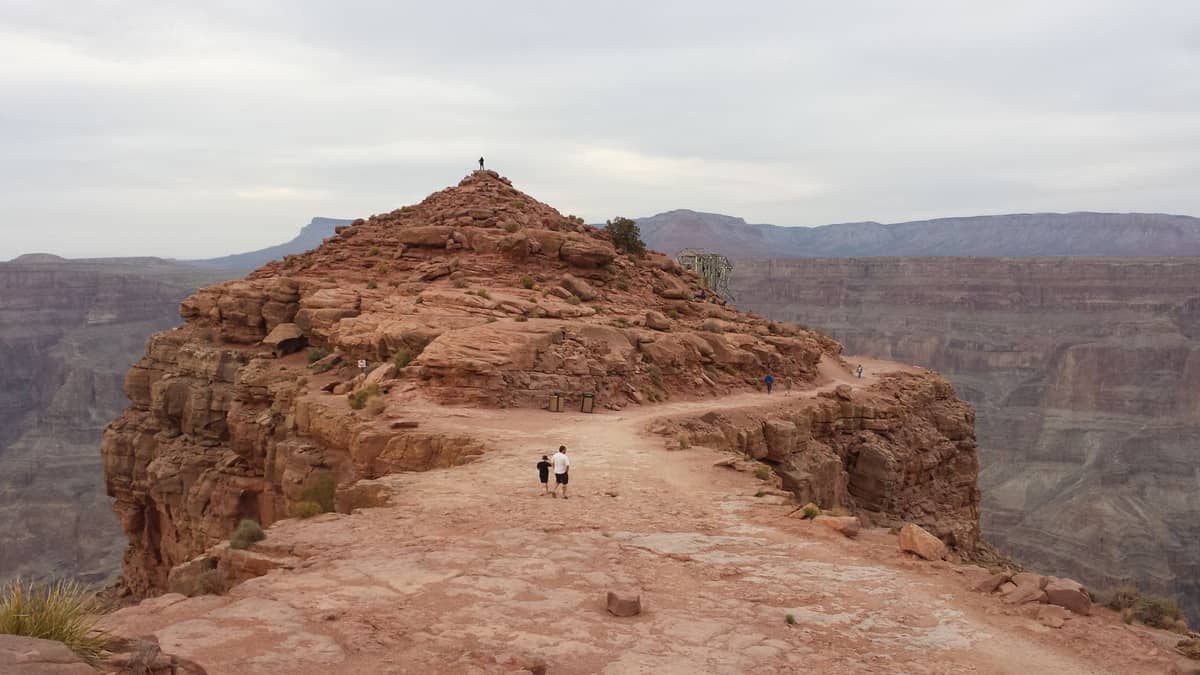
The Grand Canyon West Rim and Skywalk is not part of Grand Canyon National Park. That distinction matters. The attraction sits on land owned and operated by the Hualapai Tribe, a sovereign Native American nation whose territory borders the western end of the canyon. The U.S. National Park Service explicitly notes that the Skywalk is privately operated and separate from the National Park. You will not find the sweeping multi-mile panoramas of the South Rim here, nor the backcountry hiking infrastructure. What you will find is a genuinely dramatic stretch of canyon, a glass-floored observation bridge unlike anything else in the region, and a cultural experience tied to one of the Southwest's indigenous nations.
The Grand Canyon Skywalk itself is a horseshoe-shaped glass bridge that extends out over the canyon at Eagle Point. The floor, the walls, even the railings are transparent. On a clear day you can look straight down through your feet at the canyon floor more than 4,000 feet below. For most visitors, the first few steps onto the glass produce a visceral reaction regardless of how fearless they consider themselves. That physical jolt is the attraction's core offering, and it is difficult to replicate through photographs or video.
ℹ️ Good to know
Important distinction: Grand Canyon West is NOT Grand Canyon National Park. If you want the classic South Rim viewpoints, the Bright Angel Trail, or the North Rim, you need a separate trip. Grand Canyon West is a valid destination in its own right, but it serves a different experience.
Getting There from Las Vegas
There is no public transit connection between Las Vegas and Grand Canyon West. Your options are a self-drive, a guided coach tour, or a helicopter transfer. By car, the route runs south on US-93 toward Kingman, Arizona, then west on Pierce Ferry Road, and finally south on Diamond Bar Road. A standard sedan can handle it easily in normal conditions, but the road is still slow and remote. Budget roughly two hours each way from the Las Vegas Strip, and more if you stop or hit road construction.
Las Vegas tour operators offer day-trip packages that include round-trip coach transport, the All-Access Pass, and sometimes a Hualapai ranch lunch. Helicopter tours, departing from Las Vegas or from a terminal near the canyon, add a landing on the canyon floor for those who want an aerial perspective before walking the Skywalk. If you are planning a broader Southwest road trip, note that Valley of Fire State Park and Hoover Dam can be combined with a Grand Canyon West visit if you adjust your route, though doing all three in a single day is rushed.
💡 Local tip
If you drive yourself, fill up with fuel in Kingman or Dolan Springs before heading out on Pierce Ferry Road. There are no gas stations on the approach to Grand Canyon West. The Diamond Bar Road section is rough enough that a roof rack or loose items in a truck bed will rattle loudly for miles.
Tickets & tours
Hand-picked options from our booking partner. Prices are indicative; availability and final rates are confirmed when you complete your booking.
Golden Eagle West Rim helicopter tour with Hoover Dam and Lake Mead
From 401 €Instant confirmationFree cancellationGrand Canyon West Rim bus tour with Hoover Dam photo stop, helicopter and Skywalk ticket
From 491 €Instant confirmationFree cancellationGrand Canyon West Rim and Hoover Dam small group day tour
From 182 €Instant confirmationFree cancellationGrand Canyon West Rim by luxury limo van with Hoover Dam photo stop, helicopter and Skywalk ticket
From 533 €Instant confirmationFree cancellation
Hours, Tickets, and What the All-Access Pass Covers
Grand Canyon West opens every day of the year, including major holidays. Standard operating hours run from 8:00 a.m., with last entry at 4:30 p.m. and the park closing at 6:00 p.m. During summer months, last entry extends to 5:30 p.m. and the park closes at 7:00 p.m. Hours are in Arizona time.
The Skywalk is included with the All-Access Pass — there is no separate admission for the bridge itself once you have the pass. The pass also covers the hop-on, hop-off shuttle that connects the main terminal, Eagle Point (where the Skywalk stands), Guano Point (another canyon overlook with a slightly different geological character), and Hualapai Ranch. Children 4 and under enter free. A Kids FREE promotion typically extends free admission to up to two children aged 5–12 with one adult All-Access Pass purchase, redeemed in person at the main terminal; promotions change, so check the official tickets page before booking.
⚠️ What to skip
Personal cameras and bags are NOT permitted on the Skywalk itself. You must use lockers and purchase official photos taken by on-site photographers if you want images from the bridge. This is a firm rule, not a suggestion. Factor the photography cost into your budget if you want proof you crossed it.
On the Ground: What the Visit Actually Feels Like
The drive in from the highway is desolate in a way that is either peaceful or monotonous depending on your temperament. The Mojave desert gives way to increasingly dramatic mesa terrain, and by the time Diamond Bar Road begins its descent toward the canyon rim, the scale of the landscape starts to register. There is almost no development visible in any direction. That sense of remoteness is genuine and worth acknowledging before you arrive — Grand Canyon West is not a polished resort experience.
At the main terminal, the atmosphere is efficiently organized but not luxurious. You purchase or collect your pass, receive booties to wear over your shoes before stepping onto the glass (mandatory, to protect the surface), and join the queue for the shuttle or walk to Eagle Point. Morning arrivals, particularly on weekdays, will find shorter wait times for both the shuttle and the Skywalk itself. By mid-morning on weekends, the line for the bridge can stretch noticeably, and the experience becomes more crowded and less contemplative.
On the Skywalk, the sensation of standing over open air is immediate. The glass is thick and visibly sturdy, but your nervous system does not care about engineering specifications — the first moment you look down through the floor at the canyon far below, most people stop mid-step. The bridge curves in a horseshoe shape, so you walk out one side and back along the other. The whole crossing takes only a few minutes unless you linger at the outer bend, which most people do. The canyon walls around Eagle Point form a natural amphitheater, and the depth and color of the rock — deep reds, purples, and tans layered over millions of years — rewards time spent just looking.
Guano Point, accessible by shuttle, offers a different and arguably more expansive canyon view without any infrastructure overhead. You can walk along the rim at a reasonable distance from the edge, and the silence and the wind become more noticeable here than at the busier Eagle Point area. The Hualapai Ranch stop provides context on the tribe's history in the region and is worth a brief visit even if the cowboy-town aesthetic feels a little staged.
Best Time to Visit and Weather Considerations
Spring (March through May) and autumn (September through November) offer the most comfortable conditions for the visit. Summer temperatures at Grand Canyon West regularly exceed 100°F (38°C), and the sun is relentless at the canyon rim. If you visit in summer, bring at minimum 2 liters of water per person, apply sunscreen before you leave Las Vegas, and wear a hat that actually covers your neck. Winter visits are cooler and often less crowded, but early morning temperatures can drop sharply and winds at the rim cut through light layers. For a broader look at timing your Las Vegas area travel, the best time to visit Las Vegas guide covers seasonal patterns across the region.
Photography conditions are best in the morning when the canyon walls catch warm directional light and before atmospheric haze builds. By midday, the light is flat and harsh. Afternoon light returns some warmth to the rock faces, but if you are arriving by coach tour, your schedule will likely be set by the operator rather than the sun. Cloud cover, rare but possible especially in the July–August monsoon season, can dramatically change the mood of the canyon and occasionally improve photographic contrast.
Accessibility at Grand Canyon West
Grand Canyon West makes a genuine effort on accessibility. The main terminal is accessible. The Skywalk terminal has an elevator serving the Skywalk level, the photo area, a gift shop on the second floor, and the Sky View Restaurant on the third floor. The hop-on, hop-off shuttle buses can accommodate walkers and both motorized and manual wheelchairs. Paved pathways exist around parts of Eagle Point, though naturally surfaced rim areas present more difficulty for mobility-impaired visitors.
Strollers are not permitted on the Skywalk itself. Children who can walk may cross; infants may be carried by an adult. If you are traveling with young children, plan for the shoe covering (booties) process at the Skywalk entrance, which can be an unexpected pause when you are managing small kids.
Honest Assessment: Is It Worth the Trip?
The Grand Canyon West Rim and Skywalk is a full-day commitment from Las Vegas and carries a notable cost once you include transport, the All-Access Pass, food, and photography. The Skywalk itself is impressive, and the physical sensation of crossing a glass bridge over a 4,000-foot drop is not something you can replicate elsewhere in the world. The canyon views from Guano Point are genuinely beautiful, and the setting on Hualapai land gives the visit a cultural dimension that is often underplayed in tour marketing. It is a legitimate Southwest experience, not a theme park gimmick. That said, if your primary goal is the Grand Canyon in its full, overwhelming scope, the South Rim or the North Rim will deliver a more profound experience. Those who have already visited Grand Canyon National Park and want a different angle — literally — will find Grand Canyon West rewarding. If the Skywalk is purely a bucket-list checkbox, be clear-eyed about the total cost and travel time before booking. For other dramatic experiences closer to Las Vegas, consider Red Rock Canyon or Valley of Fire State Park, both of which offer spectacular desert scenery with significantly less travel time and cost.
Travelers who get significant anxiety from heights may find the Skywalk genuinely distressing rather than thrilling. There is no shame in deciding at the entrance that crossing it is not for you — and the other components of the All-Access Pass still justify the visit for most people. Those interested in other perspective-shifting Las Vegas-area viewpoints might also consider the High Roller Observation Wheel or the STRAT Tower for height-based experiences that require far less travel.
Insider Tips
- Book your All-Access Pass online before you arrive. On-site ticket lines, especially on weekend mornings, can consume 20–30 minutes of time you would rather spend at the canyon rim.
- The official photography package sold at the Skywalk is the only way to get images from the bridge itself. Look at the pricing before you cross so you are not making a rushed decision at the other end with a queue behind you.
- Guano Point, often skipped by visitors who spend all their time at Eagle Point, offers a wider, less obstructed view of the canyon and is typically less crowded. Take the shuttle there, walk the rim, and let the scale settle in properly.
- If you drive yourself, download offline maps before leaving Las Vegas. Cell coverage on Pierce Ferry Road and Diamond Bar Road is unreliable, and the turnoffs are easy to miss without navigation.
- The Sky View Restaurant at the Skywalk terminal offers seating with canyon views. Prices are higher than you would expect, but the setting is worth one meal or a cold drink if the heat is getting to you.
Who Is Grand Canyon West Rim & Skywalk For?
- First-time Southwest travelers looking for a dramatic canyon experience within reach of Las Vegas
- Families with older children who can handle heights and a long driving day
- Photography enthusiasts who want a glass-bridge perspective shot
- Travelers who have already seen Grand Canyon National Park and want a different vantage point on Hualapai land
- Bucket-list travelers for whom the Skywalk is a specific goal rather than a passing curiosity
Nearby Attractions
Combine your visit with:
- Antelope Canyon
Antelope Canyon is a series of sculpted slot canyons carved into Navajo Sandstone near Page, Arizona, and one of the most visually striking natural formations in the American Southwest. Accessible only on guided tours led by licensed Navajo guides, it requires advance planning but rewards visitors with an experience unlike anywhere else within day-trip range of Las Vegas.
- Area 51 & Extraterrestrial Highway
Nevada State Route 375, officially designated the Extraterrestrial Highway in 1996, is a 98-mile desert drive skirting the perimeter of the most famous restricted military installation on Earth. It costs nothing to drive, demands serious preparation, and delivers a genuinely remote American landscape that few Strip visitors ever see.
- AREA15 Immersive Entertainment Complex
AREA15 is a 35-acre immersive entertainment and events district just off the Las Vegas Strip, packed with art installations, bizarre interactive experiences, bars, and ticketed attractions like Omega Mart. Daytime entry is free, but the real substance costs extra — and it's worth understanding the pass tiers before you arrive.
- Death Valley National Park
Just two hours from the Las Vegas Strip, Death Valley National Park is the hottest, driest, and lowest national park in the United States. From the salt flats of Badwater Basin to the sculpted dunes of Mesquite Flat, it rewards early risers and well-prepared visitors with landscapes found nowhere else on Earth.