Hoover Dam: What to Expect Before You Make the Drive
Hoover Dam is one of the most significant engineering achievements of the 20th century, sitting on the Nevada-Arizona border about 30 miles from Las Vegas. Whether you spend an hour on the crest or take the full guided dam tour deep inside its concrete walls, the scale of the place is genuinely hard to prepare for.
Quick Facts
- Location
- Hoover Dam Access Road, Boulder City, Nevada — on the Nevada–Arizona state line, ~30 miles southeast of Las Vegas
- Getting There
- Drive via I-11/US-93 South to Exit 2 (NV-172); no public transit serves the dam. Parking garage open daily 8 a.m.–5:15 p.m. ($10/vehicle)
- Time Needed
- 1.5 hours for crest walk + Visitor Center; 3–4 hours for the full Guided Dam Tour experience
- Cost
- Visitor Center: $15/adult. Guided Power Plant Tour: $25 adults / $15 ages 4–16. Guided Dam Tour: $40/person (on-site purchase only). Children 3 and under free.
- Best for
- History lovers, engineering enthusiasts, families, road trippers pairing with Lake Mead or the Mike O'Callaghan–Pat Tillman Memorial Bridge
- Official website
- www.usbr.gov/lc/hooverdam/index.html
What Hoover Dam Actually Is
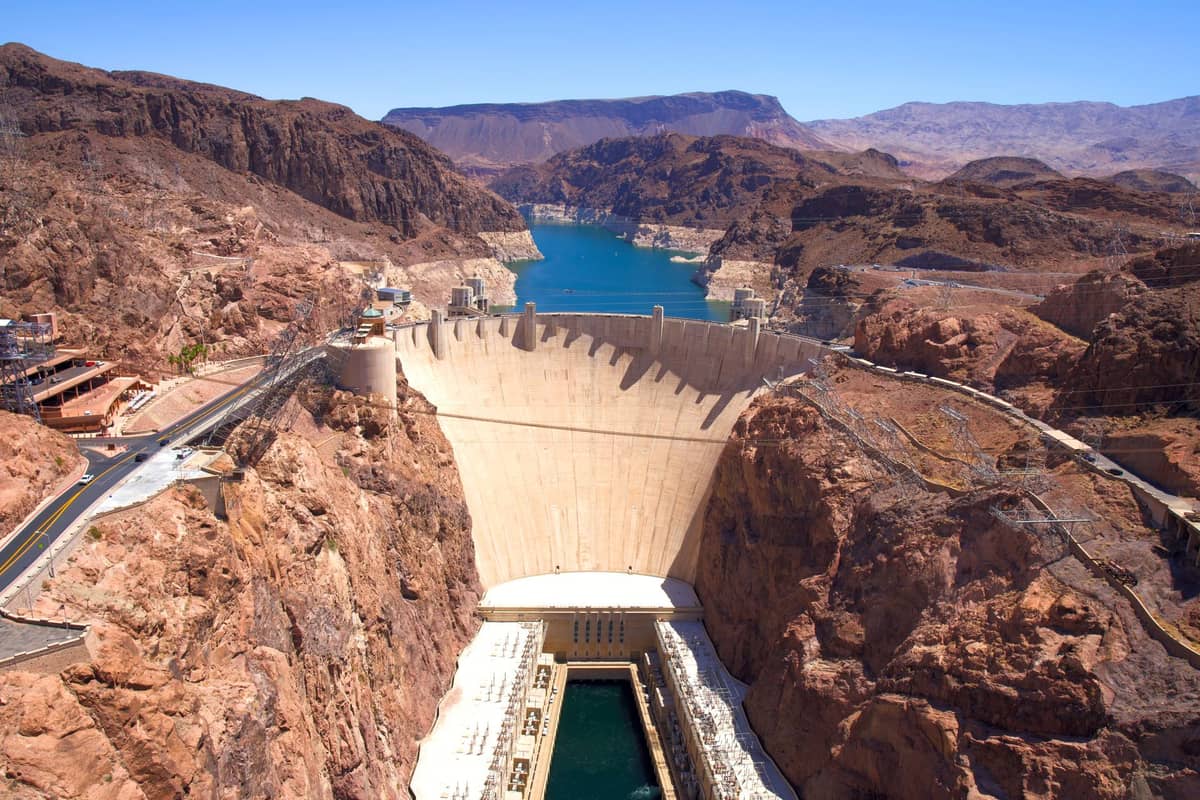
Hoover Dam is a concrete arch-gravity dam on the Colorado River, straddling the Nevada–Arizona border at the mouth of Black Canyon. At the time of its completion in 1935, it was the tallest dam in the world. It remains one of the defining infrastructure projects of the New Deal era, built during the depths of the Great Depression and completed ahead of schedule. The dam created Lake Mead, which is still the largest reservoir in the United States by capacity. It remains one of the defining infrastructure projects of the New Deal era, built during the depths of the Great Depression and completed ahead of schedule. The dam created Lake Mead, which is still the largest reservoir in the United States by capacity.
The numbers are easier to recite than to absorb: the dam stands 726 feet tall, stretches 1,244 feet across the canyon. The two flanking powerhouse wings generate electricity for parts of Nevada, Arizona, and California. What makes the dam worth visiting in person, rather than simply reading about, is how those numbers translate to actual sensation when you are standing on the crest looking straight down into the canyon below. The two flanking powerhouse wings generate electricity for parts of Nevada, Arizona, and California. What makes the dam worth visiting in person, rather than simply reading about, is how those numbers translate to actual sensation when you are standing on the crest looking straight down into the canyon below.
💡 Local tip
Arrive before 9:30 a.m. or after 3:00 p.m. to avoid the thickest tour bus crowds. Weekdays in October through March offer the most comfortable temperatures and thinnest crowds simultaneously.
The Experience on the Crest: Free and Underrated
Walking the dam crest costs nothing beyond the parking fee. The public road across the top was closed to through traffic when the Mike O'Callaghan–Pat Tillman Memorial Bridge opened in 2010. The art deco detailing throughout the dam — the clock towers, the terrazzo floors in the Visitor Center, the bronze intake towers — reflects a deliberate choice to make the structure beautiful as well as functional.
The views from the crest are split: downstream, you look into the narrow gorge of Black Canyon, the Colorado River running turquoise-green far below. Upstream, Lake Mead fills the desert landscape to the horizon, its water levels visibly marked by the pale 'bathtub ring' of mineral deposits on the canyon walls — a stark visual record of prolonged drought and reduced inflow. That ring tells a story worth pausing to consider.
Visitors who want to extend the day can combine the dam with a walk along the Historic Railroad Trail at Hoover Dam, a flat 3.7-mile trail that follows the old railroad bed used during construction and offers canyon rim views over Lake Mead.
Tickets & tours
Hand-picked options from our booking partner. Prices are indicative; availability and final rates are confirmed when you complete your booking.
Golden Eagle West Rim helicopter tour with Hoover Dam and Lake Mead
From 401 €Instant confirmationFree cancellationGrand Canyon West Rim bus tour with Hoover Dam photo stop, helicopter and Skywalk ticket
From 491 €Instant confirmationFree cancellationGrand Canyon West Rim and Hoover Dam small group day tour
From 182 €Instant confirmationFree cancellationGrand Canyon West Rim by luxury limo van with Hoover Dam photo stop, helicopter and Skywalk ticket
From 533 €Instant confirmationFree cancellation
Tours: How Deep You Want to Go
There are three tiers of access. The Visitor Center admission at $15 per adult gets you a self-guided experience with exhibits on the dam's construction history, geology, and power generation, plus elevator access down to the observation deck at the base of the Nevada-side powerhouse. The exhibits are well-produced and genuinely informative rather than superficial.
The Guided Power Plant Tour ($25 for adults, $15 for ages 4–16) adds a ranger-led walk through the Nevada-side powerhouse, where you stand next to the massive generators. This tour runs roughly 30 minutes.
The Guided Dam Tour at $40 per person is the most comprehensive option. It includes the powerhouse tour and goes further into the dam's interior. This tour is sold on-site only, with no advance purchase option, so arrive early in the day if the Dam Tour is your priority.
⚠️ What to skip
Children 3 and under are free on the Guided Dam Tour. The tunnel sections have low clearance and confined spaces that some visitors find uncomfortable. If claustrophobia is a concern, the Power Plant Tour is the better choice.
How the Experience Changes by Time of Day
Early morning before 9 a.m. is the best time to be on the crest. The canyon is partially shaded, temperatures are bearable even in summer, and the light hits the downstream face at an angle that reveals the dam's full geometry. The bronze sculptures catch the low morning sun in a way they simply do not in the flat midday glare.
By 11 a.m. in summer, the crest becomes harsh. Surface temperatures on the concrete and asphalt exceed air temperature significantly, the canyon amplifies heat, and there is no meaningful shade on the dam itself. The Visitor Center is air-conditioned and provides relief, but the outdoor experience deteriorates quickly. In July and August, midday temperatures in the canyon regularly exceed 105°F (40°C). This is not an exaggeration and not a reason to avoid the trip, but it does mean planning matters.
Late afternoon, roughly 3–4 p.m., brings another window of reasonable conditions, though the Visitor Center closes at 5:00 p.m. and the last tour departs at 4:10 p.m. The canyon shadows return, and the light on Lake Mead turns golden. If you time the drive back to Las Vegas for late afternoon, the desert landscape along US-93 through Boulder City is genuinely scenic in that light.
Practical Logistics: Getting There and Navigating the Site
There is no public transit to Hoover Dam. From Las Vegas, take I-11/US-93 South approximately 30 miles to Exit 2 for NV-172 (Hoover Dam Access Road). Navigation apps handle this route reliably. There is a security checkpoint before the dam where all vehicles are inspected.
The parking garage costs $10 per vehicle and is connected to the Visitor Center. It is open from 8 a.m. to 5:15 p.m. There is also limited street parking in the area around the dam approach, but the garage is more convenient. Motorcycles and oversized vehicles have specific designated areas.
Many visitors combine Hoover Dam with a stop at Lake Mead National Recreation Area, which borders the dam's upstream side. The Alan Bible Visitor Center for Lake Mead is just a few miles west along US-93 and adds useful geological and ecological context to what you see from the dam crest.
ℹ️ Good to know
The Visitor Center and Guided Power Plant Tour are accessible for strollers and both motorized and manual wheelchairs. The Guided Dam Tour is accessible for manual wheelchairs except at the ventilation shaft area. Confirm current accessibility arrangements when booking.
Photography: What Works and What People Miss
The most photographed angle of Hoover Dam is not from the dam itself, but from the Mike O'Callaghan–Pat Tillman Memorial Bridge, about a quarter mile downstream. The bridge has a dedicated pedestrian walkway, and from there you see the full downstream face of the dam framed within the canyon. Early morning produces the best light here, with the sun not yet above the canyon walls. A wide-angle lens or the widest setting on a phone captures more of the canyon context.
On the dam crest, the art deco details reward close attention: the clock faces on the intake towers display both Nevada and Arizona time. Arizona does not observe daylight saving time, so the two states differ by one hour in summer. Photographing the winged bronze statues with the canyon in the background requires positioning yourself carefully to avoid other visitors in frame — this is easiest in the first hour after the Visitor Center opens.
Honest Assessment: Is Hoover Dam Worth It?
For most visitors to Las Vegas, yes — with caveats. The crest walk and self-guided Visitor Center make a satisfying half-day trip, especially if combined with the nearby bridge viewpoint or a stop at Lake Mead. The dam delivers on scale in a way that photographs do not fully convey.
The Guided Dam Tour is genuinely impressive if you have an interest in engineering or history, but $40 per person is a meaningful chunk of a Las Vegas trip. For families with young children, the Power Plant Tour offers a good balance of access and engagement without the time and cost of the full dam tour.
Who should skip it: travelers on a very tight schedule with only one or two days in Las Vegas, those with significant heat sensitivity visiting in summer, and anyone whose primary interest is the natural landscape rather than infrastructure. The Valley of Fire State Park and Red Rock Canyon offer day trip alternatives that prioritize scenery over engineering.
Insider Tips
- The Guided Dam Tour tickets are sold on-site only and are not available online. If this tour is your priority, head to the ticket desk first thing when the Visitor Center opens at 9 a.m., especially on spring and fall weekends.
- Both Nevada and Arizona observe the same time at the dam year-round — Arizona does not observe daylight saving time, so the two states align during standard time but differ by one hour in summer. Check the clock towers on the intake structures, which display both time zones simultaneously.
- The downstream canyon view from the Memorial Bridge pedestrian walkway is the best overall vantage point for photographing the dam. It is free, requires no ticket, and is a 5-minute walk from the parking area. Most visitors miss it entirely.
- Bring more water than you think you need. There are water fountains inside the Visitor Center, but the crest walk and outdoor areas have no shade and no water access. In summer, 32 oz per person per hour outdoors is a reasonable baseline.
- Boulder City, the town you drive through on US-93 to reach the dam, is the Nevada city where gambling is prohibited — a deliberate policy established during dam construction to manage the worker community. It has a pleasant historic main street worth a brief stop on the return drive.
Who Is Hoover Dam For?
- History and engineering enthusiasts who want to understand how a Depression-era infrastructure project transformed the American West
- Families with kids aged 8 and up who are ready for a substantive educational day trip beyond the Strip
- Photographers looking for dramatic landscape and industrial architecture with strong morning light
- Road trippers building an itinerary that includes Lake Mead, Boulder City, or the drive toward the Grand Canyon's South Rim
- Visitors with at least three days in Las Vegas who want a half-day break from the casino environment
Nearby Attractions
Combine your visit with:
- Antelope Canyon
Antelope Canyon is a series of sculpted slot canyons carved into Navajo Sandstone near Page, Arizona, and one of the most visually striking natural formations in the American Southwest. Accessible only on guided tours led by licensed Navajo guides, it requires advance planning but rewards visitors with an experience unlike anywhere else within day-trip range of Las Vegas.
- Area 51 & Extraterrestrial Highway
Nevada State Route 375, officially designated the Extraterrestrial Highway in 1996, is a 98-mile desert drive skirting the perimeter of the most famous restricted military installation on Earth. It costs nothing to drive, demands serious preparation, and delivers a genuinely remote American landscape that few Strip visitors ever see.
- AREA15 Immersive Entertainment Complex
AREA15 is a 35-acre immersive entertainment and events district just off the Las Vegas Strip, packed with art installations, bizarre interactive experiences, bars, and ticketed attractions like Omega Mart. Daytime entry is free, but the real substance costs extra — and it's worth understanding the pass tiers before you arrive.
- Death Valley National Park
Just two hours from the Las Vegas Strip, Death Valley National Park is the hottest, driest, and lowest national park in the United States. From the salt flats of Badwater Basin to the sculpted dunes of Mesquite Flat, it rewards early risers and well-prepared visitors with landscapes found nowhere else on Earth.