The Neon Museum (Neon Boneyard): Las Vegas's Most Photogenic Open-Air Collection
The Neon Museum preserves decades of Las Vegas sign history in an open-air gravel yard just north of Fremont Street. With glowing evening tours and a collection of salvaged signs from demolished casinos and hotels, it's one of Downtown Las Vegas's most distinctive cultural stops.
Quick Facts
- Location
- 770 Las Vegas Blvd N, Las Vegas, NV 89101 (Downtown Las Vegas)
- Getting There
- Short drive or rideshare from Fremont Street; limited street parking available nearby
- Time Needed
- 1.5 to 2 hours for a standard guided or self-guided visit
- Cost
- Daytime admission from $25; Evening admission from $35. Prices as of 2026 — verify at official site.
- Best for
- Photography enthusiasts, design and history lovers, date nights, and curious travelers seeking context behind the city's visual culture
- Official website
- neonmuseum.org
What the Neon Museum Actually Is
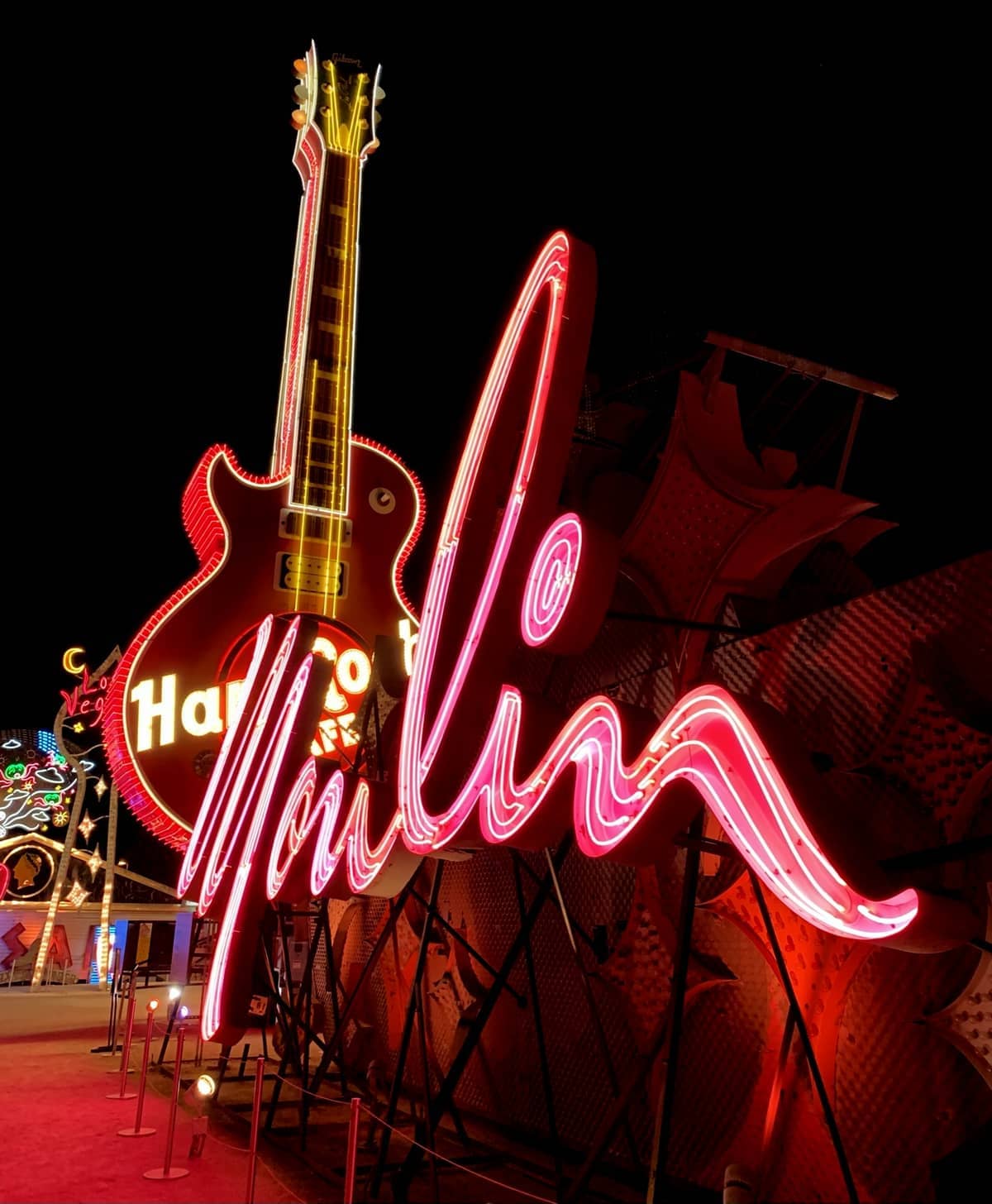
The Neon Museum is a nonprofit cultural institution dedicated to preserving and exhibiting Las Vegas's historic neon signs. Its main outdoor collection space, known as the Neon Boneyard, holds more than 200 salvaged signs from casinos, hotels, wedding chapels, and motels that no longer exist. Think of it as an open-air archive of the city's visual memory: the original sign from the Stardust, letters from the Moulin Rouge, the iconic lamp from the Aladdin. These are objects that were engineered to dominate attention from a moving car, and up close, their scale and craftsmanship read completely differently than they did on the Strip.
The facility sits on Las Vegas Boulevard North, a few blocks above Fremont Street in what was once a quieter stretch of old downtown. The Boneyard itself occupies the former La Concha Motel site, and the motel's curving mid-century modern lobby now serves as the museum's welcome center. That building alone is worth pausing over: designed by architect Paul Revere Williams and completed in 1961, it's a clamshell-shaped concrete structure that represents the kind of Googie-adjacent modernism that once defined roadside Nevada.
ℹ️ Good to know
The Neon Museum is open daily. Hours vary by season: September through May, doors open at 3:00 p.m. with last entry at 10:00 p.m. (closing at 11:00 p.m.). June through August, hours shift to 8:00 p.m. through midnight, with last entry at 11:00 p.m.
The Difference Between Daytime and Evening Visits
This is not a museum where time of day is a minor consideration. The experience changes substantially between afternoon and nightfall, and the museum's programming reflects that.
Daytime visits offer the clearest view of the signs' physical construction: the glass tubing, the rusted steel armatures, the painted sheet metal that once lit up boulevards. In strong desert sunlight the colors read differently, faded and layered with age. You can examine the fabrication closely, read the informational panels without straining, and photograph details without competing for angles. The heat is a real factor in summer months, and since the Boneyard is entirely outdoors with minimal shade, daytime visits during June through August can be uncomfortable. The museum addresses this by shifting its summer schedule to evening-only hours.
Evening visits, especially the guided nighttime experiences, are where the Neon Boneyard earns its reputation. A selection of restored and operational signs are lit, and the combination of glowing neon against the dark desert sky creates the kind of atmospheric density that's hard to photograph accurately but easy to feel standing inside it. The sound of insects, the warm smell of dusty gravel, the soft hum of working neon tubes overhead: it's quieter than you might expect, and more melancholy. These are signs built for spectacle, now still.
💡 Local tip
For photography, the 30 to 45 minutes after sunset offer the best light balance: the sky is still deep blue, the operational signs are lit, and the contrast hasn't gone completely black yet. This window is short, so arrive at opening time for evening sessions to position yourself well.
Tickets & tours
Hand-picked options from our booking partner. Prices are indicative; availability and final rates are confirmed when you complete your booking.
Neon Lights tour from Las Vegas
From 85 €Instant confirmationFree cancellationThe Neon Museum and helicopter night flight spectacular
From 174 €Instant confirmationFree cancellationNeon and Nature tour of Las Vegas
From 204 €Instant confirmationFree cancellationGo City | Las Vegas All-Inclusive Pass
From 140 €Instant confirmationFree cancellation
The Collection: What You'll See
The signs in the Neon Boneyard are grouped roughly by era and type, though the overall layout feels organic rather than rigorously curated. You move through a gravel path between leaning, stacked, and freestanding signs that range from intimate motel logos to enormous multi-story casino marquees. The scale variation keeps the walk interesting: a small wedding chapel sign at eye level followed by a looming structure from a downtown hotel that once stood four stories tall.
Many of the signs carry names that Las Vegas regulars will recognize immediately: the Sands, the Desert Inn, the Dunes, the Riviera. For visitors less steeped in casino history, the interpretive panels do enough contextual work to make the stories legible. Each sign has a short history: where it stood, when it was in service, why it was removed. Some stories are straightforward (implosion, redevelopment); others are stranger.
The museum also maintains an interior gallery and a growing restored collection. Certain signs have been conserved and re-illuminated for permanent or rotating display inside the La Concha lobby building. For visitors interested in the design history of the Strip more broadly, pairing the Neon Museum with a walk along Fremont Street provides useful contrast: one shows you the signs as they survive, the other shows what the contemporary version of that visual culture looks like in active use.
Getting There and Navigating the Visit
The museum's address is 770 Las Vegas Blvd N, roughly half a mile north of the Fremont Street Experience. Rideshare is the most convenient option for most visitors: drop-off and pickup are straightforward, and the surrounding area doesn't reward aimless walking after dark without knowing the blocks. Street parking exists in the vicinity but availability varies.
If you're building a day around Downtown Las Vegas, the Neon Museum fits naturally into an afternoon-into-evening sequence. Spend time at the Mob Museum or the Fremont Street Experience earlier in the day, then head to the Neon Museum as your evening anchor.
Advance ticket purchase is strongly recommended. Tours and timed entry sessions do sell out, particularly on weekends and during peak travel periods (spring break, major convention weeks, summer holidays). Showing up without a reservation is a real risk on busy nights. The official website at neonmuseum.org is the correct place to book.
The Boneyard surface is fine gravel, which the museum confirms is navigable by powered and unpowered wheeled mobility devices, though it requires some effort. The facility is ADA-compliant. Wear closed-toe shoes regardless: the ground is uneven in sections and the edges of some sign bases are low and hard to see in dim light.
Cultural and Historical Context
Las Vegas's neon sign tradition developed in tandem with the post-war American roadside economy. Signs needed to be visible from hundreds of feet away at highway speed, which drove a competition for scale, brightness, and novelty that produced some of the most elaborate commercial signage ever built. The designers and fabricators who worked in this tradition, many of them based in the city, developed a visual language that influenced American graphic design well beyond Nevada.
When casinos and hotels were demolished or rebranded through the 1980s and 1990s, most of their signs were simply discarded. The Neon Museum began as an effort to stop that disposal and create a permanent record of what these objects represented. It's worth taking seriously as a cultural institution, not just a photo backdrop. For visitors with a deeper interest in Las Vegas history, the Mob Museum and the Clark County Museum offer complementary angles on the same period.
Honest Assessment: Is It Worth It?
For travelers with genuine curiosity about design, American commercial history, or the specific visual culture of Las Vegas, the Neon Museum is genuinely rewarding. The evening guided experience in particular offers something you can't replicate elsewhere.
For visitors primarily looking for entertainment or active experiences, it may underwhelm. You're walking through a gravel lot looking at old signs. There's no ride, no performance, no casino floor. The experience is contemplative, even a little somber in the best sections. Families with young children who can't hold attention for a slow-paced guided walk may find it frustrating. The same goes for travelers whose Las Vegas priorities are nightlife, shows, or pools: those visitors are unlikely to feel the visit justified the ticket price.
Those undecided might cross-reference with the broader list of things to do in Las Vegas to weigh it against other options for their available time.
Insider Tips
- Book tickets at least a week ahead for weekend evening sessions. The most popular time slots, particularly the first post-sunset entry on Friday and Saturday nights, sell out days in advance during peak season.
- The summer schedule (June through August) shifts to evening-only hours starting at 8:00 p.m. This is intentional given the desert heat. Don't plan a daytime summer visit expecting the museum to be open.
- Bring a jacket for evening visits even in warm months. Desert temperatures drop noticeably after sunset, and the gravel yard has no climate control. What feels comfortable at 8:00 p.m. can feel cool by 10:00 p.m.
- A wide-angle lens or phone camera with a wide mode will serve you better than a telephoto for the large signs. The Boneyard is tightly packed and you often can't step back far enough to frame the biggest pieces any other way.
- The La Concha Motel lobby building is worth your attention even if you're primarily there for the signs. It's a surviving example of Paul Revere Williams's work and represents a significant piece of mid-century architecture that would otherwise have been lost.
Who Is Neon Museum (Neon Boneyard) For?
- Photography enthusiasts, particularly those interested in neon, signage, and mid-century Americana
- Design, architecture, and graphic arts travelers who want cultural depth beyond the Strip
- Couples looking for an atmospheric evening experience that isn't a nightclub or casino
- History-focused visitors who want to understand what Las Vegas looked like before the mega-resort era
- Travelers following the Las Vegas hidden gems circuit who've already covered the standard attractions
Nearby Attractions
Other things to see while in Downtown Las Vegas:
- Circa Resort & Casino
Circa Resort & Casino is the first ground-up casino resort built in Downtown Las Vegas in decades, stacking 35 floors of adults-only luxury above the Fremont Street Experience. From a six-pool amphitheater to a three-story sportsbook with a 78-million-pixel screen, it's a serious operation with a distinct downtown identity.
- Downtown Container Park
Built from stacked and repurposed shipping containers in the Fremont East Entertainment District, Downtown Container Park offers free admission, local boutique shopping, casual dining, live music on a central stage, and a playground — all in a walkable outdoor setting distinct from the Strip's casino corridors.
- Discovery Children's Museum
Tucked inside Symphony Park just north of downtown Las Vegas, DISCOVERY Children's Museum offers three floors of interactive science, art, and early-learning exhibits designed for children from toddlers to pre-teens. It is one of the few genuinely kid-first attractions in a city built for adults.
- Fremont Street Experience
The Fremont Street Experience is a five-block pedestrian mall covered by an approximately 1,375-foot LED canopy that lights up downtown Las Vegas every night. Entry is free, the energy is raw, and the history runs deeper than anything on the Strip.