Clark County Museum: Southern Nevada's History in Henderson
Clark County Museum in Henderson preserves the layered history of Southern Nevada through indoor galleries, mining artifacts, and a walkable Heritage Street lined with relocated historic buildings. At free admission, it delivers more than the ticket price suggests for anyone curious about the region beyond the Strip.
Quick Facts
- Location
- 1830 S. Boulder Highway, Henderson, NV 89002
- Getting There
- By car: ~20 min southeast of the Strip via US-93/Boulder Hwy. Limited direct public transit; check RTC routes.
- Time Needed
- 1.5 to 2.5 hours
- Cost
- Free general admission for all ages
- Best for
- History buffs, families, local culture seekers, budget travelers
What the Clark County Museum Actually Is
The Clark County Museum sits on Boulder Highway in Henderson, about 20 minutes southeast of the Strip, and it is run by Clark County Parks and Recreation. That civic ownership matters: this is not a commercial attraction dressed up as history. It is a working regional museum with a genuine collection, a knowledgeable volunteer and staff presence, and admission prices that feel almost anachronistic in a city where a cocktail costs more than the entry fee.
The museum covers the sweep of Southern Nevada history, from prehistoric geology and Indigenous cultures through the railroad era, the mining boom, dam construction, atomic testing, and the mid-century growth that turned a desert railroad stop into one of the most visited cities on earth. The indoor galleries handle the chronological narrative, while the outdoor Heritage Street does something more unusual: it lets you walk through physical structures from different eras of Nevada settlement, relocated here and restored.
ℹ️ Good to know
Hours: Daily 9:00 a.m. to 4:30 p.m. Closed Thanksgiving, Christmas Day, and New Year's Day. Admission: free for all ages. Phone: (702) 455-7955.
Heritage Street: The Outdoor Exhibit That Sets This Museum Apart
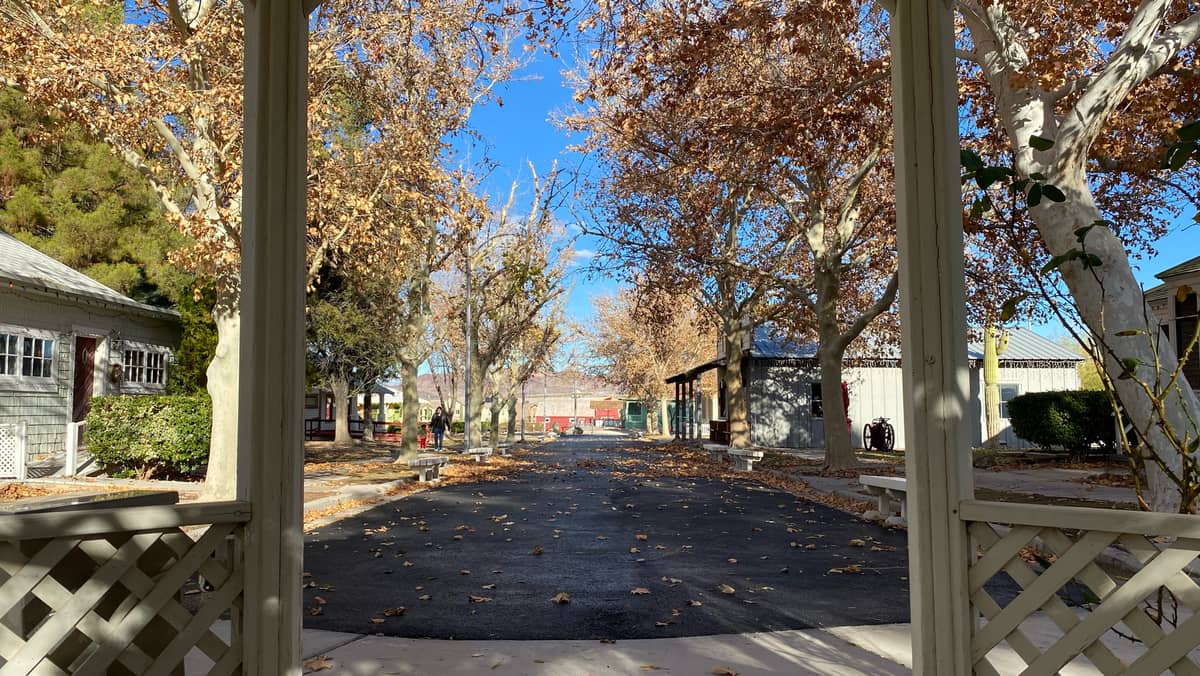
The outdoor Heritage Street is the main reason this museum earns a separate trip rather than just a footnote. The county has relocated and painstakingly restored a collection of historic structures from across Southern Nevada, arranging them along a shaded path that feels genuinely contemplative on a mild morning. A 1905 Boulder City Depot, a 1930s-era print shop, Victorian-influenced residential structures, and period commercial facades give the street an almost stage-set quality, except that every building is an actual artifact with traceable provenance.
Morning visits work best for Heritage Street. By midmorning the Henderson light is warm but not yet punishing, and the relative quiet of a weekday lets you move at your own pace between buildings. Docents are often present and willing to unlock specific structures or explain the architectural details. On weekends, school groups sometimes arrive in clusters, which changes the pace but rarely makes the space feel crowded given its open layout.
In summer, the outdoor portion becomes uncomfortable after around 11:00 a.m. Temperatures on Boulder Highway in July and August regularly exceed 105 degrees Fahrenheit. If you are visiting between June and September, arrive when the museum opens and do Heritage Street first while the pavement is still in shadow.
💡 Local tip
Summer visit strategy: arrive at 9:00 a.m. sharp, walk Heritage Street immediately, then retreat to the air-conditioned indoor galleries for the rest of your visit.
Tickets & tours
Hand-picked options from our booking partner. Prices are indicative; availability and final rates are confirmed when you complete your booking.
Count's Kustom VIP car tour
From 94 €Instant confirmationFree cancellationGo City | Las Vegas All-Inclusive Pass
From 140 €Instant confirmationFree cancellationGolden Eagle West Rim helicopter tour with Hoover Dam and Lake Mead
From 401 €Instant confirmationFree cancellationGrand Canyon 6-in-1 tour
From 417 €Instant confirmationFree cancellation
Indoor Galleries: Southern Nevada From Desert to Neon
The indoor exhibition space is modest in scale but dense with context. The geology and prehistory section establishes the Mojave Desert landscape that shaped every human settlement that followed, including fossil specimens and mineral samples from the region's mining heritage. What follows traces the arrival of the railroad, the establishment of Las Vegas as a railroad town in 1905, and the subsequent waves of population driven by dam construction in the 1930s and military and defense activity in the 1940s and 1950s.
The atomic era material is worth lingering over. Nevada's role as a nuclear test site from 1951 onward left a complicated imprint on the region, and the museum treats it with appropriate seriousness rather than the novelty framing you encounter at the Strip-adjacent National Atomic Testing Museum. The Clark County Museum's coverage is less exhaustive but contextualizes the test site within the lived experience of Henderson and the broader valley, including the impact on local workers and communities.
For visitors who want to go deeper on the atomic history angle, the National Atomic Testing Museum on the Strip corridor is a logical pairing, covering the Nevada Test Site in far greater technical and narrative detail.
Historical and Cultural Context: Why Henderson Has This Museum
Henderson was not always a suburb. It was established during World War II as an industrial city to support a magnesium processing plant serving the war effort, making it one of the few Nevada cities with a genuine manufacturing origin. That history gives the Clark County Museum a different kind of story to tell than a typical Western frontier narrative. Henderson grew rapidly, incorporated in 1953, and has since become the second-largest city in Nevada.
Clark County itself encompasses the entire Las Vegas metropolitan area, including the Strip (which sits in the unincorporated community of Paradise rather than the City of Las Vegas proper). The museum's county-level framing means its scope is broad, drawing material from Henderson, North Las Vegas, Boulder City, and the surrounding valley rather than focusing narrowly on any single municipality.
Visitors interested in another dimension of Las Vegas area history, specifically the preservation of vintage neon signage and the city's casino heritage, should also consider the Neon Museum in downtown Las Vegas, which covers a very different but complementary slice of Southern Nevada culture.
Practical Walkthrough: Getting There and Getting Around
The museum is at 1830 S. Boulder Highway, Henderson. By car from the Strip, take I-515 South or US-93 toward Henderson and exit toward Boulder Highway. The drive takes roughly 20 minutes without traffic. There is free parking on-site. Boulder Highway itself is a wide commercial arterial road, not a scenic approach, but the museum grounds feel calm once you are inside.
Public transit to this specific location is limited. The RTC operates bus routes in the Henderson area, but the museum is not a primary transit hub, and journey times from the Strip by bus can exceed 45 to 60 minutes with transfers. For most visitors, a rental car, rideshare, or taxi is the practical choice. The museum is an easy add-on to a drive out toward Lake Mead or Boulder City.
If you are planning a day that extends further east, the museum pairs well geographically with a stop at Hoover Dam or the shoreline of Lake Mead National Recreation Area, both within 30 to 40 minutes of Henderson by car.
Photography, Accessibility, and What to Bring
Heritage Street photographs well in the morning, when low-angle light catches the wooden facades and period signage. The structures have enough visual texture, weathered wood, old glass, period lettering, that even a phone camera produces worthwhile results. Indoor gallery lighting is functional rather than dramatic, and some of the display cases involve significant glare. A polarizing filter helps if you are shooting with a dedicated camera.
For accessibility, the museum is part of a county parks system accredited by the Commission for Accreditation of Park and Recreation Agencies, which implies adherence to public-facility accessibility standards. The outdoor Heritage Street involves some uneven surfaces between structures. Visitors with specific accessibility needs should call ahead at (702) 455-7955 to confirm current conditions and any assistance available.
Wear comfortable walking shoes. Bring water, especially in warmer months, as the outdoor portion of the visit is exposed. The indoor galleries are air-conditioned. There is no on-site cafe, so plan to eat before or after your visit. Henderson has a range of dining options along nearby commercial corridors.
Honest Assessment: Who Should Visit and Who Should Not
The Clark County Museum is genuinely good for what it is: a well-maintained regional history museum with an unusual outdoor component, priced at essentially nothing. It is not, however, a blockbuster attraction. The indoor galleries are modest in scale, and visitors accustomed to the production values of a large urban natural history museum may find the presentation somewhat understated. There are no large-format films, immersive installations, or interactive digital exhibits.
If you are primarily in Las Vegas for the Strip experience, gaming, or nightlife, this museum is unlikely to compete for your attention. But for travelers who want to understand the place underneath the spectacle, or who have already spent time on the Strip and want something grounded and different, the Clark County Museum is one of the more rewarding ways to spend a morning in the Las Vegas Valley.
For a broader overview of what the valley's museum landscape looks like, the best museums in Las Vegas guide covers the full range of options, from the Strip-adjacent to the genuinely off-the-beaten-path.
⚠️ What to skip
The museum closes on Thanksgiving Day, Christmas Day, and New Year's Day. Admission is free, but confirm hours before visiting on or around major U.S. holidays.
Insider Tips
- Call ahead at (702) 455-7955 if you want to visit a specific Heritage Street building interior. Not all structures are open every day, and staff can sometimes accommodate advance requests.
- Pair this with a Boulder City stop. The drive from Henderson to Boulder City adds only 15 minutes, and Boulder City is itself a remarkably preserved New Deal-era town worth walking. It is one of only two Nevada cities that prohibit gambling.
- Weekday mornings between 9:00 and 11:00 a.m. are the quietest. School groups tend to arrive midmorning on Tuesdays and Thursdays during the school year.
- The mining artifact collection in the indoor galleries includes equipment that rarely makes it into larger museums. If that period of Nevada history interests you, budget extra time in that section rather than rushing through.
- There is no gift shop in the conventional sense, but the county sometimes has reproduction prints and local history publications available at the front desk. Ask when you check in.
Who Is Clark County Museum For?
- History and heritage travelers who want context beyond casino mythology
- Families with older children curious about the American West and 20th-century industrial history
- Budget travelers: with free admission, it represents one of the best-value cultural experiences in the Las Vegas metro area
- Photographers looking for textured, period architectural subjects outside of the Strip corridor
- Day-trippers combining Henderson with Lake Mead or Hoover Dam
Nearby Attractions
Other things to see while in Henderson:
- Ethel M Chocolates Factory & Cactus Garden
A short drive from the Strip, Ethel M Chocolates Factory & Cactus Garden combines a free peek at a working chocolate production line with a genuine 3-acre botanical cactus garden. The combination is unusual, the admission is free, and the holiday light season makes it one of the more underrated winter experiences in the Las Vegas Valley.
- Lake Las Vegas
Lake Las Vegas is a 320-acre man-made reservoir in Henderson, Nevada, ringed by upscale resorts, waterfront restaurants, and a walkable promenade. It costs nothing to visit, offers a genuine change of pace from the Strip, and delivers some of the quietest desert scenery in the Las Vegas Valley.