The Mob Museum Las Vegas: What to Know Before You Visit
The Mob Museum, officially The National Museum of Organized Crime and Law Enforcement, is one of downtown Las Vegas's most serious and rewarding cultural attractions. Spread across a historic federal courthouse, it covers American organized crime with a depth and honesty that consistently surprises first-time visitors.
Quick Facts
- Location
- 300 Stewart Avenue, Las Vegas, NV 89101
- Getting There
- RTC bus routes serve downtown Las Vegas; walkable from Fremont Street
- Time Needed
- 2 to 4 hours depending on depth of interest
- Cost
- Paid admission; check official site for current pricing
- Best for
- History lovers, true crime fans, adults seeking substance beyond the Strip
- Official website
- themobmuseum.org
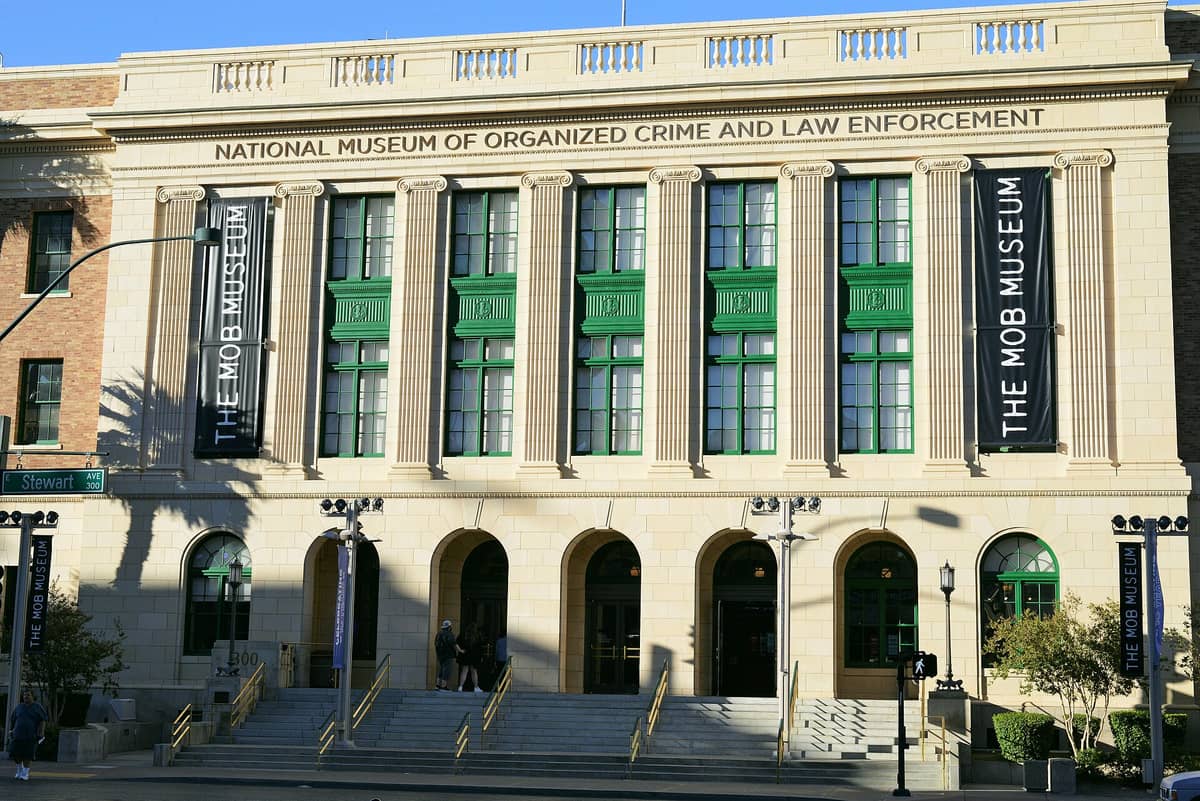
What the Mob Museum Actually Is
The Mob Museum, formally known as The National Museum of Organized Crime and Law Enforcement, sits at 300 Stewart Avenue in downtown Las Vegas. The building itself is part of the story: this is the former United States Post Office and Courthouse, a three-story Neoclassical structure built in 1933. It hosted one of the Kefauver Committee hearings in 1950, the U.S. Senate's landmark investigation into organized crime in America. That courtroom still exists on the second floor, preserved with its original wood paneling and furniture, and it remains one of the most unexpectedly affecting rooms in Las Vegas.
The museum covers both sides of the crime equation with unusual balance: the rise and reach of the American Mafia, the bootlegging era, the expansion of organized crime into Las Vegas, and the long arc of law enforcement's response. Exhibits cover the St. Valentine's Day Massacre, the FBI's pursuit of mob figures, and the eventual prosecution campaigns that broke up major crime families. This is not sensationalism for its own sake. The curatorial tone is serious without being dry, and the writing on the panels is some of the most carefully sourced you'll find in any Las Vegas attraction.
ℹ️ Good to know
The museum is open daily from 9:00 a.m. to 9:00 p.m., unless otherwise posted on the official site. Check before visiting, especially on holiday weekends.
The Building and the Space
Walking up to the museum on Stewart Avenue, the scale of the building reads as civic rather than commercial. There are actual steps leading to the entrance, which the museum accommodates with a front lift for accessibility. Once inside, the layout moves across three floors, with elevator access to each level. The building's bones create a texture that modern purpose-built museums often can't replicate: high ceilings, solid walls, the faint institutional quality of a place that once conducted serious government business.
Sound design is used thoughtfully throughout. In some exhibit rooms, ambient audio plays softly: radio broadcasts from the 1940s, intercepted FBI recordings, courtroom testimony. It pulls you into the period without overwhelming conversation. The lighting is deliberate and occasionally dramatic, with darker corridors giving way to brighter display cases. The physical artifacts on display include actual weapons, period documents, surveillance equipment, and items seized from crime scenes. The infamous St. Valentine's Day Massacre wall, with the actual bullet-marked bricks from the Chicago garage, is the most visceral exhibit in the building.
Tickets & tours
Hand-picked options from our booking partner. Prices are indicative; availability and final rates are confirmed when you complete your booking.
Vegas Golden Knights NHL game ticket at T-Mobile Arena
From 48 €Instant confirmationThe Mob Museum tickets
From 26 €Instant confirmationFree cancellationGo City | Las Vegas All-Inclusive Pass
From 140 €Instant confirmationFree cancellationGolden Eagle West Rim helicopter tour with Hoover Dam and Lake Mead
From 401 €Instant confirmationFree cancellation
How to Move Through It
Most visitors approach the museum chronologically, starting on the upper floors and working down, though the layout allows flexibility. The third floor covers the origins of organized crime and the Prohibition era in the most detail. The second floor holds the preserved Kefauver hearing room, interactive law enforcement exhibits, and sections on the mob's infiltration of labor unions and legitimate business. The ground floor covers more recent history, including takedowns of major crime families in the 1980s and 1990s. A lower-level space features a working speakeasy experience.
The speakeasy element on the lower level is worth noting. It functions as a bar where cocktails inspired by the Prohibition era are served. It is not a gimmick bolted on to attract foot traffic. The space is designed to match the period, and it offers a natural pause point if you've been moving through exhibits for 90 minutes or more. Some visitors make it a deliberate stop at the end of their visit.
💡 Local tip
If you want to see the Kefauver hearing room with space to yourself, arrive when the museum opens at 9:00 a.m. Any morning, especially early in the day, keeps the second floor quieter before group tours and school visits arrive. By midday, group tours and school visits can make the second floor crowded.
Time of Day and Crowd Patterns
Morning visits, particularly on weekdays, offer the quietest experience. The exhibits reward slow reading and listening, and the ambient audio is far easier to absorb without crowds. By early afternoon, especially on weekends, the museum fills noticeably. Family groups with children are common, which is worth factoring in if you plan to spend extended time with the more nuanced text panels.
Late afternoon and evening visits have a different character. The downtown area around Stewart Avenue is more active by then, and visitors arriving in the final two hours before closing (7:00 to 9:00 p.m.) often move faster through exhibits. If your goal is depth, a morning slot is the clear choice. If you are pairing the museum with a broader downtown evening, arriving around 5:00 p.m. and planning two hours works well before heading toward Fremont Street.
The museum is within easy walking distance of the Fremont Street Experience, making it a natural pairing on the same afternoon, particularly if you want contrast between a serious cultural stop and the outdoor entertainment corridor a few blocks north.
Historical and Cultural Significance
Las Vegas has an obvious connection to organized crime's mid-twentieth century history, and the museum does not shy away from that relationship. Figures like Bugsy Siegel and Meyer Lansky are covered in detail, as is the role of mob financing in the construction of early Strip casinos. But the museum frames this as American history with national implications, not as a romantic origin story for the city.
The Kefauver hearings held here in 1950 were nationally televised and represent one of the first moments Americans watched organized crime examined in real time on broadcast media. That courtroom on the second floor carries genuine historical weight. Sitting in it, looking at the original furniture and the chamber layout, produces a sense of proximity to an important moment in U.S. legal and social history that is difficult to manufacture. It is the kind of room that reminds you why preserving civic buildings matters.
For travelers building a broader cultural itinerary in downtown Las Vegas, the Neon Museum a few blocks northeast offers a very different but complementary angle on the city's history, focusing on its visual and commercial identity rather than its criminal past.
Practical Details for Your Visit
The museum is located in downtown Las Vegas, not on the Strip. That distinction matters for planning. RTC bus routes serve the downtown area, and rideshare drop-off on Stewart Avenue is straightforward. The museum provides a dedicated parking page on its site for those driving. The walk from Fremont Street is short, roughly four to six minutes on foot, making it accessible from the main downtown hub without needing transportation.
Accessibility is well-handled. The front steps are accompanied by a lift, and elevators serve each floor. The Museum currently offers one complimentary admission for a support person with a purchased ticket; confirm this policy directly with the museum before visiting as policies can change.
Admission is ticketed, with pricing available through the museum's official booking site. Tickets can be purchased in advance online, which is advisable on weekends and during peak tourist months (March through May, and September through November). Photography is generally permitted in the exhibits, though flash and tripods may be restricted in certain areas. Check current rules at the entrance.
⚠️ What to skip
The museum contains authentic crime scene photographs, graphic historical images, and detailed accounts of violence. It is not suitable for young or sensitive visitors. Most of the content is written for adults.
If you are planning a broader downtown Las Vegas day, the Container Park is nearby for a midday break, and the Golden Nugget is a few minutes' walk if you want to experience a downtown casino with genuine history of its own.
Is It Worth Your Time?
The Mob Museum consistently outperforms expectations set by its premise. What sounds like a novelty attraction delivers a museum experience that would be considered serious and well-executed in any major American city. The artifact quality, the archival depth, the preservation of the courthouse itself, and the clarity of the curatorial approach all work in its favor.
That said, visitors who expect a fast, flashy experience may find the text-heavy panels slow going. This is a reading museum as much as a display museum. If you are not prepared to spend time with the wall text and listen to audio elements, you will miss most of what makes it good. Plan for at least two hours. Three is more appropriate if you intend to absorb it rather than skim it.
Travelers interested in other substantive Las Vegas attractions beyond gaming should also consider the National Atomic Testing Museum on the other side of the city, which covers Nevada's nuclear history with similar curatorial seriousness. And for a broader sense of what downtown Las Vegas offers beyond casinos, the downtown Las Vegas guide covers the full picture.
Insider Tips
- The basement speakeasy bar is easy to miss if you move through the museum top-down and exit at the main level. Look for it on the lower floor before you leave, especially if you want a Prohibition-era cocktail in an appropriately designed setting.
- The actual bricks from the St. Valentine's Day Massacre wall are the most requested exhibit in the building. They are displayed at ground-floor level. If you arrive during a busy period, this area can get tight. Visit it early in your tour rather than leaving it to the end.
- Weekday mornings before 11:00 a.m. are noticeably quieter. The audio ambience in the exhibit rooms is much easier to follow without background crowd noise, and the Kefauver courtroom is often empty enough to sit and read without interruption.
- The museum shop stocks a range of books on organized crime history, many of them substantive nonfiction rather than souvenir publications. If you have research interests in the period, it is worth browsing before you leave.
- Purchasing tickets online in advance is faster than buying at the door, particularly on weekend afternoons when short queues can form at the ticket window.
Who Is The Mob Museum For?
- History and true crime enthusiasts who want depth over spectacle
- Adults traveling without children who have three-plus hours to spend
- Travelers interested in American legal and social history of the twentieth century
- Anyone pairing a downtown Las Vegas afternoon with Fremont Street
- Visitors who want a substantive indoor option during summer heat or bad weather
Nearby Attractions
Other things to see while in Downtown Las Vegas:
- Circa Resort & Casino
Circa Resort & Casino is the first ground-up casino resort built in Downtown Las Vegas in decades, stacking 35 floors of adults-only luxury above the Fremont Street Experience. From a six-pool amphitheater to a three-story sportsbook with a 78-million-pixel screen, it's a serious operation with a distinct downtown identity.
- Downtown Container Park
Built from stacked and repurposed shipping containers in the Fremont East Entertainment District, Downtown Container Park offers free admission, local boutique shopping, casual dining, live music on a central stage, and a playground — all in a walkable outdoor setting distinct from the Strip's casino corridors.
- Discovery Children's Museum
Tucked inside Symphony Park just north of downtown Las Vegas, DISCOVERY Children's Museum offers three floors of interactive science, art, and early-learning exhibits designed for children from toddlers to pre-teens. It is one of the few genuinely kid-first attractions in a city built for adults.
- Fremont Street Experience
The Fremont Street Experience is a five-block pedestrian mall covered by an approximately 1,375-foot LED canopy that lights up downtown Las Vegas every night. Entry is free, the energy is raw, and the history runs deeper than anything on the Strip.