Sedlec Ossuary (Bone Church): What to Expect Before You Visit
The Sedlec Ossuary, known widely as the Bone Church, is a Roman Catholic chapel beneath the Cemetery Church of All Saints in Kutná Hora, 70 km east of Prague. Its interior is decorated entirely with the remains of an estimated 40,000 to 70,000 people, making it one of the most singular architectural and artistic sites in Central Europe. This guide covers everything you need to plan a visit, from train logistics to what the space actually feels like.
Quick Facts
- Location
- Zámecká 279, 284 03 Kutná Hora, Czech Republic (Sedlec district) — approx. 70 km east of Prague
- Getting There
- Train from Prague to Kutná Hora hlavní nádraží; from there it is about 2–2.5 km to the ossuary, reachable by a short local train or bus or a 25–35 minute walk
- Time Needed
- 30 minutes inside the ossuary chapel; allow 2–3 hours total including travel from Kutná Hora station and the Cathedral of the Assumption
- Cost
- 220 CZK adult (Sedlec Area ticket, includes ossuary and Cathedral of the Assumption; verify current concession and child prices before visiting)
- Best for
- History enthusiasts, architecture lovers, dark tourism, day-trippers from Prague
- Official website
- www.sedlec.info/en/ossuary
What the Sedlec Ossuary Actually Is
The Sedlec Ossuary is not a museum in the conventional sense, nor is it a carnival attraction, though it can feel misread as both. It is a functioning Roman Catholic chapel, formally situated beneath the Cemetery Church of All Saints (Hřbitovní kostel Všech Svatých) in the Sedlec district of Kutná Hora. The building itself is the lower level of a Gothic two-storey church, the upper structure of which was built in the 14th century as part of the former Cistercian Sedlec Abbey.
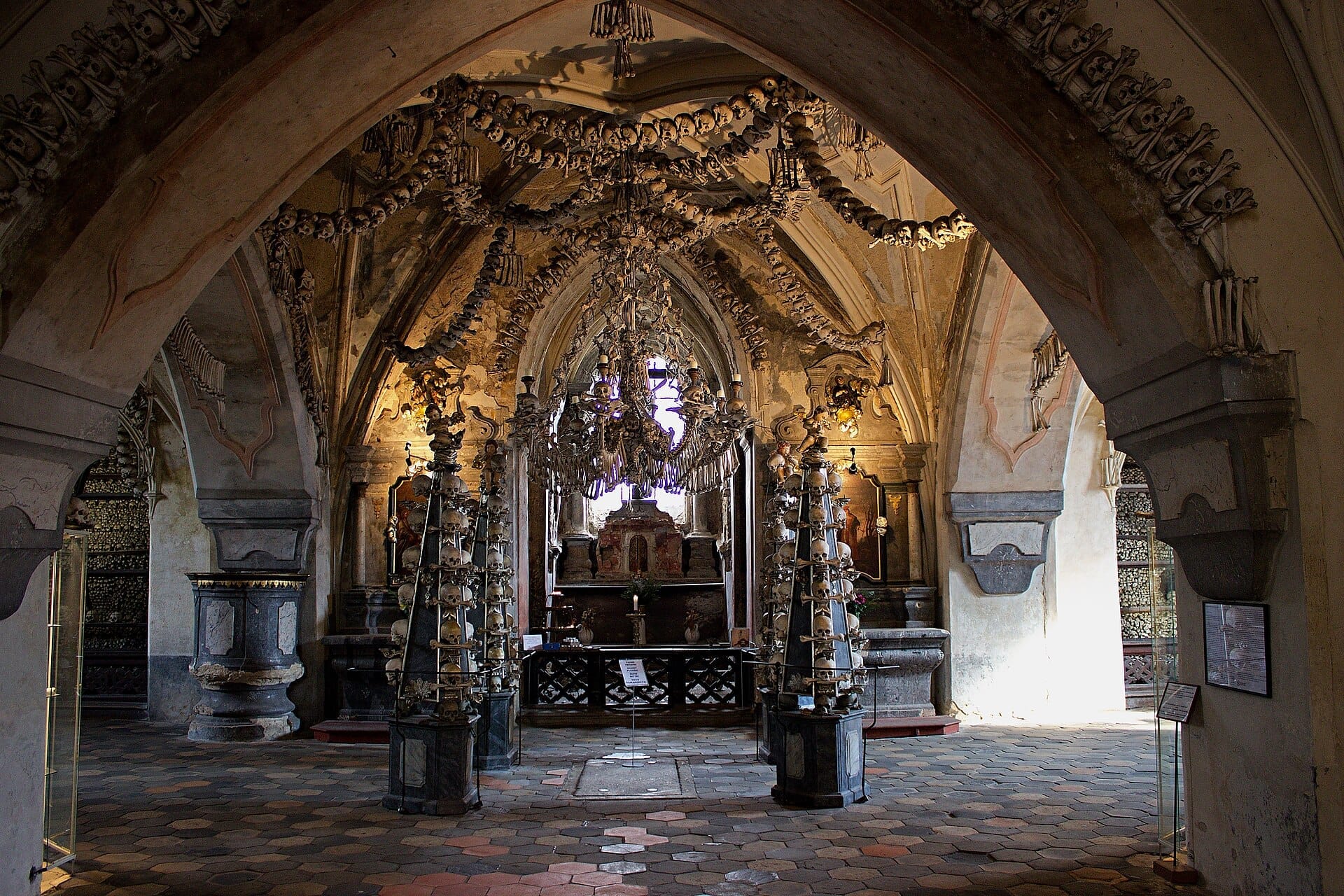
What makes the ossuary extraordinary, and difficult to fully prepare for, is that the bones of approximately 40,000 people have been arranged within it not simply as storage, but as deliberate artistic composition. Chandeliers, garlands, coats of arms, and monstrances constructed entirely from human skeletal remains line every surface of the chapel's lower chamber. The arrangement was carried out by woodcarver František Rint in 1870, commissioned by the Schwarzenberg noble family. His signature, also rendered in bone, appears on the wall near the entrance.
ℹ️ Good to know
The site remains open during a long-term structural reconstruction project ongoing since 2014. You may notice scaffolding or restricted zones during your visit. Confirm current conditions at sedlec.info before traveling.
The History Behind the Bones
The accumulation of remains here is rooted in medieval catastrophe. The cemetery at Sedlec was enlarged in the late 13th century, after the Abbot Henry returned from a pilgrimage to Jerusalem carrying soil from Golgotha, which he scattered over the grounds. This act made Sedlec a sought-after burial site across Central Europe. The Black Death in the mid-14th century and the Hussite Wars in the early 15th century both contributed massive numbers of dead to the site. Estimates of the total buried here across the centuries reach into the tens of thousands.
By the late 15th century, the church could no longer accommodate all the remains being unearthed as new graves were dug. A half-blind monk was reportedly tasked with stacking the exhumed bones in the chapel. They remained in rough pyramidal piles for centuries until Rint's 1870 commission transformed the accumulation into what visitors see today. That transformation is itself historically significant: it reflects 19th-century Romantic attitudes toward death and memorialization, overlaid onto genuinely medieval remains.
For broader context on Czech history and how sites like this fit into the country's religious and political past, the Prague history guide provides useful background before you visit.
Tickets & tours
Hand-picked options from our booking partner. Prices are indicative; availability and final rates are confirmed when you complete your booking.
Self guided tour with interactive city game of Prague
From 5 €Instant confirmationFree cancellationPrague by night city tour
From 27 €Instant confirmationFree cancellationPrague city tour with Vltava River cruise
From 38 €Instant confirmationFree cancellationPrague Castle online audio guide
From 5 €Instant confirmationFree cancellation
What You See Inside: A Room-by-Room Reality
You enter through a small doorway into the lower chapel, a vaulted stone space with relatively low ceilings and modest natural light filtering in through narrow windows. The smell is dry and faintly mineral, not unpleasant, but distinctly different from an ordinary church interior. The air carries the particular stillness of a space with thick stone walls and no airflow. In summer, this makes the chapel noticeably cooler than the street outside.
The central chandelier dominates the room. It is said to contain at least one of every bone in the human body and hangs from the ceiling on a heavy metal mount. Four large pyramidal accumulations of skulls and long bones occupy the corners of the chapel. Along the walls, garlands of skulls alternate with tibias and femurs in rhythmic, almost geometric patterns. The Schwarzenberg coat of arms constructed in bone along one wall includes a raven pecking at a severed eye socket — the detail that tends to stop visitors mid-step.
Entry is managed in timed slots to control capacity, and in practice most visitors find 20–30 minutes is enough to absorb the space fully. The chapel is not large. Groups move through in a rough circuit; it does not feel crowded as long as you avoid peak summer midday arrivals.
💡 Local tip
Photography is permitted inside, but conditions are challenging. The interior is dimly lit with warm artificial light supplemented by small windows. A camera that handles low light well will produce far better results than a phone flash, which flattens the texture of the bones and creates harsh shadows. Arrive shortly after opening for quieter shots with fewer visitors in frame.
How to Get There from Prague
The ossuary is in Kutná Hora, approximately 70 km east of Prague, and is straightforwardly reachable by train. Frequent services depart from Praha hlavní nádraží (Prague Main Railway Station) and the journey takes roughly one hour depending on the service. Kutná Hora hlavní nádraží (the main train station) sits directly adjacent to the Sedlec district, which means the ossuary is one of the closer landmarks to the station itself, approximately a 10–15 minute walk. Local buses also connect the station to the town centre if you plan to continue into Kutná Hora proper.
Organized day tours from Prague are widely available and bundle transport with a guide, which some visitors find worthwhile for the historical context. Independent travel is straightforward, however, and leaves more flexibility around timing.
If you are planning a full day trip, Kutná Hora pairs naturally with other excursions from Prague. See the day trips from Prague guide for how to sequence the town with other nearby destinations. The nearby Kutná Hora town centre, a UNESCO World Heritage Site, is worth the additional half-day to explore on the same trip.
Opening Hours, Tickets, and Booking
Seasonal opening hours apply. The ossuary is open 09:00 to 16:00 from November through February, 09:00 to 17:00 in March and October, and 09:00 to 18:00 from April through September. These hours refer to opening; last entry is typically 15–30 minutes before closing, so the site closes promptly at the stated times.
The standard adult ticket is 220 CZK and covers both the ossuary and the Cathedral of the Assumption of Our Lady as a Sedlec Area combined ticket. Concession tickets are 150 CZK, and children's tickets are 80 CZK. These prices should be verified before visiting as they are subject to change. Tickets can be purchased online through the official site or at the Sedlec Information Centre at 279 Zámecká Street.
⚠️ What to skip
Visitor capacity is limited and timed entry tickets are recommended, especially in peak season. Walk-in access is not guaranteed, particularly on summer weekends and during Czech public holidays. Book in advance at sedlec.info to secure your preferred time slot.
Physical accessibility details are not specified on the official site. The ossuary is a lower-level chapel accessed via stairs. Visitors with mobility requirements should contact the site directly before planning a visit.
Best Time to Visit and What to Expect by Season
Summer, specifically July and August, brings the heaviest visitor numbers. The morning opening slot (09:00 to 10:30) is consistently the quietest part of the day throughout the year. Mid-morning on a weekday in spring or autumn offers the most comfortable experience. The chapel's stone construction means it stays cool regardless of outdoor temperature, so summer visits are not physically unpleasant, only more crowded.
Winter visits have a particular atmosphere. The shorter opening hours reduce crowd pressure, and the grey light of a Central European November or January suits the subject matter of the site better than bright midsummer sunshine. If you are visiting Prague in winter and looking for a day trip that works in limited daylight, Kutná Hora and the ossuary make good sense.
For seasonal planning, the best time to visit Prague guide covers weather, crowds, and seasonal trade-offs across the full calendar year.
Is It Worth It? An Honest Assessment
The Sedlec Ossuary is genuinely unlike almost anything else in Central Europe. The combination of medieval history, 19th-century artistic intervention, and the sheer scale of what the bones represent produces an experience that is difficult to categorize and harder to forget. The 30-minute time limit inside the chapel is not a frustrating constraint. The space rewards attention, not duration, and most visitors have absorbed everything meaningful within 20 minutes.
The site is occasionally framed as morbid tourism or criticized for aestheticizing human remains. That tension is real and worth acknowledging before you visit. For some travelers, the sacred and historical context is clear and the experience is moving. For others, the collision of death, art, and tourism feels uncomfortable regardless of context. Neither response is unreasonable. If you are uncertain whether this is the right kind of attraction for you, the honest answer is that photographs do not fully capture the scale or atmosphere of the interior, and you should read accounts from past visitors before committing to the day trip.
Travelers who are specifically sensitive to explicit imagery of human remains, or those visiting with young children, should be aware that the bones are displayed without screening or protective distance. This is not a sanitized exhibit.
Insider Tips
- Arrive at the 09:00 opening on a weekday, particularly outside June to August. The first 45 minutes before tour groups arrive from Prague produces a noticeably quieter and more reflective atmosphere inside the chapel.
- Combine the ossuary with the Cathedral of the Assumption of Our Lady, included in the same Sedlec Area ticket, before heading into Kutná Hora town centre. The cathedral is a short walk away and is architecturally significant in its own right as a UNESCO-listed site.
- The train station at Kutná Hora hlavní nádraží is unusually close to the ossuary — about a 10–15 minute walk and closer than the town centre. If your primary interest is the ossuary, you do not need to take a bus or taxi from the station.
- Rint's signature rendered in human bone is located near the entrance wall. Most visitors walk past it without noticing. Take a moment to look for it before moving to the central chandelier.
- The reconstruction project means that portions of the site exterior may be scaffolded or partially obscured. Check current site conditions at sedlec.info within a week of your visit to avoid surprises.
Who Is Sedlec Ossuary (Bone Church) For?
- Travelers with an interest in medieval history and the history of death in Europe
- Architecture and art enthusiasts curious about 19th-century Romantic interpretations of earlier periods
- Day-trippers from Prague looking for a substantive UNESCO-linked experience beyond the city
- Dark tourism visitors who approach unusual sites with historical seriousness
- Photographers seeking dramatic interior subjects in challenging low-light conditions
Nearby Attractions
Combine your visit with:
- Český Krumlov
Český Krumlov is a medieval South Bohemian town wrapped in a horseshoe bend of the Vltava River, home to the second-largest castle complex in the Czech Republic and a UNESCO-protected historic centre. It makes for one of the most rewarding day trips or overnight stays from Prague, though it demands some planning to do properly.
- Divoká Šárka Nature Reserve
Divoká Šárka is a protected nature reserve on Prague's northwestern edge where limestone gorges, steppe grasslands, and a reservoir beach sit just 30 minutes from the city centre. Entry is free, trails are open year-round, and the landscape shifts dramatically with the seasons.
- Karlovy Vary
Karlovy Vary (historically Carlsbad) sits in a steep river valley about 120 km west of Prague, its colonnades and pastel-colored Grand Hotels reflected in the Teplá River. A UNESCO World Heritage site and the oldest spa town in Bohemia, it rewards a full day — or longer — with thermal springs, ornate promenades, and an atmosphere unlike anything in the Czech capital.
- Karlštejn Castle
Founded in 1348 by Holy Roman Emperor Charles IV as a treasury for the Imperial Regalia and Bohemian crown jewels, Karlštejn Castle rises from a limestone ridge above a quiet Bohemian village. Roughly 30 km southwest of Prague and 40 minutes by train, it is one of the most architecturally intact Gothic royal complexes in Central Europe. All interior visits are guided tours only, and the hilltop setting demands a 20-minute uphill walk from the station.