Kutná Hora: Prague's Most Rewarding Day Trip
Once one of medieval Europe's wealthiest cities, Kutná Hora sits about 70 km east of Prague and packs a serious amount of history into a walkable town centre. A UNESCO World Heritage Site since 1995, it rewards visitors with Gothic architecture, a bone church that genuinely unsettles, and far fewer crowds than Prague's Old Town.
Quick Facts
- Location
- Central Bohemian Region, about 70 km east of Prague
- Getting There
- Direct trains from Praha hlavní nádraží (Prague Main Station) to Kutná Hora; journey time varies by service — check Czech Railways (cd.cz) for current timetables
- Time Needed
- Full day (6–8 hours) to cover the town centre, St Barbara's Church, and Sedlec Ossuary comfortably
- Cost
- Town centre entry is free; individual monuments charge separate admission — verify current prices with each site before visiting
- Best for
- History lovers, architecture enthusiasts, day-trippers from Prague
- Official website
- www.kutnahora.cz
Why Kutná Hora Earns a Full Day
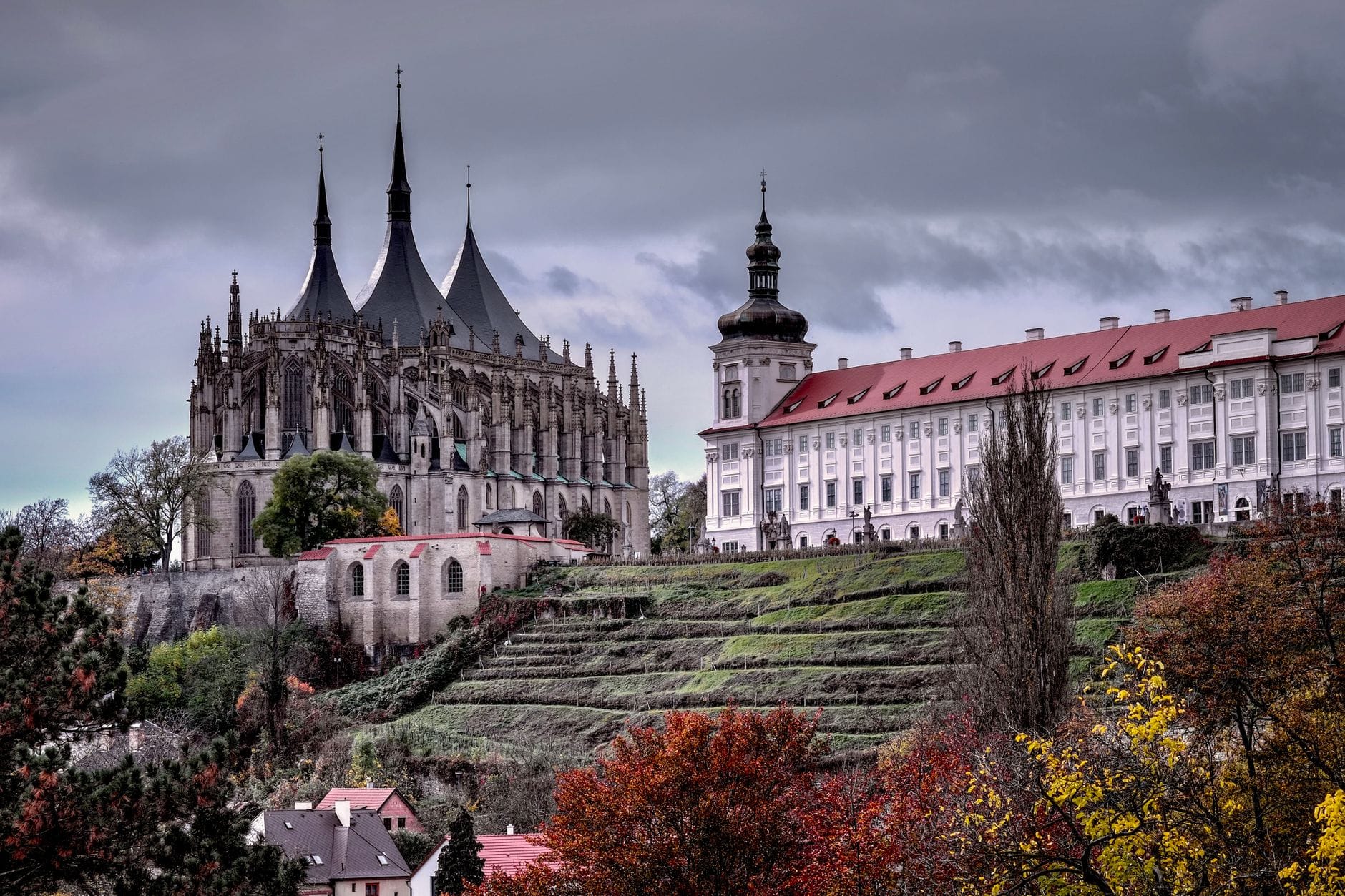
Kutná Hora is not a place you can rush. It is a working town built on the bones of a silver-mining empire, and that layered history shows in everything from the Gothic spires of St Barbara's Church to the narrow lanes that once connected miners' quarters to royal mints. The UNESCO designation covers not just one building but an entire historic centre, including the Cathedral of Our Lady at Sedlec roughly 3 km away, recognising the town as an exceptionally well-preserved medieval urban landscape.
Unlike many Central European day-trip destinations that deliver a single attraction surrounded by ordinary streets, Kutná Hora offers a genuine density of sights. The Sedlec Ossuary, St Barbara's Church, the Italian Court (Vlašský dvůr), and the stone fountain at Rejsek Square all warrant time on their own. Budget six to eight hours and you will leave without feeling you have skimmed the surface.
💡 Local tip
Sedlec and the town centre are about 3 km apart. Most visitors take a local bus or taxi between the two rather than walking, especially with a full day of sightseeing ahead. Plan your itinerary so you visit one area in the morning and the other after lunch.
A City Built on Silver: The Historical Context
Kutná Hora's story begins in the early 13th century, when silver deposits were discovered in the hillside above the Vrchlice River. The find transformed a modest settlement into one of the most important cities in the medieval Kingdom of Bohemia. By the 14th century, the town was minting Bohemian silver groš coins, a currency that circulated widely across Central Europe and gave the Bohemian crown real financial power.
At its peak, Kutná Hora rivalled Prague in population and wealth. The royal mint, known as the Italian Court because Florentine craftsmen were brought in to oversee minting operations, still stands near the centre and is open to visitors. The wealth generated by silver funded the construction of St Barbara's Church, one of the finest examples of Gothic architecture in Central Europe, begun in 1388 and not completed until the early 20th century.
When the silver veins ran out in the late 16th and early 17th centuries, Kutná Hora declined sharply. That economic stagnation, often brutal for its residents, had an inadvertent preserving effect: the town never had the industrial investment that would have swept away its medieval fabric. What you see walking its streets today is substantially what was left standing when the money ran out. For more historical context, the Prague history guide covers the Bohemian silver economy and its political consequences in more depth.
Tickets & tours
Hand-picked options from our booking partner. Prices are indicative; availability and final rates are confirmed when you complete your booking.
Kutna Hora walking tour and St Barbara Cathedral from Prague
From 55 €Instant confirmationFree cancellationKutna Hora with St.Barbara's Cathedral and Bone Church
From 72 €Instant confirmationFree cancellationSelf guided tour with interactive city game of Prague
From 5 €Instant confirmationFree cancellationPrague by night city tour
From 27 €Instant confirmationFree cancellation
The Sedlec Ossuary: What to Expect Before You Go
The Sedlec Ossuary is the attraction that puts Kutná Hora on travel lists worldwide, and it is worth addressing honestly. The small Roman Catholic chapel at the Cemetery Church of All Saints contains the bones of an estimated 40,000 to 70,000 people, arranged into decorative forms including a chandelier, four baroque pyramids, and garlands of skulls. It is genuinely striking and unlike anything else in the region.
The bones date primarily from victims of the Black Death in the 14th century and casualties of the Hussite Wars in the 15th century. In 1870, a local woodcarver named František Rint was commissioned to put the accumulated remains in order. His solution was the elaborate arrangement still visible today. Whether this reads as art, devotional practice, or spectacle is a matter of individual perspective, and the chapel does not force an interpretation on you.
Practically: the ossuary is small and fills quickly. Weekend mornings in summer can mean a queue. The space inside is compact, so the experience on a busy day involves waiting, shuffling, and sharing the room with dozens of other visitors. Arriving before 10am on a weekday gives you more time to absorb the details without the crowd pressure. Photography is permitted. The smell inside is cool and faintly earthy, exactly what a stone vault centuries old would produce. Opening hours and admission prices are set by the Roman Catholic Parish of Sedlec and change seasonally; check directly before visiting.
⚠️ What to skip
The Sedlec Ossuary is located in the suburb of Sedlec, not in Kutná Hora's main historic centre. The two areas are about 3 km apart. If you arrive by train at Kutná Hora hlavní nádraží (the main railway station), you are actually closer to Sedlec than to the town centre — consider visiting the ossuary first, then continuing to the centre.
St Barbara's Church and the Town Centre
St Barbara's Church (Chrám sv. Barbory) is the architectural centrepiece of the historic town centre, and it earns that status. The exterior is immediately arresting: a forest of flying buttresses supports a distinctive triple-tent roof, and the whole structure sits at the edge of a terrace overlooking the valley, framed by a Baroque balustrade lined with statues of saints. The approach along Barborská Street, lined with those statues against an open sky, is one of the better architectural promenades in Bohemia.
Inside, the late Gothic vaulting is remarkable in detail. Sections of the ribbed ceiling bear painted decorations referencing the town's two industries: mining motifs and heraldic symbols of the royal mint appear alongside religious iconography. The church was patron-funded by the miners themselves, which explains why St Barbara, the patron saint of miners, was chosen as its dedicatee. The building's long construction history across different Gothic phases is visible if you look closely at variations in stonework and tracery.
The town centre around Palackého náměstí and the streets leading toward the Italian Court rewards slow walking. The Stone House (Kamenný dům), a late Gothic burgher's house with an ornate facade, is easy to miss if you are moving quickly. The stone fountain at Rejsek Square, a hexagonal Gothic structure from 1495, is another detail that registers differently once you understand it was built not for decoration but to supply the town with water pumped up from a significant depth.
For those comparing Gothic church interiors across the country, the St Vitus Cathedral in Prague and St Barbara's represent different phases and ambitions of Czech Gothic — the cathedral is royal, St Barbara's is civic and mercantile, and that difference is legible in the decoration.
How the Experience Changes by Time of Day
Kutná Hora receives most of its visitors during the middle hours of the day, when tour groups arrive from Prague by coach. The town centre from roughly 10am to 3pm on weekends in summer is noticeably more crowded than during the quieter shoulder hours. If your train arrives before 9am, you can walk Barborská Street and visit St Barbara's Church in near-silence, with the morning light coming in at a low angle through the nave windows.
By late afternoon, most day-trippers have returned to their coaches. The streets around the historic centre take on a different quality: local residents are more visible, the cafes shift from tourist traffic to local regulars, and the light on the stone facades turns a warmer tone. Staying until early evening, if your return train allows it, gives you Kutná Hora more or less to yourself.
Weather matters here more than in Prague. The town's position on an open plateau means wind is a factor in cooler months, and the cobbled streets collect water quickly in rain. Sturdy footwear with grip is genuinely useful, not just advisable. In summer, the open approaches to St Barbara's Church have little shade.
Getting There and Practical Logistics
The most practical way to reach Kutná Hora from Prague is by train from Praha hlavní nádraží (Prague Main Railway Station). Direct and connecting services run regularly throughout the day. Journey times and the number of changes vary by service, so checking the Czech Railways website (cd.cz) or the national public transport planner (idos.cz) for current timetables before you travel is essential. The town has two stations: Kutná Hora hlavní nádraží, near Sedlec, and Kutná Hora město (town), closer to the historic centre. Confirm which station is most useful for your itinerary.
Kutná Hora is also reachable by car on the D1 motorway and regional roads, making it a logical addition to a broader Central Bohemia itinerary that might include other destinations. The Karlštejn Castle lies west of Prague and could be combined on a two-day circuit, though the logistics require planning. The day trips from Prague guide covers Kutná Hora alongside other Central Bohemian options and practical transport comparisons.
Within the town, a local bus connects the main railway station, Sedlec, and the historic centre. Taxis are available but in limited numbers; agree on a price before setting off. The historic centre is compact and walkable once you are in it, but the distance between Sedlec and the town centre is enough to justify the bus, particularly in summer heat or wet weather.
ℹ️ Good to know
The historic town centre streets, squares, and outdoor spaces are freely accessible at any time. Admission fees apply only at individual monuments: St Barbara's Church, the Sedlec Ossuary, the Cathedral of Our Lady at Sedlec, and the Italian Court each charge separate entry. Prices change seasonally — verify current rates at each attraction's official site before your trip.
Who Should Manage Expectations
Kutná Hora is frequently promoted as one of the best day trips from Prague, and for visitors interested in medieval history and Gothic architecture, that reputation holds. But some visitors arrive expecting a quaint market town and find instead a functioning small Czech city with tourist infrastructure concentrated around two or three monuments. The streets between the main sights are ordinary, the restaurant options around the main square are predictably tourist-facing, and the town has the slightly worn feel of a place that has been on the day-trip circuit for long enough to show it.
Visitors who primarily want good food, a lively atmosphere, or shopping will find Prague itself far more rewarding. Kutná Hora's value is specific: it is for people who want to understand medieval Bohemia beyond what Prague's Old Town can show them, and who are willing to walk cobblestones and look closely at stone.
If architecture is your primary interest and you want to stay within Prague, the Prague architecture guide covers Gothic, Baroque, and 20th-century buildings that reward the same kind of close attention.
Insider Tips
- Train tickets can be purchased at the station on the day, but checking timetables in advance via cd.cz or idos.cz saves time and avoids waiting for a slow connection. Some services require a change at Kolín.
- The Kutná Hora město (town) train station is small and unmanned for parts of the day. If you plan to take the train back to Prague in the late afternoon, confirm the return schedule before you leave the platform on arrival.
- The terrace along Barborská Street beside the statues of saints looks directly over the valley and is one of the better photography spots in the region, particularly in the late afternoon when the light falls on the town below. Most visitors walk straight past it toward the church.
- Several of the town's monuments offer combination tickets that bundle St Barbara's Church with the Italian Court or other sites. Ask at the first ticket desk you reach, as this can reduce total admission costs.
- The Cathedral of Our Lady at Sedlec, adjacent to the ossuary, is a Cistercian Gothic cathedral rebuilt in Baroque style in the early 18th century by Jan Blažej Santini-Aichel in his idiosyncratic Gothic-Baroque hybrid manner. It draws far fewer visitors than the ossuary next door and is worth the few extra minutes.
Who Is Kutná Hora For?
- History enthusiasts wanting to understand medieval Bohemia beyond Prague's Old Town
- Architecture lovers drawn to Gothic church interiors and the Santini-Aichel Baroque-Gothic synthesis at Sedlec
- Travelers with a full day free from Prague looking for a substantive rather than scenic excursion
- Visitors interested in unusual or confronting art and memorial spaces, specifically the Sedlec Ossuary
- Photographers looking for stone architecture with good natural light and fewer crowds than central Prague
Nearby Attractions
Combine your visit with:
- Český Krumlov
Český Krumlov is a medieval South Bohemian town wrapped in a horseshoe bend of the Vltava River, home to the second-largest castle complex in the Czech Republic and a UNESCO-protected historic centre. It makes for one of the most rewarding day trips or overnight stays from Prague, though it demands some planning to do properly.
- Divoká Šárka Nature Reserve
Divoká Šárka is a protected nature reserve on Prague's northwestern edge where limestone gorges, steppe grasslands, and a reservoir beach sit just 30 minutes from the city centre. Entry is free, trails are open year-round, and the landscape shifts dramatically with the seasons.
- Karlovy Vary
Karlovy Vary (historically Carlsbad) sits in a steep river valley about 120 km west of Prague, its colonnades and pastel-colored Grand Hotels reflected in the Teplá River. A UNESCO World Heritage site and the oldest spa town in Bohemia, it rewards a full day — or longer — with thermal springs, ornate promenades, and an atmosphere unlike anything in the Czech capital.
- Karlštejn Castle
Founded in 1348 by Holy Roman Emperor Charles IV as a treasury for the Imperial Regalia and Bohemian crown jewels, Karlštejn Castle rises from a limestone ridge above a quiet Bohemian village. Roughly 30 km southwest of Prague and 40 minutes by train, it is one of the most architecturally intact Gothic royal complexes in Central Europe. All interior visits are guided tours only, and the hilltop setting demands a 20-minute uphill walk from the station.