Santuari de Lluc: Mallorca's Spiritual Heart in the Mountains
Perched at 525 metres in the Serra de Tramuntana, the Santuari de Lluc is Mallorca's most important pilgrimage site. A working monastery since the 13th century, it combines a Renaissance-Baroque church, a world-famous boys' choir, mountain trails, and the quiet gravity of a place that Mallorcans have been walking to for generations.
Quick Facts
- Location
- Plaça dels Pelegrins 1, Escorca, Serra de Tramuntana, Mallorca
- Getting There
- By car via MA-10 mountain road; public bus from Inca or Palma (verify current routes); hiking trails from surrounding villages
- Time Needed
- 2 to 4 hours for the sanctuary; full day if hiking nearby trails
- Cost
- Free entry to church and sanctuary grounds; fees apply for museum, accommodation, and guided visits
- Best for
- History enthusiasts, hikers, pilgrims, photography, families
- Official website
- www.lluc.net/en
What Is the Santuari de Lluc?
The Santuari de Lluc is not simply a church in the mountains. It is the closest thing Mallorca has to a national spiritual symbol: a working monastery, a hostel for pilgrims, a nature gateway, and a home to one of Spain's longest-running boys' choirs, all folded into a single complex at 525 metres above sea level in the heart of the Serra de Tramuntana.
For Mallorcans, Lluc carries a weight that most tourist sites do not. Every year, thousands of islanders make the night walk from Palma, departing from Plaça Güell at 23:00 on the first weekend of August, covering roughly 47 kilometres through mountain darkness to arrive at dawn. It is not a religious exercise for everyone who does it, but it is a deeply Mallorcan one. The sanctuary earns its place on the island's emotional map in a way that no beach ever will.
💡 Local tip
The entrance to the church and sanctuary grounds is free. If you want to visit the museum (which holds archaeological finds, sacred art, and natural history collections), expect a small separate fee. Confirm current prices at the ticket desk on arrival.
History and Significance: Seven Centuries of Pilgrimage
The founding story of Lluc belongs to the 13th century, when a young shepherd boy is said to have discovered a dark stone statue of the Virgin Mary near a hill called Pujol de la Trobada (Hill of the Finding). The statue was moved twice to a local church, and both times it reportedly returned on its own to the spot where it had been found. The monastery was established at that location, and the statue, La Moreneta (the Dark One), became the focus of Mallorcan Catholic devotion.
The current church was built between 1622 and 1691 in a transitional Renaissance-Baroque style, its stone facade suitably austere against the surrounding holm oaks and limestone peaks. In 1884, the Virgin of Lluc was ceremonially crowned, and in 1962 the church was elevated to the status of a minor basilica. Since 1891, the sanctuary has been administered by the Missionaries of the Sacred Hearts, who continue to run it today.
The site also holds a broader UNESCO context: the Serra de Tramuntana, the mountain range in which Lluc sits, was declared a UNESCO World Heritage Cultural Landscape in 2011, recognised for its centuries of human interaction with a dramatically rugged terrain.
Tickets & tours
Hand-picked options from our booking partner. Prices are indicative; availability and final rates are confirmed when you complete your booking.
Dinosaurland and Caves of Hams combined ticket
From 25 €Instant confirmationFree cancellationShuttle Boat from Cala Millor to Cala Ratjada
From 26 €Instant confirmationFree cancellation3-hour Es Trenc Boat Tour in Mallorca
From 39 €Instant confirmationFree cancellationShuttle Boat Roundtrip from Cala Bona to Cala Ratjada
From 29 €Instant confirmationFree cancellation
Els Blauets: The Boys' Choir That Has Sung Since 1531
One of Lluc's most distinctive features has nothing to do with stone or landscape. Els Blauets, named for the blue cassocks worn by its members, is one of the oldest boys' choirs in Spain, founded in 1531. On most mornings, the choir sings the Salve Regina inside the basilica, a brief but striking experience that draws visitors who have no particular interest in liturgy but simply want to hear something remarkable happen in a place built for it.
The exact schedule for choir performances varies and can change with school terms and religious calendars. Check the official website at lluc.net before planning your visit around the singing. Arriving mid-morning on a weekday typically offers the best chance of hearing the choir in an uncrowded church.
ℹ️ Good to know
Els Blauets sing the Salve Regina on most mornings inside the basilica. Performance times vary seasonally. Verify the current schedule at lluc.net before your visit.
What to Expect When You Arrive
The sanctuary complex is larger than most first-time visitors expect. The approach from the car park leads you through a broad, stone-paved square flanked by arched colonnades. The architecture creates an immediate sense of enclosure, a deliberate separation from the noise of the MA-10, the mountain road that brought you here. In the early morning, before tour buses arrive, the square is almost silent except for birdsong and the occasional echo of footsteps on stone.
The basilica interior is relatively plain by Spanish ecclesiastical standards, but the Camarin de la Mare de Déu, the small chapel housing the revered Virgin statue, draws a steady stream of visitors and pilgrims throughout the day. The statue is small and dark, positioned at the centre of an ornate altar. Many Mallorcans visit in silence, occasionally for extended periods. It is worth slowing down and letting the space do what it does, rather than moving through quickly.
Beyond the church, the complex includes a museum with three distinct collections: sacred art, a natural history section, and archaeological finds from across the island. There is also a botanical garden, a gift shop, a restaurant, and former monk cells that have been converted into simple guest accommodation. The whole compound operates with the self-contained logic of a small village.
For those combining a visit to Lluc with a broader itinerary, the sanctuary pairs naturally with stops like Valldemossa and Deià along the MA-10 mountain road. A well-planned day route through the Serra de Tramuntana can cover all three without feeling rushed.
Hiking and the Surrounding Landscape
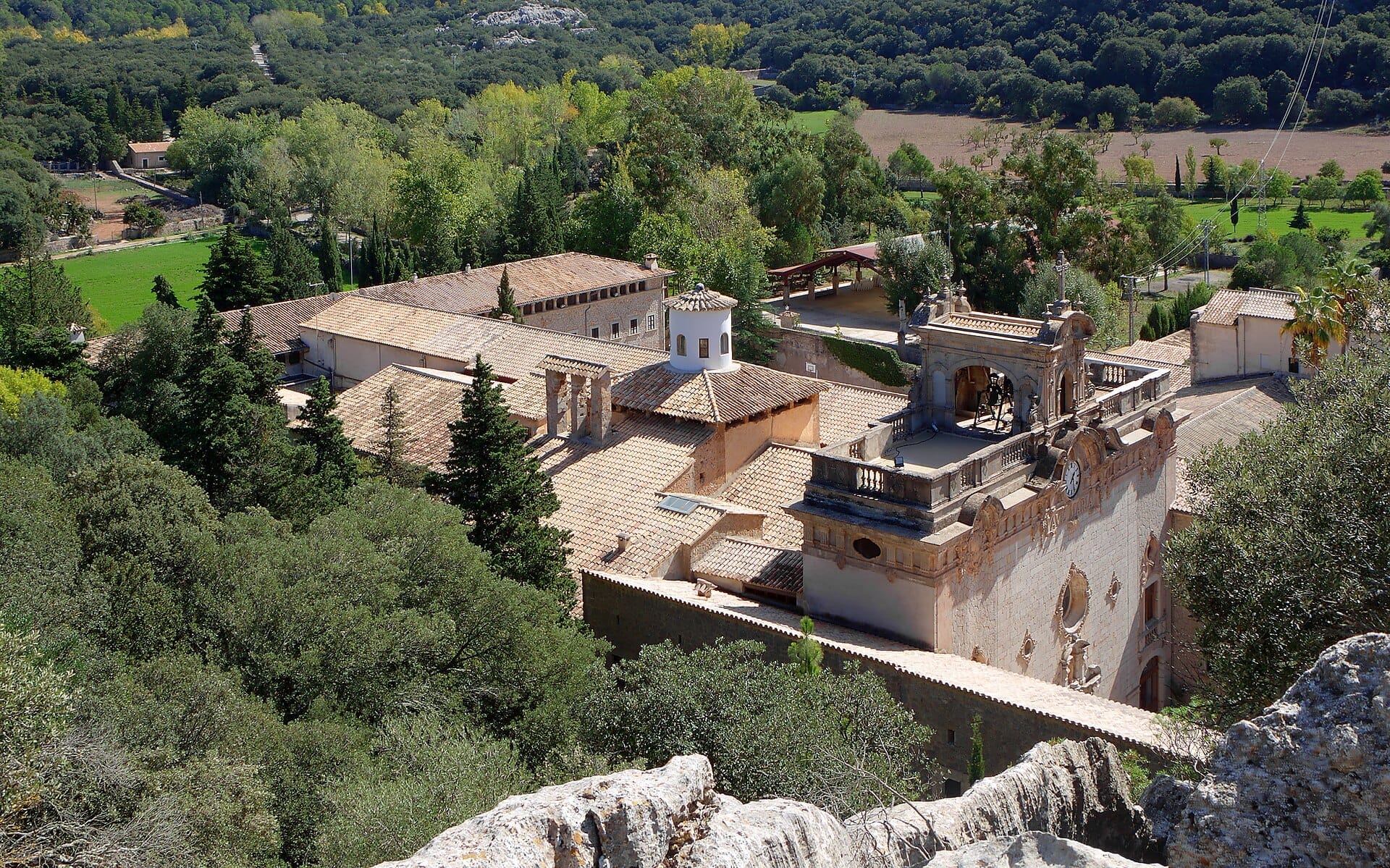
Lluc functions as one of the main trailheads for walking in the central Tramuntana. The most-visited short route leads up to the Pujol de la Trobada, the hill of the founding legend, which takes around 20 to 30 minutes and rewards you with views over the monastery complex from above. Early morning light hits the stone rooftops at a low, warm angle and makes this one of the better photography vantage points in the area.
Longer trails connect Lluc to the surrounding peaks and valleys, including routes toward Puig Tomir and the high karst plateaus that define this part of the island. The terrain is rocky and can be uneven. Proper footwear is not optional on anything beyond the paved monastery grounds. In summer, these trails are best walked before 9:00 or after 17:00 to avoid the midday heat, which climbs sharply even at altitude.
The hiking possibilities around the Serra de Tramuntana extend well beyond Lluc, but the sanctuary makes an excellent base for those wanting to spend a night in the mountains and set out on longer routes at dawn.
⚠️ What to skip
The MA-10 road to Lluc involves tight mountain hairpins. If you are uncomfortable with narrow mountain driving, allow extra time and avoid the route in rain or low cloud, when visibility on exposed sections drops significantly. There is no easy alternative public road.
How the Experience Changes Through the Day
Early morning is Lluc at its most atmospheric. Before 9:00, the car park is sparse, the square is cool and often lightly misted, and the smell of pine and damp limestone drifts through the colonnades. This is also the window to catch morning prayers or the choir, and to walk the Pujol de la Trobada in near-solitude.
By mid-morning, particularly in summer, coach groups begin arriving. The square fills, the gift shop becomes busy, and the basilica sees a steady flow of visitors. The experience is still worthwhile but moves at a different rhythm. Afternoon visits can feel crowded between June and September, and the mountain road itself gets congested around popular lunch hours.
Late afternoon, once day-trippers begin their return drive, brings a second window of quiet. The low sun turns the monastery stone a deeper amber, and the restaurant terrace becomes a genuinely pleasant place to sit. If you are staying overnight in the converted monk cells, the evenings here, after the crowds leave, are among the more quietly memorable experiences the island offers.
Practical Details for Your Visit
The sanctuary is located at Plaça dels Pelegrins 1, in the municipality of Escorca, which has almost no permanent population beyond the monastery itself. There is no village to explore around it. The nearest settlements of any size are Caimari to the south and Pollença to the north.
By car, Lluc is approximately 35 kilometres from Palma and roughly 20 kilometres from Pollença, via the MA-10. Public bus connections exist from Inca and Pollença, but schedules are limited and change seasonally. Verify current routes through the Serveis Ferroviaris de Mallorca or local tourism offices before relying on them. If you are planning to explore the island without a car, read the guide to getting around Mallorca before booking transport.
Dress codes inside the church follow standard Catholic site expectations: covered shoulders and knees. The monastery can be cool even in summer due to its elevation and thick stone walls, so bringing a light layer is sensible regardless of the season. In winter, temperatures at 525 metres can drop sharply, and the road is occasionally affected by ice.
Those interested in the broader landscape and photography context of this part of the island will find useful framing in the Mallorca photography guide, which covers the Tramuntana specifically.
Who Might Want to Skip This
Lluc requires a deliberate effort to reach. It sits on no convenient circuit unless you are specifically touring the Tramuntana, and it offers little to travellers focused exclusively on beaches or resort areas. The landscape is the attraction as much as the monument: if mountain drives, religious history, and quiet contemplation do not interest you, the time spent on the MA-10 is difficult to justify. Similarly, visitors with limited mobility should know that while the monastery square is paved and manageable, the surrounding terrain, including the Pujol de la Trobada path, is uneven and steep.
Insider Tips
- Arrive before 9:00 to have the monastery square essentially to yourself, catch cooler temperatures, and potentially hear the choir during morning prayers without the mid-morning crowd.
- The walk up to Pujol de la Trobada (Hill of the Finding) takes about 25 minutes and gives you a straight-down view of the entire monastery complex. It is the most photogenic angle available and almost no one does it.
- If you want to stay overnight in the converted monk cells, book well in advance for summer weekends. The accommodation is basic but the experience of being at the site after all day visitors have left is worth the simplicity.
- The annual night walk from Palma happens on the first weekend of August. If you are on the island that weekend, even watching the walkers arrive at dawn is a striking thing. Participating requires proper preparation, but it is open to the public.
- The monastery museum is often skipped by visitors in a hurry, but its archaeological collection includes Bronze Age finds from across Mallorca that provide rare context for the island's pre-Roman history.
Who Is Santuari de Lluc For?
- Hikers using Lluc as a base for Serra de Tramuntana routes
- Travellers interested in Mallorcan history and religious heritage
- Photography enthusiasts, particularly at golden hour or in morning mist
- Families wanting a cultural stop that includes outdoor walking
- Anyone doing a full Tramuntana road trip along the MA-10
Nearby Attractions
Other things to see while in Serra de Tramuntana:
- Deià
Perched above olive groves on the northwestern cliffs of Mallorca's Serra de Tramuntana, Deià has drawn artists, writers, and travelers for decades. The honey-colored stone houses, the smell of wild rosemary on the lane up to the church, and the long views over the Mediterranean make it genuinely special. But it rewards slow visitors, not quick stop-and-snap day-trippers.
- Fornalutx
Perched in the Serra de Tramuntana above Sóller, Fornalutx is a compact stone village of about 700 people that has won national recognition for how well it has been preserved. The streets are steep, the buildings are honey-coloured, and the orange groves press in close on every side. Entry is free, the walk takes one to two hours, and it pairs naturally with a day in Sóller.
- Jardines de Alfabia
Set against the Serra de Tramuntana mountains, Jardines de Alfabia is a layered estate with roots in 13th-century Moorish Mallorca. Its terraced gardens, vaulted cistern, famous water pergola, and Baroque manor house make it one of the island's most rewarding half-day visits for anyone interested in history, botany, or architecture.
- Mallorca Cycling (Sa Calobra & Tramuntana Routes)
The Sa Calobra climb is the centerpiece of road cycling in Mallorca, winding 9.5 km through 26 hairpin bends into the heart of the UNESCO-listed Serra de Tramuntana. Whether you're a seasoned climber chasing Strava times or a touring cyclist exploring one of Europe's most dramatic mountain landscapes, these routes deliver scenery and challenge in equal measure.