Salesforce Park: San Francisco's Rooftop Garden Above the City Streets
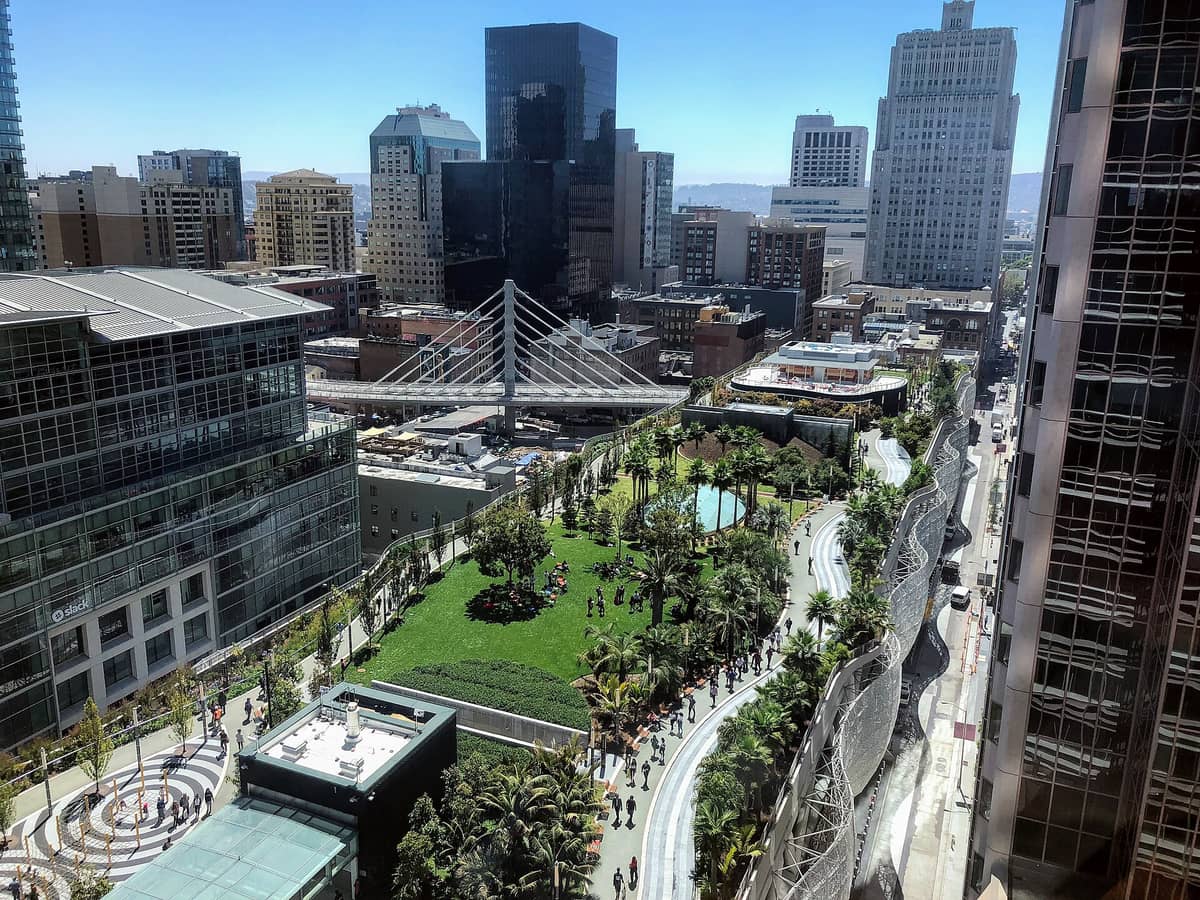
Perched five stories above Mission Street, Salesforce Park is a free, 5.4-acre rooftop park atop the Salesforce Transit Center in SoMa. With native plantings, open lawns, city views, and a surprisingly quiet atmosphere on weekday mornings, it rewards visitors who take the elevator up.
Quick Facts
- Location
- 425 Mission Street, SoMa, San Francisco, CA 94105
- Getting There
- Embarcadero and Montgomery Street BART/Muni stations (about a 10-minute walk); multiple Muni bus lines stop at the Salesforce Transit Center
- Time Needed
- 30–60 minutes for a relaxed loop
- Cost
- Free admission
- Best for
- Lunchtime escapes, architecture lovers, views of Salesforce Tower, quiet urban greenery
- Official website
- www.tjpa.org/salesforce-transit-center/salesforce-park
What Salesforce Park Actually Is
Salesforce Park is a publicly accessible rooftop garden spanning 5.4 acres atop the Salesforce Transit Center at 425 Mission Street in San Francisco's SoMa district. It opened in 2018 as part of the larger transit center complex and sits roughly 70 feet above street level, elevated on a concrete platform that spans several city blocks between First and Beale Streets.
The park is free to enter and is managed by the Transbay Joint Powers Authority. Unlike the manicured rooftop gardens you might expect from a corporate-adjacent project, the landscape design here takes an ecological approach: the plantings represent distinct world biomes, from Australian meadows to New England forest groves, arranged in a winding loop trail roughly a third of a mile long.
ℹ️ Good to know
Hours vary by season. May 1–October 31: 6:00 a.m.–9:00 p.m. November 1–April 30: 6:00 a.m.–8:00 p.m. Hours are subject to change; check the TJPA website before visiting.
Getting Up There: Access and Arrival
Reaching the park requires taking one of the public elevators from street level or from the Grand Hall inside the transit center. The main elevator banks are accessible from Salesforce Plaza on Mission Street near Fremont and from the transit center's interior. Escalators also connect the Grand Hall to the park level. There is no separate ticket booth or gate: you simply ride up.
For transit access, the closest BART and Muni Metro station is Embarcadero, about a 10-minute walk northwest along the waterfront. Multiple Muni bus lines also stop near First and Mission Street. If you are combining the park with the broader waterfront, see the Embarcadero neighborhood guide for context on what's within walking range.
💡 Local tip
Arrive via the Grand Hall interior if the weather is cool or foggy. The hall itself is worth a moment: its undulating roof panels filter natural light into the main concourse in a way that changes noticeably throughout the day.
Tickets & tours
Hand-picked options from our booking partner. Prices are indicative; availability and final rates are confirmed when you complete your booking.
Sonoma and Napa Valley wine tour from San Francisco
From 127 €Instant confirmationFree cancellationGo City | San Francisco Explorer Pass
From 76 €Instant confirmationFree cancellationMuir Woods and Sausalito guided tour with transportation
From 82 €Instant confirmationFree cancellationSan Francisco CityPASS
From 77 €Instant confirmationFree cancellation
What the Park Looks and Feels Like
Standing on the main lawn at the center of the park, the scale is surprising. The open grass area is large enough for small groups to spread out, and the skyline framing is dramatic: Salesforce Tower rises immediately to the west, and on clear days you can see the Bay Bridge to the east and the hills of the East Bay beyond that.
The planting is dense and varied in a way that feels genuinely botanical rather than decorative. The biome concept means you move through distinct micro-environments within a short walk: conifers and shade-tolerant ground covers give way to drought-resistant California natives, then to a grove of trees that, in late morning light, creates genuine canopy shade. The soil mix is engineered to work within a structural platform, which means root depth is limited, but the mature trees already present give the garden more verticality than you might expect from a rooftop.
Sound on the park level is one of the more counterintuitive elements of the experience. Street noise from Mission Street below is largely absent. What you hear instead is wind, occasional bird activity in the plantings, and the background hum of the city at a distance. On a clear weekday morning, it is genuinely quiet in a way that few open spaces in downtown San Francisco manage.
How the Experience Changes by Time of Day
Early mornings (6:00–8:30 a.m.) draw joggers and commuters cutting through on their way to the tower or transit center below. The light is soft and directional, making this the best window for photography: the glass and steel of the surrounding towers catch the morning sun at angles that look stark and structural rather than washed out.
Midday on weekdays is the park's most populated window. Office workers from Salesforce Tower and adjacent buildings arrive with lunches and laptops. The lawn fills but rarely feels crowded in the way that, say, Yerba Buena Gardens fills during a lunch rush. Weekend afternoons are quieter than you might expect, partly because the surrounding blocks are primarily office and transit infrastructure rather than retail or residential.
Late afternoons in September and October, when San Francisco reaches its warmest temperatures, are genuinely pleasant here. The park faces south and west, meaning it captures the afternoon light well. By contrast, in June and July, afternoon fog typically rolls in from the west, dropping temperatures quickly and making a jacket essential even if the morning was mild.
⚠️ What to skip
San Francisco's summer months (June–August) are frequently foggy by early afternoon. If you want the park in warm sunshine, September and October are more reliable. Always bring a layer regardless of season.
The Architecture Around the Park
The Salesforce Transit Center itself is one of the more significant pieces of public infrastructure built in San Francisco in recent decades. The building was designed by Pelli Clarke & Partners and was intended to eventually serve as a regional rail hub, including a planned extension of Caltrain and California High-Speed Rail into downtown San Francisco. That rail component remains unfinished as of this writing, meaning the transit center currently operates primarily as a bus terminal. For travelers interested in the broader architectural story of SoMa, the San Francisco architecture guide covers several nearby landmarks worth combining with a visit.
The park's structural logic is visible if you look for it. The platform's depth determines soil volume, which in turn caps the size of plantings. The drainage systems, irrigation pipes, and load-bearing requirements are all embedded in the path edges and planting bed borders. For anyone with an interest in landscape engineering, the design is a case study in what is possible when ecological ambition meets genuine structural constraint.
Practical Notes for Your Visit
There are restrooms at the park level. Seating is distributed throughout the loop in the form of fixed benches and movable chairs in the central lawn area. A small amphitheater hosts occasional free programming; check the TJPA events calendar before visiting if you want to time a visit to coincide with a performance.
Photography here is straightforward. The Salesforce Tower framed against the park plantings is the obvious shot, but the east-facing views toward the Bay Bridge are often more interesting compositionally, particularly in the hour before sunset. Wide-angle lenses work well for the tower framing; a standard or short telephoto compresses the bridge nicely against the sky.
Accessibility is solid by San Francisco standards. Elevators from both street level and the Grand Hall interior reach the park, the path surface is paved and level throughout the main loop, and seating is available at regular intervals. For more on getting around the city generally, the getting around San Francisco guide covers transit options across all neighborhoods.
Who should skip this? Travelers primarily chasing panoramic views of the bay or the Golden Gate will find this park limiting: the sight lines are partial and framed by towers rather than open. If you want an unobstructed 360-degree city view, Twin Peaks or the Marin Headlands will serve you better. Salesforce Park is not a destination view point. It is a destination for urban greenery, architectural curiosity, and a quiet pause in a dense part of the city.
Combining Salesforce Park With the Surrounding Area
The park's location in SoMa puts it within easy walking distance of several major cultural sites. The San Francisco Museum of Modern Art (SFMOMA) is about a 10-minute walk southwest. Yerba Buena Gardens is similarly close and offers a contrasting green space experience at street level, with a more programmatic events calendar and a different demographic mix.
If you are arriving by ferry from the East Bay or Marin, the Ferry Building Marketplace is a short walk north along the Embarcadero, making Salesforce Park a natural stop between the waterfront and the museums of SoMa. First-time visitors planning a full day in this corridor should look at the one-day San Francisco itinerary for a logical route that strings these together without backtracking.
Insider Tips
- The park's central lawn has movable chairs, not just fixed benches. On busy lunch days, the best seating disappears fast. Arrive before noon if you want to claim a spot in the sun.
- The amphitheater at the east end of the park hosts free events, from live music to fitness classes. The TJPA posts the schedule on their website, but it's rarely advertised widely, so most visitors walk through without knowing a free concert is 50 feet away.
- For the cleanest Bay Bridge photography from the park, position yourself at the eastern rail near Beale Street and shoot in the late afternoon when the bridge faces the setting sun. Morning light hits the western towers of the Financial District instead.
- The park loop is only about a third of a mile, so you can do the full circuit in under 10 minutes if you walk steadily. Slow down near the wooded grove section on the north side of the loop: the planting density there is the highest on the roof and the contrast with the surrounding towers is genuinely striking.
- On windy days, the park is significantly more exposed than street level. The lack of surrounding buildings at the roof level means the wind is unbroken. A light jacket that works on the street often isn't enough up here when the fog comes in.
Who Is Salesforce Park For?
- Office workers and downtown visitors looking for a genuine outdoor lunch break away from street traffic
- Architecture and urban design enthusiasts interested in landscape engineering and the Salesforce Transit Center's structural ambition
- Photographers seeking skyline shots with foreground greenery rather than pure skyline or pure nature
- Travelers building a SoMa cultural day that combines multiple museums and public spaces within walking distance
- Early-morning visitors who want a quiet, uncrowded green space before the Financial District crowds arrive
Nearby Attractions
Other things to see while in SoMa (South of Market):
- Children's Creativity Museum
Inside Yerba Buena Gardens in SoMa, the Children's Creativity Museum (CCM) is a hands-on space where kids make animation, music, and art using real creative tools. It suits ages 2 to 12 best and pairs well with the surrounding gardens and nearby cultural institutions.
- Oracle Park
Oracle Park, home of the San Francisco Giants, sits on the edge of McCovey Cove in San Francisco's South Beach district. Whether you're catching a Giants game or joining a ballpark tour, this guide covers everything you need to plan a smart visit.
- San Francisco Museum of Modern Art (SFMOMA)
The San Francisco Museum of Modern Art (SFMOMA) anchors the Yerba Buena cultural district in SoMa with seven floors of modern and contemporary art, a landmark building, and a collection that rewards slow looking. Here is what to expect, what to budget, and how to get the most out of your visit.
- Yerba Buena Gardens
Yerba Buena Gardens is a free, three-block public park in San Francisco's South of Market district, open daily from 6 a.m. to 10 p.m. Surrounded by world-class museums and anchored by a dramatic waterfall memorial, it's one of the most accessible and genuinely pleasant green spaces in the city center.