Yerba Buena Gardens: San Francisco's Cultural Heart in SoMa
Yerba Buena Gardens is a free, three-block public park in San Francisco's South of Market district, open daily from 6 a.m. to 10 p.m. Surrounded by world-class museums and anchored by a dramatic waterfall memorial, it's one of the most accessible and genuinely pleasant green spaces in the city center.
Quick Facts
- Location
- 750 Howard St, SoMa, San Francisco, CA 94103
- Getting There
- Muni Metro: Yerba Buena/Moscone Station (T Third Street line); Powell Street BART about a 5-minute walk
- Time Needed
- 45 minutes for the park itself; half a day if visiting surrounding museums
- Cost
- Free (park admission). Nearby museums and attractions charge separately.
- Best for
- Families, museum-goers, lunch-break escapes, public art enthusiasts
- Official website
- yerbabuenagardens.org
What Yerba Buena Gardens Actually Is
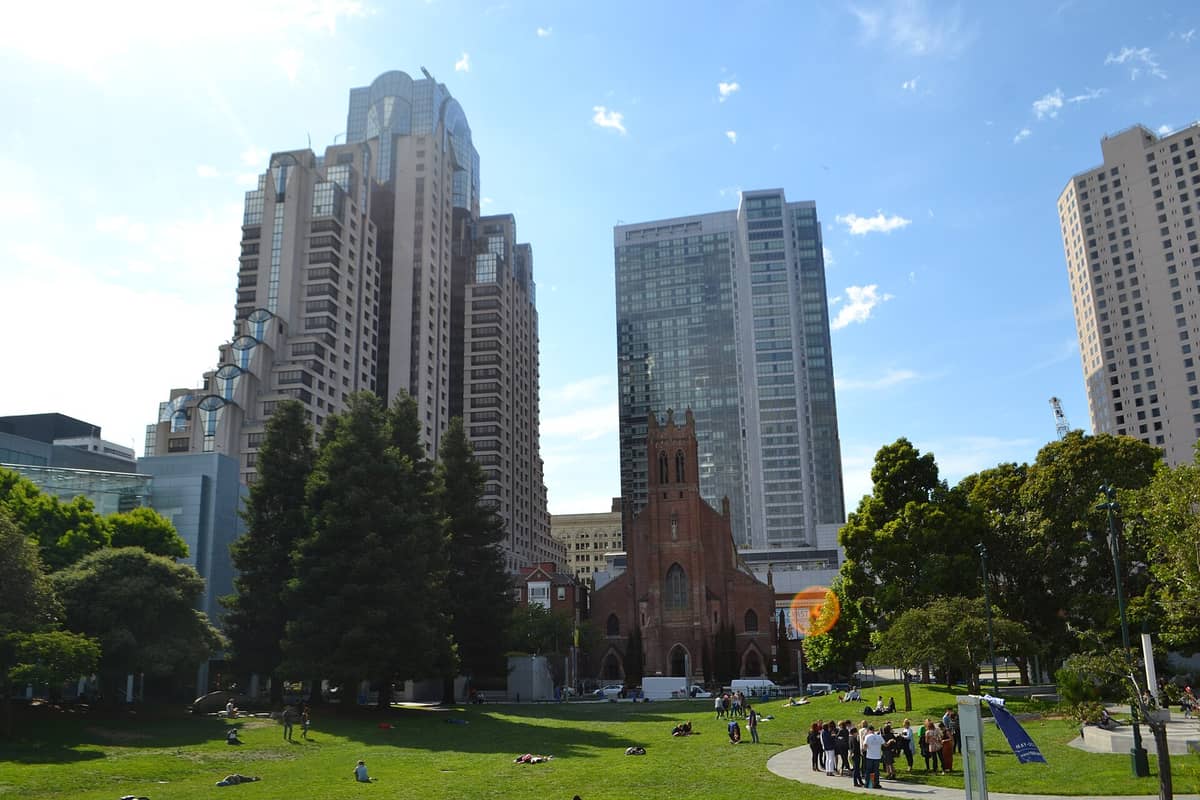
Yerba Buena Gardens is a public urban park complex covering three city blocks between Market and Folsom Streets, and Third and Fourth Streets, in San Francisco's South of Market neighborhood. The Spanish name translates loosely to 'good herb,' a reference to the wild mint that early settlers found growing along the bay's shoreline. The complex opened in 1993 as part of a major civic redevelopment effort that transformed what had been a struggling industrial and residential pocket into a cultural district anchored by the Moscone Convention Center below and the Yerba Buena Center for the Arts above ground.
The park sits on top of the Moscone Convention Center's underground exhibition halls, which gives the landscape a slightly elevated, platform-like quality. Gardens, plazas, public sculptures, a large waterfall memorial, an outdoor performance stage, and a children's garden are spread across the two blocks. The surrounding cluster of institutions, including SFMOMA, the California Historical Society, and the Contemporary Jewish Museum, makes this one of the most culturally dense corners of the city.
💡 Local tip
The park is open daily from 6:00 a.m. to 10:00 p.m. and admission is free. If you are planning to visit SFMOMA or other major museums nearby on the same trip, note that those require separate, paid tickets booked in advance.
The Walk Through the Gardens
The most striking feature of the gardens is the Martin Luther King Jr. Memorial, a curved waterfall installation that spans roughly 50 feet of one garden's northern edge. Water sheets steadily down a dark granite face, and engraved quotes from King's speeches and writings are cut into the stone on either side. The sound of the falling water creates a low, consistent rush that cuts through street noise. It is genuinely peaceful to stand in front of, especially on a weekday morning when foot traffic is light.
Beyond the memorial, the central lawn draws office workers at lunchtime and families on weekends. The grass is well maintained and usually firm enough for sitting without a blanket. Several large-scale sculptures are positioned throughout the grounds, and the public art changes periodically, so repeat visitors often find something new. The overhead canopy from mature trees provides partial shade in the warmer months, though the garden is open enough that you will notice San Francisco's characteristic afternoon wind by mid-day.
The children's side of the complex, sometimes called the Children's Garden, includes a carousel, a small bowling alley, and an ice skating rink (year-round, with separate fees). These facilities are physically adjacent to the main park but managed separately. If you are visiting with young children, the Children's Creativity Museum sits right at the park's edge and is worth checking for programming before your visit.
Tickets & tours
Hand-picked options from our booking partner. Prices are indicative; availability and final rates are confirmed when you complete your booking.
Sonoma and Napa Valley wine tour from San Francisco
From 127 €Instant confirmationFree cancellationGo City | San Francisco Explorer Pass
From 76 €Instant confirmationFree cancellationMuir Woods and Sausalito guided tour with transportation
From 82 €Instant confirmationFree cancellationSan Francisco CityPASS
From 77 €Instant confirmationFree cancellation
How the Park Changes by Time of Day
Early morning, before 9 a.m., the park is almost entirely quiet. The waterfall runs, pigeons patrol the edges of the lawn, and a few joggers cut through on their way to and from the nearby Embarcadero. The light is flat and cool, and the surrounding streets are still largely empty. This is the best time for photography of the MLK Memorial without people in the frame.
From late morning through early afternoon, the park fills quickly. Tech workers from nearby offices use the central lawn as an outdoor meeting space. Food trucks and vendors set up along the perimeter. The outdoor performance stage sometimes hosts free programming at midday, particularly in summer and early fall. By 1 p.m. on a dry day, almost every bench is occupied.
Late afternoon, after 4 p.m., brings a second wave of visitors as museum-goers from SFMOMA and the nearby institutions spill into the park. The light shifts lower and warmer, and the waterfall's granite takes on a different texture in the angled sun. By 7 p.m. in summer, the lawn crowd thins and the park settles into an evening rhythm with couples and solo walkers. The gardens are lit at night but feel noticeably quieter, and some isolated corners of the lower plaza can feel less secure after dark.
⚠️ What to skip
Like much of SoMa, the immediate surroundings of Yerba Buena Gardens include areas with visible homelessness. The park itself is generally well-maintained and staffed, but visitors should remain aware of their surroundings, particularly in the early morning or late evening.
Historical Context: From Redevelopment to Cultural District
The land beneath Yerba Buena Gardens has one of San Francisco's more contested urban histories. Through the 1950s and 1960s, the city displaced thousands of low-income residents, many of them elderly and Filipino, from what was then called the South of Market neighborhood to build the Moscone Convention Center. Community activists fought back through the courts and organized resistance for more than a decade, resulting in the eventual development of the cultural and public park complex as a form of mitigation and public benefit.
The 1993 opening of the Yerba Buena Center for the Arts, the anchor institution of the complex, represented the start of a broader cultural investment in SoMa that eventually drew SFMOMA's expanded facility (reopened 2016), the Contemporary Jewish Museum, and the Museum of the African Diaspora. The result is a cluster of serious cultural institutions within a five-minute walk of each other, which is unusual for any American city and genuinely worth treating as a half-day cultural itinerary.
If you are building a full cultural day in this part of the city, SFMOMA is directly across Third Street and is one of the most significant modern art museums on the West Coast. The Asian Art Museum is a short walk northwest near Civic Center if you want to extend the itinerary further.
Getting There and Getting Around
The easiest transit approach is the Muni Metro, which stops directly at Yerba Buena/Moscone Station on the T line and other Muni Metro subway services. The station exits bring you up within a half block of the park. BART also stops at Powell Street Station, roughly a five-minute walk north along Third or Fourth Street. Both options are reliable and straightforward.
If you are coming from Union Square on foot, the walk south on Third Street takes about eight to ten minutes and passes through a stretch of the SoMa corridor with good street-level interest. Parking in the immediate area is limited and expensive during weekdays, particularly when conventions are running at Moscone Center below. On convention days, the entire surrounding block radius fills up quickly, and street parking becomes nearly impossible by mid-morning.
For visitors working through a broader San Francisco itinerary, the park pairs naturally with Salesforce Park about a ten-minute walk northeast, another elevated public green space worth seeing for its architecture and rooftop garden design. For a full overview of how to plan your time in the city, the San Francisco 3-day itinerary places Yerba Buena Gardens within a practical day-by-day structure.
Photography, Weather, and What to Bring
The Martin Luther King Jr. Memorial photographs best in the morning, when the light hits the granite face at a low angle and the water contrast is strongest. The sculptures across the lawn work well in afternoon light, which picks up the textures and casts longer shadows. The surrounding skyline, including the visible edge of the Salesforce Tower to the north, makes for a distinctive urban backdrop from the lawn's northern end.
San Francisco's climate in SoMa follows the city's broader Mediterranean pattern, with the warmest and clearest days typically falling in September and October. Summer months (June through August) are cooler and often foggy, with afternoon wind picking up in the open sections of the park by 2 or 3 p.m. A light layer is worth carrying year-round. Winter visits (November through March) bring the possibility of rain, and while the park remains open, extended time on the lawn becomes less comfortable.
ℹ️ Good to know
September and October are statistically the warmest and clearest months in San Francisco. If your goal is to spend time sitting in the gardens rather than passing through, these two months offer the most reliable outdoor conditions.
Is Yerba Buena Gardens Worth Your Time?
As a standalone destination, the gardens are pleasant but not a reason to make a dedicated trip across the city. The real value is as a connector: a calm, free public space between several paid cultural attractions, ideal for a lunch break, a quiet moment between museum visits, or a short walk with children. The MLK Memorial is more affecting than guidebooks tend to suggest, and the surrounding cultural cluster is genuinely world-class.
Visitors who expect a grand park experience along the lines of Golden Gate Park will find the scale modest. The two-block footprint means you can walk the entire perimeter in under ten minutes. But for what it is, a well-maintained urban green space in a dense city neighborhood, it delivers reliably. The free admission, central location, and direct transit access make it easy to include in almost any SoMa-based itinerary without any planning overhead.
If this kind of free, accessible city experience appeals to you, the guide to free things to do in San Francisco covers several other spots across the city that follow a similar model.
Insider Tips
- The upper terrace level near the Yerba Buena Center for the Arts building offers a slightly elevated view over the central lawn and makes a better photography position than standing at ground level near the waterfall.
- Lunchtime (roughly 11:30 a.m. to 1:30 p.m.) on weekdays brings the densest crowds and the most competition for benches and lawn space. Arriving before 11 a.m. or after 2 p.m. makes for a noticeably more relaxed experience.
- Convention schedules at Moscone Center directly affect the surrounding area. On heavy convention days, restaurants and cafes within a three-block radius have long waits and higher foot traffic. Check the Moscone Center calendar if you prefer a quieter visit.
- The children's carousel in the adjacent Children's Garden operates on a separate schedule and charges a small per-ride fee. If you are visiting with toddlers, confirm it is running before building your visit around it.
- The outdoor performance stage in the gardens hosts free community events, particularly on weekends from spring through fall. The official Yerba Buena Gardens website publishes a current events calendar that is worth checking in advance.
Who Is Yerba Buena Gardens For?
- Families combining the park with a visit to the Children's Creativity Museum or the carousel
- Museum-hoppers who want a free outdoor break between SFMOMA and other nearby cultural institutions
- First-time visitors building a walkable SoMa cultural itinerary in a single afternoon
- People interested in public art and urban landscape design in a city context
- Travelers looking for a calm, free midday stop in a central San Francisco location
Nearby Attractions
Other things to see while in SoMa (South of Market):
- Children's Creativity Museum
Inside Yerba Buena Gardens in SoMa, the Children's Creativity Museum (CCM) is a hands-on space where kids make animation, music, and art using real creative tools. It suits ages 2 to 12 best and pairs well with the surrounding gardens and nearby cultural institutions.
- Oracle Park
Oracle Park, home of the San Francisco Giants, sits on the edge of McCovey Cove in San Francisco's South Beach district. Whether you're catching a Giants game or joining a ballpark tour, this guide covers everything you need to plan a smart visit.
- Salesforce Park
Perched five stories above Mission Street, Salesforce Park is a free, 5.4-acre rooftop park atop the Salesforce Transit Center in SoMa. With native plantings, open lawns, city views, and a surprisingly quiet atmosphere on weekday mornings, it rewards visitors who take the elevator up.
- San Francisco Museum of Modern Art (SFMOMA)
The San Francisco Museum of Modern Art (SFMOMA) anchors the Yerba Buena cultural district in SoMa with seven floors of modern and contemporary art, a landmark building, and a collection that rewards slow looking. Here is what to expect, what to budget, and how to get the most out of your visit.