Real Colegio Seminario del Corpus Christi: Valencia's Forgotten Renaissance Masterpiece
Founded in 1583 by Archbishop Juan de Ribera, the Real Colegio Seminario del Corpus Christi sits in Valencia's historic centre as one of Spain's most complete Renaissance complexes. Its cloister, frescoed church, and art collection — including works attributed to El Greco — reward visitors who take the time to look beyond the city's more publicised landmarks.
Quick Facts
- Location
- Calle de la Nau 1, 46002 Valencia (historic centre, La Xerea neighbourhood)
- Getting There
- Walk from Plaza del Ayuntamiento (around 10 minutes) or take any city bus to the historic centre; directly opposite La Nau (Universitat de València cultural centre)
- Time Needed
- Around 1 to 1.5 hours with guided tour; about 45 minutes self-guided
- Cost
- Approx. 5 € for self-guided visit, 12 € with guided tour (verify current prices directly)
- Best for
- Architecture enthusiasts, art lovers, history travellers, visitors seeking quiet interiors
- Official website
- www.seminariocorpuschristi.org
What You Are Actually Walking Into
The Real Colegio Seminario del Corpus Christi, widely known as the Colegio del Patriarca, occupies an entire city block in Valencia's historic centre. From the outside, the stone facade on Calle de la Nau is restrained to the point of severity, which is partly why tourists walk past it without a second glance. That restraint is deliberate: the building's founders were Counter-Reformation clergy who placed their energy inward, not outward.
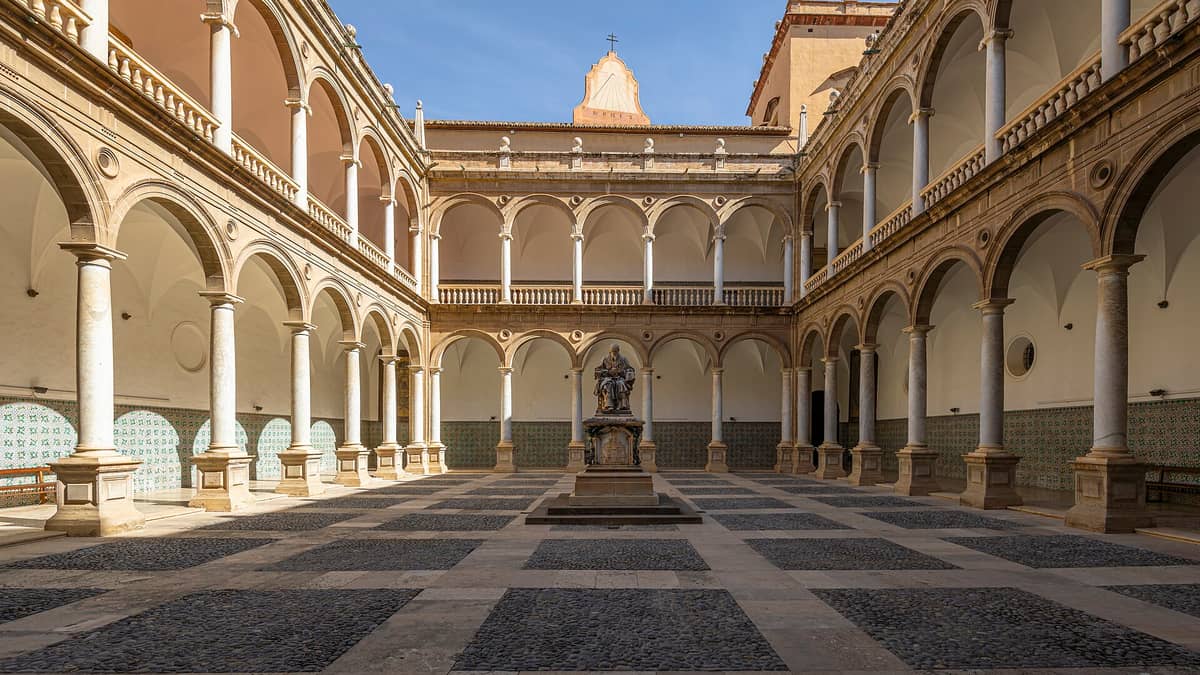
Step through the entrance and the proportions change immediately. The central cloister opens up as a two-storey arcade of rounded arches, its colonnades framing a garden courtyard with a stone well at the centre. The silence here is real, not performed. Even on mornings when the cathedral and the Mercado Central are crowded, this cloister tends to hold only a handful of visitors, which makes the contrast with the street outside feel almost theatrical.
💡 Local tip
The complex is a functioning seminary, not just a museum. Guided tours typically run Monday to Saturday at fixed times: 10:30, 11:30, 12:30, 16:30, 17:30, and 18:30. Hours can vary, so confirm directly with the institution before visiting — especially around religious holidays.
History and Founding: Juan de Ribera's Legacy
Juan de Ribera, Archbishop of Valencia and Patriarch of Antioch, founded the college in 1583. The first stone was laid in 1586, and the complex was completed in the early seventeenth century — a remarkable pace for a project of this scale. Ribera's intention was explicit: to train priests according to the reform decrees of the Council of Trent, which had concluded in 1563 and fundamentally reshaped Catholic clerical education across Europe.
Ribera himself was later beatified and canonised, and his remains are preserved in the chapel. His portrait appears throughout the complex, as do references to his theological priorities. Understanding this context matters when you visit, because the art collection, the architecture, and the liturgical spaces are not decorative choices made for aesthetic reasons alone. They reflect a specific religious and political programme — the reassertion of Catholic orthodoxy in a region that had recently expelled its Moorish population.
The building was declared a Monumento Histórico-Artístico Nacional in 1962 and designated Bien de Interés Cultural in 2007. It sits directly opposite La Nau, the former seat of the University of Valencia, forming a pairing of ecclesiastical and academic power that once defined the intellectual geography of the historic centre.
Tickets & tours
Hand-picked options from our booking partner. Prices are indicative; availability and final rates are confirmed when you complete your booking.
Cala del Moraig Hiking and Beach Trip from Valencia
From 32 €Instant confirmationFree cancellationValencia Silk Museum tickets and audio guide
From 7 €Instant confirmationFree cancellationSaint Nicholas Church Entrance Tickets and Audioguide
From 11 €Instant confirmationHistoric Valencia walking tour
From 27 €Instant confirmationFree cancellation
The Architecture: Renaissance Discipline in Stone
The Colegio del Patriarca is considered one of the most complete and coherent Renaissance complexes in Spain. Unlike much of Valencia's architecture, which layers Gothic foundations under Baroque additions, this building was conceived and executed as a unified whole within a relatively short period. The result is a spatial clarity that feels unusual in a Spanish historic centre.
The cloister is the structural and spiritual heart of the complex. Its two levels of arcaded galleries connect the church, the chapel of Corpus Christi, the library, and the former classrooms. The stonework is precise without being cold. Morning light enters the upper gallery at an angle that makes the arcade shadows move slowly across the floor — something you notice if you linger for more than a few minutes rather than rushing straight to the church.
The church interior is where the architecture becomes genuinely surprising. The barrel-vaulted nave is covered in frescoes attributed to Bartolomé Matarana, a Genoese painter who worked extensively in Valencia during the late sixteenth century. The programme depicts scenes from the life of Christ and the Virgin, executed in the Italian Renaissance manner. If you have already visited the Iglesia de San Nicolás for its Baroque ceiling paintings, the Colegio del Patriarca offers useful counterpoint: earlier in date, more restrained in colour, and far less crowded.
The Art Collection: Quality Over Quantity
The museum housed within the complex holds a relatively small collection, but its quality is disproportionate to its size and its reputation among casual tourists. The holdings include Flemish panel paintings from the fifteenth and sixteenth centuries, Spanish Golden Age canvases, and liturgical objects in gold and silver. There is a triptych attributed to the workshop of Dieric Bouts, a late-Gothic Flemish master, which would command attention in any major European museum.
Works associated with El Greco are among the most discussed in the collection, though attribution questions around sixteenth-century Spanish painting are common and visitors should read the labels carefully rather than assuming a definitive verdict. The collection was assembled by Ribera and subsequent patrons, partly as devotional objects and partly as demonstrations of cultural standing.
ℹ️ Good to know
Photography policies inside the church and museum rooms can vary and may be restricted during certain hours. Check on arrival rather than assuming free photography throughout.
How the Experience Changes Through the Day
Morning visits, particularly at the 10:30 or 11:30 tour slots, are the quietest. By midday, a trickle of tourists who have already covered the Cathedral and the Lonja tends to drift this way, though numbers rarely feel overwhelming. Afternoon slots after 16:30 have a different quality: the cloister light shifts to a warmer tone, the seminary is generally less active as an institution, and the atmosphere in the church feels markedly more contemplative.
The complex is a working seminary, which means that at certain times you may hear plainchant from the chapel or encounter seminarians crossing the cloister. This is not a staged performance for tourists; it is an ongoing institution that has functioned continuously since the sixteenth century. That living quality distinguishes it from a purely museified space and adds a layer of authenticity that is harder to find in Valencia's more heavily visited religious buildings.
If you are planning a broader tour of Valencia's religious heritage, the Colegio del Patriarca pairs naturally with the nearby Cathedral of Valencia and the Basílica de la Virgen de los Desamparados. Together, they form a coherent half-day route through the ecclesiastical heart of the old city. For a broader survey of the city's architectural heritage, the Valencia architecture guide offers useful context.
Practical Walkthrough: What to Expect on Arrival
Entrance is from Calle de la Nau 1. There is no large sign announcing the complex; the doorway is set into the stone facade and easy to miss if you are not looking for it. The entrance fee at the time of writing is reported as approximately 5 euros for self-guided access and 12 euros for a guided tour, though these figures come from visitor accounts and official tourism sources rather than an updated tariff on the seminary’s own site and should be confirmed before you go.
The guided tours are conducted in Spanish. English-language audio guides or materials may be available, but this should be confirmed directly with the seminary. The tour covers the cloister, the church, the chapel of Corpus Christi, and the museum rooms. The library, which holds a significant collection of historical manuscripts and printed books, is not always accessible to general visitors.
The floors throughout the complex are stone and uneven in places, particularly in the cloister and older sections. Visitors with mobility concerns should contact the seminary in advance, as detailed accessibility information is not publicly documented. Comfortable, flat-soled shoes are advisable regardless.
⚠️ What to skip
The complex is not a freely walkable museum open throughout the day. Visits are structured around the fixed tour times listed above, and guided visits are currently offered only at specific slots. Arriving outside these times without prior arrangement may result in being turned away. Always check the current schedule at seminariocorpuschristi.org or through official tourism channels before your visit.
Who Should Skip This and Why
Visitors looking for a quick photo stop will find little to satisfy them here. The interior restrictions on photography and the structured tour format require patience and genuine interest. If your priorities are beaches, food markets, or the dramatic contemporary architecture of the Ciudad de las Artes y las Ciencias, this may not be the right use of your limited time in Valencia.
Young children are likely to find the pace and format difficult. The tours are conducted in a functioning religious environment where quiet is expected, and there are no interactive elements. Families with children under ten would probably be better served by the Bioparc or the Gulliver Park before returning to historic religious buildings when the children are older.
Insider Tips
- The 16:30 afternoon tour often has fewer participants than morning slots, giving you more time with the guide and more space to examine the art collection without jostling.
- The cloister well at the centre of the courtyard is one of the most photographed elements of the complex, but the upper gallery arcade, accessible on the guided tour, offers a far less reproduced perspective looking down into the courtyard.
- Mass is celebrated daily in the chapel. Attending even briefly, if you arrive around a scheduled Mass time, gives you access to the liturgical atmosphere of the space in a way that no guided tour fully replicates. Check the official site for current Mass times.
- The building's exterior on Calle de la Nau is easy to miss because it shares street space with La Nau cultural centre. Look for the stone portal with the seminary's name carved above; it sits directly opposite the La Nau entrance.
- If you are interested in the art collection specifically rather than the architecture, ask when booking whether the museum rooms are included in the particular tour slot you are joining, as access can vary.
Who Is Real Colegio Seminario del Corpus Christi For?
- Travellers with a genuine interest in Spanish Renaissance architecture and its Counter-Reformation context
- Art history enthusiasts seeking Flemish and Golden Age Spanish painting outside the main museum circuit
- Visitors who want to experience a living religious institution rather than a purely museified heritage site
- Slow travellers who prefer depth over coverage and are happy to spend ninety minutes in a single building
- Anyone who has exhausted Valencia's headline attractions and wants to understand what the city looked like at the height of its ecclesiastical power
Nearby Attractions
Other things to see while in Centro Histórico:
- Basílica de la Virgen de los Desamparados
The Real Basílica de Nuestra Señora de los Desamparados stands at the heart of Valencia's historic centre, housing the revered image of the city's patron saint. Built between 1652 and 1667, it is free to enter and open every day, making it one of the most accessible and emotionally resonant stops in the old city.
- Catedral de València
Rising above Plaza de la Reina in Valencia's historic centre, the Cathedral of Valencia is a remarkable layered monument built over seven centuries. From a Romanesque doorway to Gothic vaulting, a Baroque facade, and a relic claimed to be the Holy Grail, this is one of Spain's most architecturally complex and historically loaded churches.
- Centre Cultural La Nau
Housed in the University of Valencia's historic headquarters since the late 15th century, Centre Cultural La Nau is a historic landmark in the old town offering free exhibitions, concerts, and theatre. It rewards visitors who slow down and look closely.
- Centre Arqueològic de l'Almoina
Beneath a quiet plaza steps from Valencia Cathedral lies one of Spain's most compelling urban archaeology sites. The Centre Arqueològic de l'Almoina preserves around 2,500 square metres of Roman, Visigothic, and medieval remains, excavated over two decades and now visible through a striking modern structure.