Queensland Maritime Museum: Brisbane's Working Waterfront in Miniature
The Queensland Maritime Museum brings Queensland's seafaring history to life through preserved vessels, a functioning dry dock, and hands-on exhibits. Located in South Bank beneath the Goodwill Bridge, it is compact, affordable, and genuinely absorbing for anyone with an interest in ships, history, or the sea.
Quick Facts
- Location
- Corner of Stanley & Sidon Streets, South Brisbane (beneath the Goodwill Bridge, South Bank Parklands)
- Getting There
- South Bank train station (5-min walk); CityHopper and CityCat ferry terminals nearby; buses at Mater Hill or South Bank
- Time Needed
- 1.5 to 2.5 hours
- Cost
- Adult A$18 | Child (under 15) A$8 | Concession A$15 | Family A$42–A$50.Adult A$18 | Child (under 15) A$8 | Concession A$15 | Family A$42–A$50
- Best for
- History enthusiasts, families with school-age children, naval and engineering buffs
- Official website
- maritimemuseum.com.au
What the Queensland Maritime Museum Actually Is
The Queensland Maritime Museum is an outdoor-indoor heritage site occupying a compact slice of riverbank in South Bank Parklands. It sits at the corner of Stanley and Sidon Streets, in the shadow of the Goodwill Bridge, and its centrepiece is something you can smell before you read a single exhibit label: steel, river water, and faint traces of old engine oil drifting across the dry dock.
This is not a polished, corporate museum experience. Expect modest indoor galleries, a working dry dock that still services heritage vessels, and a collection of real boats you can walk aboard. The main draw is HMAS Diamantina, a World War II frigate commissioned in 1945 and stretching 91.36 metres from bow to stern. She is one of the last remaining World War II River Class frigates in the world and is preserved at the museum in Brisbane.
The museum opens Wednesday through Sunday, 10:00 a.m. to 4:15 p.m., with entry doors closing at 3:15 p.m. It is closed on 24 to 26 December, New Year's Day, Good Friday, and ANZAC Day. Those closures are worth noting before planning a public holiday visit.
⚠️ What to skip
Entry closes at 3:15 p.m., a full hour before the museum shuts. Arrive by 2:00 p.m. at the latest if you want unhurried time aboard HMAS Diamantina and in the indoor galleries.
HMAS Diamantina: The Ship That Makes This Place
Boarding HMAS Diamantina is the highlight for most visitors, and rightly so. The frigate was commissioned into the Royal Australian Navy in 1945, arrived too late to see active combat, but served in post-war operations including prisoner-of-war repatriation in the Pacific. She later recommissioned as an oceanographic research ship before being decommissioned and transferred to Brisbane for preservation.
On the main deck, the scale of the ship becomes real in a way no photograph conveys. The gun mountings, radar mast, and cramped companionways are all intact. Below decks, the crew quarters, galley, and engine spaces are preserved with enough original fittings to understand how more than 160 sailors actually lived aboard. The narrow bunks, low overhead clearance, and close spacing between machinery make comfort feel like an afterthought, which historically it was.
Accessibility is limited on Diamantina., and lower decks involve steep companionway ladders. Visitors with mobility limitations should check the museum's accessibility guidance directly.
Tickets & tours
Live prices and dates from our booking partner. If you book, we may earn a commission at no extra cost to you.
Luggage Storage in Brisbane
From 5 €Instant confirmationFree cancellationBrisbane's dark stories true crime tour
From 21 €Instant confirmationFree cancellationFull-day Mount Tamborine winery tour from Brisbane with lunch
From 140 €Instant confirmationFree cancellationNorth Stradbroke Island small groups day tour
From 79 €Instant confirmationFree cancellation
The Dry Dock and Outdoor Precinct
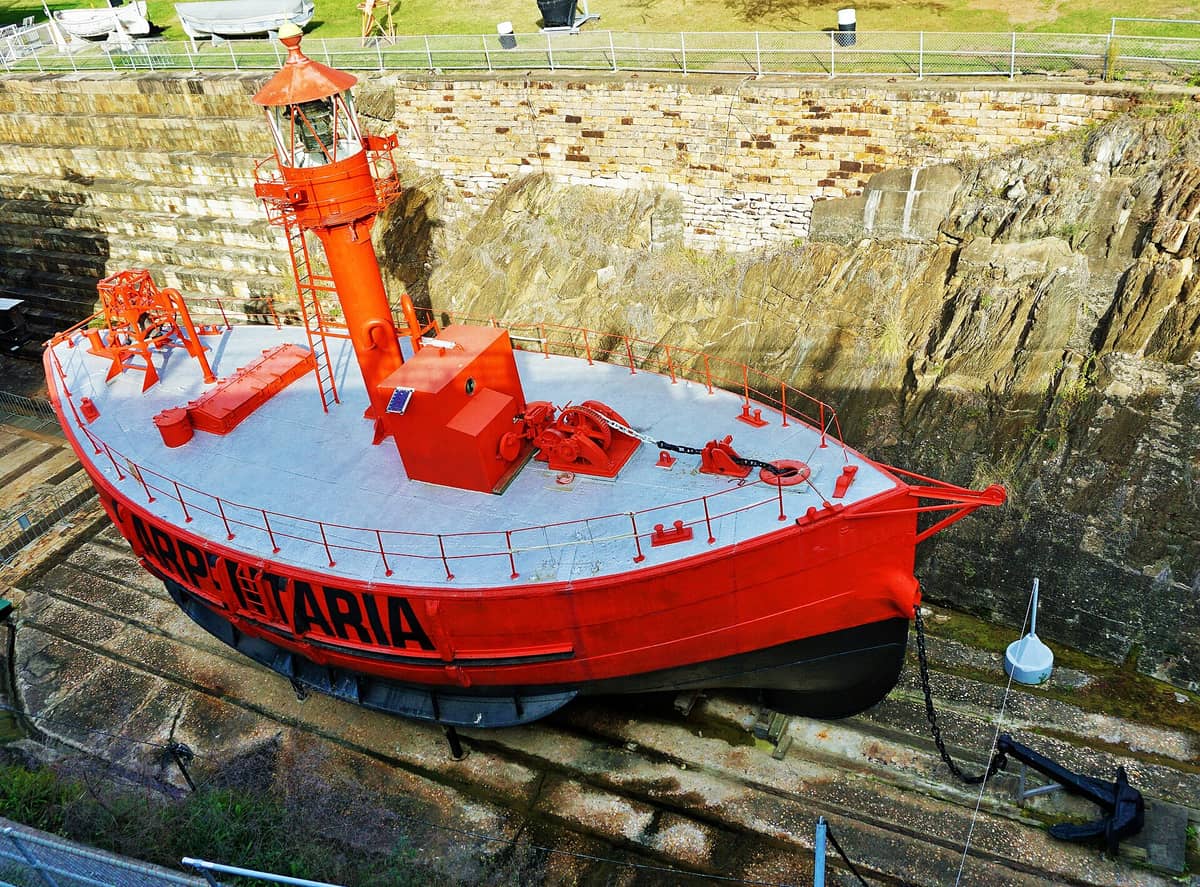
The dry dock at Queensland Maritime Museum is not a static display. It remains operational and periodically holds vessels undergoing conservation or repair work. When a vessel is in the dock, it becomes a spectacle in itself: the scale of the dock walls, the engineering required to flood and drain the chamber, and the exposed hull of whatever boat happens to be present all combine into something genuinely interesting that most museum visitors have never seen in a working context.
The outdoor precinct also holds a scattering of smaller heritage vessels, engines, and maritime equipment displayed under shelter or in the open air. On warmer days the sun is direct here, and the exposed metal surfaces heat up significantly. Comfortable footwear matters: the grounds include uneven surfaces, wooden decking, and grated walkways.
💡 Local tip
Wear closed-toe shoes. Sandals are uncomfortable on the grated deck surfaces aboard Diamantina, and the dry dock area involves some uneven ground.
Indoor Galleries and Permanent Collection
The indoor galleries cover Queensland's broader maritime history: early colonial shipping, river trade along the Brisbane River, pearling and fishing industries, passenger liners, and the critical role of sea freight to a geographically isolated colony. The presentation style is traditional rather than interactive, relying on artefacts, models, historic photographs, and interpretive panels.
For visitors expecting the kind of digital interactivity found at larger institutions, the indoor galleries may feel understated. That is an honest assessment. What they offer instead is density of genuine objects: navigational instruments, salvaged ironwork, ship models built to serious detail, and documents that carry the texture of real maritime commerce in colonial Queensland. The collection rewards patience and curiosity more than it rewards a quick walk-through.
The museum sits within walking distance of the broader South Bank Parklands, which means you can combine a visit here with an afternoon along the riverfront without significant extra effort.
How It Changes by Time of Day
Morning visits, particularly on weekdays, are quieter. The light on the river is softer before midday, and the dry dock area is easier to photograph without harsh overhead sun bleaching the detail out of the hull surfaces. School groups occasionally arrive mid-morning, especially during term time, which can compress the experience aboard Diamantina into a noisier, slower-moving queue through the lower decks.
Weekend afternoons bring a different energy: families with younger children, tourists combining the museum with a South Bank day, and the occasional cruise-ship visitor. The museum's compact size means it never feels truly overcrowded, but the outdoor areas do fill up on fine Saturday afternoons in the cooler months between May and September.
Photography is best done in the first two hours after opening on a clear day. Diamantina's port side faces east, catching direct morning light across the deck. By early afternoon the light flattens and the shadows inside the gun housings become harder to work with.
Getting There and Practical Planning
South Bank train station is the most straightforward option from the CBD, a short walk through South Bank Parklands to reach the museum entrance. The CityHopper and CityCat ferry services stop at nearby terminals, making it easy to arrive by river, which feels appropriately thematic. Bus stops at Mater Hill or South Bank cover other directions. For drivers, South Bank Parklands underground parking is approximately a five-minute walk from the museum entrance.
If you are planning a broader day in the area, the Gallery of Modern Art and the State Library of Queensland are both within comfortable walking distance, making the South Bank precinct easy to combine into a half-day cultural circuit.
For a wider sense of how to structure a day in this part of the city, the best museums in Brisbane guide covers how the Queensland Maritime Museum compares to other institutions across the city.
ℹ️ Good to know
Queensland does not observe daylight saving time. Brisbane operates on AEST (UTC+10) year-round, so opening hours remain consistent regardless of season.
Who Should Skip This (And Who Definitely Should Not)
Visitors looking for a high-tech, immersive experience with audio-visual theatrics will likely find the Queensland Maritime Museum underwhelming. The same goes for anyone with limited mobility who primarily wants to explore the vessels: access restrictions on Diamantina's lower decks and the exclusion of the dry dock and Penguin from accessible routes significantly reduce what is available.
It is, however, excellent for school-age children who respond well to being aboard a real warship rather than reading about one. Naval history enthusiasts, engineers interested in dry dock operations, and anyone who appreciates the specificity of a well-curated collection of original objects will get real value from the entry price. At A$18 for adults and A$8 for children, the cost sits at a reasonable level for what the museum delivers.
If Brisbane's broader heritage appeals to you, the Brisbane heritage and history guide provides useful context for how the maritime museum fits into the city's colonial and industrial past.
Insider Tips
- The dry dock is occasionally occupied by a vessel undergoing active conservation work. Check the museum's social media or call ahead if you want to see the dock in operation — it is not always guaranteed.
- Entry closes at 3:15 p.m., not 4:15 p.m. Arriving at 3:00 p.m. will get you a rushed experience. Aim for 10:00–10:30 a.m. for the most comfortable visit.
- HMAS Diamantina's lower decks involve steep, narrow ladders. If you or anyone in your group has difficulty with confined spaces or steep descents, assess the main deck first before committing to the full below-decks tour.
- Weekday mornings during school terms can bring large organised groups. If you prefer a quieter visit, weekends before noon or midweek afternoons (term time aside) tend to be calmer.
- Combine the museum with a walk across the Goodwill Bridge directly overhead for a useful perspective on the dry dock and vessel layout from above.
Who Is Queensland Maritime Museum For?
- Naval and military history enthusiasts who want to walk aboard a genuine WWII-era warship
- Families with school-age children who respond better to hands-on, real-scale exhibits than to panels and screens
- Engineers and maritime professionals interested in working dry dock infrastructure
- Travellers building a half-day South Bank cultural itinerary alongside GOMA or the State Library
- Budget-conscious visitors looking for substantive history content at a moderate entry price
Nearby Attractions
Other things to see while in South Bank:
- Fish Lane
Fish Lane is a compact but layered laneway in South Brisbane connecting the Cultural Centre precinct with West End. It packs street art, independent cafés, bars, and restaurants into a short stretch that rewards slow exploration at almost any hour.
- Gallery of Modern Art (GOMA)
The Gallery of Modern Art (GOMA) is Australia's largest gallery dedicated to modern and contemporary art, anchoring Brisbane's South Bank cultural precinct. General entry is free, the building itself is architecturally striking, and the rotating program of exhibitions consistently draws international attention.
- Kurilpa Bridge
Kurilpa Bridge is a free pedestrian and bicycle bridge crossing the Brisbane River between Kurilpa Point in South Brisbane and Tank Street in the CBD. Opened in 2009, it is one of the world's largest structures built on tensegrity principles, and it doubles as a solar energy generator. Whether you're crossing to reach the Gallery of Modern Art or simply looking for a river walk with architectural interest, the bridge earns a place in any South Bank itinerary.
- Nepalese Peace Pagoda
Standing three storeys tall in the heart of South Bank Parklands, the Nepalese Peace Pagoda is a remarkable piece of traditional Himalayan craftsmanship built from over 80 tonnes of hand-carved timber. Free to visit and open daily, it rewards curious travelers who slow down enough to take in the detail.
Planning a trip? Discover personalized activities with the Nomado app.