Pio Monte della Misericordia: Caravaggio in His Finest Hour
Founded in 1602 by seven Neapolitan nobles, Pio Monte della Misericordia is a working charitable institution, octagonal church, and small but exceptional art gallery on Via dei Tribunali. Its permanent centerpiece is Caravaggio's 'The Seven Works of Mercy', painted in 1607 and still hanging exactly where it was commissioned to hang.
Quick Facts
- Location
- Via dei Tribunali 253, Historic Centre, Naples
- Getting There
- Piazza Cavour Metro (Line 1), approx. 200m; buses C55 and C57 stop on Via dei Tribunali
- Time Needed
- 45–75 minutes
- Cost
- Paid entry covering church and gallery; verify current price at official site
- Best for
- Art lovers, Caravaggio enthusiasts, history travelers, quiet cultural escapes
- Official website
- piomontedellamisericordia.it/en
What Pio Monte della Misericordia Actually Is
Pio Monte della Misericordia is not a museum that happens to have a church attached. It is, first and foremost, a charitable institution that has been continuously operating since 1602. The seven Neapolitan noblemen who founded it were tasked with performing acts of mercy toward the poor, the sick, the imprisoned, and the dead. The church was built to serve that mission, and the art collected over four centuries exists because wealthy patrons donated works in exchange for spiritual credit. That context changes how you read everything inside.
The building you enter today was substantially rebuilt between 1658 and 1678 by architect Francesco Antonio Picchiatti, who gave it an unusual octagonal plan with seven chapels radiating from the central space and a dome above. Each chapel corresponds to one of the seven works of mercy: feeding the hungry, clothing the naked, visiting the sick, and so on. The geometry is intentional theology, and once you understand that, the spatial logic of the building becomes legible in a way it otherwise would not.
💡 Local tip
Cover your shoulders and knees before entering. The church is an active place of worship and dress code is enforced. A scarf or light layer in your bag solves this in seconds.
The Caravaggio: Why This Painting Stops People Cold
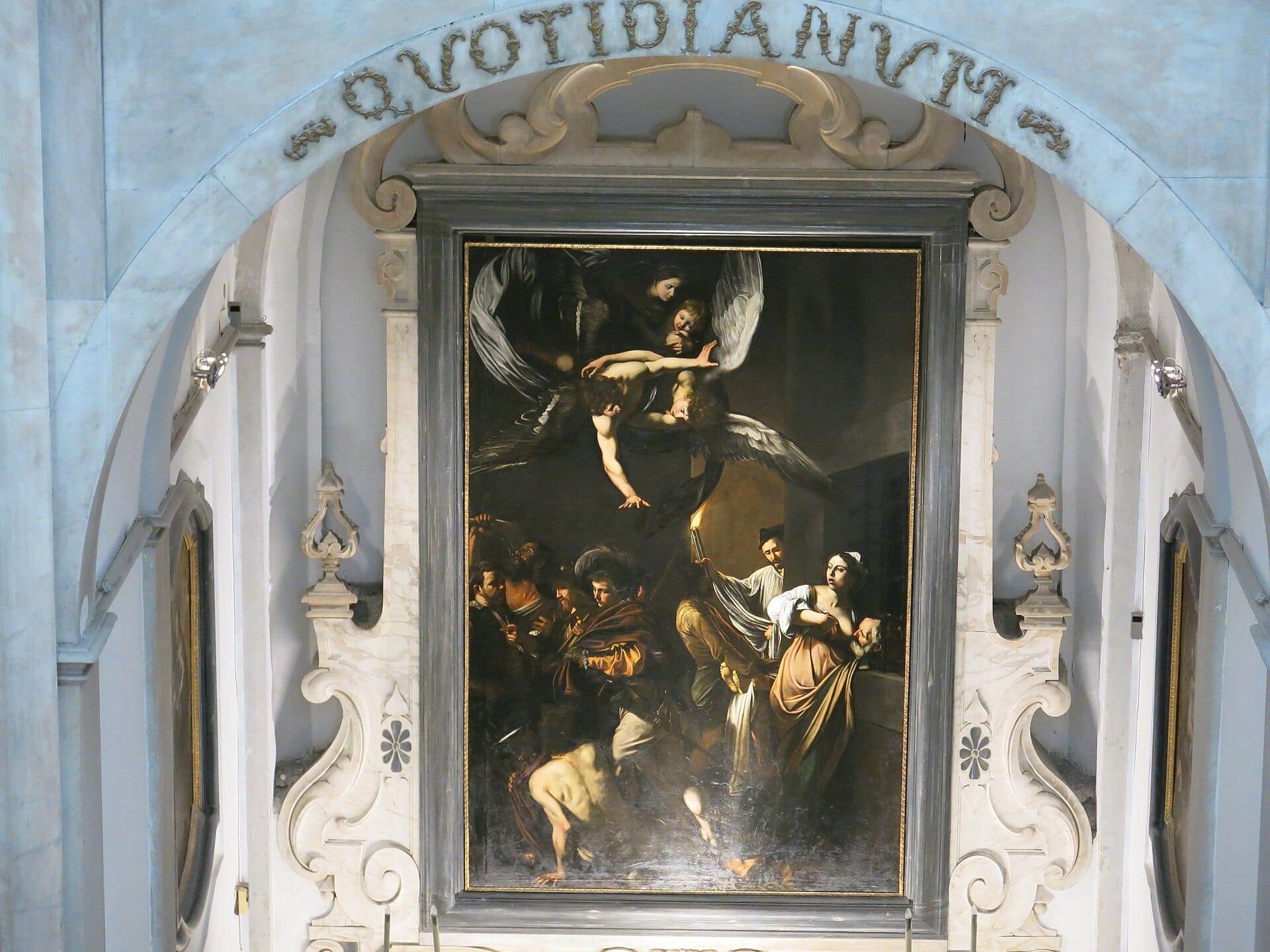
Caravaggio arrived in Naples in 1606 as a fugitive, having killed a man in Rome during a brawl. The governors of Pio Monte commissioned 'The Seven Works of Mercy' almost immediately after his arrival, and he completed it in 1607. It is a single large canvas, roughly 3.9 by 2.6 metres, painted to hang above the high altar, which is precisely where it still hangs today. That fact deserves to sit with you for a moment: this painting has not moved in over 400 years.
What Caravaggio did with the commission was structurally audacious. Rather than paint seven separate allegories, he collapsed all seven works of mercy into one compressed street scene set in a Neapolitan vicolo at night. You see a man drinking from a prisoner's breast (a reference to the Roman story of Cimon and Pero), a man being buried, a pilgrim being sheltered, the naked being clothed, all tumbling together in the foreground while the Virgin and Child float above the chaos held by angels. The lighting is Caravaggio at his most controlled: figures emerge from near-total darkness as if caught by a lantern.
Standing directly beneath it, you feel the scale in a way that reproductions entirely miss. The figures are nearly life-size. The darkness around them is actual darkness, not photographic compression. Budget time to sit on the pew in front of the altar and simply look. Most visitors spend three minutes and move on. The painting rewards ten.
For more context on where this painting sits within Caravaggio's Neapolitan period, the Naples Caravaggio guide covers the other key works scattered across the city, including pieces at the Museo di Capodimonte.
Tickets & tours
Live prices and dates from our booking partner. If you book, we may earn a commission at no extra cost to you.
Capodimonte National Gallery tour with an art historian
From 220 €Instant confirmationFree cancellationSmall Group Tour of Capodimonte Museum in Naples
From 39 €Instant confirmationFree cancellationTickets for Citta della Scienza in Naples
From 10 €Instant confirmationCapodimonte Museum admission tickets
From 20 €Instant confirmation
The Upstairs Gallery: Smaller than You Expect, Better than You Expect
The picture gallery occupying the upper floor of the palazzo is accessed via a staircase inside the building. It holds around 130 paintings collected over four centuries through donations from noble Neapolitan families. The collection includes works by Luca Giordano, Jusepe de Ribera, Francesco De Mura, and Fabrizio Santafede, among others. It is not a comprehensive survey of Italian painting, but it is a coherent document of what wealthy Neapolitan patrons valued from the 17th through the 19th century.
The rooms are small and the labeling is sometimes sparse, so this rewards visitors who arrive with some prior knowledge of the Neapolitan Baroque tradition. That said, even without that background, the Ribera works in particular are arresting: rough-textured, brutally lit, deeply skeptical of idealization. If you have already visited the Naples National Archaeological Museum earlier in the day, the contrast between ancient idealism and Counter-Reformation grit makes the gallery feel like the second chapter of a coherent story.
When to Go and What the Visit Actually Feels Like
The institution is open Monday through Saturday from 9:00 to 18:00, and Sunday from 9:00 to 14:30 (verify current hours on official site). Mornings on weekdays are the quietest. Via dei Tribunali is always loud, with scooters, market vendors, and pedestrian traffic creating a constant low roar, but the moment you step through the entrance portal the noise drops sharply. The courtyard and church interior are genuinely calm even when the street outside is chaotic.
The light inside the church is low and warm. On overcast days, the Caravaggio looks closer to how it would have looked by candlelight in 1607. On bright mornings when sunlight angles through the dome, the contrast with the shadowed chapels is more dramatic. Neither condition is wrong, just different. Photographers working with natural light should note that the painting is set back in shadow by design, so a wide aperture and patience are more useful than a flash.
The gallery upstairs is climate-controlled and tends to be several degrees cooler than the church, which matters in July and August when central Naples can feel genuinely oppressive. In summer, the combined church-and-gallery visit offers about an hour of air-conditioned relief in a neighborhood that has very little of it.
ℹ️ Good to know
The building is on Via dei Tribunali 253, facing Piazza Riario Sforza near the Duomo. From Piazza Cavour metro station (Line 1), walk south on Via Duomo and turn right onto Via dei Tribunali. The walk takes under five minutes.
How It Fits Into the Historic Centre
Via dei Tribunali is one of the three main east-west decumani of the ancient Greek and Roman city of Neapolis, and it remains one of the densest streets in the historic centre. Pio Monte sits about 100 metres west of the Cathedral of Naples (Duomo), which means a sensible routing combines both in a single morning.
A few minutes further west along Via dei Tribunali sits Cappella Sansevero, home to the Veiled Christ sculpture. That combination of Pio Monte, the Duomo, and Cappella Sansevero constitutes what is arguably the single densest concentration of major art in the entire city. All three can be done in a half-day if you move with intent, or stretched into a full day if you stop for lunch on the street.
The surrounding Centro Storico rewards slow walking. San Gregorio Armeno, the street famous for its nativity craftsmen, is two blocks south. The street food on Via dei Tribunali itself is worth treating as a category: fried pizza, cuoppo of mixed fritti, and sfogliatelle from nearby bakeries are all within a three-minute radius of the entrance.
Who This Is For, and Who Might Find It Underwhelming
Pio Monte is a focused, serious stop. The main draw is a single painting and a mid-size collection of Baroque work. Visitors who arrive primarily for the Caravaggio and are prepared to give it genuine attention tend to leave describing it as a highlight of their entire Italy trip. Visitors who arrive expecting a major museum experience with multilingual interactive displays, comprehensive labeling, and café facilities will find the reality more modest.
Families with young children may struggle with the intimacy of the space and the absence of child-oriented programming. Visitors with limited mobility should be aware that the upstairs gallery involves a staircase, and no specific accessibility information has been confirmed for the upper floors. The church itself is at street level.
If your time in Naples is very short and you are prioritizing breadth over depth, it is honest to say that Pio Monte is not the place to rush. The Caravaggio is worth your full attention or none of it. That said, for anyone with a genuine interest in painting, it belongs near the top of any Naples itinerary, not near the bottom.
If you are trying to structure your time across multiple days, the 3-day Naples itinerary places Pio Monte on day one alongside the historic centre's other major stops, which is the most efficient approach.
Insider Tips
- Buy your ticket and go directly to the upstairs gallery first. By the time you come back down to the church, any small tour groups that arrived with you will have moved on, and you will have the Caravaggio largely to yourself.
- The painting is positioned high above the altar and lit by the dome above rather than artificial light. Bring or borrow a small pair of binoculars if you want to read the upper register of figures clearly, particularly the two angels holding the Virgin.
- The institution still operates charitable programs today. There is often a small explanatory panel near the entrance detailing current initiatives. Reading it before you enter the church gives the artwork a different weight.
- Via dei Tribunali immediately outside fills with lunch traffic between 12:30 and 14:00. If you are visiting around midday, entering the institution is a good way to avoid the peak pedestrian chaos on the street and time your exit for when things calm down.
- The church occasionally hosts evening concerts and special events. Check the official website before your visit, as these can either enrich or complicate access to the painting during your planned visit.
Who Is Pio Monte della Misericordia For?
- Art travelers with a specific interest in Caravaggio or the Neapolitan Baroque
- History-focused visitors exploring the layered identity of the Centro Storico
- Repeat Naples visitors who have covered the major sites and want depth over breadth
- Photographers interested in chiaroscuro and low-light interior work
- Anyone building a half-day art route through Via dei Tribunali
Nearby Attractions
Other things to see while in Centro Storico:
- Cappella Sansevero
Cappella Sansevero is a small baroque chapel in Naples' historic centre that contains one of the most technically staggering sculptures in the world: the Veiled Christ, a life-sized marble figure so realistically carved it appears draped in real fabric. The chapel is compact, deeply atmospheric, and almost certainly unlike anything else you will see in Italy.
- Naples Cathedral (Duomo di Napoli)
The Cattedrale di Santa Maria Assunta, known to locals simply as the Duomo, is Naples' most historically layered religious site. Built over Greek temples, Roman structures, and early Christian basilicas, it has been the spiritual center of the city for seven centuries. It is also where the famous liquefaction of San Gennaro's blood draws thousands of pilgrims three times a year.
- Naples Botanical Garden (Orto Botanico)
The Orto Botanico di Napoli is one of southern Italy's most significant botanical institutions, covering 12 hectares in the heart of Naples with around 9,000 plant species. Free to enter and largely overlooked by tourists, it offers a genuinely quiet counterpoint to the city's sensory intensity.
- Catacombs of San Gennaro
Carved into the volcanic tuff beneath Rione Sanità, the Catacombs of San Gennaro form one of Southern Italy's most significant early Christian sites. Spanning roughly 5,600 square metres across two levels, they preserve underground basilicas, bishop tombs, and some of the oldest Christian frescoes in the Mediterranean world.
Planning a trip? Discover personalized activities with the Nomado app.