Piazza Bellini: Naples' Most Layered Square
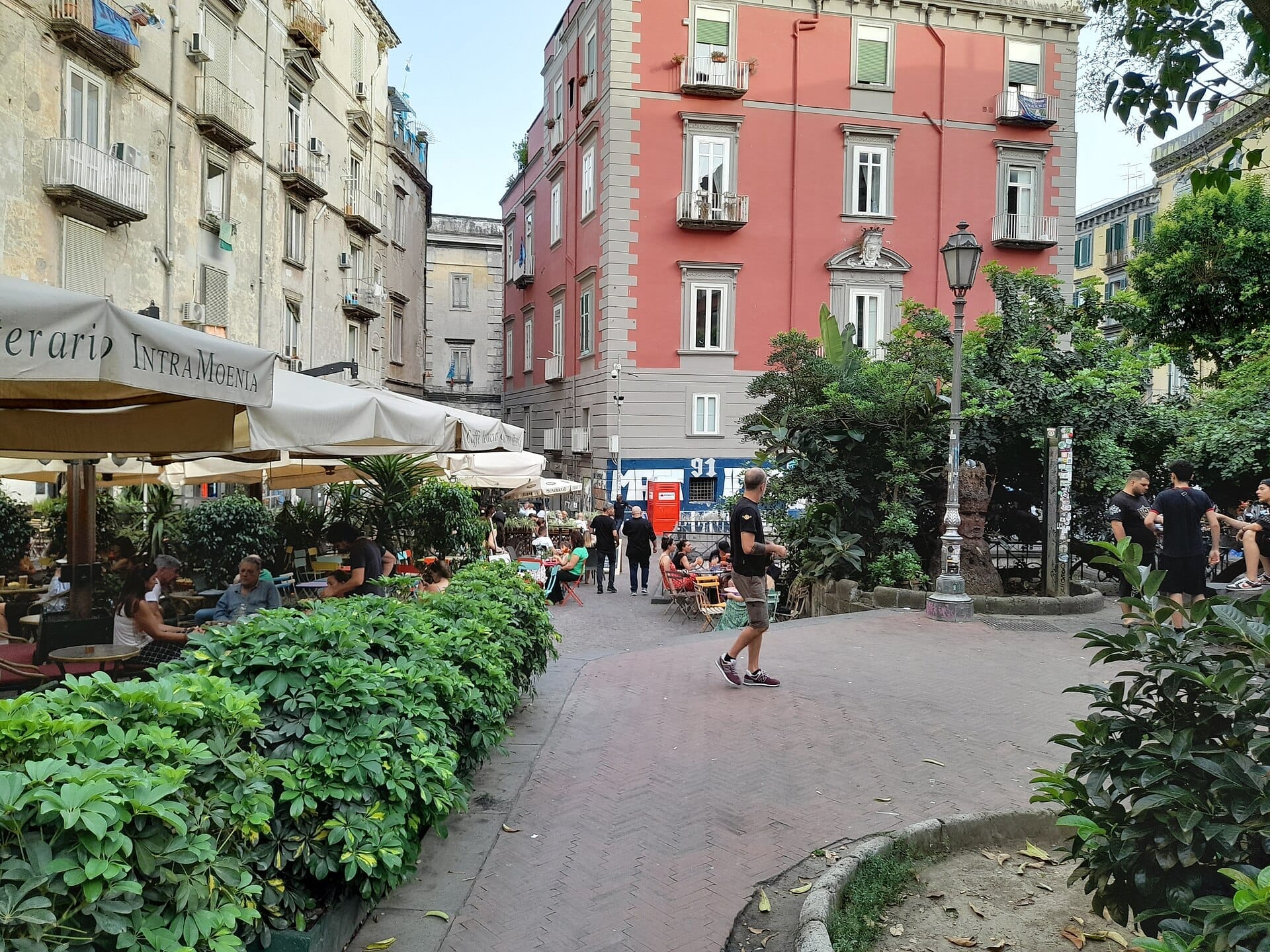
Piazza Bellini occupies a singular spot in Naples' historic center, built directly above the ruins of ancient Greek city walls. By day it draws students and academics from nearby institutions; by evening it transforms into one of the most atmospheric places in the city to sit outdoors with a drink. Admission is free, the history runs 2,500 years deep, and the surrounding streets connect directly to the city's most significant cultural landmarks.
Quick Facts
- Location
- Piazza Vincenzo Bellini, Via S.M. di Costantinopoli, Centro Storico, Naples
- Getting There
- Metro Line 1, Dante station (5 min walk); multiple ANM bus routes along Via dei Tribunali
- Time Needed
- 30–60 minutes to explore the square; longer if you linger at a café or browse antique shops
- Cost
- Free (public square, open 24/7)
- Best for
- History lovers, architecture, evening atmosphere, students, slow travelers
What Piazza Bellini Actually Is
Piazza Bellini is a mid-sized public square in Naples' UNESCO-listed historic center, positioned at one of the most archaeologically significant street intersections in Southern Italy. The square itself is pleasant but not monumental in scale. What makes it extraordinary is what lies beneath it: visible sections of the ancient Greek defensive walls of Neapolis, dating to the fourth century BCE, exposed in sunken garden beds around the central statue. You can lean over the railing and look directly at stonework that predates the Roman Empire.
The statue at the center is of composer Vincenzo Bellini, the Sicilian opera master behind 'La Sonnambula' and 'Norma'. Sculptor Alfonso Bazzico completed it in 1886 (Bazzico lived 1825–1901). Bellini is depicted in a relaxed, almost contemplative pose, and the surrounding piazza has absorbed something of that spirit. This is not a grand ceremonial space. It is a square where people genuinely gather, sit, argue, study, and drink coffee.
ℹ️ Good to know
The Greek walls visible in the sunken enclosures around the piazza are original fortification remnants from ancient Neapolis. They are not reconstructions. Look for the large tufa stone blocks — the greenish-grey color is characteristic of the volcanic stone quarried near Naples in antiquity.
The Historical Layers Beneath Your Feet
Naples is one of the oldest continuously inhabited cities in Europe, and Piazza Bellini is one of the places where that age becomes tangible rather than abstract. The Greek colony of Neapolis, established in the fifth century BCE, was defended by substantial stone walls, and portions of those walls survived underground for millennia. Urban development in the seventeenth century shaped the piazza into its current form, but the archaeological remains were only properly exposed and displayed in the twentieth century.
The surrounding streets reinforce the historical density. Via dei Tribunali, which forms the ancient Decumanus Maximus — the main east-west artery of Greek and Roman Neapolis — lies just a short walk south. The National Archaeological Museum is roughly ten minutes on foot to the northwest, making this corner of the centro storico an unusually coherent archaeological and cultural zone. A piazza existed at this site by the seventeenth century, meaning the square has functioned as a gathering place for over four hundred years.
The institutional context matters too. The Music Conservatory of San Pietro a Majella, one of Italy's oldest and most prestigious music schools, sits close by. The Academy of Fine Arts is nearby. These are active institutions, not museums, and their students fill the piazza's cafés throughout the day. The energy here is genuinely academic and creative in a way that many tourist-facing squares in Naples are not. If you want to explore more of this district's depth, the Centro Storico rewards slow, exploratory walking.
Tickets & tours
Live prices and dates from our booking partner. If you book, we may earn a commission at no extra cost to you.
Origins and legends of Naples walking tour
From 28 €Instant confirmationFree cancellationGuided walking tour of Naples city and Naples underground
From 45 €Instant confirmationFree cancellationCaserta Royal Palace day-trip from Naples
From 100 €Instant confirmationFree cancellationSafe and Convenient 24-7 Luggage Storage in Naples
From 6 €Instant confirmationFree cancellation
How the Square Changes Through the Day
Mornings at Piazza Bellini are calm and local. The cafés on the perimeter open early, and the clientele at that hour is mostly residents and students picking up espresso before class or work. The light arrives from the east, casting long shadows across the piazza's stone surface and catching the tufa wall ruins at an angle that makes the textures particularly visible. It is a good time to photograph the ancient walls without crowds pressing in.
Midday through mid-afternoon, the square fills with the lunch-hour rhythm of the neighborhood. The surrounding streets — Via Costantinopoli in particular — carry a steady flow of pedestrians moving between the centro storico and the museum quarter. Antique shops and small galleries on the piazza's flanks are open, and this is the most practical window to browse them. The air in summer carries the smell of stone heated by the sun, and the relative shade of the café terraces becomes genuinely valuable.
Evenings are when Piazza Bellini shifts its character most dramatically. From around seven in the evening onward, outdoor tables fill quickly, and by nine the square has the density of a social event rather than a café stop. The crowd skews young — university students, young professionals, foreign visitors staying in the centro storico. Conversation competes with music drifting from open doors. It is one of the more reliably lively outdoor evening spots in central Naples without being a tourist-only environment.
💡 Local tip
If you want a table at one of the main café terraces on a weekend evening, aim to arrive before 8pm. After that point, seating becomes competitive and service slows considerably. Midweek evenings are substantially more relaxed.
The Architecture and Surrounding Palaces
The piazza is framed by significant historic palaces: Palazzo Firrao-Bisingano, Palazzo Castriota Scanderbeg, and the Palazzo dei Principi di Conca. These are not open to tourists as museums, but their facades define the character of the square. The architecture is layered baroque over earlier foundations, with the kind of ornamental stonework that Naples does particularly well — heavy, confident, occasionally asymmetric, weathered but not neglected.
Photography here rewards patience. The combination of the statue, the sunken archaeological enclosures, the palace facades, and the café furniture creates compositions that change substantially depending on angle and time of day. The late-afternoon golden hour catches the stone facades well, though the square's orientation means direct light on the Bellini statue is strongest in the morning. Wide-angle lenses work better than telephoto for capturing the spatial relationship between the archaeological remains and the surrounding buildings.
Getting There and Practical Notes
The most direct approach by metro is Metro Line 1 to Dante station, followed by a five-minute walk east along Via Costantinopoli. Multiple ANM bus routes run along Via dei Tribunali, which intersects with the streets approaching the piazza. For orientation within the wider historic center, the getting around Naples guide explains the metro, bus, and funicular network in practical terms.
The piazza is a public outdoor space with no admission charge and no restricted hours. The surrounding streets are pedestrian-priority and manageable on foot. The surface is largely level stone paving, which is generally walkable with mobility devices, though the sunken archaeological enclosures themselves are not accessible by design. The surrounding antique shops and galleries typically observe afternoon closing hours between 1pm and 4pm, so plan browsing accordingly.
Weather affects the experience more than at enclosed attractions. In summer, the stone piazza retains heat, and midday visits between June and August can be uncomfortable without shade. The café terraces offer partial cover. In winter, the square is notably quieter in the evenings. Light rain gives the stone a reflective quality that photographers often find appealing, but the café terraces close their outdoor sections during heavier precipitation.
⚠️ What to skip
Pickpocketing can occur in crowded evening conditions anywhere in the centro storico. Keep bags closed and in front of you when the piazza is at its busiest. This is standard urban awareness rather than cause for alarm — the square itself is well-trafficked and generally safe.
What to Do Nearby
Piazza Bellini's position makes it a natural staging point for several significant nearby attractions. The Cappella Sansevero, home to the extraordinary Veiled Christ sculpture, is roughly ten minutes on foot to the southeast. The Naples Underground entrance on Via dei Tribunali is within easy walking distance, offering a completely different perspective on the city's layered history — this time from below ground rather than at street level.
Via Costantinopoli, which borders the piazza, is worth walking slowly in both directions. It carries a concentration of antiquarian booksellers, print dealers, and small galleries that have no equivalent elsewhere in Naples. The street connects visually and physically to the National Archaeological Museum at its northern end, making a logical half-day circuit: the museum for the city's collected antiquities, then Piazza Bellini to see those same ancient walls still standing in situ. For a broader view of historic Naples, San Gregorio Armeno — the famous street of nativity craftsmen — is also accessible on foot from here.
Honest Assessment: Is It Worth Your Time?
Piazza Bellini is not Naples' most dramatic attraction. It will not compete with the National Archaeological Museum or the Cappella Sansevero for visual impact. Travelers who need concentrated highlights in limited time may find it feels like a pleasant stop rather than a destination in its own right.
Where it earns its place is in the quality of the experience it offers for free, and in what it adds to a day spent exploring the centro storico on foot. Standing over 2,500-year-old Greek fortification walls while drinking coffee at a student café in one of Europe's oldest cities is an experience that is genuinely difficult to replicate. The combination of archaeology, active social life, surrounding architecture, and proximity to other major sites makes Piazza Bellini a strong choice for anyone building a walking route through historic Naples rather than moving between isolated set-piece attractions.
Insider Tips
- The sunken Greek wall enclosures are best photographed in the morning when low-angle eastern light brings out the texture of the tufa blocks. By midday the light flattens and the detail is harder to capture.
- Via Costantinopoli's antique print and book dealers are rarely crowded and frequently have genuinely old material at reasonable prices. The window displays alone are worth a slow look even if you're not buying.
- The Music Conservatory of San Pietro a Majella occasionally hosts public concerts and open rehearsals. Check their schedule if you're in Naples for several days — hearing student ensembles in a historic building a short walk from the piazza is worth the effort.
- If the main café terraces are full on a weekend evening, try the smaller bars on the side streets immediately off the piazza. They serve the same drinks at lower prices and with considerably less waiting.
- Combine Piazza Bellini with a visit to the National Archaeological Museum in the same half-day. The walk between them along Via Costantinopoli takes about ten minutes and passes some of the best independent bookshops in central Naples.
Who Is Piazza Bellini For?
- Travelers building a walking circuit through Naples' historic center who want a natural rest point with genuine historical context
- Architecture and archaeology enthusiasts interested in seeing ancient Greek city walls visible at street level
- Evening visitors looking for an outdoor social atmosphere that mixes locals and visitors without being exclusively tourist-facing
- Students of music history or fine arts, given the proximity of the Conservatory of San Pietro a Majella and the Academy of Fine Arts
- Slow travelers and photographers who want texture and layered atmosphere rather than set-piece landmarks
Nearby Attractions
Other things to see while in Centro Storico:
- Cappella Sansevero
Cappella Sansevero is a small baroque chapel in Naples' historic centre that contains one of the most technically staggering sculptures in the world: the Veiled Christ, a life-sized marble figure so realistically carved it appears draped in real fabric. The chapel is compact, deeply atmospheric, and almost certainly unlike anything else you will see in Italy.
- Naples Cathedral (Duomo di Napoli)
The Cattedrale di Santa Maria Assunta, known to locals simply as the Duomo, is Naples' most historically layered religious site. Built over Greek temples, Roman structures, and early Christian basilicas, it has been the spiritual center of the city for seven centuries. It is also where the famous liquefaction of San Gennaro's blood draws thousands of pilgrims three times a year.
- Naples Botanical Garden (Orto Botanico)
The Orto Botanico di Napoli is one of southern Italy's most significant botanical institutions, covering 12 hectares in the heart of Naples with around 9,000 plant species. Free to enter and largely overlooked by tourists, it offers a genuinely quiet counterpoint to the city's sensory intensity.
- Catacombs of San Gennaro
Carved into the volcanic tuff beneath Rione Sanità, the Catacombs of San Gennaro form one of Southern Italy's most significant early Christian sites. Spanning roughly 5,600 square metres across two levels, they preserve underground basilicas, bishop tombs, and some of the oldest Christian frescoes in the Mediterranean world.
Planning a trip? Discover personalized activities with the Nomado app.