Phra Nang Cave & Princess Shrine: Railay's Sacred Sea-Spirit Sanctuary
Tucked into the limestone cliffs at the southern tip of Railay Peninsula, Phra Nang Cave holds a shrine to a revered sea-princess spirit, surrounded by hundreds of carved wooden offerings left by local fishermen. The cave sits steps from one of Krabi's most photographed beaches, making it easy to combine a cultural visit with a morning swim or a sunset sit on the sand.
Quick Facts
- Location
- Southern end of Railay Peninsula, Mueang Krabi District, Krabi Province, Thailand
- Getting There
- No road access. Take a longtail boat to Railay from Ao Nang or Krabi Town pier, then walk to the beach's eastern end. Some boats require wading ashore.
- Time Needed
- 30–60 minutes at the cave and shrine; extend with beach time
- Cost
- Free (no admission). Longtail boat fares vary by departure point and operator — verify locally.
- Best for
- Cultural curiosity, photography, beach visits, spiritual interest, and combining with a Railay day trip
What Is Phra Nang Cave?
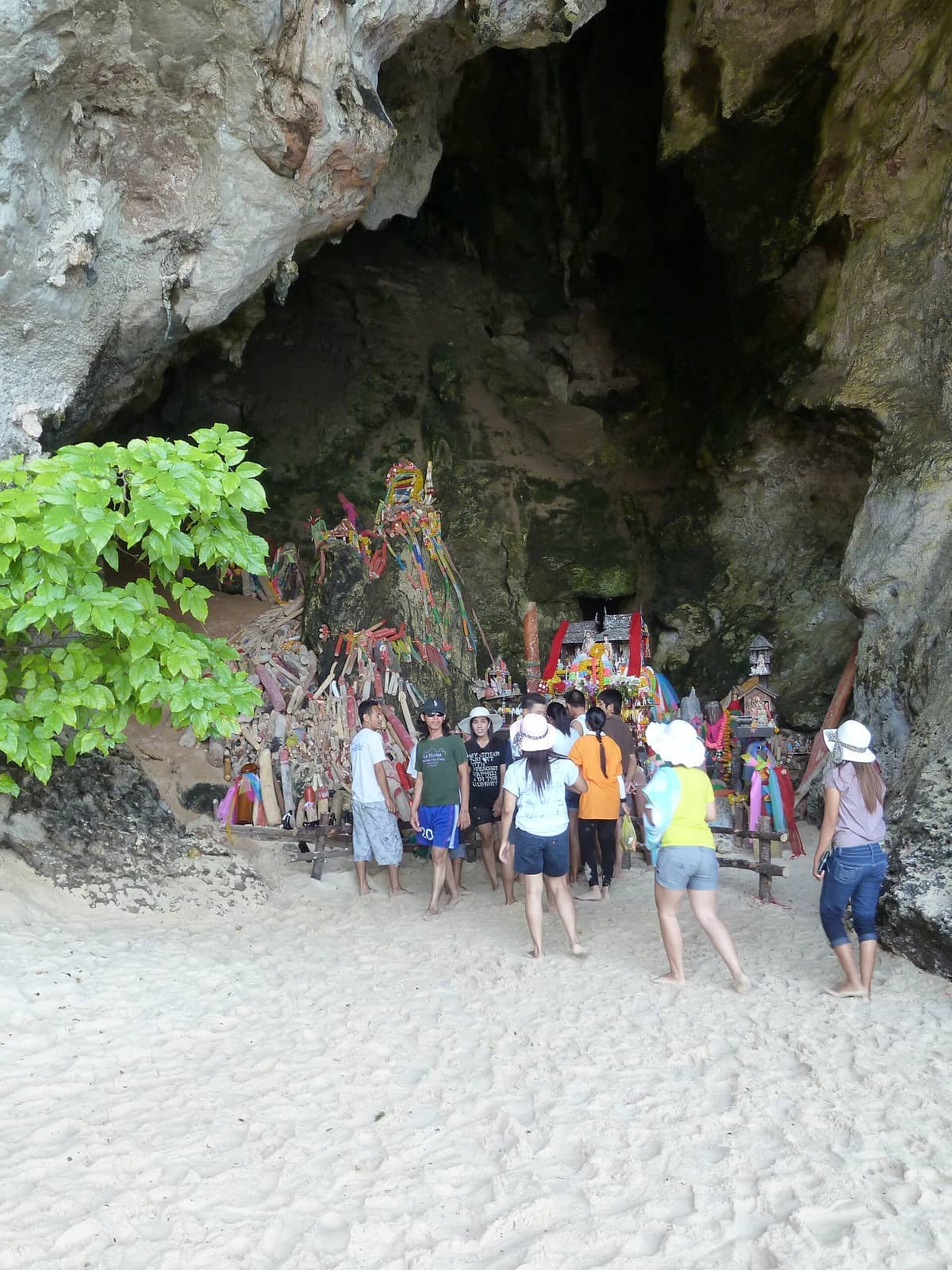
Phra Nang Cave, known in Thai as ถ้ำพระนาง (Tham Phra Nang Nok), is a natural limestone cavern at the southern end of Phra Nang Beach on Railay Peninsula. Inside and around its entrance, fishermen and devotees have accumulated an extraordinary collection of carved wooden phalluses, offerings of flowers, incense sticks, and small figurines, all dedicated to Phra Nang, a sea-princess spirit believed to protect those who work the surrounding waters. For travelers arriving at Railay for the beach, the cave adds an unexpected layer of lived local culture to what might otherwise feel like a purely scenic stop.
The site carries no ticket booth, no formal opening hours, and no rope-off zone. You simply walk to it along the sand. That openness is part of what makes it unusual: a genuinely active religious site, maintained by the fishing community, sitting beside one of Krabi Province's most-visited beaches.
ℹ️ Good to know
Phra Nang Beach and the cave are free to enter. Boat fares to reach Railay are the main cost — confirm current prices with longtail operators at Ao Nang Beach or Krabi Town before departure, as fares vary by time of day and season.
Getting There: Boats, Wading, and the Walk In
Railay Peninsula is surrounded by water on three sides and backed by sheer limestone cliffs, so there is no road connection to the mainland. Every visitor arrives by longtail boat. The most common departure points are Ao Nang Beach and the pier in Krabi Town, with boats running regularly during daylight hours. From Ao Nang, the crossing typically takes around 15 to 20 minutes.
Most boats land at West Railay Beach, from where you walk east across the narrow peninsula to reach Phra Nang Beach. The walk takes roughly 10 minutes on a flat, shaded path. Some operators run boats directly to Phra Nang Beach, which saves time but may require wading through shallow water to reach the shore — sandals you can get wet are worth wearing. For a broader sense of how to plan a day on the peninsula, the West Railay Beach guide covers landing logistics and what to expect on arrival.
💡 Local tip
Wear water-friendly footwear. Longtail boats often pull up in shallow water, and you may need to step out before reaching dry sand. Flip-flops that won't float away are the practical choice.
Tickets & tours
Live prices and dates from our booking partner. If you book, we may earn a commission at no extra cost to you.
Jurassic Jungle Kayak and Phra Nang Cave Beach Tour from Krabi
From 742 €Instant confirmationFree cancellationEvening Thai cookery class with chef Ya in Ao Nang
From 36 €Instant confirmationFree cancellationPrivate Longtail Boat Island Hopping Tour from Ao Nang
From 132 €Instant confirmationFree cancellationFull-day Four Islands and Emerald Cave tour
From 42 €Instant confirmationFree cancellation
The Shrine Itself: Offerings, Atmosphere, and What You'll Actually See
The cave entrance is shaded by the overhanging cliff face, and the air inside is noticeably cooler and faintly smoky from incense burned regularly by devotees. Your eyes adjust slowly from the bright beach to the interior gloom. As they do, the scale of the offerings becomes clear: the carved wooden pieces range from small figurines to objects the size of a forearm, all left as petitions and thanks to the Phra Nang spirit.
The shrine is considered an active place of worship, not a museum display. Fishermen from communities around Krabi Province stop here before heading out to sea. You may find fresh flowers, still-burning incense sticks, and small cups of water or fruit left that morning. Treating the space with the same respect you would bring to any working temple — speaking quietly, not handling offerings, not posing irreverently for photos — is simply good conduct.
The cave's limestone walls are deeply textured, and stalactites form from the ceiling above the shrine. Natural light filters in from the opening but fades quickly into the interior. A torch or the flashlight on your phone allows you to see deeper into the cave, though most visitors spend the majority of their time near the entrance where the offerings are concentrated.
How the Experience Changes by Time of Day
Morning visits, roughly between 8 and 10 a.m., offer the best combination of light and relative quiet. The cliff face catches early light at an angle that makes the limestone texture glow, and the beach in front of the cave has fewer people. Local fishermen are more likely to be visiting the shrine at this hour, which gives the site a grounded, everyday quality that contrasts sharply with the tourist traffic that arrives later.
By mid-morning, Phra Nang Beach becomes one of the most crowded spots on Railay. Groups from island-hopping tours and longtail charters arrive in clusters. The cave area is small enough that even moderate crowds can feel tight. If your priority is photographing the shrine without other visitors in the frame, aim for the first boat of the day from Ao Nang.
Late afternoon sees the crowds thin again as day-trippers return to their boats. The cliffs cast long shadows across the beach by around 4 p.m., and the cave's interior becomes darker. The trade-off is that the beach itself looks spectacular in the softer light, and if you have the flexibility to stay on Railay overnight, an early-evening visit to the shrine is noticeably more contemplative than midday.
💡 Local tip
Photography inside the cave is low-light work. A phone with a capable night mode handles it reasonably well, but avoid using flash directly on the offerings or toward other visitors. The cave entrance, with the bright beach framed behind you, makes a strong natural composition without any extra equipment.
Cultural and Historical Context
The Phra Nang spirit is associated with a princess who, according to local legend, drowned near the peninsula long ago and whose presence now protects the sea and those who work it. The tradition of leaving carved wooden offerings at the cave is specific to this site and reflects a form of animist belief that coexists alongside Buddhism throughout southern Thailand. No verified historical date for the shrine's origin could be found in available sources, and the legend itself exists in several versions depending on who is telling it.
What is clear is that this is not a reconstructed folklore attraction. The fishermen who maintain it and the boat operators who circle the peninsula daily treat it as a functioning spiritual site. That authenticity distinguishes it from many of the region's other visitor draws. For travelers interested in how local communities interact with the sea and landscape around Railay, the Krabi hidden gems guide touches on other sites where that relationship is visible.
Combining the Cave With the Rest of Railay
Phra Nang Beach sits at the southern tip of the peninsula and works well as the anchor point for a half-day or full-day circuit of Railay. From the beach, you can walk back toward West Railay and East Railay Beach, or take on the steeper trail toward Railay Viewpoint for elevated perspectives across the peninsula and the Andaman Sea.
Rock climbers will already know that the cliffs above Phra Nang Beach are some of the most storied routes in Southeast Asia. Even if you are not climbing, watching experienced climbers ascend the vertical limestone while you sit on the sand below is a legitimate spectacle. The Railay rock climbing page has detail on routes, grades, and how to book a guide.
If you are organizing a full day around Railay, the Krabi 3-day itinerary shows how the peninsula fits into a broader schedule, including transfers from Ao Nang.
Practical Notes: Accessibility, Weather, and Who Should Think Twice
The path from West Railay to Phra Nang Beach is mostly flat and well-worn, but it passes through soft sand and involves some uneven ground near the cliff base. Wheelchair access is not established, and the boat landing itself requires navigating shallow water and a sloped sand bank. Visitors with significant mobility limitations should consider whether the boat transfer and beach terrain are manageable before making the trip.
Weather matters more here than at most attractions. During the southwest monsoon season, roughly May through October, seas between Ao Nang and Railay can become rough, and boat operators may cancel services on short notice. The beach is still striking in the shoulder months, but conditions are less predictable. If you are visiting between December and February, when Krabi Province is typically at its driest and calmest, the boat crossing and beach experience are at their most reliable.
⚠️ What to skip
Visitors who find religious or cultural symbolism relating to fertility or animist practice confronting may want to read up on the shrine's contents before visiting. The cave is an active devotional site, not a sanitized attraction, and the offerings reflect that directly.
Travelers who want a controlled, air-conditioned cultural experience, or who are making the boat trip purely for the beach and find the cave incidental, may feel the shrine is not enough on its own to justify the journey. It is most rewarding for visitors who go in curious and stay present, rather than those rushing through for a photo before heading back to the water.
Insider Tips
- Take the first longtail of the day from Ao Nang. Phra Nang Beach is empty or nearly so before 9 a.m., and the cave has a different quality without the midday crowd pressing around it.
- The lagoon trail between Railay East and Phra Nang Beach is often overlooked. Ask locally about access before attempting it — the route involves a short but steep rope-assisted climb and can be slippery after rain.
- Bring cash for the boat fare and any food or drinks on Railay. ATMs are limited and may run dry, and card payment is not reliable at the beach vendors.
- If you are staying overnight on Railay, visit the shrine in the early evening. Most day-trippers are gone by 5 p.m. and the light on the cliffs at that hour is worth having the camera out for.
- The cave is deeper than it first appears. A phone flashlight reveals formations and a sense of scale that you completely miss from the entrance. Take two or three minutes to walk in before you leave.
Who Is Phra Nang Cave & Princess Shrine For?
- Travelers curious about active local religious practice outside of formal temple settings
- Photographers who want limestone cliffs, turquoise water, and cultural texture in the same frame
- Beach visitors combining a cultural stop with a half-day on Phra Nang Beach
- Rock climbing spectators who want to watch climbers on the cliffs above the beach
- Anyone already spending time on Railay Peninsula who wants to understand the place beyond its scenery
Nearby Attractions
Other things to see while in Railay Peninsula:
- East Railay Beach
East Railay Beach is the main arrival point for longtail boats reaching the Railay Peninsula. It is not a swimming beach, but it is the first thing most visitors see — and understanding what it is, and what it is not, shapes the entire Railay experience.
- Phra Nang Beach
Phra Nang Beach sits at the southern tip of Railay Peninsula, hemmed in by sheer limestone cliffs and reachable from the mainland only by longtail boat, or on foot from Railay East. The roughly 450-metre stretch of pale sand, a sea cave shrine, and turquoise water make it one of Krabi Province's most visually striking beaches — though its reputation means it is rarely quiet during peak hours.
- Railay Lagoon
Railay Lagoon, also known as Princess Lagoon, is a secluded tidal pool carved into the limestone heart of the Railay peninsula. Reaching it requires a steep, rope-assisted scramble that most visitors never attempt, which is exactly why the reward feels so outsized for those who do.
- Railay Rock Climbing
Railay Peninsula is one of Southeast Asia's most striking climbing destinations, where sheer limestone karst towers rise directly from the Andaman Sea. Whether you've never touched a climbing wall or you're chasing multi-pitch routes above the ocean, the cliffs at Railay deliver a setting that's genuinely hard to match.
Planning a trip? Discover personalized activities with the Nomado app.