West Railay Beach: Krabi's Cliff-Framed Shore Worth the Boat Ride
West Railay Beach (หาดไร่เลย์ตะวันตก) sits on the Railay Peninsula in Krabi Province, cut off from the mainland by towering limestone karsts and reachable only by longtail boat. The result is a beach that feels genuinely removed from the rest of the coast — calmer, more concentrated, and defined by geology as much as by sand.
Quick Facts
- Location
- Railay Peninsula, Ao Nang Subdistrict, Mueang Krabi District, Krabi Province
- Getting There
- Longtail boat from Ao Nang (approx. 15 min); no road access due to limestone cliffs
- Time Needed
- 2–5 hours, or a full day if combining with Phra Nang Beach or Railay Viewpoint
- Cost
- Beach entry is free; longtail boat fare applies (verify current rates locally)
- Best for
- Scenery, swimming, photography, rock climbing, and couples
What Makes West Railay Beach Different
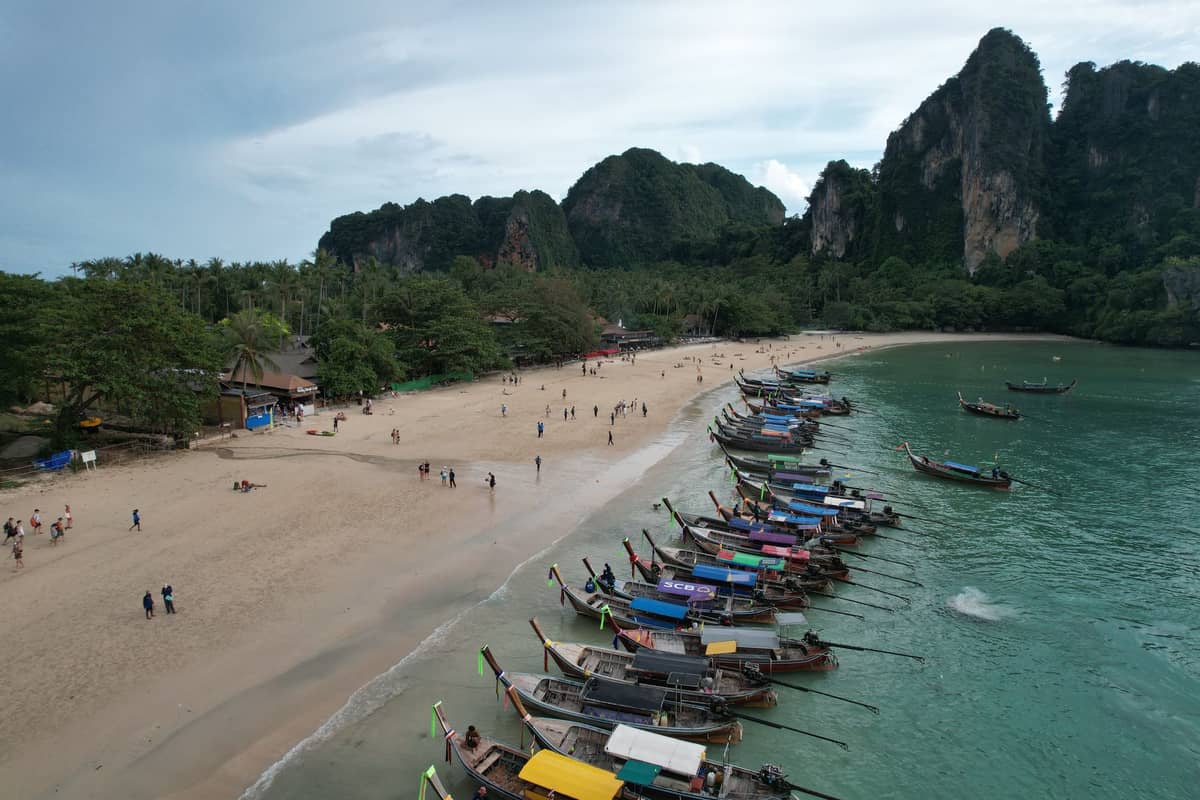
West Railay Beach is not simply a pretty strip of sand. It is a beach shaped by its own inaccessibility. The Railay Peninsula is surrounded on three sides by water and on the fourth by a wall of limestone karsts so sheer and dense that no road has ever been cut through them. Every visitor arrives by longtail boat, and that short crossing over warm turquoise water is itself a kind of threshold — the moment the cliffs close in around you and the noise of the highway disappears.
The beach faces west, which has two practical consequences worth knowing before you go. First, the water on this side is generally calmer than on the exposed eastern shore, making it the preferred side for swimming and paddling. Second, the sunsets here are exceptional: the low sun catches the face of the limestone towers and turns them from grey-white to deep amber in the space of twenty minutes.
The Railay Peninsula is compact enough that West Railay connects on foot to East Railay Beach in under ten minutes, and to Phra Nang Beach in about fifteen. That walkability makes West Railay a natural base for exploring the whole peninsula in a single day.
The Arrival: Longtail Boats and First Impressions
Longtail boats depart from the beach at Ao Nang Beach throughout the day. The crossing takes around 15 minutes and the boats run on a shared basis, departing when they have enough passengers rather than on a fixed timetable. In the morning and late afternoon, departures are frequent and waits are short. In the middle of the day, you may wait slightly longer. Verify current fares at the departure point, as prices can change seasonally.
💡 Local tip
Longtail boats beach directly on the sand. There are no jetties or gangways. You will need to wade through shallow water to reach the shore, so wear sandals you can get wet, or remove footwear before stepping off the boat.
The arrival itself is one of the more memorable moments. As the boat rounds the headland and the beach comes into full view, you are looking at a crescent of pale sand backed by resort structures and dense jungle, with vertical cliff faces rising several hundred meters on either side. The karst towers are not a backdrop — they are the frame, and they make the beach feel enclosed in a way that is dramatic rather than claustrophobic.
Accessibility note: the boat landing and beach surface may be difficult for visitors with limited mobility. There are no official wheelchair-accessible facilities at the beach, and the boat transfer itself requires stepping over the boat's side into shallow water. If this applies to your group, contact accommodation providers on Railay directly before booking, as some may have more practical information about managing the arrival.
Tickets & tours
Live prices and dates from our booking partner. If you book, we may earn a commission at no extra cost to you.
Island Hopping by Private Longtail Boat from Railay
From 130 €Instant confirmationFree cancellationDaily Cooking Class at Thai Cookery School in Krabi
From 42 €Instant confirmationFree cancellation7 islands speedboat excursion from Krabi
From 41 €Instant confirmationFree cancellationSpeedboat Tour to Hong Island Archipelago from Krabi
From 34 €Instant confirmationFree cancellation
How the Beach Changes Through the Day
Arriving before 9 am puts you on the beach ahead of most day-trippers, and the difference in atmosphere is significant. The sand is undisturbed, the water catches the early light at a low angle, and the cliff faces are still partially in shadow, creating strong contrasts for photography. The smell at this hour is clean salt air with a faint note of the jungle behind the beach — vegetation warmed by the rising sun.
By mid-morning, the beach fills steadily. By noon, sunloungers (available for a small fee from beach operators) are largely claimed, the water is active with swimmers and kayakers, and the sand between the waterline and the resort buildings becomes crowded. The heat between 11 am and 2 pm is intense: daytime highs in the dry season routinely reach 31 to 34 degrees Celsius, and the limestone cliffs limit any cooling breeze during the middle of the day. This is the least comfortable window to be sitting on the sand.
Late afternoon is the other peak window, but for different reasons. The crowds thin slightly as some day-trippers leave. The light shifts toward the golden hour, and the westward orientation of the beach means the sun sets directly in front of you rather than to the side. Around 30 minutes before sunset, photographers cluster near the waterline to capture the cliffs at maximum colour. If you are staying on Railay overnight, this is the version of the beach that makes the most lasting impression.
ℹ️ Good to know
West Railay Beach has no formal opening hours. The Thailand Tourism Directory lists Railay Beach as open daily, and beach access itself is free. The beach is effectively available from first light, though facilities and boats operate on their own schedules.
The Limestone Setting: Context and Character
The karst landscape surrounding Railay is part of the same geological formation that defines much of coastal Krabi Province. These towers of marine limestone were formed over hundreds of millions of years from accumulated coral and shell material, then sculpted by water and time into the overhanging walls and sharp ridgelines visible today. What makes Railay unusual is the density: the cliffs are tall enough and close enough to the shore that they dominate the sightline from nearly every point on the beach.
The cliffs are not just scenery. They are also a destination in themselves. West Railay and the surrounding area are among the most recognized sport climbing locations in Southeast Asia, drawing serious climbers alongside casual visitors. Routes of varying difficulty run up the limestone faces on and near the peninsula. If this interests you, the Railay rock climbing scene has its own established guide operators based on the peninsula — no need to arrange anything from the mainland in advance.
The vegetation behind the beach is secondary jungle, with tall palms and lower scrub filling the gaps between resort buildings and the cliff base. Tree roots show at the surface where the ground is thin, and the smell after rain is sharp and vegetal. The contrast between the open sandy beach and this dense green border is one of the defining visual features of West Railay.
Swimming, Activities, and What to Expect in the Water
The water at West Railay is generally calm in the dry season (December to March), with shallow, clear water close to shore and good visibility. The beach slopes gently, making entry easy for swimmers of all levels. The colour ranges from pale turquoise near the beach to deeper blue further out, and in clear conditions the limestone-filtered light gives the water an unusual clarity.
⚠️ What to skip
During the rainy season (roughly May to October), sea conditions at West Railay can deteriorate significantly. Swells increase, the water colour turns grey-green, and some days are unsuitable for swimming. Boat services from Ao Nang may also be reduced or cancelled in poor weather. If you are visiting between May and October, check conditions locally before committing to the crossing.
Kayak rental is available on the beach, and paddling around the headlands gives a different perspective on the cliff formations that is impossible to get from the sand. For those wanting more structured water activities, the Krabi kayaking guide covers the broader options around the peninsula and beyond.
There are no snorkeling reefs directly off West Railay beach worth singling out. For serious snorkeling or diving, the departure point is better used as an overnight base from which you join day trips, rather than expecting underwater activity on the beach itself.
Practical Walkthrough: Getting There and Around
The standard route is from Ao Nang, a short boat ride along the coast. Ao Nang is itself accessible from Krabi Town by songthaew (shared taxi truck) or private transfer. If you are coming from Krabi International Airport (KBV), Ao Nang is roughly 30 to 40 minutes by road depending on traffic and route. From Ao Nang beach, look for the longtail boat departure area — boat operators will direct you.
There are no roads on the Railay Peninsula. Once you arrive, everything is on foot. The walk from West Railay to East Railay takes under ten minutes along a concrete path through the resort zone. Phra Nang Beach is a further ten minutes on foot from East Railay, along a path that runs past the cave shrine. The Railay Viewpoint trail starts from the East Railay side and requires a short steep climb.
What to bring: reef-safe sunscreen (standard sunscreen chemicals are harmful to marine environments), a dry bag for your phone and documents during the boat crossing, sandals that can get wet, and cash. ATMs exist on Railay but options are limited, and fees apply. Do not rely on card payment for beach vendors or boat operators.
For a full plan of how to spend time on the peninsula, the Krabi 3-day itinerary includes a practical sequence for combining West Railay with the other beaches and trails nearby.
Who Should Reconsider the Trip
West Railay Beach is genuinely worth visiting for most travelers who make it to Krabi, but it is not for everyone. Visitors who are uncomfortable with boat travel, particularly in a small open longtail during choppy conditions, may find the crossing stressful rather than scenic. The beach is also not a good fit for travelers who prioritize seclusion: in peak season (December to February), it is well attended, and the resort strip behind the beach is visible throughout. If a quieter, less developed alternative appeals, Tonsai Beach — reachable on foot from West Railay at low tide or by a short scramble — has a markedly different character.
Visitors with significant mobility limitations should note that there are no wheelchair-accessible facilities and the boat landing requires wading. The beach surface itself is soft sand, which is difficult to navigate with a wheelchair or walking frame. This is a genuine constraint, not a minor inconvenience.
Insider Tips
- Book accommodation on Railay rather than day-tripping from Ao Nang if your schedule allows. Waking up on the peninsula before the first boats arrive gives you a version of the beach that most visitors never see.
- The northernmost end of West Railay, closest to the cliff base, is less crowded than the central stretch near the resort buildings. The sand quality and water access are the same.
- Sunset from the beach is excellent, but the very best viewing angle for the cliffs at golden hour is from the water. Rent a kayak an hour before sunset and paddle far enough out to see both cliff faces lit simultaneously.
- Longtail boat fares from Ao Nang are typically quoted per seat on a shared boat. If you want to depart immediately rather than wait for a full boat, you can negotiate a private charter — useful if you are traveling with a small group and arriving or leaving at an off-peak hour.
- The path to Phra Nang Beach passes a cave shrine that is an active site of local religious observance. The wooden votive offerings at the cave entrance have a specific cultural context. Walk past respectfully and do not touch or rearrange the offerings.
Who Is West Railay Beach For?
- Travelers who want Krabi's most visually dramatic beach setting without a long boat journey
- Couples looking for a scenic base for a night or two away from Ao Nang's resort strip
- Rock climbers wanting to combine beach time with access to one of Southeast Asia's best climbing areas
- Photographers: the westward orientation and cliff framing produce genuinely exceptional sunset images
- Beach-hoppers who want to walk between multiple beaches (West Railay, East Railay, Phra Nang) in a single visit
Nearby Attractions
Other things to see while in Railay Peninsula:
- East Railay Beach
East Railay Beach is the main arrival point for longtail boats reaching the Railay Peninsula. It is not a swimming beach, but it is the first thing most visitors see — and understanding what it is, and what it is not, shapes the entire Railay experience.
- Phra Nang Beach
Phra Nang Beach sits at the southern tip of Railay Peninsula, hemmed in by sheer limestone cliffs and reachable from the mainland only by longtail boat, or on foot from Railay East. The roughly 450-metre stretch of pale sand, a sea cave shrine, and turquoise water make it one of Krabi Province's most visually striking beaches — though its reputation means it is rarely quiet during peak hours.
- Phra Nang Cave & Princess Shrine
Tucked into the limestone cliffs at the southern tip of Railay Peninsula, Phra Nang Cave holds a shrine to a revered sea-princess spirit, surrounded by hundreds of carved wooden offerings left by local fishermen. The cave sits steps from one of Krabi's most photographed beaches, making it easy to combine a cultural visit with a morning swim or a sunset sit on the sand.
- Railay Lagoon
Railay Lagoon, also known as Princess Lagoon, is a secluded tidal pool carved into the limestone heart of the Railay peninsula. Reaching it requires a steep, rope-assisted scramble that most visitors never attempt, which is exactly why the reward feels so outsized for those who do.
Planning a trip? Discover personalized activities with the Nomado app.