Railay Lagoon (Princess Lagoon): The Rope-Climb to Railay's Best-Kept Secret
Railay Lagoon, also known as Princess Lagoon, is a secluded tidal pool carved into the limestone heart of the Railay peninsula. Reaching it requires a steep, rope-assisted scramble that most visitors never attempt, which is exactly why the reward feels so outsized for those who do.
Quick Facts
- Location
- Railay Peninsula, Ao Nang, Mueang Krabi District, Krabi Province, Thailand
- Getting There
- Long-tail boat to Railay East or West from Ao Nang, then on foot. Railay is only reachable by boat.
- Time Needed
- 2–3 hours including the trail, viewpoint stop, and time at the lagoon
- Cost
- No entry fee; the trail is free and unstaffed
- Best for
- Fit travelers, adventure seekers, photographers, and anyone willing to earn their swim
- Official website
- http://railay.com/railay/intro/intro.shtml
What Railay Lagoon Actually Is
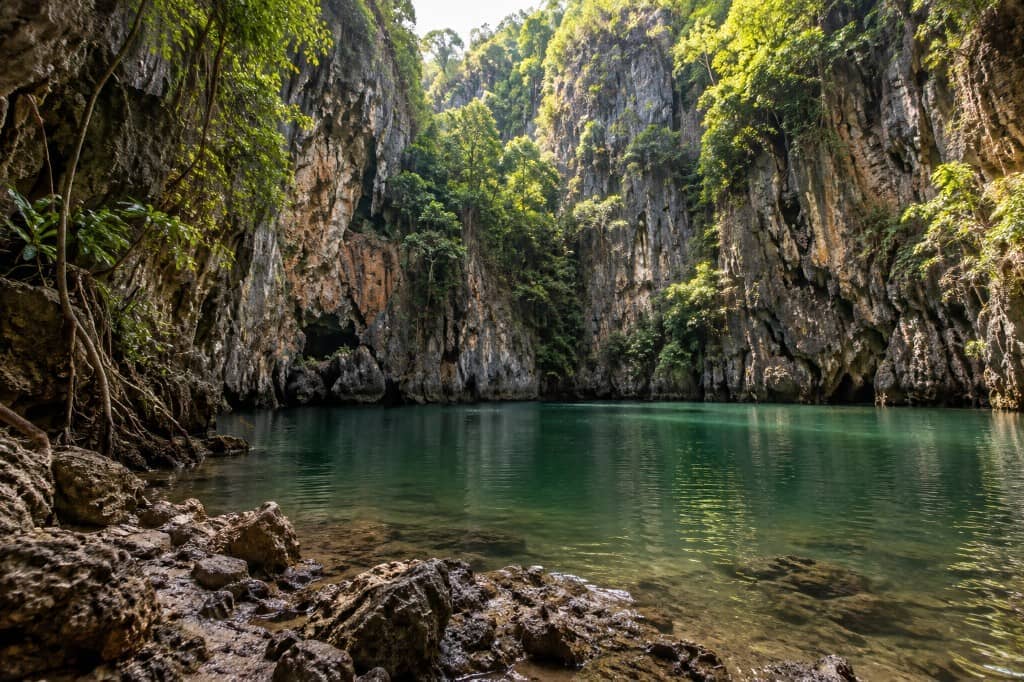
Railay Lagoon, commonly called Princess Lagoon, is a sheltered tidal pool set deep inside the limestone karst that defines the Railay peninsula. The lagoon is invisible from the beach and entirely hidden from the sea. To see it, you have to climb over the ridge that separates Railay's public beaches from its geological interior, descend a near-vertical limestone face using fixed ropes, and then drop into a cathedral of rock and jungle that feels completely separate from the resort scene below.
The water in the lagoon is tidal, meaning its depth and clarity shift with the sea. At high tide it fills to a swimmable pool; at low tide it can become shallow and murky. The surrounding walls are dense with tropical vegetation clinging to cracked limestone, and the soundscape shifts noticeably inside the bowl: the beach noise disappears, replaced by birdsong and dripping water.
ℹ️ Good to know
The lagoon goes by two names interchangeably: Railay Lagoon and Princess Lagoon. Both refer to the same place. No official Thai-language name has been reliably documented in available sources.
Getting to Railay: The Boat Ride Before the Hike
Railay is not connected to the mainland by road. The only way in is by long-tail boat, most commonly from Ao Nang. Boats run frequently during daylight hours and the crossing takes roughly 15 to 20 minutes. You can land at either Railay East (the calmer, mangrove-fringed side) or Railay West (the main beach). For the lagoon trail, either works, as the trailhead sits roughly between the two.
If you are planning a full day on the peninsula, arriving on the first or second boat of the morning puts you on the trail before the midday heat peaks. Long-tail boats do not run a fixed schedule in the same way a ferry service does. They depart when full or near-full, so wait times vary. Budget THB 100–150 each way for the Ao Nang crossing, but confirm current fares at the pier before boarding.
Tickets & tours
Live prices and dates from our booking partner. If you book, we may earn a commission at no extra cost to you.
Krabi Lagoon boat tour with beach BBQ and bioluminescent swim
From 48 €Instant confirmationFree cancellationIsland Hopping by Private Longtail Boat from Railay
From 130 €Instant confirmationFree cancellationEco-friendly kayaking journey to Khlong Nam Sai Lagoon
From 33 €Instant confirmationFree cancellationDaily Cooking Class at Thai Cookery School in Krabi
From 42 €Instant confirmationFree cancellation
The Trail: What the Climb Actually Involves
The trailhead is marked near the path that runs between Railay East and Phra Nang Beach. A handwritten sign or cluster of other hikers is usually the clearest indicator. The trail itself splits partway up: one branch leads to the Railay Viewpoint, the other continues down to the lagoon. Most people who make it to the viewpoint then choose to descend to the lagoon, combining both in a single out-and-back.
The ascent is steep from the start. The path uses tree roots as footholds and transitions into bare limestone as elevation increases. Fixed ropes are anchored at the most exposed sections. These ropes are essential, not decorative. You are hauling your body weight up near-vertical rock, gripping a rope that has been used by hundreds of others before you. The ropes are generally maintained, but their condition is not guaranteed. Grip strength and reasonable physical fitness are genuine requirements, not suggestions.
The descent to the lagoon from the ridge is shorter but arguably more nerve-wracking for people who are not comfortable with heights. You are lowering yourself down the inner face of the limestone wall using those same ropes. The rock can be damp even in dry season, especially in shadowed sections. Rubber-soled shoes with grip are not optional. Flip-flops are a serious liability and have caused injuries on this trail.
⚠️ What to skip
Wear closed-toe shoes with rubber soles. The limestone is slippery when damp. Flip-flops and sandals are actively dangerous on the rope sections. Bring water: there is no shade on the upper ridge and no vendor on the trail.
The Lagoon Itself: What You Find at the Bottom
The lagoon sits in a roughly bowl-shaped depression encircled by limestone walls rising 30 to 40 meters on all sides. Vegetation covers every available surface: ferns, mosses, and creeping vines that colonize cracks in the rock. The water, when the tide is cooperative, is a deep green-blue that photographs beautifully in the diffuse light that filters down from the open sky above.
Swimming is possible at higher tides but the lagoon is not a pristine snorkeling spot. The water is not reliably clear, and the primary appeal is the setting rather than the water quality. Arriving at low tide can be a disappointment: the pool shrinks significantly and the exposed muddy base reduces its visual appeal. Check local tide tables before you go, particularly if swimming is your main motivation.
The atmosphere inside the lagoon is genuinely unlike anything else on the Railay peninsula. The enclosing rock creates an acoustic pocket. You can be surrounded by dozens of other visitors and still feel a degree of isolation that the open beaches never offer. Groups tend to stay 20 to 40 minutes before beginning the climb out.
Timing, Light, and What the Trail Looks Like at Different Hours
Morning is the clearest recommendation, for two reasons. First, the limestone heats up over the course of the day and the upper ridge offers no shade. By midday, the rock radiates heat and the physical exertion of the climb becomes significantly more uncomfortable. Second, the lagoon is more likely to be at or near high tide in the morning during the dry season months, which improves the swimming and photography.
The best window for photography inside the lagoon is when the sun is directly overhead, around 11:00 to 13:00, because that is the only time direct light penetrates the bowl. At other hours the light is flat and the water appears darker. This creates a tension with the heat argument above: either accept dimmer light in a cooler morning, or tolerate peak heat for peak light.
During the dry season, December through early April, the trail is passable and the views from the ridge reward the effort. During the rainy season (broadly May through October), the limestone becomes significantly more slippery, the ropes can be waterlogged, and the overall risk of the descent increases substantially. The peninsula remains accessible year-round, but the lagoon trail is not the same experience in wet conditions. For more context on seasonal planning, see the best time to visit Krabi guide.
Combining the Lagoon with the Railay Viewpoint
The trail branches near the top of the climb, and the Railay Viewpoint is worth the short detour before descending to the lagoon. From the ridge, you get an unobstructed panorama across both sides of the peninsula: Railay West's beach stretching south, Ao Nang's coastline to the north, and the open Andaman Sea beyond the limestone towers. The viewpoint adds perhaps 15 minutes to the overall route and the elevation gain from the fork to the viewpoint is modest.
Many visitors make the viewpoint their turnaround point and skip the lagoon descent entirely. This is a completely reasonable choice. The viewpoint is the visual highlight of the experience for most people, and it avoids the most technically demanding section of the trail. If you are uncertain about rope descents or have any concerns about your grip strength, stop at the viewpoint.
Who Should Skip Railay Lagoon
This is not a trail for everyone, and there is no shame in that. The rope sections require genuine upper-body strength and confidence on steep terrain. Anyone with knee problems, vertigo, or limited mobility should not attempt the descent to the lagoon. The trail is entirely inaccessible by wheelchair or mobility aid. Children can attempt the viewpoint section with adult supervision, but the lagoon descent is not appropriate for young children.
If you are visiting during the rainy season and the path is wet, the risk calculus changes significantly. Several travelers have reported falls on the descent, almost always attributable to wet footwear or overconfidence on slick rock. The lagoon is beautiful, but it is not worth an injury.
Travelers who want limestone scenery without the physical commitment will find more accessible alternatives nearby. Phra Nang Beach at the base of the same cliff system is one of the most striking beach settings in southern Thailand and requires no climbing at all. Phra Nang Cave sits directly on the beach and adds cultural interest without any trail difficulty.
Insider Tips
- Check a tide chart for Krabi before you set out. Arriving at the lagoon near high tide makes a meaningful difference to the water depth and color. Low tide can leave you looking at a small, murky pool after a significant physical effort.
- The ropes on the steepest sections are shared. Wait for the person ahead of you to clear the section before you start — the rock ledges are narrow and two people on the same rope creates risk.
- Bring a dry bag or at least a zip-lock bag for your phone. Sweat, mist from the vegetation, and the possibility of a stumble all threaten electronics on this trail.
- Start as early as Railay's first boats allow, typically around 07:30 from Ao Nang. The lagoon sees noticeably more foot traffic by 10:00, and the heat on the ridge becomes a factor after 11:00.
- If you are tall or broad-shouldered, test your grip on the ropes before committing to the descent. Some of the footholds are sized for smaller frames and the approach angle can be awkward on the way down.
Who Is Railay Lagoon For?
- Fit travelers who want something that requires real effort and rewards it
- Photographers chasing an unusual limestone interior shot during the midday light window
- Hikers who have already covered Railay's beaches and want a second act
- Couples or small groups who value a sense of discovery over volume of sights
- Anyone combining the lagoon with the Railay Viewpoint for a half-day ridge walk
Nearby Attractions
Other things to see while in Railay Peninsula:
- East Railay Beach
East Railay Beach is the main arrival point for longtail boats reaching the Railay Peninsula. It is not a swimming beach, but it is the first thing most visitors see — and understanding what it is, and what it is not, shapes the entire Railay experience.
- Phra Nang Beach
Phra Nang Beach sits at the southern tip of Railay Peninsula, hemmed in by sheer limestone cliffs and reachable from the mainland only by longtail boat, or on foot from Railay East. The roughly 450-metre stretch of pale sand, a sea cave shrine, and turquoise water make it one of Krabi Province's most visually striking beaches — though its reputation means it is rarely quiet during peak hours.
- Phra Nang Cave & Princess Shrine
Tucked into the limestone cliffs at the southern tip of Railay Peninsula, Phra Nang Cave holds a shrine to a revered sea-princess spirit, surrounded by hundreds of carved wooden offerings left by local fishermen. The cave sits steps from one of Krabi's most photographed beaches, making it easy to combine a cultural visit with a morning swim or a sunset sit on the sand.
- Railay Rock Climbing
Railay Peninsula is one of Southeast Asia's most striking climbing destinations, where sheer limestone karst towers rise directly from the Andaman Sea. Whether you've never touched a climbing wall or you're chasing multi-pitch routes above the ocean, the cliffs at Railay deliver a setting that's genuinely hard to match.
Planning a trip? Discover personalized activities with the Nomado app.